



English
News Center
—— NEWS CENTER ——
On November 4, 2026, the National Development and Reform Commission, the Ministry of Industry and Information Technology, the Ministry of Natural Resources, the Ministry of Water Resources, and the National Government Offices Administration issued the Notice on Issuing the Action Plan for Implementing the Comprehensive Conservation Strategy, which states:
Improve the refined and standardized recycling networks for waste from industry and society. Vigorously promote the recycling and utilization of solid waste from the “new trio” and other sectors; establish a full-lifecycle management system for power batteries used in new energy vehicles; and improve regulations on the management of decommissioned and scrapped wind power and photovoltaic equipment.
Promote revisions to laws and regulations such as the Energy Conservation Law, the Circular Economy Promotion Law, and the Regulations on Energy Conservation in Public Institutions, and implement the requirements of laws and regulations including the Ecological and Environmental Code, the Food Security Law, the Anti-Food Waste Law, the Land Administration Law, the Mineral Resources Law, and the Regulations on Water Conservation. Further implement the energy-efficiency and water-efficiency labeling systems, and continuously improve standards for energy, water, and material consumption in key industries, fields, and products. Strengthen the provision and management of energy and carbon-emissions measuring instruments, and conduct energy and carbon measurement audits.
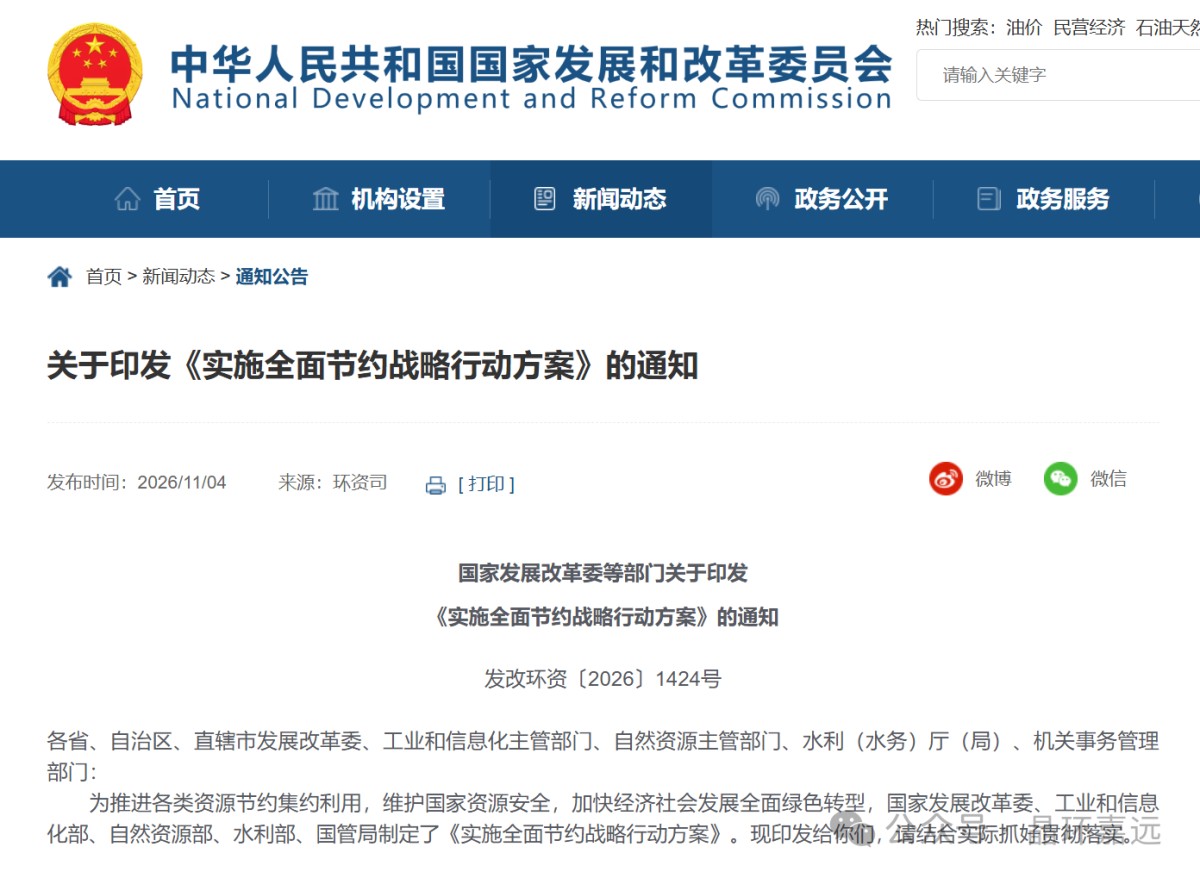
Notice of the National Development and Reform Commission and Other Departments on Issuing the Action Plan for Implementing the Comprehensive Conservation Strategy
Fagai Huanzi [2026] No. 1424
Development and reform commissions, industry and information technology departments, natural resources departments, water resources (water affairs) departments, and government offices administration departments of all provinces, autonomous regions, and municipalities directly under the Central Government:
To promote the conservation and intensive utilization of all kinds of resources, safeguard national resource security, and accelerate the comprehensive green transformation of economic and social development, the National Development and Reform Commission, the Ministry of Industry and Information Technology, the Ministry of Natural Resources, the Ministry of Water Resources, and the National Government Offices Administration have formulated the Action Plan for Implementing the Comprehensive Conservation Strategy. It is hereby issued to you; please implement it in light of local conditions.
National Development and Reform Commission
Ministry of Industry and Information Technology
Ministry of Natural Resources
Ministry of Water Resources
National Government Offices Administration
September 29, 2026
Action Plan for Implementing the Comprehensive Conservation Strategy Resource conservation is a fundamental national policy of China. To promote the conservation and intensive utilization of all kinds of resources, safeguard national resource security, accelerate the comprehensive green transformation of economic and social development, and promote high-quality development, this Plan is formulated to implement the comprehensive conservation strategy in depth. I. Overall Requirements Guided by Xi Jinping Thought on Socialism with Chinese Characteristics for a New Era, thoroughly implement the guiding principles of the 20th National Congress of the Communist Party of China and all plenary sessions of the 20th CPC Central Committee; fully, accurately, and comprehensively implement the new development philosophy; firmly establish a resource outlook that emphasizes conservation, intensive use, and recycling; integrate resource conservation throughout every stage and field of economic and social development; advance total resource management, scientific allocation, comprehensive conservation, and recycling; and improve the efficiency of energy, water, food, land, mineral, raw material, and other resource use, providing solid resource support for building a modern socialist country in all respects. By 2030, the comprehensive conservation system will be further strengthened and resource-use efficiency significantly improved. Compared with 2025, China’s energy consumption, water use, and built-up land used per unit of GDP will fall by approximately 10%, 10%, and 15%, respectively; losses at all stages of the food industry chain will continue to decline; annual recycling of major renewable resources will reach 510 million tonnes; and a social ethos that values conservation will be further fostered. II. Deepen Energy Conservation and Improve Energy Efficiency Give energy conservation priority in carbon peaking and carbon neutrality efforts, and carry out energy conservation and carbon reduction at a higher level and to a higher standard. Focus on addressing issues such as the haphazard launch of high-energy-consumption, high-emissions projects and inadequate potential for energy-saving and carbon-reduction upgrades, and continuously improve energy-use efficiency. (I) Curb unreasonable growth in total energy consumption. Strengthen source control of energy conservation and carbon reduction; strictly implement the measures for energy-conservation reviews and carbon-emissions assessments of fixed-asset investment projects; and strengthen comprehensive reviews and assessments of project energy use, coal consumption, and carbon emissions. Newly built, renovated, or expanded high-energy-consumption, high-emissions industrial projects shall implement equivalent or reduced carbon-emissions substitution. Effectively manage and control such projects. Newly built, renovated, or expanded coal-consuming projects in key national regions for air pollution prevention and control shall, in accordance with the law, implement equivalent or reduced coal substitution. Vigorously replace coal-fired boilers and industrial kilns with clean alternatives, and phase out all coal-fired boilers rated at 10 tonnes of steam per hour or less. Accelerate heating-system upgrades for coal-fired generating units and construction of supporting pipe networks, and phase out old, inefficient coal-fired generating units and boilers. Orderly phase out inefficient coal-fired facilities and equipment used in agriculture, commerce, and households. (II) Vigorously promote energy conservation in key sectors. Focus on key industries such as steel, non-ferrous metals, petrochemicals, chemicals, and building materials, and carry out energy-saving and carbon-reduction upgrades tailored to each industry to continuously improve energy efficiency. Actively upgrade existing buildings to improve energy conservation and reduce carbon emissions, and promote large-scale development of ultra-low-energy buildings. Promote energy-efficient, low-carbon transport vehicles, appropriately optimize vehicle energy-consumption limits, and vigorously develop new energy heavy-duty trucks and vessels powered by green fuels. Further tap the potential for energy-saving and carbon-reduction upgrades in public institutions, and promote third-party service models such as energy performance contracting. Upgrade infrastructure such as computing facilities, communications base stations, and server rooms to conserve energy and reduce carbon emissions, and optimize energy structures. Improve energy production efficiency, including by upgrading coal-fired generating units for low-carbon operation, and steadily reduce the grid’s overall line-loss rate. By 2030, energy consumption per unit of value added in industrial enterprises above designated size will be at least 10% lower than in 2025, and energy savings achieved through energy-saving and carbon-reduction upgrades in key industries will exceed 150 million tonnes of standard coal. III. Improve the Efficient and Conservation-Oriented Use of Water Resources Adhere to determining urban development, land use, population, and industrial development based on available water resources; apply region-specific controls and targeted measures; focus on addressing issues such as inadequate water-conservation systems and structural water shortages; and promote water-saving ways of production and living. (III) Fully implement a system of rigid constraints on water resources. Strictly control both total water use and water-use intensity; set control targets scientifically; improve the system of total water-use control indicators for river basins and administrative regions at the provincial, municipal, and county levels; apply differentiated controls on water-use intensity; and promote the establishment of a water-budget management system. Establish and improve water-resource assessment requirements for relevant plans involving the development and utilization of water resources; strengthen water-resource assessments for construction projects and management of water abstraction permits; strictly supervise water use during and after project implementation; conduct credit assessments in the water-use sector; and further implement and improve the system requiring water-saving facilities for construction projects to be designed, built, and put into operation at the same time as the main project. Strengthen water conservation and control in water-scarce regions such as Beijing-Tianjin-Hebei and the Yellow River Basin, and strictly curb the haphazard launch of high-water-consumption projects. (IV) Deepen water conservation in key sectors. Improve agricultural water-use efficiency; establish and improve scientific irrigation systems; enhance water-use metering and monitoring systems; promote water-saving irrigation technologies; and encourage crop planting suited to water availability and production based on measured water use. Promote industrial water conservation and emissions reduction, continue industrial water-efficiency improvement initiatives, strengthen corporate water-use management and water-saving technology upgrades, promote wastewater recycling, improve the supply capacity of water-saving equipment, and vigorously develop the water-saving industry. Promote water conservation and loss reduction in urban areas, address leakage in water-supply networks, ensure that all newly built, renovated, or expanded public buildings use water-saving fittings, strictly control water use in high-water-consuming service industries, and strictly control water use for artificial rivers, lakes, and other landscaping in water-scarce areas. Incorporate unconventional water into unified water-resource allocation and promote its development and utilization. By 2030, the effective utilization coefficient of farmland irrigation water will reach 0.60, and water use per RMB 10,000 of industrial value added will fall by 10% from 2025. IV. Reduce Food Loss and Curb Food Waste Adhere to the principle that reducing losses through conservation is equivalent to increasing output. Focus on addressing high losses in stages such as grain storage and prominent food waste in certain areas, and consolidate the progress achieved in food conservation and efforts to curb food waste. (V) Reduce losses in production and storage. Focus on areas where efforts to reduce losses during mechanized harvesting are relatively weak, and adopt targeted measures by crop and region; promote suitable harvesting machinery in hilly and mountainous areas. Establish a number of post-harvest grain service contact points, actively guide farmers in scientific grain storage, and gradually address the problem of grain stored directly on the ground. Further implement initiatives to improve green grain storage and accelerate the construction of high-standard grain warehouses. (VI) Reduce losses during transport and processing. Further develop, upgrade, and renovate dedicated railway lines, dedicated terminals, bulk grain transfer facilities, and supporting infrastructure; reduce grain handling and transfer; and vigorously develop multimodal grain transport. Improve the reliability and processing precision of domestically produced grain-processing equipment, set appropriate processing-precision indicators, and encourage moderate processing. Vigorously implement the National Whole Grain Action Plan to promote efficient use of grain resources and healthy nutrition among residents. (VII) Resolutely curb food waste in catering. Strengthen the primary responsibility of catering service providers; remind customers to order appropriate amounts according to their needs; clearly indicate dish specifications; actively promote smaller portions; and proactively remind customers to take leftovers away. Encourage catering providers hosting banquets to agree with consumers on obligations to prevent food waste. Strengthen supervision and inspections to prevent food waste, and promptly investigate and handle violations in accordance with the law. Curb extravagant banquets and other forms of extravagance and waste. Reduce food waste from takeaway orders; guide online catering platforms and merchants to promote smaller portions and prevent “spend-more-to-save” promotions from inducing excessive ordering; and explore improvements to food-waste prevention measures in consumer feedback and review mechanisms. V. Promote the Conservation and Intensive Utilization of Land Resources Adhere to strictly controlling total land use, revitalizing existing land, optimizing its structure, and improving efficiency. Focus on addressing issues such as inadequate territorial spatial-use control systems and enforcement, as well as scattered and inefficient use of existing construction land, and accelerate the development of intensive and efficient land-use practices. (VIII) Strictly control territorial spatial use. Apply differentiated, refined controls by region and category; strictly protect the red line for cultivated land; and strictly control urban development boundaries. Reclamation of sea areas through encroachment and filling is prohibited in all cases except for major national projects. Optimize territorial spatial layouts, strengthen implementation of the strategy for major functional zones, strengthen monitoring and assessment of territorial spatial planning, and improve dynamic assessment and adjustment mechanisms. During the 15th Five-Year Plan period, the scale of newly added construction land shall be limited to 26 million mu. (IX) Improve intensive and efficient utilization. Explore controlling total construction land use over the planning period, and coordinate the allocation of existing and newly added land. Promote mixed-use land development, composite use of space, and lawful and reasonable changes in land use; and rationally develop underground space. Coordinate the protection and utilization of forestland and grassland, and encourage replenishing forestland and grassland through ecological restoration and other means. Conserve and intensively utilize marine resources; orderly promote layered, three-dimensional use of sea areas; and establish mechanisms for the withdrawal of inefficient sea-area use. (X) Revitalize and utilize existing land. Steadily carry out comprehensive land improvement across entire areas, conserve and intensively utilize collectively owned rural commercial construction land, and lawfully revitalize and make good use of idle rural land. Conduct special governance of land use in industrial parks, and revitalize existing industrial land for strategic emerging industries, advanced manufacturing, and producer services. Intensify the disposal of idle land and deepen and expand pilot programs for the redevelopment of inefficiently used land. VI. Improve the Development and Utilization of Mineral Resources Adhere to innovation-led development, conservation and intensive use, and security. Focus on addressing low efficiency in mineral exploration and extraction, as well as the inadequate comprehensive utilization of low-grade, refractory, and associated minerals, and accelerate the green, low-carbon transformation of the mining industry. (XI) Promote green exploration and mining. Advance green exploration across the board and promote the application of intelligent and green exploration and development technologies and equipment. Accelerate the development of green mines. Newly built mines shall become green mines within one to two years of officially commencing production, while operating mines shall accelerate green upgrading. By 2030, more than 90% of large operating mines and 80% of medium-sized operating mines with valid permits shall meet green-mine standards; small mines shall strengthen management with reference to those standards. (XII) Strengthen the comprehensive utilization of mineral resources. Systematically promote the conservation and intensive utilization of mineral resources; strengthen the high-quality, efficient, and comprehensive utilization of important strategic minerals; and reinforce the incentive and constraint role of key indicators such as mining recovery rates, mineral processing recovery rates, and comprehensive utilization rates. Deepen reassessment of associated strategic minerals and low-grade resources, and encourage the comprehensive utilization of associated minerals. By 2030, the comprehensive utilization rate of associated minerals in major non-ferrous metals will be 2–3 percentage points higher than in 2025. VII. Conserve Raw Materials and Promote Recycling and Circular Utilization Adhere to reduction, reuse, and resource recovery; conserve raw materials in manufacturing; vigorously develop the circular economy; focus on addressing shortcomings in systems for recycling solid waste; and continuously improve the waste recycling system. (XIII) Promote green design and green manufacturing. Widely promote green product design; issue guidelines for the green design of industrial products; promote the use of materials with low or zero volatile organic compound content; encourage packaging and printing designs that use fewer materials and colors; and strengthen efforts to address excessive product packaging. Further promote cleaner production across industries, deepen mandatory cleaner production audits in key industries, and improve their environmental performance. Improve the green manufacturing system and continue to develop green supply chains. Improve the green product certification and labeling system. (XIV) Accelerate improvements in resource recovery. Further improve the quality and efficiency of comprehensive utilization of bulk solid waste from industry, urban areas, agriculture, and forestry; strengthen the recovery and utilization of tailings; and improve the system for classifying and grading bulk solid waste. Improve refined and standardized recycling networks for waste from industry and society. Strengthen the recycling and utilization of “urban mines” such as scrap steel, end-of-life motor vehicles, and waste electrical and electronic products. Vigorously promote the recycling and utilization of solid waste from the “new trio” and other sectors; establish a full-lifecycle management system for power batteries used in new energy vehicles; and improve regulations on the management of decommissioned and scrapped wind power and photovoltaic equipment. Accelerate the development of a number of recycling projects for scarce and precious metal resources, and promote the recovery and high-value utilization of valuable components. Promote the recycling and utilization of waste plastics, used textiles, and other materials. By 2030, annual utilization of bulk solid waste will reach approximately 4.5 billion tonnes. (XV) Continue to expand reuse. On the premise of ensuring zero imports of solid waste, orderly promote the import and utilization of high-quality overseas renewable resources; optimize inspection and supervision models for recycled raw materials; and study the establishment of distribution and processing centers for high-quality overseas recycled raw materials in eligible regions. Implement initiatives to upgrade the use of recycled materials in industries such as automobiles, home appliances, and daily chemicals; leverage the leading role of key enterprises; and increase the proportion of recycled materials used. VIII. Foster a Social Ethos That Values Conservation Adhere to leadership by public institutions, public participation, and shared governance by society. Focus on addressing persistent wasteful practices in daily life, foster a strong culture of practicing conservation and opposing waste, and continuously raise public awareness of conservation. (XVI) Strengthen the exemplary and leading role of public institutions. Strictly implement the requirement for Party and government bodies to maintain a tight budget, and build conservation-oriented government bodies across the board. Public institutions shall lead by example in conserving resources; strictly implement the government’s mandatory and priority procurement policies for energy-saving products; apply advanced energy- and water-saving technologies and products; strengthen management of energy-consumption quota indicators; promote green travel and green offices; and assess and report on the effectiveness of efforts to prevent food waste in institutional canteens. (XVII) Promote green lifestyles. Vigorously advocate simple, moderate, green, and low-carbon lifestyles; promote energy- and water-saving household products; and make green travel, saving water and electricity, taking part in the “Clean Your Plate” campaign, and reducing the use of disposable products everyday public habits. (XVIII) Deepen public communication, education, and guidance. Regularly conduct campaigns to promote conservation and oppose waste in conjunction with events such as National Ecology Day. Continue to promote changes in customs and incorporate conservation requirements into social norms such as residents’ conventions and village rules. Develop themed group lessons and educational materials for young people on energy conservation and carbon reduction, grain conservation, and cherishing food. IX. Strengthen Supporting Measures Adhere to the strictest systems and the most rigorous rule of law, and focus on addressing shortcomings in standards, policies, oversight, science, and technology systems, thereby providing support and safeguards for implementing the comprehensive conservation strategy. (XIX) Improve the legal and standards systems. Promote revisions to laws and regulations such as the Energy Conservation Law, the Circular Economy Promotion Law, and the Regulations on Energy Conservation in Public Institutions, and implement the requirements of laws and regulations including the Ecological and Environmental Code, the Food Security Law, the Anti-Food Waste Law, the Land Administration Law, the Mineral Resources Law, and the Regulations on Water Conservation. Further implement energy-efficiency and water-efficiency labeling systems, and continuously improve standards for energy, water, and material consumption in key industries, fields, and products. Strengthen the provision and management of energy and carbon-emissions measuring instruments, and conduct energy and carbon measurement audits. (XX) Increase policy support. Leverage the driving and multiplier effects of government investment to support eligible projects in energy conservation, water conservation, and resource recycling. Improve differentiated electricity pricing policies for energy-intensive industries, and optimize tiered residential water pricing and progressive pricing for non-residential water use exceeding quotas. Encourage financial institutions to support resource-conservation-related projects through financial instruments such as green loans and green bonds. Guide and regulate the participation of private capital in the investment, construction, and operation of related projects. (XXI) Strengthen supervision, management, and law enforcement. Fully leverage existing assessment mechanisms that reflect conservation requirements, and ensure that all parties fulfill their responsibilities. Conduct regulatory enforcement in accordance with assigned duties, intensify enforcement, and investigate and penalize all forms of disorderly development and resource waste seriously in accordance with laws and regulations. Improve statistical survey systems and explore the establishment of an indicator system for the conservation and intensive utilization of resources. (XXII) Strengthen support from scientific and technological innovation. Include resource-conservation technologies in relevant key special programs under the National Key R&D Program, and focus on overcoming a number of common key technologies. Support cooperation between enterprises, universities, and research institutes to accelerate the commercialization and application of technological achievements. Update, issue, and promote the application of advanced and appropriate technologies.
About RESOLAR
Shanghai RESOLAR Energy Technology Co., Ltd. is committed to becoming a recycled material photovoltaic group with deep decarbonization. RESOLAR focuses on technological innovation and builds a world-leading solution for component recycling, impurity removal of damaged cells, recycled silicon materials and cells, and cascaded utilization of components. With professional technology and services, we help customers realize the recycling and reuse of waste photovoltaic resources, and make positive contributions to the development of environmental protection and new energy industries. For more detailed information, you can browse the official website: www.resolartech.com .

Latest developments/news
Contact information
Service Hotline: 13585742918 (Monday to Friday 9:00-18:00)
Enterprise email: ps@resolartech.com (Reply within 48 hours after receiving the email consultation!)
Company Address: Building 8, No. 1528, Wangxu East Road, Fengjing Town, Jinshan District, Shanghai (Caohejing Fengjing Park)