


English
News Center
—— NEWS CENTER ——
On October 2, 2026, the Regulations of Fujian Province on the Prevention and Control of Environmental Pollution by Solid Waste were promulgated. The Regulations contain the following provisions:
Article 10 The competent department of ecology and environment of the people's government of the province shall establish an information platform for the prevention and control of environmental pollution by solid waste, including industrial solid waste and hazardous waste. Other departments responsible for the prevention and control of environmental pollution by solid waste shall, within the scope of their respective duties, promote the interconnection and sharing of information on the prevention and control of solid waste pollution, so as to achieve whole-process supervision and information-based traceability of the generation, collection, storage, transfer, utilization, disposal and other activities relating to solid waste.
Entities and other producers and business operators that generate, collect, store, transport, utilize or dispose of solid waste shall, in accordance with relevant provisions of the State and the Province, truthfully record relevant information through the information platform for the prevention and control of environmental pollution by solid waste, and shall be responsible for the authenticity, accuracy and completeness of such information.
Article 16 Entities that generate, collect, store, transport, utilize or dispose of solid waste shall, in a manner convenient for public awareness, disclose information on the prevention and control of environmental pollution by solid waste in a timely manner in accordance with the law.
Article 61 Social capital is encouraged to participate in the construction of solid waste recycling projects, and financial institutions shall be actively guided to provide financing services for eligible solid waste recycling projects.
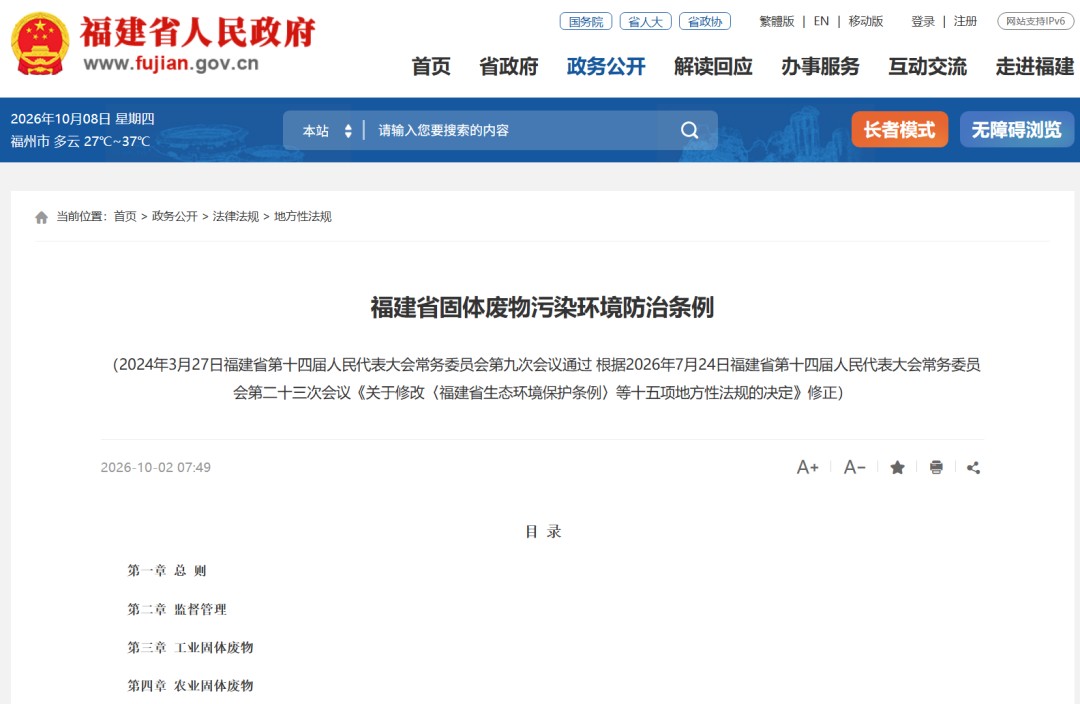
(Adopted at the Ninth Meeting of the Standing Committee of the Fourteenth People's Congress of Fujian Province on March 27, 2024 Amended in accordance with the Decision of the Standing Committee of the Fourteenth People's Congress of Fujian Province at its Twenty-third Meeting on July 24, 2026 on Amending the Fujian Province Ecological Environmental Protection Regulations and Fifteen Other Local Regulations) Chapter I General Provisions Article 1 These Regulations are formulated in accordance with the Ecological and Environmental Code of the People's Republic of China and other relevant laws and administrative regulations, and in light of the actual circumstances of the Province, in order to implement Xi Jinping Thought on Ecological Civilization, fully, accurately and comprehensively implement the new development philosophy, protect and improve the ecological environment, and promote sustainable economic and social development. Article 2 These Regulations shall apply to the prevention and control of environmental pollution by solid waste and the supervision and administration thereof within the administrative region of the Province. These Regulations shall not apply to the prevention and control of marine environmental pollution by solid waste or environmental pollution by radioactive solid waste. Article 3 The prevention and control of environmental pollution by solid waste shall adhere to the principles of reduction, resource utilization, harmless treatment and polluter responsibility; source control, systematic control and comprehensive control of solid waste shall be strengthened; recycling shall be encouraged; and green and low-carbon development shall be promoted. Article 4 Local people's governments at all levels shall be responsible for the prevention and control of environmental pollution by solid waste within their respective administrative regions. They shall strengthen leadership over such work and organize, coordinate and urge relevant departments to perform their supervisory and administrative duties in accordance with the law. The Province shall implement a target responsibility system and an assessment and evaluation system for the prevention and control of environmental pollution by solid waste, and the fulfillment of relevant targets shall be included in the assessment and evaluation of local people's governments. Township people's governments and subdistrict offices shall urge entities and individuals within their administrative regions to carry out prevention and control of environmental pollution by solid waste, regularly organize inspections and patrols in accordance with relevant provisions, and promptly investigate and handle violations involving environmental pollution by solid waste. Management bodies of industrial agglomeration areas shall carry out relevant work on the prevention and control of environmental pollution by solid waste in accordance with the law. Villagers' committees and residents' committees shall assist in relevant work on the prevention and control of environmental pollution by solid waste and guide villagers and residents to consciously fulfill their obligations concerning the classified disposal and reduction of household waste and the prevention and control of environmental pollution by other solid waste. Article 5 The competent departments of ecology and environment of the people's governments of the Province and cities divided into districts shall exercise unified supervision and administration over the prevention and control of environmental pollution by solid waste within their respective administrative regions. The competent departments of development and reform, industry and information technology, education, science and technology, natural resources, housing and urban-rural development, transport, agriculture and rural affairs, commerce, culture and tourism, health, emergency management, market regulation, forestry and other departments of local people's governments at or above the county level, as well as customs and postal administration departments, shall be responsible for supervision and administration of the prevention and control of environmental pollution by solid waste within the scope of their respective duties. Article 6 All entities and individuals shall raise their awareness of ecological environmental protection, consciously fulfill their obligations for ecological environmental protection, adopt simple, moderate, green and low-carbon working and living practices, and reduce the generation of solid waste. Relevant industry associations shall strengthen industry self-discipline, promote new processes and technologies for source reduction, resource utilization and harmless disposal of solid waste, and guide their members in taking effective measures to prevent and reduce solid waste pollution. Article 7 Local people's governments at or above the county level shall support scientific research, advanced technology development, application and promotion of achievements, scientific popularization and professional talent training in the field of prevention and control of environmental pollution by solid waste, and strengthen scientific and technological support for such prevention and control. Article 8 State organs, social organizations, enterprises and public institutions, grassroots self-governing organizations and news media shall strengthen publicity and education on the prevention and control of environmental pollution by solid waste, disseminate laws, regulations and scientific knowledge, enhance public awareness, and expand channels for public participation in the prevention and control of environmental pollution by solid waste. Schools, scientific research institutions, medical institutions and other entities shall carry out education and dissemination of knowledge on the classified disposal of household waste, laboratory waste and medical waste, as well as the prevention and control of environmental pollution by other solid waste. Chapter II Supervision and Administration Article 9 Local people's governments at or above the county level shall incorporate the prevention and control of environmental pollution by solid waste into national economic and social development plans and ecological environmental protection plans; make overall arrangements for and organize the construction of facilities for centralized collection, storage, utilization and disposal of solid waste; and strengthen cross-regional co-construction and sharing of such facilities. The competent department for standardization of the provincial people's government may, jointly with relevant departments, formulate local standards for technologies for the prevention and control of environmental pollution by solid waste and comprehensive utilization that are suited to the actual circumstances of the Province. Article 10 The competent department of ecology and environment of the people's government of the province shall establish an information platform for the prevention and control of environmental pollution by solid waste, including industrial solid waste and hazardous waste. Other departments responsible for the prevention and control of environmental pollution by solid waste shall, within the scope of their respective duties, promote the interconnection and sharing of information on the prevention and control of solid waste pollution, so as to achieve whole-process supervision and information-based traceability of the generation, collection, storage, transfer, utilization, disposal and other activities relating to solid waste. Entities and other producers and business operators that generate, collect, store, transport, utilize or dispose of solid waste shall, in accordance with relevant provisions of the State and the Province, truthfully record relevant information through the information platform for the prevention and control of environmental pollution by solid waste, and shall be responsible for the authenticity, accuracy and completeness of such information. Article 11 The competent departments of ecology and environment of the people's governments of the Province and cities divided into districts shall incorporate the prevention and control of environmental pollution by solid waste into environmental monitoring. Management entities of solid waste storage, utilization and disposal sites shall, in accordance with relevant State provisions and technical specifications, monitor pollutant emissions and surrounding environmental quality and establish an emergency management system for environmental emergencies. Management entities without monitoring capabilities shall entrust environmental monitoring institutions with professional technical capabilities to conduct monitoring. Article 12 Solid waste centralized utilization and disposal entities included in the administration of automatic monitoring of pollution sources shall, in accordance with relevant provisions of the State and the Province, construct and install automatic pollutant emission monitoring equipment and supporting facilities, connect them to the monitoring systems of the competent departments of ecology and environment, and ensure the normal operation of the automatic monitoring equipment. Article 13 The competent departments of ecology and environment of the people's governments of the Province and cities divided into districts and their dispatched bodies, environmental law enforcement bodies, and other departments responsible for supervision and administration of the prevention and control of environmental pollution by solid waste, shall have the right, within the scope of their respective duties, to conduct on-site inspections in accordance with the law of enterprises, public institutions, other producers and business operators, ecological environment technical service institutions and others that pollute the environment or damage ecology, and shall strengthen information sharing and law enforcement coordination in solid waste management. Article 14 Local people's governments at or above the county level and their relevant departments may establish cross-administrative-region joint prevention and control mechanisms for environmental pollution by solid waste, conduct regional cooperation in administrative law enforcement for prevention and control of environmental pollution by solid waste, emergency response to accidents, compensation for ecological and environmental damage and other matters, and collaboratively advance relevant work. Entities accepting solid waste transferred from outside the Province shall, in accordance with the law, possess the relevant legal qualifications and actual storage, utilization or disposal capabilities, and shall not engage in any of the following acts: (1) conducting disposal in the name of utilization; (2) conducting long-term storage in the name of utilization or disposal; or (3) accepting solid waste in the name of by-products, raw materials, fuels or the like. Article 15 Competent departments of ecology and environment, public security organs and procuratorial organs shall establish coordination mechanisms between environmental administrative law enforcement and criminal justice; strengthen cooperation in the transfer and acceptance, investigation and evidence collection, joint supervision, and information sharing of cases involving violations and crimes of environmental pollution by solid waste; promote integrated collection and transfer of evidence for administrative law enforcement and criminal justice; and jointly punish violations and crimes involving environmental pollution by solid waste. Where organs and social organizations prescribed by law initiate ecological and environmental public interest litigation in people's courts in accordance with the law concerning acts of environmental pollution by solid waste, competent departments responsible for supervision and administration of the prevention and control of environmental pollution by solid waste shall provide support. Article 16 Entities that generate, collect, store, transport, utilize or dispose of solid waste shall, in a manner convenient for public awareness, disclose information on the prevention and control of environmental pollution by solid waste in a timely manner in accordance with the law. Chapter III Industrial Solid Waste Article 17 The people's governments of the Province and cities divided into districts may, according to industry characteristics within their respective administrative regions and requirements for solid waste reduction, determine industry-specific reduction measures for industrial solid waste. Enterprises in key industries that generate industrial solid waste shall adopt advanced processes and equipment, carry out cleaner production upgrading and transformation, reduce the volume of industrial solid waste generated, and improve the comprehensive utilization rate of industrial solid waste. Industrial solid waste utilization entities are encouraged to independently conduct cleaner production audits. Article 18 Local people's governments at or above the county level shall take measures to promote coordinated development between the industrial solid waste comprehensive utilization industry and upstream and downstream industries and build circular economy industries. Local people's governments at or above the county level shall strengthen the construction of collection and transfer systems for industrial solid waste, rationally arrange collection and transfer sites and facilities, increase policy support, capital investment, demonstration and promotion for industrial solid waste comprehensive utilization projects, and encourage social forces to invest in, construct and operate industrial solid waste collection and transfer sites and facilities. Article 19 Mining enterprises shall strengthen the management of storage facilities for mining solid waste, such as tailings, coal gangue and waste rock (powder); formulate environmental safety risk response measures; regularly investigate potential pollution hazards; and prevent environmental pollution and ecological damage. In accordance with relevant State provisions, they shall monitor wastewater discharged by the enterprise and surrounding groundwater. Where monitoring results exceed applicable standards, they shall formulate rectification plans, immediately take effective treatment measures, and report to the competent department of ecology and environment and relevant departments. Mining enterprises shall strengthen the comprehensive resource utilization of tailings, coal gangue and waste rock (powder), improve mineral resource utilization rates, and reduce the quantities generated and stored. Article 20 Relevant departments of local people's governments at or above the county level shall, according to their division of duties, supervise and administer the implementation of tailings pond safety and environmental management by entities constructing, operating and managing tailings ponds. Entities constructing tailings ponds shall scientifically and reasonably determine design plans and implement operations based on circumstances such as the storage and discharge of tailings, waste materials and wastewater. Entities operating and managing tailings ponds shall formulate tailings pollution prevention and control plans, establish pollution prevention and control responsibility systems, and take effective measures to prevent environmental pollution and ecological damage. Article 21 Entities that generate, collect, store, utilize or dispose of industrial solid waste shall, before termination or relocation, report to the competent department of ecology and environment at their location on the storage and disposal of industrial solid waste and pollution prevention and control measures taken for relevant facilities and sites. Within 90 days after termination or relocation, they shall entrust qualified entities to test and assess the extent of damage to and pollution of soil and groundwater at the original site. Where soil or groundwater at the original site has been damaged or polluted, ecological restoration or remediation shall be carried out, and the test and assessment results as well as the restoration or remediation status shall be reported to the relevant competent departments. Article 22 For industrial solid waste of unknown properties, industrial solid waste for which hazardous characteristics cannot be determined, or industrial solid waste whose properties may change due to changes in raw materials or processes, the solid waste generating entity shall entrust relevant technical appraisal institutions to conduct identification and shall implement classified management based on the identification conclusions. Chapter IV Agricultural Solid Waste Article 23 Local people's governments at or above the county level shall adopt policy measures such as fiscal measures and government procurement to support the comprehensive utilization and harmless disposal of agricultural solid waste, including discarded crops, discarded agricultural film, pesticide and fertilizer packaging waste, and livestock and poultry manure; advance the construction of facilities for comprehensive utilization and harmless disposal of agricultural solid waste; regulate the collection, storage, utilization and disposal of agricultural solid waste; and prevent environmental pollution. Agricultural producers and business operators shall, in accordance with relevant provisions of the State and the Province, carry out classified collection and resource utilization of agricultural solid waste such as discarded crops, discarded agricultural film, pesticide and fertilizer packaging waste, and livestock and poultry manure, or deliver it to entities with disposal capabilities for harmless disposal. Article 24 The competent departments of agriculture and rural affairs and forestry of local people's governments at or above the county level shall guide agricultural producers in adopting circular agriculture technologies, carrying out the comprehensive utilization of agricultural and forestry waste as fertilizer, feed, substrate and the like, and reducing the generation of agricultural and forestry waste. Large agricultural production parks, fruit and vegetable wholesale markets, and forest product processing enterprises shall adopt appropriate advanced technologies, establish networks for classified collection, storage, transportation and disposal of agricultural and forestry waste, and promote resource utilization of agricultural and forestry waste. Article 25 Local people's governments at or above the county level shall organize relevant departments to establish a full-chain supervision mechanism covering the production, sale, use, recovery and reuse of agricultural film; regulate and reduce the coverage area of non-fully biodegradable agricultural film in light of local conditions; organize routine monitoring of agricultural film residues; carry out evaluations of the suitability of agricultural film covering technologies and biodegradation and other performance; and promptly understand pollution from agricultural film residues and recovery and utilization conditions. Township people's governments shall increase the promotion of fully biodegradable agricultural film products and mature technologies, advance the orderly substitution of fully biodegradable agricultural film, guide producers, sellers and users of agricultural film and others to adopt governance methods such as mechanized collection, specialized recovery, resource utilization and reduction-oriented substitution of discarded agricultural film, and urge them to fulfill their primary responsibility for agricultural film recovery. Producers and sellers of agricultural film shall produce and sell agricultural film that complies with mandatory national standards. Users of agricultural film shall, before the expiry of the service life, collect non-fully biodegradable agricultural film waste in fields and deliver it to relevant recovery stations or recovery workers, and shall not discard, landfill or incinerate it at will. Article 26 Local people's governments at or above the county level shall organize competent departments of agriculture and rural affairs, forestry and others to establish classified recovery systems for pesticide and fertilizer packaging waste. Resource utilization of pesticide and fertilizer packaging waste is encouraged and supported; waste not subject to resource utilization shall undergo harmless disposal, including incineration, in accordance with laws and regulations. Where pesticide packaging waste is incinerated in household waste incineration plants, the disposal process shall not be managed as hazardous waste. Pesticide producers and operators shall fulfill their packaging waste recovery obligations, establish packaging waste recovery facilities at their business premises, take effective measures to guide pesticide users to promptly return packaging waste, and deliver it to specialized institutions or organizations for harmless treatment. Pesticide users shall promptly collect packaging waste and return it to pesticide product operators or packaging waste recovery stations (points). Pesticide and fertilizer manufacturers are encouraged to use packaging that is easy to utilize as resources and easy to dispose of, explore the use of degradable packaging such as water-soluble polymers, gradually phase out aluminum foil packaging, and reduce the generation of pesticide and fertilizer packaging waste at source. New business entities and socialized service organizations are encouraged and supported to provide concentrated and contiguous pesticide and fertilizer application services, thereby reducing the quantity of pesticide and fertilizer packaging waste. Article 27 Livestock and poultry farms, animal slaughtering and processing sites, and facilities for harmless treatment of animals and animal products shall be equipped with facilities for the utilization or disposal of solid waste, or entrust entities with utilization or disposal capabilities to promptly collect, store, utilize or dispose of livestock and poultry manure, discarded animal viscera and carcasses, discarded veterinary drugs and other solid waste generated during breeding, slaughtering and harmless treatment. Individual operators engaged in livestock slaughtering shall operate at designated locations, and the solid waste generated shall be disposed of centrally. Chapter V Hazardous Waste Article 28 The provincial people's government shall organize relevant departments to prepare plans for the construction of centralized hazardous waste disposal facilities and sites, scientifically assess centralized hazardous waste disposal needs and capacity based on the industrial structure and the quantity and types of hazardous waste generated within the administrative region, and rationally arrange centralized hazardous waste disposal facilities and sites in conjunction with national economic development plans and other plans. The people's governments of cities divided into districts shall formulate implementation plans in accordance with planning and organize the construction of centralized hazardous waste disposal facilities and sites. Adjacent cities divided into districts may conduct regional coordination and cooperation regarding centralized hazardous waste disposal facilities and sites. Article 29 Entities generating hazardous waste shall, in accordance with the classified management requirements of the competent departments of ecology and environment and through the information platform for the prevention and control of environmental pollution by solid waste, formulate and file hazardous waste management plans, establish hazardous waste management ledgers, and truthfully declare relevant information on hazardous waste types, quantities generated, destinations, storage, utilization and disposal. Article 30 For newly constructed, reconstructed or expanded hazardous waste utilization and disposal projects, environmental impact assessment documents shall include detailed analyses demonstrating conformity between the project and relevant hazardous waste pollution prevention and control plans, as well as measures for hazardous waste generation, storage, utilization, disposal and pollution prevention and control. Article 31 Professional hazardous waste collection, transfer, utilization and disposal entities may establish regional collection outlets and storage facilities, provide paid collection and transfer services for hazardous waste generated by small and micro enterprises, scientific research institutions, schools and others, and provide services such as centralized collection and storage of hazardous waste in industrial parks. In areas where universities and scientific research institutions are concentrated and conditions permit, demonstration projects for classified collection and pretreatment of laboratory hazardous waste may be constructed. Article 32 Hazardous waste shall be stored separately according to its characteristics. It is prohibited to mix hazardous waste with non-hazardous waste or to mix and store incompatible hazardous waste. Hazardous waste storage facilities likely to generate dust, volatile organic compounds, acid mist, toxic and harmful air pollutants, or irritating odors shall be equipped with gas collection devices connected to gas purification facilities. Article 33 The competent department of ecology and environment of the provincial people's government may establish cross-provincial hazardous waste transfer cooperation mechanisms with relevant departments of the people's governments of relevant provinces, autonomous regions and municipalities directly under the Central Government; strengthen supervision and administration of entities and vehicles engaged in cross-provincial hazardous waste transfer; and jointly investigate and handle environmental violations and crimes such as illegal transfers of hazardous waste. Entities generating, transporting, collecting, utilizing or disposing of hazardous waste shall operate electronic transfer manifests through the information platform for the prevention and control of environmental pollution by solid waste in accordance with relevant provisions of the State and the Province. Hazardous waste transferred into the Province from other provinces shall be primarily for comprehensive utilization. It is prohibited to transfer hazardous waste into the Province for incineration or landfill. Where hazardous waste is transported by road or waterway, the consignor shall entrust an enterprise that has lawfully obtained relevant permits for the road transport or waterway transport of dangerous goods to carry it. Where an entity independently utilizes or disposes of hazardous waste generated within the same plant area, it shall establish an internal transfer management system and truthfully record transfer and handover data. Article 34 Products made through the comprehensive utilization of hazardous waste shall have clearly specified product standards and control indicators for harmful substances. Harmful substances discharged into the environment during the production of products from hazardous waste resource utilization, and the content of harmful substances in such products, shall comply with relevant national and provincial pollutant emission (control) standards or technical specifications. Article 35 Where a hazardous waste business entity ceases to engage in hazardous waste collection, storage, transportation, utilization or disposal activities, it shall utilize or dispose of remaining hazardous waste, take pollution prevention and control measures for facilities, sites and land, conduct site investigation and assessment, and may close, transfer or change the use of the facilities only after pollution has been eliminated. The decommissioning management of key centralized hazardous waste disposal facilities and sites shall be carried out in accordance with relevant State provisions. Article 36 Relevant departments of local people's governments at or above the county level shall establish and improve mechanisms for regulatory cooperation and joint law enforcement concerning discarded hazardous chemicals, and strengthen whole-process supervision and administration of the generation, collection, storage, transfer, utilization and disposal of discarded hazardous chemicals. Entities that produce, operate or use hazardous chemicals shall, in accordance with relevant State provisions, conduct stabilization pretreatment of discarded, expired or ineffective hazardous chemicals. Discarded hazardous chemicals that have not undergone stabilization pretreatment shall be managed as hazardous chemicals. Article 37 Schools, scientific research institutions, medical institutions and other relevant entities that establish laboratories shall establish and improve systems for classified collection, registration and management, emergency plans and other systems for hazardous waste generated by laboratories; equip themselves with hazardous waste storage rooms, collection containers and other facilities that meet national technical specification requirements; collect and store generated hazardous waste by category; and regularly entrust entities with corresponding qualifications to dispose of it. Expired, ineffective and surplus reagents and other chemicals generated by laboratories that constitute hazardous waste shall be stored by category in dedicated storage locations and shall not be discarded or landfilled without authorization. Article 38 Local people's governments at or above the county level shall establish medical waste collection, transfer and disposal systems; plan and construct centralized medical waste collection, transfer and disposal facilities within their administrative regions; strengthen emergency medical waste disposal capacity; and promote nearby centralized, safe and standardized disposal of medical waste. Article 39 Entities generating medical waste shall establish temporary medical waste storage points in accordance with relevant provisions of the State and the Province, equip themselves with standard-compliant collection containers, packaging and facilities, and promptly collect the medical waste generated by category. Entities generating medical waste shall conclude medical waste collection, transportation and disposal agreements with centralized disposal entities to specify the rights and obligations of both parties. Centralized medical waste disposal entities shall be equipped with dedicated transport vehicles to collect and transport medical waste. Article 40 County people's governments may, based on actual needs, establish medical waste transfer stations or implement transport price subsidy systems where entities generating medical waste are dispersed or located in remote areas. The construction and operation of medical waste transfer stations shall comply with health safety and technical specification requirements. Article 41 Centralized medical waste disposal entities shall ensure the safe and normal operation of medical waste disposal facilities during their prescribed operating periods. Where disposal facilities and equipment need to be temporarily suspended for maintenance, measures shall be taken to properly collect, store and transfer medical waste, and filings shall be promptly made with the competent departments of ecology and environment and health at the location. Where disposal facilities will cease operation upon the expiry of their service life, centralized medical waste disposal entities shall report separately to the competent departments of ecology and environment and health at the location one year before the expiry of the operating period and properly coordinate the disposal of medical waste. Article 42 Local people's governments at or above the county level shall make overall arrangements for the collection, storage, transportation and disposal of medical waste and epidemic-related waste during major infectious disease outbreaks; organize emergency disposal of medical waste, epidemic-related waste and the like in accordance with emergency response plans; and ensure the availability of required vehicles, sites, disposal facilities and protective supplies. Local people's governments at or above the county level shall coordinate resources such as household waste incineration facilities, hazardous waste incineration and disposal facilities, and cement kilns co-processing solid waste within their administrative regions; establish lists of facilities for coordinated emergency disposal of medical waste; and ensure emergency medical waste disposal capacity. Article 43 For hazardous waste or suspected hazardous waste with no clearly identified responsible person, or where the responsible person no longer has the capacity to assume responsibility, the county people's government at the location shall arrange funds and take measures to dispose of it in accordance with relevant State provisions and standards and remediate the polluted environment. Chapter VI Household Waste and Other Solid Waste Article 44 Local people's governments at or above the county level shall strengthen supervision and administration over the abandonment, stockpiling and treatment of solid waste in coastal land areas and take effective measures to prevent solid waste from entering the ocean. Article 45 The Province shall, in accordance with the law, implement a household waste treatment system featuring classified disposal, classified collection, classified transportation and classified disposal. Local people's governments at or above the county level shall take measures to gradually achieve zero landfill of untreated household waste. Municipal and county people's governments shall, based on local terminal household waste disposal needs, construct sanitary landfills for the landfill of incineration residues, fly ash meeting exemption conditions and emergency use. Adjacent areas are encouraged to jointly construct and share household waste treatment facilities. The construction and operation of resource utilization projects for household waste incineration fly ash are encouraged to reduce the landfill volume of such fly ash. Operators of household waste incineration treatment facilities are encouraged, in accordance with relevant laws, regulations, environmental and safety standards and other provisions, to co-process relevant solid waste where technically feasible and environmental risks are controllable. Article 46 Local people's governments at or above the county level shall organize the construction of construction waste stockpiling and transfer sites and resource utilization facilities through increased fiscal investment, introduction of social capital and other means, and encourage priority procurement of products made through construction waste resource utilization. Construction entities or entrusted construction waste disposal entities may transport, accept, utilize or dispose of construction waste only after obtaining approval for urban construction waste disposal, and shall not dump, scatter or stockpile it without authorization. Construction entities shall establish construction waste management ledgers, truthfully record information such as the types, quantities and destinations of construction waste generated, and file such information with the environmental sanitation department of the county people's government at the location. Transport, utilization and disposal entities shall establish construction waste management ledgers, truthfully record information on the transportation, storage, utilization and disposal of construction waste received, and file such information with the environmental sanitation department of the county people's government at the location. Construction waste generated from building decoration and renovation shall be collected centrally, stockpiled at designated locations, and cleared, utilized or disposed of in accordance with relevant provisions. Designated waste stockpiling points shall be publicly disclosed. It is prohibited to stockpile construction waste at will at non-designated locations. Article 47 Producers of products such as electrical and electronic equipment and motor vehicles shall give priority, during product manufacturing, to designs that are non-toxic and harmless, easily degradable or convenient for recycling. Producers of products such as electrical and electronic equipment, motor vehicles, lead-acid batteries and traction batteries shall, in accordance with State provisions, establish end-of-life product recovery systems matching product sales volumes through self-establishment, entrustment or other methods. Enterprises engaged in the construction and operation of wind power and photovoltaic power generation shall themselves, or entrust qualified enterprises to, recycle or harmlessly dispose of decommissioned wind turbine blades, photovoltaic modules and the like. Article 48 Producers and sellers of electric vehicles and electric bicycles are encouraged to recover used electric vehicles and electric bicycles through trade-in, discounted repurchase and other methods. Owners of electric vehicles and electric bicycles shall deliver used vehicle traction batteries and storage batteries to producers, sellers or third-party recovery entities of electric vehicles and electric bicycles. Where such batteries constitute hazardous waste, they shall be delivered to entities holding hazardous waste business permits or eligible waste lead-acid battery collection entities for centralized collection, and shall not be dumped, stockpiled or discarded without authorization. Article 49 The collection, dismantling, utilization and disposal of discarded electrical and electronic products shall be carried out in accordance with relevant provisions of the State and the Province to achieve standardized recovery, effective utilization and safe disposal, with measures taken to prevent environmental pollution. Entities and individuals that have obtained qualifications for the treatment of discarded electrical and electronic products, lawfully completed registration and indicated the treatment of discarded electrical and electronic products within their business scope may engage in treatment activities for discarded electrical and electronic products. Where dismantling products from discarded electrical and electronic products, such as lead-containing glass, printed circuit boards, fluorescent powder, mercury-containing lamps and ink, constitute hazardous waste, they shall be handled by entities holding hazardous waste business permits for the relevant categories. Article 50 Local people's governments at or above the county level shall take measures to support the development of the green plastic products industry, encourage plastic product enterprises to give priority to new environmentally friendly functional materials in production, manufacture safe, reliable and recyclable plastic products, and increase the supply and coverage of green products. Operators of commodity retail venues, e-commerce platform enterprises, and enterprises engaged in express delivery, food delivery, catering, accommodation and the like shall promote the use of alternatives to disposable plastic products that are reusable, easy to recycle and degradable, and shall report the use and recovery of disposable plastic products such as plastic bags in accordance with relevant provisions of the competent departments of commerce, market regulation, culture and tourism and postal administration departments of local people's governments at or above the county level. Article 51 Local people's governments at or above the county level shall organize relevant departments to carry out green certification of packaging products and promote the use of green-certified packaging products in production, circulation, consumption and other fields. Key industries such as commodity retail, e-commerce, express delivery, food delivery and accommodation shall strengthen industrial coordination with commodity manufacturers, use integrated commodity and logistics packaging and reusable and foldable packaging products, and reduce secondary and excessive packaging of commodities. Postal and express delivery enterprises are encouraged to establish reusable express packaging recovery facilities at various outlets, conduct centralized recovery of express packaging cartons, and increase the reuse rate. Article 52 Institutions engaging in animal diagnosis and treatment activities shall, in accordance with relevant provisions of the Animal Epidemic Prevention Law of the People's Republic of China, dispose of animal diagnosis and treatment waste, such as discarded veterinary instruments and veterinary drugs, generated during diagnosis and treatment, and shall not discard it at will. Institutions engaging in animal business activities shall dispose of dead and diseased animals, animal pathological tissues and the like generated during their business activities in accordance with relevant provisions on the harmless disposal of dead and diseased animals. Article 53 Where relevant departments of local people's governments at or above the county level and customs handle prohibited goods, counterfeit and inferior commodities, and other illegal goods in accordance with their duties and the law, they shall conduct resource utilization or harmless disposal in manners meeting ecological environmental protection requirements. Where such goods constitute hazardous waste, they shall entrust entities qualified to conduct hazardous waste business activities to utilize or dispose of them. Chapter VII Recycling Article 54 The people's governments of the Province and cities divided into districts shall establish solid waste recycling systems, improve solid waste recycling mechanisms, clarify the responsibilities of governments, enterprises, individuals and other stakeholders, and promote green, low-carbon and circular development in production, circulation, consumption and treatment. Article 55 The people's governments of the Province and cities divided into districts shall establish and improve an indicator system for solid waste recycling with resource output rate and resource recycling rate as core indicators, and connect it with green development indicator systems and zero-waste city construction indicator systems. Article 56 Local people's governments at or above the county level shall rationally adjust industrial and energy structures, promote circular economy development, accelerate the formation of solid waste treatment models adapted to urban green and low-carbon development, achieve whole-process management from source classification of solid waste to resource recycling, minimize solid waste landfill volumes, and advance the construction of zero-waste cities across the entire region. Enterprises, public institutions and other producers and business operators are encouraged and supported to promote the construction of zero-waste industrial parks, zero-waste factory areas, zero-waste mining areas, zero-waste scenic areas and the like. Article 57 When preparing territorial spatial plans, local people's governments at or above the county level shall make overall arrangements for the needs of renewable resource recovery system construction, rationally arrange and standardize the construction of renewable resource recovery delivery points, transfer stations and sorting centers, and include them within the scope of land for public infrastructure. Local people's governments at or above the county level shall establish catalogs of low-value recyclables and adopt measures such as fiscal subsidies, government procurement of services and concessions to support the recovery and utilization of low-value recyclables, gradually improving the efficiency of classified recovery and utilization of low-value recyclables such as waste glass bottles and waste plastic products. Recovery enterprises are encouraged to use advanced information technologies such as the Internet, the Internet of Things, big data and cloud computing to establish information platforms for waste material recovery business and recovery traceability systems. Article 58 Local people's governments at or above the county level shall make overall plans for comprehensive renewable resource utilization bases and regional trading venues, support the development of the renewable resource recycling industry, and promote coordinated development of recovery, processing and utilization among manufacturing enterprises in sectors such as steel, non-ferrous metals, papermaking, textiles, plastics, glass, automobiles and household appliances. Local people's governments at or above the county level shall guide enterprises to use environmentally friendly raw materials in production and increase the proportion of substitute use of recycled raw materials. Enterprises generating industrial solid waste shall carry out industrial solid waste exchange utilization and circular use according to economic and technical conditions. Article 59 Local people's governments at or above the county level shall support and develop solid waste recycling projects through fiscal subsidies, land arrangements, energy consumption quotas, rent reductions or exemptions, government procurement and other measures, and promote the park-based, large-scale and industrialized development of solid waste recycling. Solid waste recycling enterprises shall enjoy tax, credit and other preferential policies and financial support in accordance with the law. Article 60 When preparing territorial spatial plans, the people's governments of cities divided into districts shall make overall arrangements for the land needs of solid waste recycling projects and designate a certain proportion of land in the plans specifically for developing the solid waste recycling industry. Article 61 Social capital is encouraged to participate in the construction of solid waste recycling projects, and financial institutions shall be actively guided to provide financing services for eligible solid waste recycling projects. Article 62 Local people's governments at or above the county level shall establish systems for the use of solid waste recycling products. Entities and individuals are encouraged and guided to use various solid waste recycling products. State organs, public institutions and State-owned enterprises shall give priority to the use of solid waste recycling products. Chapter VIII Legal Liability Article 63 Where laws or administrative regulations already provide for legal liability for acts in violation of these Regulations, such provisions shall apply. Article 64 Where Article 29 or the second paragraph of Article 33 of these Regulations is violated by committing any of the following acts, the competent department of ecology and environment of the people's government of the Province or a city divided into districts, or its dispatched body, shall order correction, confiscate illegal gains and impose a fine of not less than RMB 50,000 but not more than RMB 200,000. Where correction is refused, a fine of not less than RMB 200,000 but not more than RMB 1,000,000 shall be imposed. In serious circumstances, the people's government with approval authority shall, upon approval, order suspension of business or closure: (1) a hazardous waste generating entity fails to formulate a hazardous waste management plan through the information platform for the prevention and control of environmental pollution by solid waste as required; (2) a hazardous waste generating entity fails to establish a hazardous waste management ledger through the information platform for the prevention and control of environmental pollution by solid waste as required and truthfully declare relevant hazardous waste information; or (3) an entity generating, transporting, collecting, utilizing or disposing of hazardous waste fails to operate electronic transfer manifests through the information platform for the prevention and control of environmental pollution by solid waste as required. Article 65 Where the second paragraph of Article 46 of these Regulations is violated and a construction entity or entrusted construction waste disposal entity transports, accepts, utilizes or disposes of construction waste without obtaining approval for urban construction waste disposal, the environmental sanitation department of the local people's government at or above the county level shall order correction, impose a fine of not less than RMB 100,000 but not more than RMB 1,000,000, and confiscate illegal gains. Where the fourth paragraph of Article 46 of these Regulations is violated and construction waste is stockpiled at will at a non-designated location, the environmental sanitation department of the local people's government at or above the county level shall order cessation of the illegal act, require remediation measures to eliminate pollution, confiscate illegal gains, and impose a fine of not less than RMB 100,000 but not more than RMB 1,000,000. In serious circumstances, it shall order restrictions on production or suspension of production for rectification. Where remediation measures are refused, an entity with remediation capability shall be designated to carry out remediation, and the required costs shall be borne by the violator. Where an individual stockpiles construction waste generated by that individual at will at a non-designated location, the environmental sanitation department of the local people's government at or above the county level shall order correction and impose a fine of not less than RMB 100 but not more than RMB 1,000. Chapter IX Supplementary Provisions Article 66 These Regulations shall come into force on June 1, 2024. The Several Provisions of Fujian Province on the Prevention and Control of Environmental Pollution by Solid Waste, adopted at the Twelfth Meeting of the Standing Committee of the Eleventh People's Congress of Fujian Province on November 26, 2009, shall be repealed simultaneously.
About RESOLAR
Shanghai RESOLAR Energy Technology Co., Ltd. is committed to becoming a recycled material photovoltaic group with deep decarbonization. RESOLAR focuses on technological innovation and builds a world-leading solution for component recycling, impurity removal of damaged cells, recycled silicon materials and cells, and cascaded utilization of components. With professional technology and services, we help customers realize the recycling and reuse of waste photovoltaic resources, and make positive contributions to the development of environmental protection and new energy industries. For more detailed information, you can browse the official website: www.resolartech.com .

Latest developments/news
Contact information
Service Hotline: 13585742918 (Monday to Friday 9:00-18:00)
Enterprise email: ps@resolartech.com (Reply within 48 hours after receiving the email consultation!)
Company Address: Building 8, No. 1528, Wangxu East Road, Fengjing Town, Jinshan District, Shanghai (Caohejing Fengjing Park)