


English
News Center
—— NEWS CENTER ——
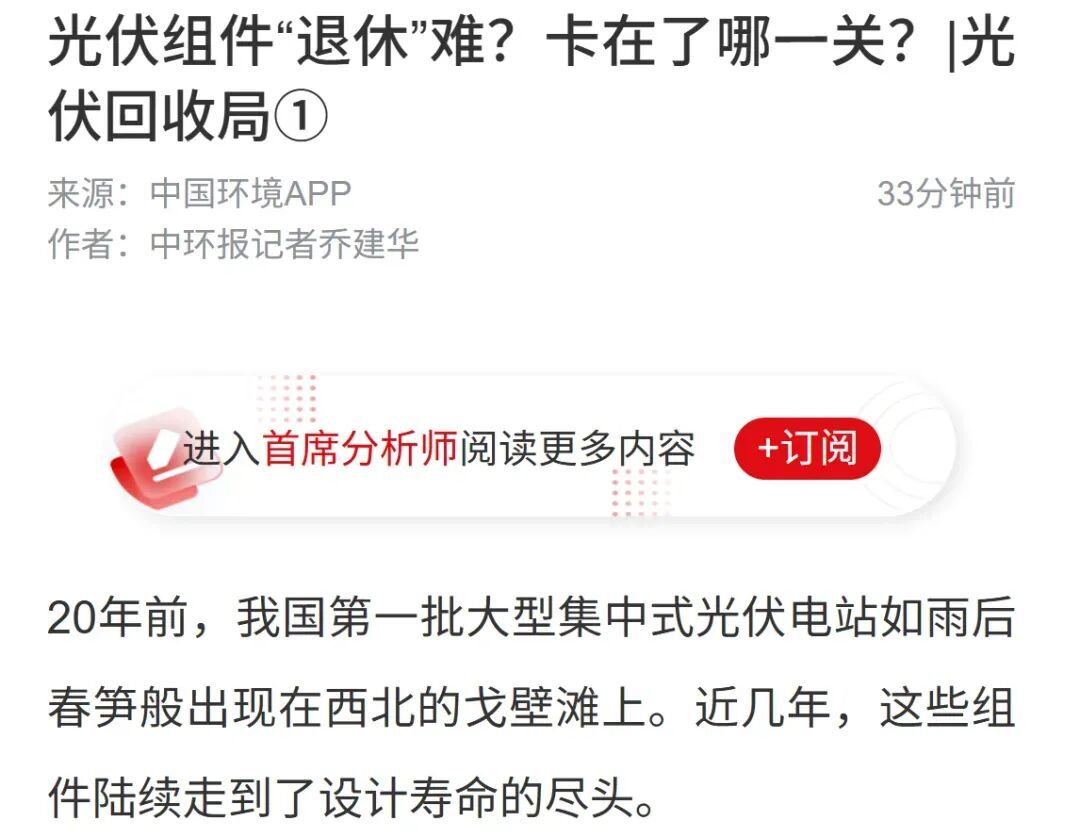
China Environment APP reported on April 16 that the first batch of large-scale centralized photovoltaic power stations in China has entered the concentrated decommissioning period. It is estimated that the decommissioning volume will enter a rapid growth period by 2030, and will exceed the 10 million-ton level by 2040. However, the legal retirement of photovoltaic modules still faces three major core obstacles: lack of standards, complicated state-owned asset disposal procedures, and insufficient economic benefits. The industry is generally still in a state of active preparation but slow implementation.
Wang Hudong, Deputy General Manager of RESOLAR.clearly pointed out the key pain points of the industry in the interview, providing a professional direction for standardizing the decommissioning process: different modules show significant differences in efficiency degradation, and power station modules are massive in scale. How to scientifically measure the actual overall performance and determine the standard at which efficiency decline qualifies for decommissioning is currently the most urgent gap in the industry.
Article Information
China Environment APP reported on April 16 that starting from 2025, the decommissioning volume of photovoltaic modules will gradually increase, enter a rapid growth period by 2030, and exceed the 10 million-ton level by 2040.
The difficulty of “retiring” photovoltaic modules is stuck at three major hurdles:
1. Current policies and standards are mainly based on encouragement and guidance, and decommissioning criteria have yet to be established
“The current decommissioning standards are still somewhat lagging behind.There are no corresponding comprehensive standards on when decommissioning should take place, how it should be carried out, and whether it should be mandatory or decided by the enterprise itself, so enterprises have no basis to follow.” Zhang Shengguang, Director of the Intelligent Equipment Institute of Changsha Research Institute of Mining and Metallurgy Co., Ltd., pointed out in an interview with reporters.
The National Energy Administration's Guidelines for Project Applications under the 2025 Energy Industry Standards Plan also include “upgrading and retrofitting of old wind farms, retirement recycling and reuse of wind turbine units” as a key project direction.
However, at the implementation level, according to Chen Zhijun, General Manager of Yidao Intelligent Environmental Technology (Quzhou) Co., Ltd., the detailed rules for key operations involving approval processes for large-scale retired unit projects, collection of distributed sources, industry access white lists, recycled material reuse ratios, green finance tools for the full life cycle, digital trading platforms, and regional coordination networksare still being improved, and the market is generally in a stage of active preparation but slow implementation.
2. State-owned asset disposal is handled prudently, and modules may be “kept in service beyond schedule”
If the lack of standards is an industry-wide problem, then the four words “state-owned assets” make the decommissioning of centralized photovoltaic projects even more cautious.
Most centralized photovoltaic power stations are controlled by central state-owned enterprises. Although photovoltaic panels are retired, they are still valuable assets. It is understood that since last year, with the rise in silver prices,the price of waste photovoltaic panels has also increased from 40 yuan–50 yuan per panel to more than 100 yuan per panel.
Therefore, when retired photovoltaic panels classified as state-owned assets are to be decommissioned, a professional third party must first be hired to conduct on-site inspections of scrapped modules and materials, analyze their residual value, potential transaction prices in the second-hand market, and the value of recyclable and reusable parts, and prepare a qualified evaluation report. If it meets the relevant requirements for state-owned asset disposal, it can then pass the review of the relevant departments of the group.
Wang Hudong, Deputy General Manager of RESOLAR, told reporters: “Different modules may have different conversion efficiency degradation rates, and the number of modules in a power station is huge. How to scientifically measure the actual performance of the overall modules, and what standard of performance decline qualifies for decommissioning conditions, all urgently require the establishment of a professional evaluation system.”
At the same time, different models and different products also contain different amounts of valuable metals. In terms of silver content, 1 ton of battery cells can recover 3–4 kilograms of silver. Based on the current silver price of 20 yuan per gram, the profit is about 60,000 yuan–70,000 yuan. Professional and independent evaluation can balance the preservation of state-owned asset value and the reasonable profits of recycling enterprises.
Li Qiuna, Chief Engineer of Inner Mongolia Runmeng Energy Co., Ltd., further pointed out: “After the evaluation report is completed, it is also necessary to cooperate in completing the filing of asset appraisal and the related workflow and decision-making procedures for group asset appraisal. Then the estimated value will be used as a price ceiling for the enterprise's online tendering, and other recycling enterprises will bid according to product models, with the final transaction price determined through a market-based bidding mechanism.”
However,Lü Fang, Secretary General of the Photovoltaic Recycling Industry Development Cooperation Center of the China Green Supply Chain Alliancebelieves that,these photovoltaic power station asset owners are usually relatively large in scale and have comparatively complex decision-making processes. In addition, replacement projects require sufficient technical demonstration, economic benefit evaluation, and risk analysis, which may cause modules that could have been “retired” earlier to be forced to “remain in service beyond schedule.”
3. Economic benefits are not obvious, and enterprises lack motivation to promote decommissioning
Lü Fang said: “Judging from this year's photovoltaic recycling market, there is a gap between the theoretically estimated decommissioning scale and the actual market situation. The core issue lies in the insufficiently refined implementation details of incentive policies, and at the specific operational level of project implementation, there are still ‘breakpoint’ problems such as unclear procedures and inconsistent standards. In addition, a sustainable business model has not yet taken shape, and the endogenous driving force of marketization is insufficient.”
According to the introduction, on the one hand, although new modules are technically more advanced and have somewhat improved power generation efficiency, considering the cost of replacing old with new,it is difficult to see obvious economic returns in the short term. For example, the increase in power generation efficiency of new modules may only be a few percentage points, and it may take several years for the additional power generation revenue to offset the cost of replacement; on the other hand, early photovoltaic projects had relatively high investment, and the residual value of fixed assets is relatively large. Retrofit upgrades involve the dismantling and disposal of huge fixed assets. How to reasonably dispose of these assets without causing loss of fixed assets and without affecting the company's financial returns is a problem facing enterprises.
Report link:https://www.cenews.com.cn/h5hjb/news/news.html?id=1779561&nav=1
About RESOLAR
Shanghai RESOLAR Energy Technology Co., Ltd. is committed to becoming a recycled material photovoltaic group with deep decarbonization. RESOLAR focuses on technological innovation and builds a world-leading solution for component recycling, impurity removal of damaged cells, recycled silicon materials and cells, and cascaded utilization of components. With professional technology and services, we help customers realize the recycling and reuse of waste photovoltaic resources, and make positive contributions to the development of environmental protection and new energy industries. For more detailed information, you can browse the official website: www.resolartech.com .

Latest developments/news
Contact information
Service Hotline: 13585742918 (Monday to Friday 9:00-18:00)
Enterprise email: ps@resolartech.com (Reply within 48 hours after receiving the email consultation!)
Company Address: Building 8, No. 1528, Wangxu East Road, Fengjing Town, Jinshan District, Shanghai (Caohejing Fengjing Park)