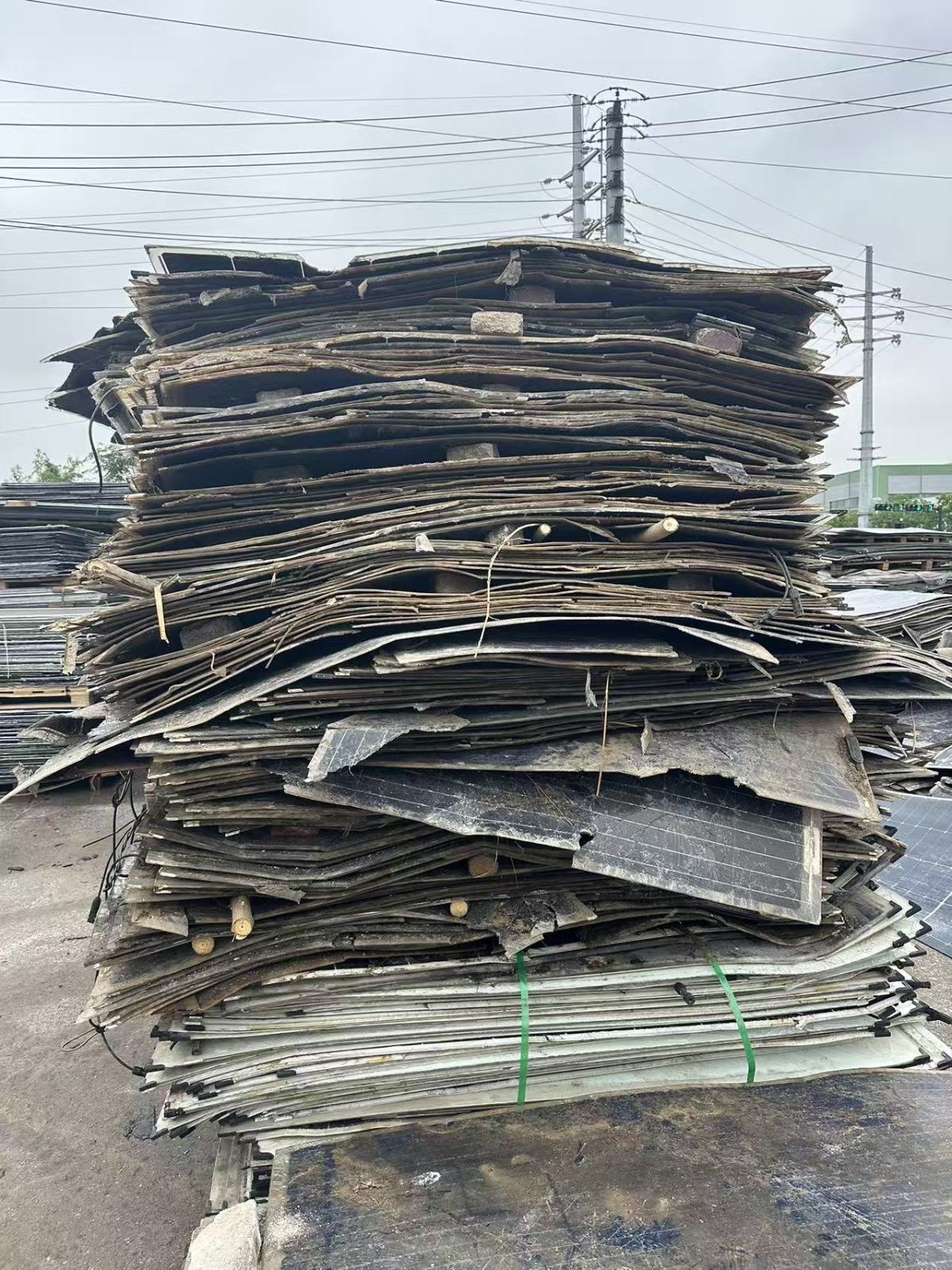
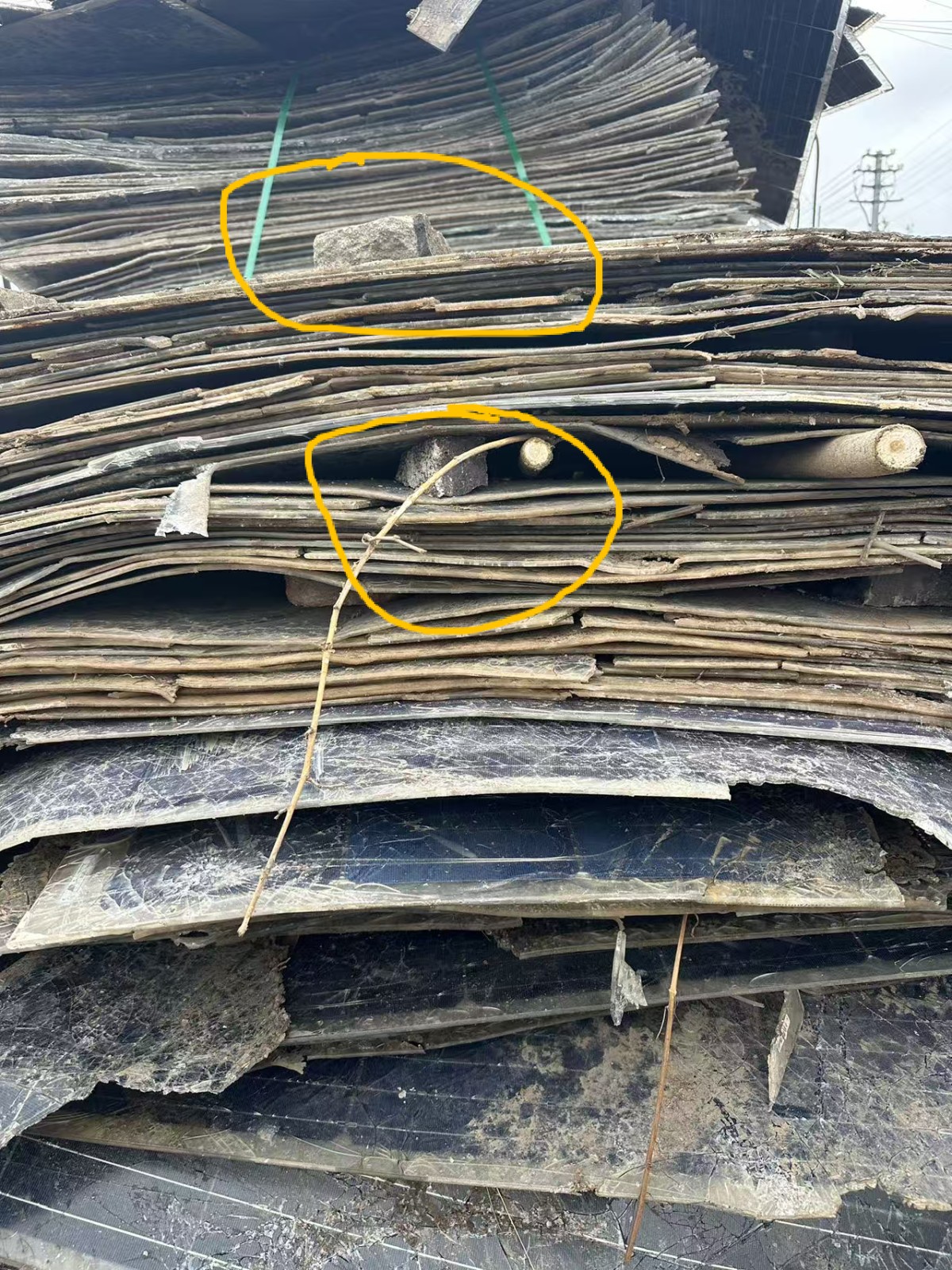
In the current photovoltaic recycling and second-hand module trading market, the goods delivery process has long given rise to many industry malpractices, among which the most visible and most damaging to the interests of all parties is the bad practice of inserting bricks to add weight when stacking and loading modules.
During the process of stacking photovoltaic modules neatly, some practitioners deliberately stuff bricks, stones, and other heavy objects into the gaps between module panels and the internal voids of the whole stack for filling and compaction. From the outside, the stack looks neat and visually appealing, and it is simply impossible to distinguish the internal reality with the naked eye. The industry mostly uses whole-truck weighbridge weighing to settle cargo, and these heavy objects with no use value directly increase the total vehicle weight, greatly compressing the proportion of genuine photovoltaic materials and directly causing economic losses to suppliers. Especially when shipping in full truckloads in large quantities, with many layers in the stack body and dense stacking, on-site verification is difficult, making such non-compliant operations even easier to slip through. This unhealthy trading practice also reflects, from another angle, the disorderly state of the entire second-hand photovoltaic module market, where various deep-rooted industry problems are becoming increasingly prominent.


1. Industry Development Background
With the explosive expansion of the global photovoltaic industry over many years, photovoltaic power stations built on a large scale in the early stage have gradually entered the cycle of technical upgrading and retirement, and second-hand photovoltaic modules have gradually formed a large-scale circulation market, becoming a core component of the photovoltaic recycling industry. Second-hand photovoltaic modules mainly include three categories: decommissioned dismantled modules from power stations, downgraded defective modules from the production process, and refurbished and repaired modules. They are not only an important carrier for circular resource utilization, but also carry the economic value of reducing photovoltaic project construction costs and expanding into emerging overseas markets.
At present, the photovoltaic recycling and second-hand module market is at a critical stage of transformation from wild growth to standardization, but the industry as a whole shows prominent characteristics of spontaneous disorder. A large number of dismantled modules and downgraded modules circulate privately through informal channels, lacking unified quality testing standards and a traceability supervision system. This not only disrupts the normal order of the photovoltaic recycling industry, but also creates safety hazards for the operation of distributed photovoltaic systems and off-grid power stations. Under the support of dual-carbon goals and circular economy policies, clarifying the current status, circulation channels, and existing problems of the second-hand module market, and promoting the standardized and industrialized development of the photovoltaic recycling industry, has become an urgent need for industry development.
2. Market Size and Growth Trend of Second-Hand Photovoltaic Modules
(1) Overall Market Size
The domestic second-hand photovoltaic module market has maintained rapid expansion, with an average annual growth rate of over 15%. In 2023, the market size reached 4.5GW, and the total transaction value exceeded 4.12 billion yuan; in 2024, it is expected to increase to 5.8GW, with transaction value exceeding 5.2 billion yuan. Over the past five years, the market's average annual compound growth rate has been as high as 18%, showing strong growth momentum.
According to industry forecasts, by 2030, the domestic volume of retired photovoltaic modules will exceed 15GW. Combined with modules replaced in advance due to power station technical upgrades, the circulation volume of second-hand modules will usher in exponential growth, and the hundred-billion-yuan market potential of the photovoltaic recycling industry will be gradually released.
(2) Segmented Market Structure
- Retired dismantled modules: accounting for 65% of the market and serving as the main circulation force, mostly replacement modules from large ground-mounted power stations that have operated for 5-10 years, with power degradation of 10%-20%; the growth rate over the next five years will remain above 22.5%;
- Production-downgraded modules: accounting for 35%, originating from quality inspection elimination at module factories, with no service record but with appearance or minor electrical performance defects. Affected by manufacturing process upgrades, the growth rate has slowed to 8.5%;
- Refurbished and repaired modules: currently accounting for only 3.3% of the market, but with a growth rate of 35% due to their high value-added advantages, making them a highly promising niche track in the photovoltaic recycling field.
(3) Characteristics of Regional Distribution
The market shows a separation pattern between production and sales: the supply side is concentrated in western photovoltaic-rich regions such as Xinjiang, Qinghai, and Gansu, which are core source areas for retired dismantled modules; the domestic demand side is concentrated in regions such as Shandong, Langfang in Hebei, and Henan, where distributed photovoltaic adoption is widespread and price sensitivity is high; coastal ports such as Ningbo in Zhejiang, Kunshan in Jiangsu, and Shenzhen rely on logistics advantages and have become core distribution hubs for exporting second-hand modules overseas.
3. Second-Hand Photovoltaic Module Industry Chain and Circulation Channels
(1) Complete Industry Chain Structure
- Upstream supply side: photovoltaic power station operators provide retired dismantled modules, and module manufacturers provide downgraded modules with appearance defects or substandard electrical performance;
- Midstream circulation side: covering individual recyclers, professional recycling enterprises, basic testing institutions, module refurbishment factories, and trading intermediaries, undertaking core functions such as source collection, sorting and cleaning, fault repair, and channel distribution, and also serving as a key link in the photovoltaic recycling industry;
- Downstream application side: domestically oriented toward self-built rural distributed photovoltaic systems, agricultural photovoltaics, and off-grid lighting systems; overseas mainly flowing to regions with weak power infrastructure such as Southeast Asia, Africa, and South America, capturing microgrid and off-grid power supply markets by relying on price advantages.
(2) Mainstream Circulation Channels
- Offline private transactions: the traditional mainstream channel, dominated by industry insider circles, small traders, and scalpers, with cash / private card settlement and no contracts or invoices. Source matching is flexible, but transactions are concealed, with no formal quality inspection or transaction certificates, making this the main route for the circulation of inferior modules;
- Online platform customer acquisition: relying on second-hand e-commerce, industry communities, and social media to publish source information, enabling nationwide source matching and breaking regional limitations, but marked as “tax-exclusive cash price”, using private transfers and avoiding invoicing, lacking platform supervision, and with uneven product quality;
- Bulk export trade: coastal traders centrally procure downgraded modules and ordinary dismantled modules, then export full containers to low-end overseas markets. Cash transactions without invoices are used in procurement and sales, customs declarations are undervalued, and profit margins are considerable, making this an important current outlet for second-hand modules;
- Enterprise-oriented recycling: some formal photovoltaic recycling enterprises sign agreements with power stations and module factories to recycle retired and defective modules, conduct professional testing, refurbishment and reuse, or material dismantling and recycling. A small number of enterprises issue invoices and pay taxes in compliance, but their share remains insufficient.
4. Core Existing Market Pain Points
(1) Lack of a Quality Standards System
The industry has no unified standards for testing, grading, and pricing second-hand modules. Transactions rely only on visual inspection and basic voltage testing, making it impossible to identify hidden problems such as microcracks, PID degradation, and internal aging. The market generally suffers from the same price for good and bad products and the practice of passing off inferior products as good ones, seriously damaging the transaction trust system and constraining the large-scale development of the photovoltaic recycling industry.
(2) Fragmented Market Structure
The industry lacks leading enterprises with capabilities in testing, refurbishment, and channel integration, while large numbers of individual operators, small workshops, and small traders compete disorderly. Some unqualified merchants use violent dismantling and non-compliant refurbishment methods to compress costs, disrupting market pricing and at the same time causing resource waste and environmental pollution.
(3) Missing Circulation Supervision and Traceability
Informal circulation accounts for a high proportion of second-hand modules, and no full-process traceability certification system has been established. Illegal refurbishment and counterfeit branded modules are common. The export process lacks standardized control, and the outflow of inferior modules not only affects industry reputation, but also creates hidden risks for international trade.
(4) Disorderly Pricing Mechanism
The price of second-hand modules is far lower than that of new products, but it fluctuates sharply under the influence of silicon material prices, new product market conditions, and source supply and demand. In addition, due to the lack of professional valuation standards, transaction bargaining is highly arbitrary, making it difficult to protect the rights and interests of small and medium practitioners as well as end users. Coupled with practices such as inserting bricks during loading to add weight, transaction unfairness is further aggravated.
5. Development Recommendations for the Photovoltaic Recycling and Second-Hand Module Industry
(1) Establish Unified Quality and Grading Standards
Led by industry associations, official testing specifications for second-hand photovoltaic modules should be formulated to clarify the defining indicators, degradation thresholds, and safety standards for dismantled modules, downgraded modules, and refurbished modules, divide them into grades, and provide supporting standardized pricing references, so as to put an end to the industry's disorder caused by the absence of standards.
(2) Improve Traceability Supervision and Industry Access
Regulatory authorities should build a traceability certification platform for second-hand photovoltaic modules to achieve full-process traceability covering recycling, testing, refurbishment, trading, and export. Industry entry thresholds should be raised, unqualified small workshops and illegal refurbishment outlets should be banned, market competition order should be standardized, and all kinds of illegal weight-adding practices in cargo loading and transport should be strictly investigated.
(3) Innovate Industry Business Models
Enterprises should rely on the photovoltaic recycling industry chain to build an integrated service model of testing - certification - refurbishment - trading - export, using professional technology to eliminate information asymmetry and establish brand credibility. At the same time, they should increase R&D in refurbishment technology, enhance the added value of second-hand modules, and transform from low-end scrap recycling to asset reoperation.
(4) Deepen Presence in Domestic and Overseas Segmented Markets
Domestically, focus on sinking markets such as rural household use, agricultural photovoltaics, and off-grid power stations to meet demand for low-price, high-cost-performance products; overseas, prioritize emerging markets such as Southeast Asia and Africa, improve overseas channel layout, and rely on cost advantages to capture the microgrid construction market, thereby releasing the dividends of export trade.
6. Outlook on Industry Development Trends
In the short term, the second-hand photovoltaic module market will still face difficulties such as missing standards, absent supervision, low-price competition, and various unhealthy practices in cargo trading; in the long term, with the implementation of dual-carbon policies, the improvement of the circular economy system, and the full arrival of the retirement wave, the photovoltaic recycling industry will usher in reshuffling and consolidation. In the next 3-5 years, professional leading enterprises will gradually rise, and the industry will move from disorderly wild growth into a new stage of standardization, regulation, and industrialization. Second-hand modules will also become an important support for green closed-loop management throughout the photovoltaic lifecycle, and the market will have broad long-term development space.
Original link:https://max.book118.com/html/2026/0419/6100003042012124.shtm