


English
News Center
—— NEWS CENTER ——
Nine departments, including the Ministry of Commerce, the National Development and Reform Commission, and the Ministry of Industry and Information Technology, recently issued the Opinions on Further Advancing the Development of the Renewable Resources Recycling System and Promoting High-Quality Development of the Recycling Industry. Released to the public on November 17, the Opinions state that
recycling and dismantling of retired photovoltaic equipment and used wind power equipment should be developed. State-owned power enterprises and comprehensive utilization enterprises should be encouraged to establish market-based business coordination mechanisms.
Pilot cities for the development of renewable resources recycling systems are encouraged to develop and apply information platforms for renewable resources recycling, making it easier for residents to find information and hand in materials, and for businesses to coordinate supply and demand.
Law enforcement and supervision should be strengthened. Environmental oversight and law enforcement in renewable resources recycling and utilization should be intensified. Labor protection for workers in the renewable resources recycling industry should be strengthened, and workplace safety hazards must be firmly prevented. Environmental sanitation at recycling collection sites should be improved, and market order in the recycling industry should be more closely supervised and managed. Violations in the renewable resources recycling sector should be investigated and handled in accordance with the law, and related criminal activities should be firmly combated.
The Ministry of Commerce will establish a working mechanism for developing the renewable resources recycling system and continue to advance related work in pilot cities and enterprises. The work will also cover the recycling and utilization of solid waste from the “new trio,” and a number of representative models and practices will be promoted. The system for key enterprises in renewable resources recycling to maintain regular contact will be explored and improved.
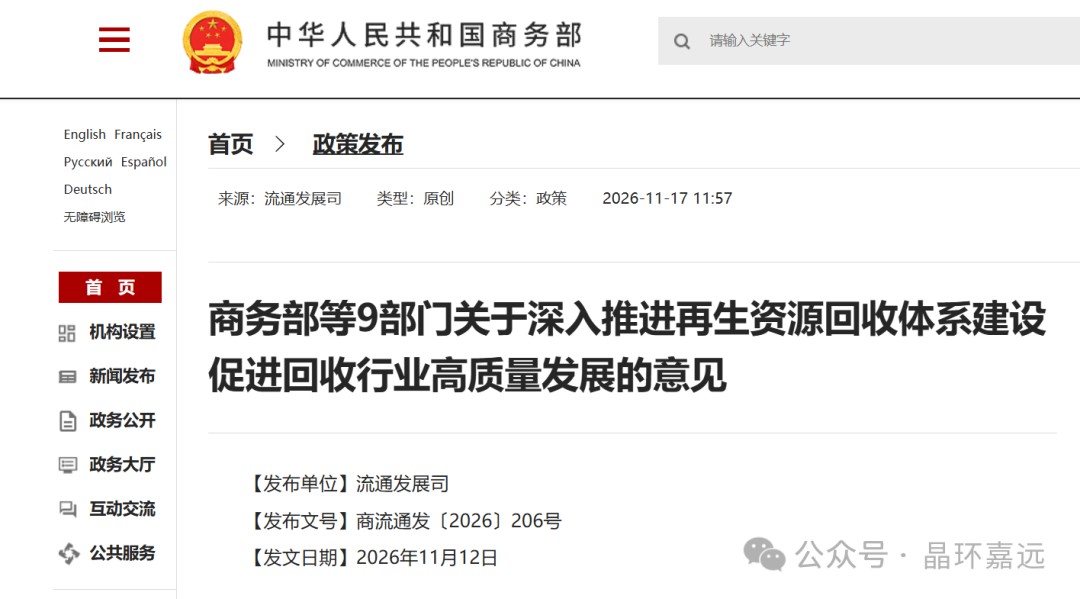
Opinions of Nine Departments, Including the Ministry of Commerce, on Further Advancing the Development of the Renewable Resources Recycling System and Promoting High-Quality Development of the Recycling Industry
[Issuing Department] Department of Circulation Development
[Document No.] Shang Liutong Fa [2026] No. 206
To thoroughly implement the decisions and arrangements of the CPC Central Committee and the State Council and continuously improve the renewable resources recycling system, the following opinions are hereby issued.
I. Overall Requirements
Guided by Xi Jinping Thought on Socialism with Chinese Characteristics for a New Era, we will combine market leadership with government guidance, align convenience and benefits for the public with collaborative development, and coordinate comprehensive advancement with adaptation to local conditions. We will accelerate the development of the renewable resources recycling system, continuously improve the convenience and standardization of recycling, and effectively address issues such as “throwing things away being harder than buying them.” By 2030, we will initially establish a renewable resources recycling system with a well-developed recycling network, convenient and efficient drop-off services for residents, advanced and efficient sorting, and environmentally sound, standardized end processing.
II. Promote the Application of Representative Recycling Models
(I) Adopt a comprehensive recycling model covering multiple categories of renewable resources. Promote the “integration of the two networks.” Strengthen the connection and integration between household waste sorting and renewable resources recycling collection points, promote the shared use of facilities and sites and the joint development of operating teams, and ensure that recyclables recovered from household waste enter the renewable resources recycling system, thereby reducing household waste and recovering resources. Develop “Internet + recycling.” Encourage residents to submit recycling requests online through internet platforms or mobile mini-programs, with recycling company staff collecting the items at the agreed time and price; alternatively, recycling companies may install smart recycling bins in eligible residential communities, where residents can deposit renewable resources themselves by following the operating instructions. Promote “mobile collection vehicles as an alternative to storage facilities.” In areas where recycling sites are limited or collection points are remote, encourage the deployment of mobile recycling vehicles capable of collecting, temporarily storing, and transporting used items. These vehicles will supplement fixed collection sites and ensure that items are removed promptly or as soon as the vehicle is full. (Local commerce, housing and urban-rural development, and transport authorities, and supply and marketing cooperatives, shall be responsible according to their respective duties.)
(II) Establish and improve collection and removal models for bulky used furniture. Explore contracted collection and removal. Based on local conditions, designate one or more recycling companies to take responsibility for carrying, storing, and subsequently collecting and removing bulky used furniture from households within a specified area. Promote market-based door-to-door collection and removal. Encourage recycling companies to provide door-to-door collection and removal services for bulky used furniture, taking into account factors such as furniture type and dimensions, floor level, and elevator availability. Support cooperation between recycling companies and property management service providers to collect bulky used furniture. Support public-interest collection and removal services. Arrange for recycling companies to collect, free of charge and in a coordinated manner, bulky used furniture that residents place at designated storage points at agreed times. Encourage furniture manufacturers and retailers to hold regular events such as “Bulky Furniture Collection Days” and increase publicity for green, low-carbon activities. (Local commerce, housing and urban-rural development, and transport authorities shall be responsible according to their respective duties.)
(III) Actively promote recycling models for used household appliances. Improve the implementation of “trade-in plus recycling.” Support household appliance retailers in partnering with manufacturers and recycling companies to run trade-in promotions. Companies should proactively offer consumers a one-stop “delivery of new products and collection of old ones” service, and send recovered used appliances to qualified processing enterprises. Promote cooperation across the entire value chain. Encourage household appliance manufacturers to build recycling, sorting, dismantling, and utilization facilities independently or through joint ventures. Encourage used appliance dismantling companies to strengthen upstream and downstream cooperation and effectively link front-end appliance collection with standardized downstream dismantling. Expand channels for the circular use of “government asset warehouses.” Support government agencies and public institutions in placing idle assets under the management of “government asset warehouses” for allocation, strengthening cooperation with recycling companies, and promoting the circular use of office equipment and furniture, such as old computers and air conditioners, that can continue to be used after repair. (Local commerce and government affairs administration authorities, and supply and marketing cooperatives, shall be responsible according to their respective duties.)
III. Strengthen the Recycling and Dismantling of Solid Waste from the “New Trio”: Power Batteries, Photovoltaic Modules, and Wind Turbine Blades
(IV) Strengthen the recycling and processing of used power batteries. Revise and implement the Detailed Rules for the Implementation of the Administrative Measures for the Recycling of End-of-Life Motor Vehicles, and promote the scrapping and dismantling of new energy vehicles together with their batteries. Study and formulate a digital identification management system for new energy vehicle power batteries, along with related administrative regulations. Strengthen the provision of key technical standards and actively promote the adoption of mature domestic standards as international standards. (Industry and information technology, development and reform, public security, ecology and environment, and commerce authorities, as well as market regulation and financial regulation departments, shall be responsible according to their respective duties.)
(V) Develop the recycling and dismantling of retired photovoltaic equipment and used wind power equipment. Promote the establishment of market-based business coordination mechanisms between state-owned power enterprises and comprehensive utilization enterprises. Implement relevant disposal requirements for waste photovoltaic modules and wind turbine blades, and encourage power generation companies to establish recycling systems for retired equipment. Guide large centrally administered state-owned enterprises to make reasonable investments in recycling networks and utilization facilities based on the distribution of the new energy industry. Encourage enterprises to make breakthroughs in key common technologies and promote the application of advanced technological equipment, including artificial intelligence. Formulate administrative measures for the recycling and processing of retired wind turbine blades and photovoltaic modules. (Energy, development and reform, state-owned assets administration, ecology and environment, and commerce authorities shall be responsible according to their respective duties.)
IV. Upgrade and Improve the Quality of the Recycling Industry
(VI) Strengthen the planning of recycling networks. In urban areas, focus on upgrading and renovating sorting centers, support the development of a number of green, intelligent, and specialized sorting centers, and improve the three-tier recycling system comprising collection sites, transfer stations, and sorting centers. In rural areas, further leverage county-level commercial systems and the renewable resources recycling networks of supply and marketing cooperatives to achieve full coverage of recycling networks. Guide enterprises to build and operate their facilities in a standardized manner, support front-end individual operators and other dispersed recycling teams, provide standardized and convenient recycling services, and strengthen environmental sanitation management. Business operators that have not obtained the qualification to process waste electrical and electronic products are strictly prohibited from engaging in such processing without authorization. (Local commerce and ecology and environment authorities, and supply and marketing cooperatives, shall be responsible according to their respective duties.)
(VII) Improve the digital and intelligent capabilities of recycling. Make full use of information technologies such as big data, cloud computing, and artificial intelligence to advance the digital and intelligent development of the renewable resources recycling industry. Encourage pilot cities for the development of renewable resources recycling systems to develop and apply information platforms for renewable resources recycling, making it easier for residents to find information and hand in materials, and for businesses to coordinate supply and demand. Encourage eligible recycling companies to build integrated information service platforms for renewable resources recycling, provide value-added services, and improve data analysis and aggregation capabilities for renewable resources. (Local commerce and development and reform authorities shall be responsible according to their respective duties.)
V. Promote Improvements to the Recycling System
(VIII) Ensure local governments fulfill their primary responsibilities. Commerce authorities at all levels of local government shall take the lead, while relevant departments shall collaborate according to their respective responsibilities in industry management. Local authorities shall apply representative recycling models in light of local conditions and jointly advance key tasks for renewable resources recycling. Both incentives and constraints shall be applied. Officials at all levels shall be urged to take responsibility and act proactively; serious problems such as ineffective implementation shall be publicly reported and subject to accountability in accordance with relevant rules and disciplines. Cultivate a number of standardized, large-scale recycling companies. Support business operators of all forms of ownership equally in contributing to the development of the recycling system; private enterprises, small and medium-sized enterprises, and individual businesses must not be excluded from participation. (Local commerce and state-owned assets administration authorities, and supply and marketing cooperatives, shall be responsible according to their respective duties.)
(IX) Implement the extended producer responsibility system. Encourage manufacturers to incorporate recycling throughout the entire process of product design, research and development, production, and sales, and to establish recycling systems for used products commensurate with sales volumes, either independently or through outsourcing. Promote low-carbon, resource-efficient eco-design, giving priority to solutions that are non-toxic and harmless, readily degradable, or easy to recycle and reuse. Use production technologies and processes that facilitate recycling and processing. (Local development and reform and commerce authorities shall be responsible according to their respective duties.)
(X) Improve recycling services provided by retailers. Support household appliance retailers in running trade-in promotions to encourage residents to exchange used products for new ones. Guide furniture retailers to leverage their channel advantages in connecting production and sales and distributing goods, continuously improve their service capabilities, and offer collection services for used furniture when delivering new furniture. (Local commerce authorities shall be responsible.)
(XI) Improve the professional capabilities of recycling companies. In eligible areas, encourage manufacturers, retailers, recycling companies, and utilization enterprises to deepen cooperation across the entire value chain and jointly fulfill their social responsibilities. Promote the presence of specialized, standardized recycling companies in subdistricts, communities, and villages, and continuously improve service levels. (Local commerce authorities shall be responsible.)
(XII) Encourage relevant organizations to play their part. Support relevant associations and other organizations in publishing information on bulky waste storage points and renewable resources collection points through smart community service platforms and other means, guiding residents to hand in renewable resources in a standardized manner. Property management service providers may, in response to residents’ needs, facilitate access to residential communities for recycling personnel and vehicles. (Local commerce and housing and urban-rural development authorities shall be responsible according to their respective duties.)
VI. Strengthen Coordination
(XIII) Strengthen support for key factors. Fully consider land requirements for recycling infrastructure and increase land support. Set up storage points for bulky waste in residential communities to make it convenient for residents to drop off and temporarily store items. Ensure reasonable road access for recycling operation vehicles, implement relevant policies such as “reverse invoicing” in accordance with laws and regulations, and explore product carbon footprint accounting in the renewable resources recycling industry. Further advance the development of urban 15-minute convenient living circles, address gaps in community collection points, and include renewable resources recycling among the basic public convenience services. (Commerce, development and reform, public security, and ecology and environment authorities, and supply and marketing cooperatives, shall be responsible according to their respective duties.)
(XIV) Strengthen law enforcement and supervision. Intensify environmental oversight and law enforcement in renewable resources recycling and utilization. Strengthen labor protection for workers in the renewable resources recycling industry and firmly prevent workplace safety hazards. Improve environmental sanitation management at recycling collection sites, strengthen supervision and management of market order in the recycling industry, investigate and handle violations in the renewable resources recycling sector in accordance with the law, and firmly combat related criminal activities. (Commerce, public security, and ecology and environment authorities, as well as market regulation departments, shall be responsible according to their respective duties.)
(XV) Improve the system of laws, regulations, and standards. Accelerate the development of laws and regulations on renewable resources recycling and support local efforts to strengthen legislation on renewable resources recycling systems. Improve the standards system for renewable resources recycling and provide necessary support for statistics on renewable resources recycling in accordance with relevant provisions. (Commerce and ecology and environment authorities, as well as market regulation departments, shall be responsible according to their respective duties.)
(XVI) Further advance pilot programs. The Ministry of Commerce will establish a working mechanism for developing the renewable resources recycling system and continue to advance related work in pilot cities and enterprises. The work will also cover the recycling and utilization of solid waste from the “new trio,” and a number of representative models and practices will be promoted. The system for key enterprises in renewable resources recycling to maintain regular contact will be explored and improved. (Commerce, industry and information technology, energy, and state-owned assets administration authorities shall be responsible according to their respective duties.)
Ministry of Commerce
National Development and Reform Commission
Ministry of Industry and Information Technology
Ministry of Ecology and Environment
Ministry of Housing and Urban-Rural Development
State Administration for Market Regulation
State Government Offices Administration
National Energy Administration
All China Federation of Supply and Marketing Cooperatives
November 11, 2026
About RESOLAR
Shanghai RESOLAR Energy Technology Co., Ltd. is committed to becoming a recycled material photovoltaic group with deep decarbonization. RESOLAR focuses on technological innovation and builds a world-leading solution for component recycling, impurity removal of damaged cells, recycled silicon materials and cells, and cascaded utilization of components. With professional technology and services, we help customers realize the recycling and reuse of waste photovoltaic resources, and make positive contributions to the development of environmental protection and new energy industries. For more detailed information, you can browse the official website: www.resolartech.com .

Latest developments/news
Contact information
Service Hotline: 13585742918 (Monday to Friday 9:00-18:00)
Enterprise email: ps@resolartech.com (Reply within 48 hours after receiving the email consultation!)
Company Address: Building 8, No. 1528, Wangxu East Road, Fengjing Town, Jinshan District, Shanghai (Caohejing Fengjing Park)