


English
News Center
—— NEWS CENTER ——
On June 2, 2026, the "Notice of Fujian Provincial Development and Reform Commission and Fujian Provincial Department of Finance on Implementing Large-Scale Equipment Renewal and Consumer Goods Trade-in Policy in 2026" was officially released.
The document mentions improving the management, evaluation, and appraisal systems for secondhand goods transactions, promoting the application of the "Internet + recycling + secondhand" model and technologies, and facilitating the standardized development of the secondhand goods trading market.
Strengthen supervision of scrap recycling and dismantling enterprises to improve the standardization of scrap equipment recycling. Continue to promote the implementation of the "reverse invoicing" system for resource recycling enterprises to sell scrapped products to natural persons and strengthen supervision to regulate the tax order of the resource recycling industry.
Compared to the policies of 2025 and earlier, which focused on encouraging the expansion of the recycling market, the policy development focus of Guangdong, Shanxi, Jiangsu, Shandong, Henan, Sichuan, Heilongjiang, and Fujian in 2026 shifted to three dimensions: channel standardization and platformization, environmental management and control, and tax compliance. The latest policies, for the first time at the provincial level, strengthen the implementation of compliance measures, driving the local renewable resource recycling industry to move away from extensive incremental expansion and towards a comprehensive transformation towards refined and compliant operations.
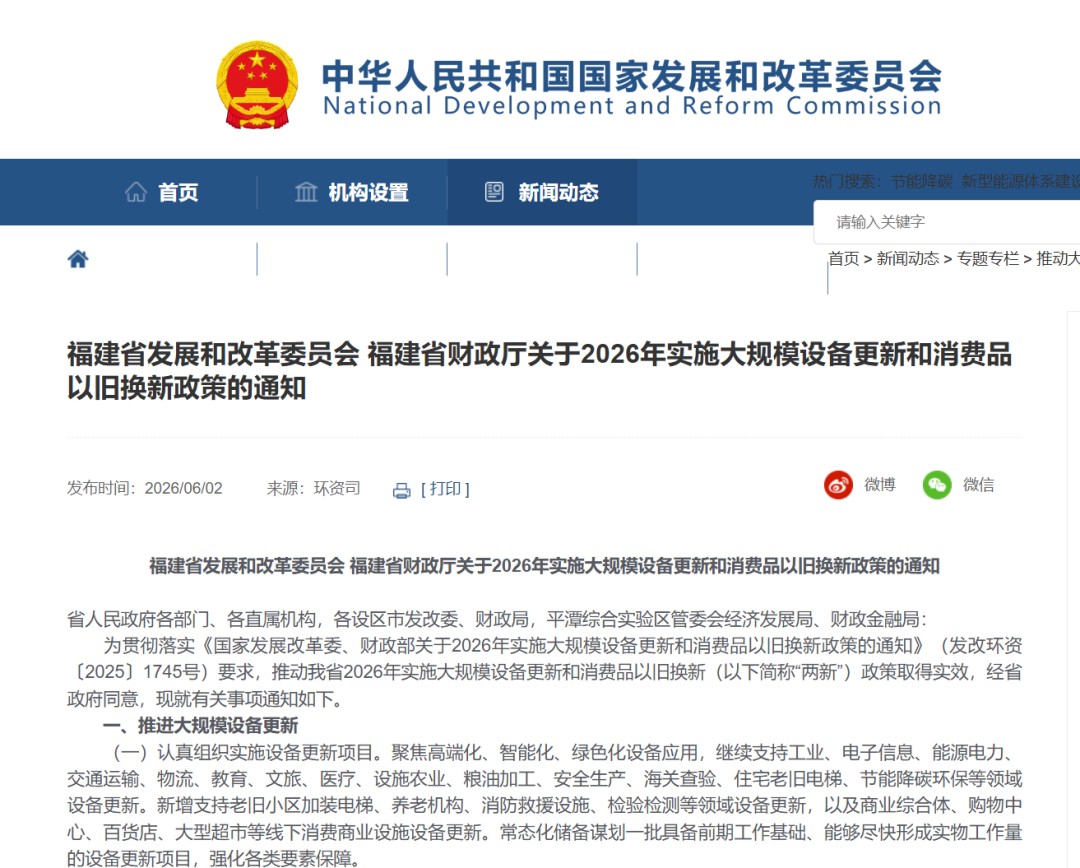
Notice from the Fujian Provincial Development and Reform Commission and the Fujian Provincial Department of Finance on Implementing Large-Scale Equipment Renewal and Consumer Goods Trade-in Policies in 2026
Issuing agencies: Fujian Provincial Development and Reform Commission, Fujian Provincial Department of Finance
Release date: June 2, 2026
Notice from the Fujian Provincial Development and Reform Commission and the Fujian Provincial Department of Finance on Implementing the Large-Scale Equipment Renewal and Consumer Goods Trade-in Policy in 2026
To all departments and directly affiliated institutions of the Provincial People's Government, the Development and Reform Commissions and Finance Bureaus of all prefecture-level cities, and the Economic Development Bureau and Finance and Financial Bureau of the Pingtan Comprehensive Experimental Zone Management Committee:
In order to implement the requirements of the "Notice of the National Development and Reform Commission and the Ministry of Finance on Implementing the Large-Scale Equipment Renewal and Consumer Goods Trade-in Policy in 2026" (NDRC Circular [2025] No. 1745) and promote the effectiveness of the large-scale equipment renewal and consumer goods trade-in policy (hereinafter referred to as "two new policies") in our province in 2026, with the approval of the provincial government, the following matters are hereby notified.
I. Promote large-scale equipment upgrades
(I) Conscientiously organize and implement equipment upgrade projects. Focusing on the application of high-end, intelligent, and green equipment, continue to support equipment upgrades in industries such as manufacturing, electronics and information, energy and power, transportation, logistics, education, culture and tourism, healthcare, facility agriculture, grain and oil processing, work safety, customs inspection, old residential elevators, energy conservation, carbon reduction, and environmental protection. New support will be provided for equipment upgrades in areas such as elevator installation in old residential communities, elderly care institutions, fire and rescue facilities, and inspection and testing, as well as equipment upgrades in offline consumer commercial facilities such as commercial complexes, shopping centers, department stores, and large supermarkets. A number of equipment upgrade projects with a solid foundation of preliminary work and capable of generating tangible results will be regularly planned and prepared, and the guarantee of various resources will be strengthened.
(II) Support the scrapping and replacement of old commercial freight vehicles and the replacement of old urban buses with new energy vehicles. In accordance with the subsidy standards of the "Notice of the Ministry of Transport, the National Development and Reform Commission, and the Ministry of Finance on Implementing the Scrapping and Replacement of Old Commercial Freight Vehicles" (Jiao Guihua Fa [2025] No. 17), support will continue to be provided for scrapping commercial freight vehicles with emission standards of National IV and below to replace them with low-emission freight vehicles, with priority given to electric freight vehicles. In accordance with the subsidy standards of the "Notice of the General Office of the Ministry of Transport, the General Office of the National Development and Reform Commission, and the General Office of the Ministry of Finance on Issuing the 'Implementation Rules for Subsidies for the Replacement of New Energy Urban Buses and Power Batteries in 2025'" (Jiao Ban Yun [2025] No. 4), the electrification of urban buses will be promoted, and support will continue to be provided for the replacement of old urban buses and power batteries with new energy vehicles.
(III) Support the scrapping and replacement of old agricultural machinery. Detail the annual implementation plan for agricultural machinery scrapping and replacement subsidies across the province, optimize and adjust the types of agricultural machinery eligible for scrapping and replacement subsidies, and actively adopt convenient measures such as processing scrapping subsidies for small and medium-sized agricultural machinery on behalf of residents.
II. Conduct trade-in programs for old consumer goods
(iv) Facilitate vehicle scrapping and replacement. Individual consumers who scrap gasoline passenger vehicles registered before June 30, 2013 (inclusive), diesel and other fuel passenger vehicles registered before June 30, 2015, or new energy passenger vehicles registered before December 31, 2019, and purchase new energy passenger vehicles or fuel passenger vehicles with an engine displacement of 2.0 liters or less in Fujian Province, will receive vehicle scrapping and replacement subsidies. The subsidy for purchasing new energy passenger vehicles is 12% of the vehicle price (including tax, the same below) (maximum not exceeding RMB 20,000), and the subsidy for purchasing fuel passenger vehicles with an engine displacement of 2.0 liters or less is 10% of the vehicle price (maximum not exceeding RMB 15,000). The scrapped used vehicles that meet the conditions should be registered in the applicant's name before January 8, 2025. The newly purchased passenger vehicles that meet the conditions should have their "Unified Invoice for Motor Vehicle Sales" and "Motor Vehicle Registration Certificate" issued or processed in Fujian Province.
(V) Facilitating Vehicle Replacement and Renewal. Individual consumers who transfer their passenger vehicles registered in their own name and purchase new energy passenger vehicles or fuel passenger vehicles with an engine displacement of 2.0 liters or less listed in the Ministry of Industry and Information Technology's "Catalogue of New Energy Vehicle Models Eligible for Vehicle Purchase Tax Reduction and Exemption" within Fujian Province will receive vehicle replacement and renewal subsidies. The subsidy will be 8% of the vehicle price for new energy passenger vehicles (maximum RMB 15,000) and 6% of the vehicle price for fuel passenger vehicles with an engine displacement of 2.0 liters or less (maximum RMB 13,000). The old passenger vehicle transferred by the consumer must be registered in the applicant's name before January 8, 2025; the "Unified Invoice for Motor Vehicle Sales" and "Motor Vehicle Registration Certificate" for the newly purchased eligible passenger vehicle must be issued or processed within Fujian Province. During the implementation period of the 2026 vehicle trade-in policy, each individual consumer can only choose to receive either a vehicle scrapping and renewal subsidy once or a vehicle replacement and renewal subsidy once.
(vi) Implement the trade-in program for home appliances. Individual consumers who purchase appliances of the following six categories—refrigerators, washing machines, televisions, air conditioners, computers, and water heaters—that meet the Level 1 energy efficiency or water efficiency standard will receive a subsidy of 15% of the final sales price after deducting discounts at each stage. Each consumer can receive a subsidy for one appliance of each category, with a maximum subsidy of 1,500 yuan per appliance.
(VII) Facilitate the purchase of new digital and smart products. Individual consumers purchasing mobile phones, tablets, smartwatches/bands, and smart glasses (with a single item sales price not exceeding 6,000 yuan) will receive a subsidy of 15% of the final sales price after deducting discounts at each stage. Each consumer can receive a subsidy for one item of each product category, with a maximum subsidy of 500 yuan per item. Subsidies will also be provided for the purchase of new smart home products (including age-friendly home products). The specific categories and standards for subsidies will be determined by our province based on actual conditions.
(VIII) Further Improve and Perfect the Trade-in System. In accordance with the requirements for building a unified national market, the nationally unified subsidy standards will apply to the vehicle scrapping and replacement, vehicle replacement, six types of home appliance trade-ins, and four types of digital and smart product purchases specified in this notice. These standards will be implemented in accordance with the relevant provisions of the "Notice of the General Office of the Ministry of Commerce and other eight departments on Issuing the 'Implementation Rules for the 2026 Vehicle Trade-in Subsidy'" (Shangban Xiaofei Han [2025] No. 467) and the "Notice of the General Office of the Ministry of Commerce and other five departments on Doing a Good Job in the 2026 Home Appliance Trade-in and Digital and Smart Product Purchase Subsidy Work" (Shangban Liutong Han [2025] No. 469). All localities should unify and standardize the management system for consumer goods trade-ins, and improve the implementation rules for the entire chain, including the management of the list of participating business entities, product sales price filing, subsidy eligibility issuance, and fund review and payment. The system for advance payment of subsidy funds should be improved. Based on the implementation of budget arrangements, a portion of the subsidy funds should be pre-allocated to the corresponding enterprises or payment platforms according to the enterprises' sales and advance payment situation, effectively alleviating the pressure on enterprises' advance payment. Effectively leverage the advantages of different sales channels and improve offline physical retail; further enhance the convenience of consumption in rural areas by increasing the number of offline businesses in rural areas and guiding online channels to rural areas.
(ix) Strengthen financial support. The Provincial Development and Reform Commission, the Provincial Department of Finance, and the Provincial Department of Commerce shall reasonably determine the scale of support funds for each prefecture-level city and the Pingtan Comprehensive Experimental Zone, and optimize and adjust the fund allocation in a timely manner according to the fund usage situation in each region. The Provincial Department of Finance shall take the lead in implementing the arrangement, coordination, disbursement, and supervision of provincial matching funds. Each prefecture-level city and the Pingtan Comprehensive Experimental Zone shall promptly complete the settlement of the 2025 consumer goods trade-in subsidy funds and ensure a smooth and orderly transition of relevant support policies across years. If a prefecture-level city or the Pingtan Comprehensive Experimental Zone uses up its allocated consumer goods trade-in fund quota, the excess portion shall be borne by the prefecture-level city, and any unused quota as of December 31, 2026, shall be recovered.
III. Improve the recycling network
(X) Improve the recycling system for renewable resources. Make good use of existing funding channels to support the construction of a three-tiered recycling network of recycling points, transfer stations, and sorting centers, and facilitate the sale of used equipment and consumer goods. Support the supply and marketing cooperative system in establishing a recycling network covering the grassroots level below the county level. Expand and improve the recycling channels for used household appliances, used equipment, and other renewable resources, achieving full coverage of the recycling network, standardized recycling, environmentally friendly storage and transportation, and safe management, thereby enhancing the recycling capacity for used equipment and consumer goods.
(xi) Regulate the trading of second-hand goods and the remanufacturing of scrap equipment. Improve the management, evaluation, and appraisal systems for second-hand goods transactions, promote the application of the "Internet + recycling + second-hand" model and technologies, and promote the standardized development of the second-hand goods trading market. Encourage the remanufacturing of qualified scrap electromechanical equipment, auto parts, etc., and ensure that the quality characteristics and safety and environmental performance of remanufactured products are no less than those of the original new products. Promote the replication and promotion of pilot measures for the import of remanufactured products in key industries in free trade zones.
(XII) Strengthen the resource recycling industry. Intensify research and development of key technologies and equipment for resource recycling. Promote low-value recyclable models, expand the application of recycled materials, and gradually increase their application rate. Strengthen supervision of scrap recycling and dismantling enterprises, and improve the standardization of scrap equipment recycling. Continuously promote the implementation of the "reverse invoicing" system for resource recycling enterprises to sell scrapped products to individuals, strengthen supervision, and regulate the tax order of the resource recycling industry.
IV. Enhancing the Guiding Role of Standards
(XIII) Strengthen the dissemination and implementation of standards. Promote the dissemination of standards related to "new infrastructure" and "new urbanization," using standards to drive equipment upgrading and transformation, and guide enterprises to eliminate outdated production capacity and products. Implement energy conservation and carbon reduction standards and pollutant emission standards for key industries, and strictly implement the technical specifications for pollution control in the treatment of waste electrical and electronic products. Strengthen the application of energy efficiency and water efficiency standards for consumer goods such as home appliances and electronics. Encourage the timely scrapping of home appliances that have reached their recommended service life.
(XIV) Strengthen supervision of standard implementation. Industry regulatory authorities must strictly enforce the mandatory scrapping standards for motor vehicles and vehicle safety and environmental protection inspection standards, and eliminate old vehicles that have reached the mandatory scrapping standards in accordance with laws and regulations. Strengthen quality supervision and spot checks on key consumer goods such as home appliances and new energy vehicles, and severely crack down on counterfeit and substandard products.
V. Work Requirements
(XV) Solidify Work Tasks. The Provincial Development and Reform Commission and the Provincial Department of Finance will strengthen overall coordination and follow-up monitoring. Provincial departments such as the Provincial Department of Commerce, the Provincial Department of Transportation, and the Provincial Department of Agriculture and Rural Affairs will accelerate the refinement of implementation rules in relevant fields, guide local governments to implement relevant policies, urge all prefecture-level cities and the Pingtan Comprehensive Experimental Zone to make full use of the allocated ultra-long-term special treasury bond funds, and, in conjunction with relevant departments, optimize and adjust subsidy policies as appropriate based on policy implementation. The people's governments of all prefecture-level cities and the management committee of the Pingtan Comprehensive Experimental Zone will conduct self-evaluation and self-inspection on the progress of work, project implementation, fund use, and achievement of performance targets, and promptly report the fund use and performance target achievement to the Provincial Development and Reform Commission and the Provincial Department of Finance.
(XVI) Strengthen the management of equipment renewal projects. In accordance with national support conditions and review standards for equipment renewal projects in various fields, all localities should further strengthen project screening and review, solidify preliminary project work, and continuously improve the quality of project applications; implement the requirements of relevant national ministries and commissions and our province's sectoral plans, strictly enforce equipment obsolescence and scrapping disposal; standardize project construction and fund management, and resolutely prevent problems such as projects being overstated but under-constructed, untimely fund allocation, delayed use, and misappropriation. Provincial-level industry authorities, according to their respective responsibilities, should strengthen the full-chain supervision of equipment renewal project implementation and fund payment and use, and coordinate online monitoring and early warning with offline on-site verification to ensure smooth project progress.
(XVII) Standardize the use of funds for the trade-in of old consumer goods. Local governments should formulate reasonable plans for the balanced use of funds in different sectors and implement the trade-in policy for old consumer goods in a stable and orderly manner. Funds allocated by the central government through ultra-long-term special treasury bonds to support the trade-in of old consumer goods will be used to implement relevant subsidy policies in the areas specified in the national notice. The funds allocated by our province according to the agreed proportion, if used to implement the vehicle scrapping and replacement programs, the trade-in of six types of home appliances, and the purchase of four types of digital and smart products as specified in this notice, must maintain consistency with this notice in terms of subsidy standards and implementation methods. If used to implement subsidies for the purchase of smart home products (including age-friendly home products), the specific subsidy categories and standards shall be determined independently and reasonably by local governments based on their actual circumstances. In addition, local governments may independently and reasonably determine the subsidy categories, subsidy standards, and implementation methods within the framework of the consumer goods trade-in policy, and are encouraged to prioritize support for products with high energy efficiency, water efficiency, and environmental protection levels, and to focus on supporting the new generation of smart terminals specified in the State Council's "Artificial Intelligence+" action plan. The subsidy categories and standards should be reasonably determined based on the intelligent grading standards for artificial intelligence terminals and the intelligent level certification of products, to prevent the generalization and fragmentation of subsidies, ensure that the policy can be implemented and operated effectively, and truly improve the efficiency of fund utilization. Subsidy categories implemented independently must be submitted to the Ministry of Commerce for review and approval before implementation.
(XVIII) Strengthen Supervision and Management. The people's governments of all prefecture-level cities and the management committee of the Pingtan Comprehensive Experimental Zone are the main responsible entities for project and fund management. They must strictly manage the funds from ultra-long-term special treasury bonds, conduct daily scheduling and on-site assessments of equipment upgrade projects, and strengthen supervision of funds for the trade-in of consumer goods. They must strictly implement the centralized treasury payment system, firmly adhere to the red line for fund use, and refrain from falsely listing expenditures, falsely reporting expenditures, or using appropriations in lieu of payments, to avoid idle funds. If a prefecture-level city or the Pingtan Comprehensive Experimental Zone has a large-scale outstanding subsidy fund, relevant provincial departments will increase supervision or penalties through appropriate means. All localities should strengthen cross-departmental data sharing, based on the established subsidy data platform, and establish data sharing channels among departments such as commerce, transportation, agriculture and rural affairs, finance, public security, taxation, and industry and information technology to achieve comparison and cross-verification of key data such as subsidy eligibility, new energy vehicle model information, vehicle registration information, commodity invoice information, logistics information, and fiscal expenditure information. For those that do not meet the above requirements or violate financial discipline, funds must be recovered promptly, and relevant personnel must be held accountable according to law and regulations. Establish and improve a collaborative working mechanism among departments, jointly conduct inspections and crackdowns on subsidy fraud and misappropriation, and further enhance risk prevention capabilities. Strictly handle illegal and irregular activities such as subsidy fraud, misappropriation, and "increase prices before subsidies" in accordance with laws and regulations; transfer cases suspected of criminal activity to judicial organs for severe punishment. Urge recycling companies to legally sell waste electrical and electronic equipment to qualified companies for dismantling, and severely crack down on illegal dismantling of waste equipment and consumer goods that pollutes the environment.
(XIX) Create a fair environment for participation. All localities should treat online and offline businesses equally, as well as businesses of different ownership, registration locations, and sizes, participating in large-scale equipment upgrades and consumer goods trade-in programs. The "Fujian Province Large-Scale Equipment Upgrade and Consumer Goods Trade-in Program" column should be continuously improved, and publicity efforts should be intensified, with a variety of policy interpretation and promotional activities held. The consumer rights hotline and official platform's supervision and complaint functions should be fully utilized to promptly respond to public concerns.
This policy document is valid until December 31, 2026. Xiamen City may refer to it for implementation. If there are any adjustments to relevant national or provincial policies during implementation, the newly issued policies shall prevail.
Fujian Provincial Development and Reform Commission
Fujian Provincial Department of Finance
February 4, 2026
About RESOLAR
Shanghai RESOLAR Energy Technology Co., Ltd. is committed to becoming a recycled material photovoltaic group with deep decarbonization. RESOLAR focuses on technological innovation and builds a world-leading solution for component recycling, impurity removal of damaged cells, recycled silicon materials and cells, and cascaded utilization of components. With professional technology and services, we help customers realize the recycling and reuse of waste photovoltaic resources, and make positive contributions to the development of environmental protection and new energy industries. For more detailed information, you can browse the official website: www.resolartech.com .

Latest developments/news
Contact information
Service Hotline: 13585742918 (Monday to Friday 9:00-18:00)
Enterprise email: ps@resolartech.com (Reply within 48 hours after receiving the email consultation!)
Company Address: Building 8, No. 1528, Wangxu East Road, Fengjing Town, Jinshan District, Shanghai (Caohejing Fengjing Park)