


English
News Center
—— NEWS CENTER ——
On July 31, 2026, the Twenty-sixth Session of the Standing Committee of the Fourteenth Guangdong Provincial People's Congress adopted the second revision of the Regulations of Guangdong Province on the Prevention and Control of Solid Waste Pollution, which provide:
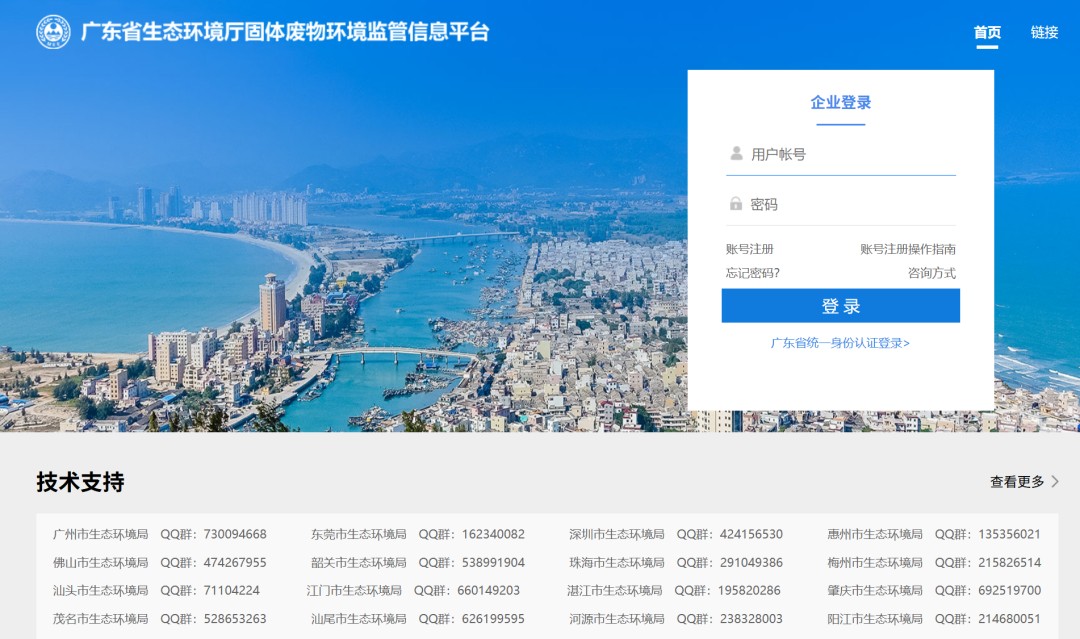
Article 9 The department of ecology and environment under the Provincial People's Government shall, together with the competent departments of public security, housing and urban-rural development, transportation, agriculture and rural affairs, commerce, and others, establish a province-wide environmental information management platform for solid waste, incorporate it into provincial digital government development, enhance information sharing and cooperation, and, in accordance with regulations, promote whole-process monitoring and information-based traceability of the generation, collection, storage, transfer, utilization, and disposal of solid waste.
Article 10 Entities generating, collecting, storing, transporting, utilizing, or disposing of solid waste shall promptly disclose solid waste pollution prevention and control information to the public in accordance with law and accept public supervision.
Entities generating industrial solid waste shall provide the competent ecology and environment department at their location, through the province-wide environmental information management platform for solid waste, with relevant information including the types, quantities, flows, storage, utilization, and disposal of industrial solid waste, as well as specific measures to reduce the generation of industrial solid waste and promote comprehensive utilization.
Article 44 Where an entity generating, collecting, storing, transporting, utilizing, or disposing of solid waste violates Paragraph 1 of Article 10 of these Regulations by failing to disclose, or by falsely disclosing, solid waste pollution prevention and control information to the public, the department or institution responsible for supervision and administration of solid waste pollution prevention and control shall, according to its division of duties, order correction and impose a fine of not less than RMB 20,000 nor more than RMB 200,000. Where correction is refused, it shall order restricted production or suspension of production for rectification and publicly disclose the aforesaid solid waste pollution prevention and control information.
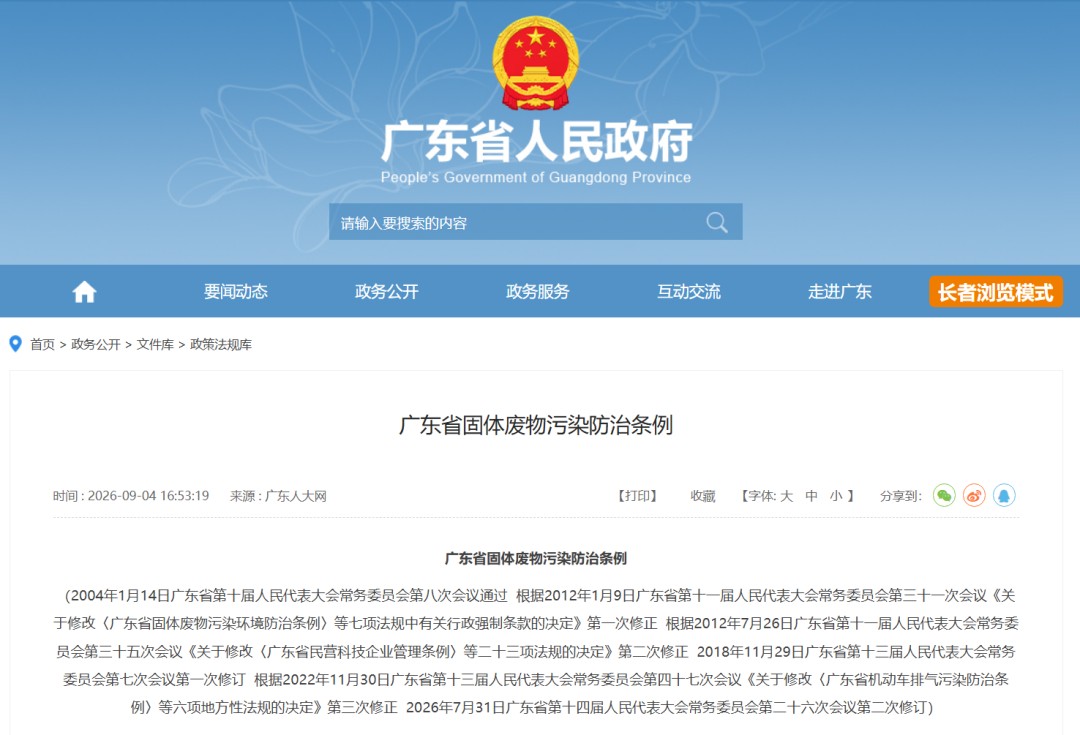
Regulations of Guangdong Province on the Prevention and Control of Solid Waste Pollution
Adopted at the Eighth Session of the Standing Committee of the Tenth Guangdong Provincial People's Congress on January 14, 2004
First amended pursuant to the Decision of the Standing Committee of the Eleventh Guangdong Provincial People's Congress at its Thirty-first Session on January 9, 2012, Regarding the Amendment of Administrative Compulsory Provisions in Seven Regulations, Including the Regulations of Guangdong Province on the Prevention and Control of Environmental Pollution by Solid Waste
Second amended pursuant to the Decision of the Standing Committee of the Eleventh Guangdong Provincial People's Congress at its Thirty-fifth Session on July 26, 2012, Regarding the Amendment of Twenty-three Regulations, Including the Regulations of Guangdong Province on the Administration of Privately Operated Science and Technology Enterprises; first revised at the Seventh Session of the Standing Committee of the Thirteenth Guangdong Provincial People's Congress on November 29, 2018
Third amended pursuant to the Decision of the Standing Committee of the Thirteenth Guangdong Provincial People's Congress at its Forty-seventh Session on November 30, 2022, Regarding the Amendment of Six Local Regulations, Including the Regulations of Guangdong Province on the Prevention and Control of Motor Vehicle Exhaust Pollution
Second revised at the Twenty-sixth Session of the Standing Committee of the Fourteenth Guangdong Provincial People's Congress on July 31, 2026
Chapter I General Provisions
Article 1 These Regulations are formulated in accordance with laws and administrative regulations, including the Environmental Code of the People's Republic of China, and in light of the actual circumstances of this Province, for the purposes of preventing and controlling solid waste pollution, safeguarding public health, advancing ecological civilization, and promoting sustainable economic and social development.
Article 2 These Regulations apply to the prevention and control of solid waste pollution and the supervision and administration thereof within the administrative region of this Province.
These Regulations do not apply to the prevention and control of marine pollution by solid waste or pollution by radioactive solid waste.
These Regulations apply to the prevention and control of pollution by liquid waste, but not to the prevention and control of wastewater pollution discharged into water bodies.
Article 3 The prevention and control of solid waste pollution shall adhere to protection as a priority and implement the principles of reduction, resource utilization, and harmless treatment; reduce the quantity and hazardousness of solid waste generated; fully and rationally utilize solid waste and dispose of it harmlessly; minimize the amount of solid waste landfilled; and promote clean production and the development of a circular economy.
Article 4 People's governments at or above the county level shall incorporate solid waste pollution prevention and control into relevant plans for national economic and social development.
The Provincial People's Government and people's governments of municipalities at or above the prefecture level shall prepare solid waste pollution prevention and control plans for their respective administrative regions.
Solid waste pollution prevention and control plans shall be coordinated with regional ecological and environmental protection plans.
Article 5 Entities and individuals generating, collecting, storing, transporting, utilizing, or disposing of solid waste shall take effective measures to prevent or reduce solid waste pollution and shall bear legal liability for pollution caused.
Article 6 People's governments at all levels shall strengthen solid waste pollution prevention and control, provide necessary financial support for such work, and arrange emergency response funds for sudden ecological and environmental incidents involving solid waste.
Subdistrict offices and grassroots self-governing mass organizations shall assist in solid waste pollution prevention and control within their areas.
Article 7 The competent ecology and environment department shall exercise unified supervision and administration over solid waste pollution prevention and control within its administrative region.
Relevant departments including development and reform, industry and information technology, public security, natural resources, urban management, housing and urban-rural development, transportation, agriculture and rural affairs, commerce, health, and customs under people's governments at or above the county level shall, within their respective duties, conduct supervision and administration over solid waste pollution prevention and control.
Article 8 The competent ecology and environment department and other relevant departments shall establish a public supervision and reporting system for solid waste pollution, promptly investigate and address reported issues, and inform real-name reporters of handling results. Reporters who submit real-name reports verified as true and provide principal clues or evidence for investigating and handling major violations involving solid waste pollution shall be rewarded in accordance with relevant regulations.
News media shall strengthen public-interest publicity concerning solid waste pollution prevention and control and conduct public opinion supervision over violations of ecological and environmental laws.
Chapter II Supervision and Administration of Solid Waste Pollution Prevention and Control
Article 9 The department of ecology and environment under the Provincial People's Government shall, together with the competent departments of public security, housing and urban-rural development, transportation, agriculture and rural affairs, commerce, and others, establish a province-wide environmental information management platform for solid waste, incorporate it into provincial digital government development, enhance information sharing and cooperation, and, in accordance with regulations, promote whole-process monitoring and information-based traceability of the generation, collection, storage, transfer, utilization, and disposal of solid waste.
Article 10 Entities generating, collecting, storing, transporting, utilizing, or disposing of solid waste shall promptly disclose solid waste pollution prevention and control information to the public in accordance with law and accept public supervision.
Entities generating industrial solid waste shall provide the competent ecology and environment department at their location, through the province-wide environmental information management platform for solid waste, with relevant information including the types, quantities, flows, storage, utilization, and disposal of industrial solid waste, as well as specific measures to reduce the generation of industrial solid waste and promote comprehensive utilization.
Article 11 The competent ecology and environment department shall strengthen emergency management capacity for sudden ecological and environmental incidents involving solid waste, conduct emergency drills, and properly carry out emergency response work.
The competent ecology and environment department shall incorporate sudden ecological and environmental incidents involving solid waste into emergency response plans for such incidents and submit them to the people's government at the corresponding level and the competent ecology and environment department at the next higher level for recordation.
Article 12 Enterprises, public institutions, and other producers and operators that generate, collect, store, transport, utilize, or dispose of hazardous waste shall, in accordance with national regulations, incorporate hazardous waste pollution prevention and control into emergency response plans for sudden ecological and environmental incidents, submit such plans to the competent ecology and environment department at their location for recordation, and conduct emergency drills regularly.
Where a sudden ecological and environmental incident involving hazardous waste occurs or may occur, enterprises, public institutions, and other producers and operators shall immediately take measures to address it, cut off or control pollution sources, prevent the expansion of harm, promptly notify persons who may be affected, report to the ecology and environment, emergency management, and other departments at the location of the incident, and accept investigation and handling.
Article 13 Insurance enterprises are encouraged and supported in carrying out liability insurance related to solid waste pollution prevention and control.
Entities collecting, storing, transporting, utilizing, or disposing of solid waste shall purchase compulsory environmental pollution liability insurance in accordance with regulations.
Chapter III Prevention and Control of Solid Waste Pollution
Article 14 The Provincial People's Government and people's governments of municipalities at or above the prefecture level shall make overall plans for facilities and sites for solid waste transfer and centralized disposal, and optimize their regional layout.
People's governments at all levels shall incorporate land for construction and construction plans for facilities and sites for solid waste transfer and centralized disposal into annual land-use plans.
Article 15 The Provincial People's Government and people's governments of municipalities at or above the prefecture level shall coordinate the construction of solid waste disposal facilities and sites. The provincial competent ecology and environment department shall be responsible for urging construction of disposal facilities and sites for hazardous waste and general industrial solid waste; the provincial competent housing and urban-rural development department shall be responsible for urging construction of disposal facilities and sites for household waste, construction waste, and sludge from domestic sewage treatment plants; and the provincial competent agriculture and rural affairs department shall be responsible for urging construction of disposal facilities and sites for agricultural waste.
People's governments of municipalities at or above the prefecture level and county-level people's governments shall implement plans for construction of solid waste infrastructure and sites and resolve issues concerning project approval, land use, funding, and other matters.
Article 16 Social forces are encouraged to invest in, construct, and operate solid waste disposal facilities and sites in accordance with law.
Scientific and technological research and development for solid waste pollution prevention and control are encouraged and supported. Advanced and applicable technologies, processes, equipment, and materials shall be promoted and applied to facilitate comprehensive utilization and harmless disposal of solid waste and improve solid waste utilization and disposal capacity.
Article 17 The construction of facilities and sites for centralized storage, utilization, or disposal of industrial solid waste, construction waste, and hazardous waste, and for sanitary landfill and incineration of household waste, shall comply with relevant national and provincial ecological and environmental protection standards. Such facilities and sites shall not be located in nature reserves, scenic areas, drinking water source protection zones, permanent basic farmland, ecological protection redlines, or other areas requiring special protection, and shall maintain protective distances from environmentally sensitive targets such as schools, hospitals, and concentrated residential areas.
Protective distances shall comply with requirements of approved environmental impact assessment reports and environmental impact assessment forms. No new environmentally sensitive targets such as schools, hospitals, or concentrated residential areas may be built within the protective distances of existing facilities for centralized collection, storage, utilization, or disposal of solid waste.
Article 18 Activities including the cleaning, sorting, collection, transportation, and disposal of urban and rural household waste shall be managed in accordance with relevant national and provincial regulations.
People's governments at or above the county level shall establish and improve coordination mechanisms for household waste classification, strengthen and coordinate capacity building for household waste classification management, accelerate the establishment and improvement of household waste management systems for sorted placement, collection, transportation, and treatment, and achieve effective coverage of the household waste classification system.
Entities collecting and transporting household waste shall deliver separately collected hazardous household waste to professional enterprises holding operation permits for treatment. Environmental sanitation departments and competent ecology and environment departments of people's governments of municipalities at or above the prefecture level and county-level people's governments shall strengthen supervision and administration.
Article 19 Enterprises, public institutions, and other producers and operators generating solid waste shall sort, store, utilize, or dispose of solid waste in accordance with relevant laws, regulations, pollution control standards, and technical specifications. Where they are unable to utilize or dispose of it themselves, they shall entrust enterprises meeting ecological and environmental protection requirements to do so.
Article 20 The competent urban drainage and sewage treatment departments of people's governments at or above the county level (hereinafter referred to as the competent urban drainage departments) shall be responsible for supervision and administration of sludge treatment and disposal by operating entities of centralized urban sewage treatment facilities within their administrative regions, and shall incorporate the construction scale, layout, construction land, and safeguard measures for sludge treatment and disposal facilities into urban drainage and sewage treatment plans for their administrative regions.
Operating entities of centralized urban sewage treatment facilities shall treat and dispose of the sludge they generate in accordance with relevant national and provincial regulations. Where they are unable to do so themselves, they shall entrust enterprises, public institutions, or other producers and operators with corresponding capabilities to do so.
Article 21 Operating entities of centralized urban sewage treatment facilities and entities conducting harmless sludge treatment and disposal shall establish sludge management ledgers, track and record generated sludge and the destination, use, quantity, and other information concerning sludge after treatment and disposal, and report to the competent urban drainage department and the competent ecology and environment department.
Article 22 Operating entities of centralized urban sewage treatment facilities and sludge treatment and disposal entities shall implement the sludge transfer manifest system and submit transfer manifests to the competent urban drainage department and the competent ecology and environment department of the people's government at or above the county level for recordation.
Transporters of sludge shall take measures to prevent dispersal, loss, leakage, or other environmental pollution, and shall not discard, dump, pile, scatter, spill, or incinerate sludge without authorization during transportation.
Article 23 People's governments at or above the county level shall, in light of local conditions and in conjunction with urban and rural household waste classification, establish a recycling network for discarded electrical and electronic products that has a rational layout, convenient delivery and sale, and orderly acquisition.
Article 24 The competent ecology and environment department shall conduct supervision and administration over pollution prevention and control in the dismantling, utilization, and disposal of discarded electrical and electronic products.
Qualifications of enterprises treating discarded electrical and electronic products shall be approved according to law by the competent ecology and environment departments of people's governments of municipalities at or above the prefecture level. Entities without such qualifications may not engage in the dismantling, utilization, or disposal of discarded electrical and electronic products.
Enterprises, public institutions, and other operators engaged in dismantling, utilizing, or disposing of discarded electrical and electronic products shall perform such activities in accordance with relevant national regulations and technical specifications to prevent environmental pollution.
Article 25 The provincial competent commerce department shall include pollution prevention and control measures for solid waste generated from end-of-life motor vehicle recycling and dismantling activities and their implementation in qualification permits and inspections of end-of-life motor vehicle recycling and dismantling enterprises.
End-of-life motor vehicle recycling and dismantling enterprises shall establish storage sites, dismantling sites, and dismantling equipment that meet relevant national requirements; shall sort and collect and store solid waste generated during recycling and dismantling; and shall deliver generated hazardous waste to entities with corresponding qualifications for utilization or disposal.
Article 26 Where solid waste is transferred outside the administrative region of this Province for storage or disposal, an application shall be made to the competent ecology and environment department under the Provincial People's Government. After consulting with and obtaining the consent of the competent ecology and environment department of the provincial people's government at the receiving location, the provincial competent ecology and environment department shall approve the transfer outside the administrative region of this Province within the prescribed time limit. No transfer may be made without approval.
Where solid waste is transferred outside the administrative region of this Province for utilization, relevant information shall be reported in advance, through the solid waste pollution prevention and control information platform or otherwise, to the competent ecology and environment departments of the provincial people's governments at both the place of transfer and the receiving location.
Article 27 Township people's governments and subdistrict offices shall strengthen routine inspections and hazard investigations for solid waste pollution prevention and control within their jurisdictions.
Where township people's governments, subdistrict offices, or grassroots self-governing mass organizations discover unauthorized dumping, illegal transfer, or illegal disposal of solid waste, they shall promptly report it to the people's government at the next higher level and relevant departments and cooperate in investigating and handling violations involving solid waste pollution.
Article 28 The following acts that pollute the environment are prohibited:
(1) Open-air burning of asphalt, roofing felt, rubber, tires, plastics, leather, wires and cables, electronic waste, and other substances producing toxic or harmful smoke and dust or foul-smelling gases;
(2) Incinerating solid waste using facilities not approved by the competent ecology and environment department;
(3) Using facilities or sites not conforming to relevant national and local technical specifications to pile, store, or dispose of solid waste;
(4) Landfilling without complying with relevant regulations, or dumping, piling, or storing solid waste in rivers, lakes, canals, channels, reservoirs, beach areas and bank slopes below their highest water level, or other locations prescribed by laws and regulations;
(5) Mixing hazardous waste with household waste, except where management exemptions are provided by the State; and
(6) Other acts prohibited by laws and regulations.
Chapter IV Special Provisions on the Prevention and Control of Hazardous Waste Pollution
Article 29 Entities engaged in business activities involving the collection, storage, utilization, or disposal of hazardous waste (hereinafter referred to as hazardous waste operating entities) shall obtain permits in accordance with national regulations. Hazardous waste operating entities shall engage in hazardous waste business activities in accordance with permit requirements.
The provincial competent ecology and environment department may entrust competent ecology and environment departments of people's governments of municipalities at or above the prefecture level to issue permits.
It is prohibited to engage in business activities involving hazardous waste collection, storage, utilization, or disposal without a permit or otherwise than in accordance with permit requirements.
Forging, altering, lending, leasing, or illegally transferring permits is prohibited.
Article 30 Enterprises, public institutions, and other producers and operators that generate hazardous waste (hereinafter referred to as hazardous waste generating entities), as well as hazardous waste operating entities, shall make declarations and registrations on the environmental information management platform for solid waste in accordance with regulations.
Where substantial changes occur to declared and registered information, enterprises, public institutions, and other producers and operators shall complete change procedures on the environmental information management platform for solid waste within fifteen working days from the date of change. Where emergency substantial changes occur due to uncontrollable factors, they shall immediately report to the competent ecology and environment department at their location.
Article 31 Hazardous waste generating entities shall formulate hazardous waste management plans and establish hazardous waste ledgers in accordance with regulations, truthfully recording information including the types, quantities, flows, storage, utilization, and disposal of hazardous waste generated. Hazardous waste ledgers shall be retained for more than ten years.
Article 32 Hazardous waste operating entities shall establish files on hazardous waste operating conditions, recording in detail matters including the types, sources, destinations, and composition of hazardous waste collected, stored, utilized, or disposed of, and whether sudden ecological and environmental incidents have occurred. Such files shall be retained for more than ten years.
Hazardous waste operating entities that dispose of hazardous waste by landfill shall permanently retain hazardous waste operating condition files and establish permanent identification marks for hazardous waste landfill at landfill sites. The competent ecology and environment department at the location shall regularly monitor hazardous waste landfill sites.
Where a hazardous waste operating entity that disposes of hazardous waste by landfill terminates its business activities, it shall transfer its hazardous waste operating condition files to the competent ecology and environment department at its location for archiving.
Article 33 Decommissioning expenses for key centralized hazardous waste disposal facilities and sites shall be accrued in advance in accordance with law and included in investment estimates or production costs. Such expenses shall be used for maintenance, monitoring, and other work after facilities and sites are decommissioned and may not be diverted to other purposes.
Article 34 The collection, storage, transfer, utilization, and disposal of hazardous waste shall follow the principles of centralized treatment and proximity.
Article 35 The provincial competent ecology and environment department shall, together with the provincial competent transportation department, establish a consultation mechanism for hazardous waste transportation management, strengthen coordination between the hazardous waste management list and names of dangerous goods for transport, and jointly advance hazardous waste transportation management in this Province.
Competent transportation departments of people's governments at or above the county level shall, within their respective duties, be responsible for road transportation management of hazardous waste and establish electronic regulatory systems to conduct focused supervision of hazardous waste transportation enterprises, vehicles, practitioners, and others.
Hazardous waste generating entities and operating entities shall entrust hazardous waste to enterprises, public institutions, or other producers and operators qualified to transport hazardous waste (hereinafter referred to as hazardous waste transportation entities). Hazardous waste transportation entities shall obtain road dangerous goods transportation permits in accordance with relevant laws and regulations, use dedicated vehicles to transport hazardous waste, take measures to prevent hazardous waste from falling, dispersing, burning, exploding, or leaking and causing possible environmental pollution, and shall not discard, dump, pile, spill, scatter, or incinerate hazardous waste without authorization during transportation.
Article 36 The transfer of hazardous waste from outside the administrative region of this Province into this Province for incineration or landfill disposal shall be strictly controlled. Flammable, explosive, highly toxic, or infectious hazardous waste is prohibited from being transferred into the administrative region of this Province.
The provincial competent ecology and environment department shall, in accordance with relevant national and provincial regulations, review hazardous waste types and methods of utilization and disposal for hazardous waste transferred into this Province.
Article 37 Hazardous waste generating entities, transportation entities, and receiving entities shall implement the hazardous waste transfer manifest system in accordance with law and truthfully complete and verify transfer manifests. Where information including the actual type, weight or quantity, or time of hazardous waste transferred is inconsistent with the transfer manifest, hazardous waste transportation entities and receiving entities may not transport or accept it.
Hazardous waste generating entities shall complete electronic manifests on the environmental information management platform for solid waste. Where conditions for completing electronic manifests are unavailable, paper manifests may be completed in accordance with relevant national and provincial regulations.
Article 38 Entities holding hazardous waste operation permits are encouraged and supported in constructing regional hazardous waste collection and storage facilities and, in accordance with law, collecting and storing hazardous waste from motor vehicle maintenance and end-of-life motor vehicle recycling and dismantling industries, waste lead-acid batteries, waste mercury-containing fluorescent lamps, and the like.
The lawful construction of hazardous waste storage facilities in industrial parks is encouraged and supported to provide hazardous waste collection and storage services to enterprises, public institutions, and other producers and operators in industrial parks.
Article 39 People's governments at or above the county level shall implement ecological and environmental protection plan requirements and organize the construction of hazardous waste incineration and landfill disposal facilities.
Enterprises, public institutions, and other producers and operators generating large quantities of hazardous waste in industries including petrochemicals, nonferrous metal smelting, and electroplating are encouraged to construct supporting hazardous waste utilization and disposal facilities themselves.
Article 40 Laboratories of all types and levels and their establishing entities shall strengthen management of solid waste generated by laboratories; collect, store, transport, utilize, and dispose of laboratory solid waste in accordance with law; establish classified and registered management systems for hazardous waste generated by laboratories; strengthen management of waste pharmaceuticals, waste reagents, and other hazardous waste; and deliver hazardous waste to permit-holding entities for disposal.
Article 41 Competent transportation departments of people's governments at or above the county level shall conduct supervision and administration over the classification, collection, storage, utilization, and disposal of hazardous waste in the motor vehicle maintenance industry, and incorporate the collection, storage, utilization, and disposal of hazardous waste by motor vehicle maintenance enterprises, public institutions, and other producers and operators into motor vehicle maintenance operation filing, inspection, and assessment.
Enterprises, public institutions, and other producers and operators engaged in motor vehicle maintenance shall implement hazardous waste management systems, construct hazardous waste collection and storage facilities in accordance with relevant regulations, and take effective pollution prevention and control measures.
Article 42 Hazardous waste generating entities shall dispose of hazardous waste in accordance with national regulations and ecological and environmental protection standards. No entity or individual may dump, pile, discard, scatter, spill, or incinerate hazardous waste without authorization. Where storage is genuinely necessary, protective measures meeting national ecological and environmental protection standards shall be adopted; the storage period shall not exceed one year; and the storage time, location, and protective measures taken shall be reported to the competent ecology and environment department at the location. For hazardous waste stored beyond the prescribed period, the competent ecology and environment department at the location shall order disposal within a specified time limit.
Article 43 Price authorities of people's governments of municipalities at or above the prefecture level and county-level people's governments shall, together with competent ecology and environment, health, and other departments, strengthen monitoring of medical waste disposal costs, formulate and adjust medical waste disposal charge standards, and implement dynamic management of medical waste disposal charges.
Chapter V Legal Liability
Article 44 Where an entity generating, collecting, storing, transporting, utilizing, or disposing of solid waste violates Paragraph 1 of Article 10 of these Regulations by failing to disclose, or by falsely disclosing, solid waste pollution prevention and control information to the public, the department or institution responsible for supervision and administration of solid waste pollution prevention and control shall, according to its division of duties, order correction and impose a fine of not less than RMB 20,000 nor more than RMB 200,000. Where correction is refused, it shall order restricted production or suspension of production for rectification and publicly disclose the aforesaid solid waste pollution prevention and control information.
Article 45 Where an operating entity maintaining urban sewage treatment facilities or a sludge treatment and disposal entity violates Paragraph 1 of Article 22 of these Regulations by failing to implement the sludge transfer manifest system in accordance with regulations, the competent urban drainage department shall order cessation of the illegal act and correction within a specified time limit and impose a fine of not less than RMB 20,000 nor more than RMB 200,000.
Article 46 Where asphalt, roofing felt, rubber, tires, plastics, leather, wires and cables, electronic waste, or other substances producing toxic or harmful smoke and dust or foul-smelling gases are openly burned in violation of Item (1) of Article 28 of these Regulations, the supervisory and administrative department designated by the county-level people's government shall order correction and impose a fine of not less than RMB 10,000 nor more than RMB 100,000 on an entity, or not less than RMB 500 nor more than RMB 2,000 on an individual.
Where facilities for incinerating solid waste are not approved by the competent ecology and environment department in violation of Item (2) of Article 28 of these Regulations, the competent ecology and environment department at the location shall order cessation of the illegal act and elimination of pollution and impose a fine of not less than RMB 10,000 nor more than RMB 100,000 on an entity, or not less than RMB 500 nor more than RMB 2,000 on an individual.
Where facilities or sites not conforming to relevant national and local technical specifications are used to pile, store, or dispose of solid waste in violation of Item (3) of Article 28 of these Regulations, the supervisory and administrative department designated by the people's government at or above the county level at the location shall order correction within a specified time limit and impose a fine of not less than RMB 10,000 nor more than RMB 100,000.
Article 47 Where hazardous waste operating condition files are not established and retained as required in violation of Article 32 of these Regulations, the competent ecology and environment department shall order correction within a specified time limit and impose a fine of not less than RMB 5,000 nor more than RMB 50,000.
Article 48 Where any of the following acts violates provisions of these Regulations on hazardous waste pollution prevention and control, the supervisory and administrative department designated by the people's government at or above the county level shall order cessation of the illegal act and correction within a specified time limit; where correction is refused, it shall impose a fine of not less than RMB 10,000 nor more than RMB 100,000:
(1) In violation of Paragraph 3 of Article 32 of these Regulations, a hazardous waste operating entity disposing of hazardous waste by landfill fails, after terminating its business activities, to transfer hazardous waste operating condition files for archiving in accordance with law;
(2) In violation of Article 40 of these Regulations, a laboratory hazardous waste classification and registration management system is not established; or
(3) In violation of Paragraph 2 of Article 41 of these Regulations, hazardous waste collection and storage facilities are not constructed in accordance with relevant regulations and effective pollution prevention and control measures are not adopted.
Chapter VI Supplementary Provisions
Article 49 These Regulations shall enter into force on August 15, 2026.
About RESOLAR
Shanghai RESOLAR Energy Technology Co., Ltd. is committed to becoming a recycled material photovoltaic group with deep decarbonization. RESOLAR focuses on technological innovation and builds a world-leading solution for component recycling, impurity removal of damaged cells, recycled silicon materials and cells, and cascaded utilization of components. With professional technology and services, we help customers realize the recycling and reuse of waste photovoltaic resources, and make positive contributions to the development of environmental protection and new energy industries. For more detailed information, you can browse the official website: www.resolartech.com .

Latest developments/news
Contact information
Service Hotline: 13585742918 (Monday to Friday 9:00-18:00)
Enterprise email: ps@resolartech.com (Reply within 48 hours after receiving the email consultation!)
Company Address: Building 8, No. 1528, Wangxu East Road, Fengjing Town, Jinshan District, Shanghai (Caohejing Fengjing Park)