


English
News Center
—— NEWS CENTER ——
In recent years, the problem of informal small workshops in the domestic photovoltaic (PV) recycling sector has attracted much attention from the industry. Lu Dongdong of Sichuan Yong'an Photovoltaic Industry Research Institute explained that, currently, except for Tibet, most provinces in China have 2 to 3 such workshops, with Hebei, Henan, and Zhejiang provinces having more than 10. Nationwide, there are hundreds of such workshops. These operators generally lack environmental protection facilities and compliant disposal capabilities. Their crude dismantling and processing methods not only waste resources but also bring environmental hazards such as exhaust gas and heavy metal pollution, disrupting the normal order of the PV recycling industry. Hebei Province has long faced the challenge of managing these scattered and hidden PV recycling workshops, which are difficult to regulate.
On April 21, 2026, the Hebei Provincial Department of Commerce released the "Comprehensive Revision of the Hebei Provincial Regulations on the Management of Recycling of Renewable Resources (Draft for Comments)".
The new regulations strongly support compliant and digitalized new recycling business models. They encourage enterprises to leverage commercial franchising , "Internet + recycling," and integrated property management to consolidate scattered recycling resources and create a standardized recycling system that integrates online booking, offline delivery, unified logistics, and centralized disposal. Simultaneously, they support recycling parks and sorting centers in building digital platforms for renewable resource recycling , integrating functions such as online transactions, intelligent matching, and traceability.
Furthermore, the new regulations include a comprehensive and robust regulatory and punitive mechanism to solidify the industry's compliance bottom line. They explicitly require recycling operators to register and trace the sources of recycled resources during collection, storage, transportation, and processing, and to take effective measures to prevent secondary pollution such as dust, noise, and leakage. Recycling operators must regularly report the types, quantities, and destinations of recycled resources to the relevant government departments . A multi-departmental, cross-sectoral coordinated regulatory, information-sharing, and joint inspection mechanism has been established to strengthen routine safety supervision; a sound market price regulation mechanism has been established to guide the industry towards standardized pricing and healthy development . At the same time, the regulations severely crack down on unlicensed operations and other illegal activities, holding those engaged in unlicensed recycling operations or providing venues and transportation services for illegal operations accountable and punished according to law, comprehensively eliminating chaos in the recycling industry and promoting green, standardized, and high-quality development of the industry.
Regarding photovoltaic recycling standards, the new regulations specifically clarify the management standards for the recycling of retired photovoltaic modules. Recycling operators are required to establish dedicated ledgers to fully record core information such as the quantity, source, destination, and dismantling and utilization units of the modules recycled. The ledgers must be kept for no less than 5 years to achieve full-process traceability. Retired photovoltaic modules may not be transferred to unqualified dismantling and utilization enterprises or individuals .
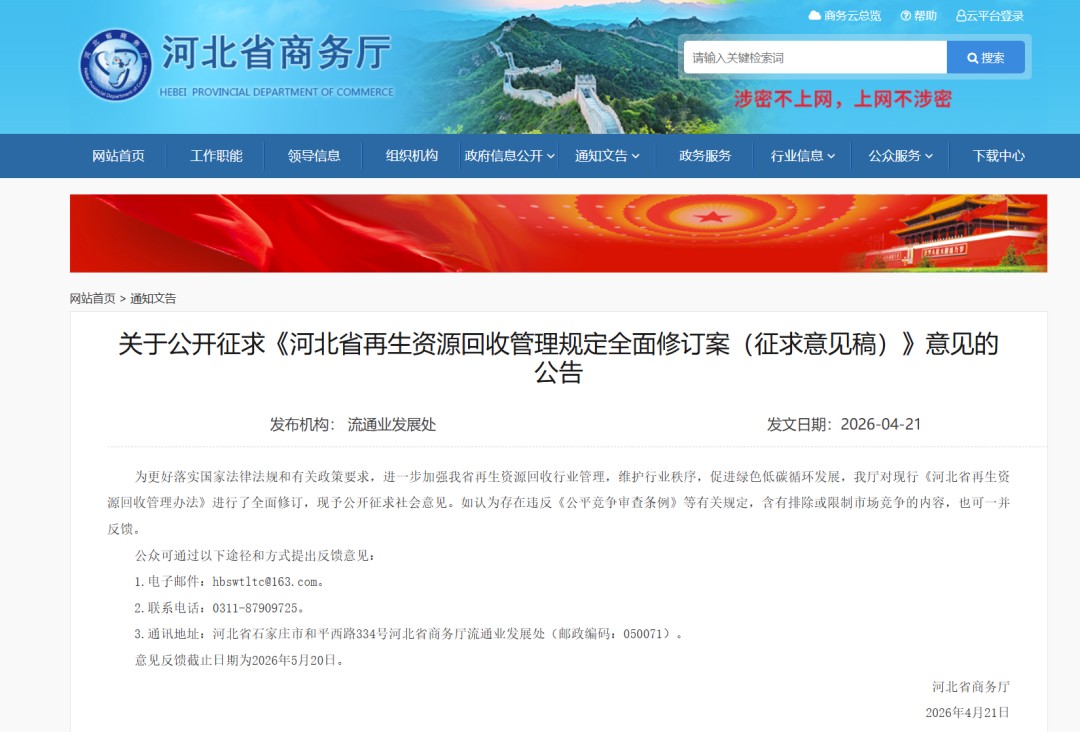
Draft Amendments to the Regulations on the Management of Recycling of Renewable Resources in Hebei Province (for Public Comment) 01 Chapter 1 General Provisions Article 1 [Purpose and Basis] To strengthen the management of recycled resources, conserve resources, protect the environment, maintain industry order, promote green, low-carbon, and circular development, and facilitate sustainable economic and social development, this regulation is formulated in accordance with the "Law of the People's Republic of China on Promoting the Circular Economy," the "Law of the People's Republic of China on the Prevention and Control of Environmental Pollution by Solid Waste," and the " Measures for the Management of Recycled Resources. " This regulation is formulated in accordance with laws and regulations such as the "Regulations on the Management of Recycling and Disposal of Waste Electrical and Electronic Products" and in light of the actual conditions of this province. Article 2 [Definitions] The term "renewable resources" as used in these Measures refers to various wastes generated during social production, operation, and consumption that have lost all or part of their original use value but can be recycled and processed to regain their use value. These include scrap metal, scrap electronic products, scrap electromechanical equipment and its parts, waste papermaking raw materials (such as waste paper, waste cotton, etc.), waste light chemical raw materials (such as rubber, plastics, pesticide packaging materials, animal bones, hair, etc.), and waste glass (hereinafter referred to as the "eight categories"). The recycling of new renewable resources, such as retired wind turbines and photovoltaic modules, shall be carried out by the relevant functional departments of the provincial government in accordance with the national division of responsibilities and relevant regulations, and shall be included in the unified management of this method. Article 3 [Scope of Application] Enterprises and individual businesses engaged in the recycling of renewable resources within the administrative region of this province (collectively referred to as "renewable resource recycling operators") shall comply with this regulation. Where laws, regulations, and rules provide otherwise for the management of the recycling of other categories such as scrapped motor vehicles, hazardous waste, and medical waste, those provisions shall prevail. Article 4 [Promoting Green Consumption] All organizations and individuals should cultivate an awareness of conserving resources and protecting the environment, consciously sort and sell recyclable resources, and reduce waste generation. Citizens are encouraged and guided to use energy-saving, water-saving, and material-saving products that are beneficial to environmental protection, as well as recycled products, to reduce waste generation and emissions. Producers and sellers of goods should comply with mandatory standards that restrict excessive packaging of goods and reduce the generation of packaging waste. Article 5 [Government Responsibilities] People's governments at or above the county level shall strengthen their leadership over the recycling of renewable resources within their administrative regions, incorporate it into national economic and social development plans, establish a target responsibility and assessment system, and improve cross-departmental coordination mechanisms. Township governments and subdistrict offices should cooperate in managing recycling outlets and guiding community recycling activities within their jurisdictions. Article 6 [Responsibilities of the Management Department] The commerce departments of people's governments at the county level and above are the competent authorities for the recycling industry, responsible for formulating and implementing development plans for the recycling industry, establishing operating standards for the recycling industry, and strengthening industry credit supervision. If the people's governments of cities with districts have other regulations governing their industry management functions, those regulations shall prevail. The competent authorities for recycling of renewable resources at the county level or above shall establish an agency to manage the recycling industry and equip it with appropriate personnel. The competent department for urban renewable resource recycling shall, in conjunction with the administrative departments of development and reform, public security, market supervision, ecology and environment, natural resources, and housing and urban-rural development, formulate a renewable resource recycling network plan in accordance with the principles of overall planning and rational layout, and based on the specific circumstances of local economic development level, population density, environment and resources. The development and reform departments of people's governments at or above the county level are responsible for researching and proposing policies to promote the development of renewable resources, and organizing the promotion, application and industrialization demonstration of new technologies and equipment. The public security organs of people's governments at or above the county level are responsible for the security management of the recycling of renewable resources, and shall register the business activities of recycling scrap metal in accordance with the law and investigate and punish suspected illegal and criminal activities. The ecological and environmental departments of people's governments at or above the county level are responsible for supervising and managing the prevention and control of environmental pollution during the recycling, storage, and disposal of renewable resources. The housing and urban-rural development and natural resources departments of people's governments at or above the county level shall be responsible for incorporating the land use and space requirements of facilities such as recycling outlets and sorting centers for renewable resources into relevant plans to ensure reasonable land use. The market supervision and management departments and urban management comprehensive law enforcement departments of people's governments at or above the county level shall, in accordance with their respective responsibilities, be responsible for the supervision and management of business registration, urban appearance and environment, and work safety. Article 7 [Encouragement Clause] We encourage the recycling and treatment of renewable resources in an environmentally sound manner, and promote scientific research, technological development, and application of renewable resource recycling and treatment. People's governments at all levels and their functional departments should implement the national tax incentives for comprehensive resource utilization and promote the practice of " reverse invoicing " by resource recycling enterprises to natural persons who sell their scrapped products. "and other facilitation measures to optimize tax services." Article 8 [Industry Organizations] Industry associations for the recycling of renewable resources should strengthen industry self-regulation, formulate industry standards in accordance with the law, promote integrity, safeguard the interests of members and the industry, organize personnel training, and provide information consulting services. Industry associations for the recycling of renewable resources should accept business guidance from the competent authorities and assist relevant departments in managing the recycling industry. Government departments can support industry associations in carrying out industry statistical surveys, promoting standards, and mediating disputes by entrusting or purchasing services. Article 9 [Basic Principles] The management of renewable resource recycling follows the principles of government guidance, market operation, social participation, standardized and orderly operation, and innovative development. 02 Chapter Two: Construction and Management of the Recycling System Article 10 [Outlet Construction and Support] Relevant functional departments of people's governments at the county level and above shall, based on local economic development levels, population density, environmental and resource conditions, formulate plans for recycling network sites . These plans, after being approved in accordance with the law, shall be incorporated into the national land spatial information platform and the "one map" system. The layout planning of recycling network sites and sanitation facilities, as well as the construction of related facilities, shall be interconnected to achieve compatibility and sharing between the recycling system and the household waste sorting and collection system . New residential areas or urban renewal projects should reserve land or space for community recycling stations in their planning. Existing areas should be supplemented and improved through renovation, leasing, sharing, and other means. Article 11 [Convenient Community Recycling] Subdistrict offices, township governments, community residents' committees, owners' committees, and property management companies should provide necessary convenience and cooperation for recycling operators to enter the community, and should not obstruct the operation of legally established recycling stations or the operation of recycling vehicles without cause. Communities that do not meet the conditions for establishing fixed recycling stations should encourage recycling operators to adopt a " vehicle-based storage " approach, adhering to the principles of "closed-loop, no-landing" recycling. "and other mobile recycling models." Article 12 [Facilitating Vehicle Access on the Road] Relevant functional departments of people's governments at or above the county level should establish a coordination mechanism to facilitate the passage, temporary parking, and operation of recycling and transportation vehicles with uniform markings and in compliance with regulations in urban areas. Article 13 [Encouraging Emerging Models] Enterprises are encouraged to adopt innovative models such as commercial franchising, "Internet + recycling , " and integrated property management to integrate scattered recycling personnel and develop new business models that combine online booking, offline delivery, unified logistics, and centralized processing. This will achieve an organic combination of online and offline recycling of renewable resources and promote convenient delivery methods. Article 14 [Online and Offline Integrated Service Platform] Encourage recycling industrial parks, sorting centers, and other operators to actively build digital platforms for renewable resource recycling , improve functions such as online transactions, intelligent matching, and traceability , and promote efficient matching of supply and demand information. Support parks in integrating resources in recycling, sorting, and processing to build a closed-loop, efficient renewable resource circulation system that links online and offline processes. Article 15 [Recycling of Environmentally Polluting Waste Products] Recycling operators primarily engaged in the recycling of eight categories of recyclable resources should, in accordance with relevant requirements, establish separate storage points for small quantities of waste energy-saving lamps, batteries, ink cartridges, and other easily polluting waste goods collected during their recycling operations, and hand them over to units with appropriate disposal capabilities for processing. The recycling of flammable and explosive materials such as gas cylinders, scrap metal contaminated by ignition or explosives, and core metal components of discarded explosives is prohibited. 03 Chapter Three: Business Standards and Management Article 16 [Registration and Tax Obligations of Business Operators] Recycling businesses must meet the registration requirements of the Administration for Industry and Commerce before they can engage in business activities. After registration, the market supervision department will share the company's information with other government departments through the same-level government data sharing platform, achieving "one license for registration" and reducing the burden on businesses. Businesses that recycle scrap metal are still required to register with the public security authorities as stipulated. Scrap metal recycling businesses must register with the county-level public security authority where their business premises are located within 15 days of obtaining their business license. If any of the filing items are changed, the change procedures shall be completed within 15 days from the date of the change. Businesses shall fulfill their tax obligations in accordance with the provisions of laws and administrative regulations and pay all taxes in accordance with the law. Article 17 [Extended Producer Responsibility] Producers and sellers of photovoltaic modules, electrical and electronic products, automobiles, lead-acid batteries, packaging materials and other products (hereinafter referred to as "key products") that are produced and sold within the administrative region of this province as stipulated by the state shall, in accordance with the law, fulfill their extended producer responsibility obligations, such as product eco-design, use of recycled raw materials, standardized recycling and utilization, and strengthening of relevant information disclosure. Support production and sales enterprises in establishing " reverse logistics" "A recycling system is needed to achieve green, low-carbon, and circular development. Production and sales companies can establish their own recycling systems or entrust sellers, renewable resource recycling operators, or third-party professional organizations to carry out recycling, and supervise the entrusted parties to ensure that the recycling is carried out in a standardized manner." Provincial government departments should establish a reporting, public disclosure, and evaluation mechanism for key product manufacturers' fulfillment of extended producer responsibility. Article 18 [Standardized Procedures for Waste Generation Entities to Hand Over Waste] Enterprises and institutions should sell or deliver recycled resources generated, except for those intended for reuse in production, to legitimate recycling operators. This includes industrial waste metals. It should be sold to a registered production-oriented scrap metal recycling company, and a goods list should be issued. Municipal public utility construction, maintenance, and management units that need to dispose of scrap metal materials from provincial public utilities must sell them to productive scrap metal recycling enterprises listed in the directory published by the provincial government's functional departments, and issue a goods list. Productive scrap metal recycling enterprises included in the directory are selected by the provincial government's functional departments and renewable resources industry organizations through fair competition methods such as regular bidding, and are subsequently announced. Enterprises that produce products and packaging materials listed in the national mandatory recycling catalog shall recycle the products and packaging materials after they are scrapped and the packaging materials are used. Manufacturing enterprises may entrust sales enterprises, renewable resource recycling operators, or other organizations to carry out recycling. The entrusted party shall be responsible for recycling in accordance with the provisions of relevant laws and regulations and the agreement in the contract. Article 19 [Daily Conduct Guidelines for Recycling Operators] Recycling operators shall comply with the following regulations during the collection, storage, processing, and transportation of recyclable resources: (a) Strengthen the safety management of fire sources and power sources; (ii) Take appropriate measures such as covering, fencing, and cleaning to prevent environmental pollution such as scattering, splashing, overflowing, odor diffusion, and explosion; (iii) Maintain the cleanliness of the surrounding environment and disinfect it regularly, strictly control pollution such as noise, dust, sewage, and odors, and prevent it from affecting the working and living environment of the surrounding residents; (iv) Other relevant regulations and recycling operation standards concerning environmental protection, urban sanitation, work safety, occupational hazard prevention and control, fire protection, public security, etc. Article 20 [Recycling Operation Standards] When engaging in mobile recycling activities, operators of renewable resource recycling services shall not loudly announce the collection process in government offices, schools, hospitals, military units, and residential areas, causing noise pollution and affecting the normal work and life of units and residents. Recycling operators must register and trace the source of recycled resources during collection, storage, transportation, and processing, and take effective measures to prevent secondary pollution such as dust, noise, and leakage. When transporting specific items such as municipal public utility scrap metal, legal proof of origin should be carried for inspection. Items without utilization value should be handed over to qualified enterprises for harmless disposal. Article 21 [Standards for the Recycling of Industrial Scrap Metals] The recycling of production-related scrap metal shall be carried out by recycling units with a business scope that includes the recycling of production-related scrap metal. Recycling units shall accurately record the name, quantity, specifications, and condition (new or used) of the scrap metal they recycle. If the seller is an entity, the certificate issued by the entity shall be verified, and the entity's name, address, and the name and ID number of the person in charge shall be registered; if the seller is an individual, the seller's name, address, and ID number shall be registered. Registration information shall be kept for no less than 2 years. Article 22 [Standards for the Recycling of Decommissioned Photovoltaic Modules] Recycling operators who recycle decommissioned photovoltaic modules shall comply with the following regulations: (i) Establish a special ledger to accurately record information such as the quantity, source, destination, and dismantling and utilization units of the recycled materials. The ledger shall be kept for no less than 5 years. (ii) Environmental protection measures such as preventing damage, leakage, and dismantling shall be taken during storage and transportation to avoid secondary pollution; (iii) Decommissioned photovoltaic modules shall not be transferred to unqualified dismantling and utilization enterprises or individuals; (iv) If any components or parts that may be hazardous waste are discovered, they shall be reported to the relevant government departments in a timely manner. Article 23 [Acquisition and Transportation of Industrial Scrap Metal and Municipal Utility Scrap Metal] Production-related scrap metal recycling enterprises shall sign purchase contracts with scrap metal sellers, verify the goods list issued by the sellers, and establish ledgers in accordance with Article 21 of these Measures. Municipal utility construction, maintenance, and management units, as well as industrial scrap metal recycling enterprises, that transport municipal utility scrap metal materials themselves or entrust others to do so, shall issue a certificate in advance, specifying the type, quantity, and destination of the municipal utility scrap metal materials being transported, and affixing their official seal. This certificate shall be carried for inspection during the transportation process. The public security department shall inspect vehicles and vessels transporting municipal public utility scrap metal materials in accordance with the law. If other departments find that transporters of municipal public utility scrap metal materials cannot provide supporting documents, they shall promptly notify the public security department to handle the matter on-site. Article 24 [Disposal of Recycled Resources] Recycling operators shall deliver recyclable or reusable items to qualified producers or operators for reuse or recycling; non-recyclable or non-reusable items shall be handed over to enterprises with appropriate disposal capabilities for harmless treatment. Waste disposal shall comply with relevant national and provincial regulations, ensure safe production, strictly prohibit illegal disposal, prevent environmental pollution, and prohibit the use of technologies and processes explicitly banned by the state. Article 25 [Supervision of Construction Waste Recycling] When enterprises and institutions conduct bidding for construction projects or bidding for the demolition of buildings (structures), they shall clearly require the construction unit to sell the production waste metal to a registered production waste metal recycling enterprise in the bidding documents and contracts, and properly dispose of other recyclable construction waste in accordance with the requirements of comprehensive resource utilization. The relevant departments of the county government should strengthen supervision and management of construction companies' sale of production-related scrap metal and disposal of other construction waste, and include the relevant information in the province's "Safe Construction Site" assessment scope. Article 26 [Prohibition on Recycling Items] Recycling operators are prohibited from recycling the following items: (a) Municipal public facilities such as manhole covers and manhole covers without scrapping certificates; (ii) Firearms, ammunition, flammable, explosive, highly toxic, radioactive and other dangerous goods; (iii) Specialized equipment for railways, highways, oil fields, power supply, telecommunications, communications, mining, water conservancy, surveying and fire protection facilities, etc., without legal proof of origin; (iv) Stolen goods or items suspected of being stolen goods reported by the public security authorities; (v) Other items that are prohibited from being recycled by laws and regulations. If a recycling operator discovers stolen goods or items suspected of being stolen goods in the course of recycling, they must immediately report it to the public security authorities. The public security department shall handle the matter in accordance with the law. Article 27 [Safety Production Management] Recycling operators must strictly abide by the provisions of the "Safety Production Law of the People's Republic of China" and the "Safety Production Regulations of Hebei Province" during the recycling, storage, transportation and processing of renewable resources. They must fulfill their main responsibility for safety production in accordance with the law, establish and improve a comprehensive safety production responsibility system, ensure investment in safety production, and improve the dual prevention mechanism of risk classification and control and hidden danger investigation and management. 04 Chapter Four: Safeguard Measures and Supervision and Management Article 28 [Formulating Policies and Measures] People’s governments at all levels and their relevant departments shall, in accordance with their respective responsibilities, formulate and implement policies and measures to promote the recycling of renewable resources, encourage units and individuals to accumulate and trade renewable resources, and encourage universities, research institutions and related enterprises to carry out scientific research, technological development and promotion of renewable resource recycling and treatment. Article 29 [Price Regulation and Policy Guidance] When public interests, environmental protection, or abnormal market fluctuations are involved, provincial government departments should introduce temporary price control measures or guide recycling companies to set reasonable prices through policies to ensure the healthy and orderly development of the recycling industry. Article 30 [Support for Low-Value Recyclable Materials] The term "low-value recyclable materials" as used in these Measures refers to recyclable resources that have a certain recycling value but are costly to recycle and have poor economic benefits, and are difficult to effectively recycle by relying solely on market mechanisms, such as waste glass, waste textiles, and some low-value waste plastics. People's governments at the county level and above should formulate special support policies for low-value recyclable materials. These policies may include: (i) Provide certain financial subsidies or tax incentives to enterprises engaged in the recycling, transportation and disposal of low-value recyclables; (ii) Guide and cultivate professional recycling and processing entities through government procurement of services, franchising, and other means; (III) Encourage various industrial parks, public institutions, and commercial venues to connect with low-value recyclable recycling companies to establish targeted recycling channels. Article 31 [Funding Guarantee] People's governments at or above the county level should allocate funds from relevant fiscal funds for circular economy and comprehensive resource utilization to support the construction of renewable resource recycling systems, subsidies for low-value recyclables, and rewards for outstanding enterprises that fulfill their extended producer responsibility obligations. Article 32 [Incentive Mechanism] Local governments are encouraged to explore positive incentives such as points redemption and green credit rewards for entities and individuals that regulate the trading of recycled resources. Entities and individuals who make outstanding contributions to the recycling of recycled resources and the promotion of green consumption may be commended or rewarded in accordance with relevant regulations. Article 33 [Grassroots Governance and Grid-based Management] Establish and improve the grassroots working mechanism for the management of renewable resource recycling. Subdistrict offices and township governments should incorporate it into the scope of community services and grid-based management, and organize and coordinate the layout of recycling outlets, environmental sanitation maintenance, and investigation of illegal recycling activities within their jurisdictions. Article 34 [Inter-departmental Coordination and Supervision Mechanism] Relevant provincial, municipal, and county-level functional departments should establish an inter-departmental coordination mechanism for the recycling of renewable resources to coordinate and promote the supervision and management of the recycling industry. Relying on public information platforms, they should implement full-chain digital tracking and supervision of all stages, from recycling sources and transportation to final disposal, conduct regular joint inspections, and investigate and punish illegal and irregular activities in accordance with the law. Article 35 [Recycling Information Reporting and Industry Statistics] Recycling operators shall regularly report to the relevant government departments on the types, quantities, and destinations of the recycled resources they collect . County (district) level departments shall conduct statistical analysis, monitoring, and related statistical information analysis of the recycling industry. Article 36 [Supervision of Work Safety] Provincial and municipal government departments should strengthen safety supervision and inspection of the renewable resource recycling industry and establish a cross-departmental coordination and information sharing mechanism . 05 Chapter Five Legal Liability Article 37 [Legal Liability for Operating Without a License] Those who engage in the recycling of renewable resources without obtaining a business license in accordance with the law shall be dealt with by the relevant government departments in accordance with their respective responsibilities and relevant regulations. If a party knows or should know that an entity is engaged in recycling activities without a valid business license, and provides it with business premises, transportation, storage, or warehousing facilities, the market supervision department shall handle the matter in accordance with relevant regulations. Article 38 [Legal Liability for Violation of Filing Regulations] If a recycling operator violates the provisions of Article [Number], Paragraph [Number], or Paragraph [Number] of these Measures by failing to complete the registration or change the registration procedures, the public security department shall order it to rectify the situation within a specified period; if it fails to rectify the situation within the specified period, it shall be fined between 500 yuan and 2,000 yuan. Article 40 [Legal Liability for Violating the Daily Conduct Norms of Recycling Operators] If a recycling operator violates the provisions of this regulation, the relevant government departments shall, according to their respective responsibilities, order it to rectify the situation within a specified period and impose penalties in accordance with the law; if the violation causes damage to others, the operator shall bear civil liability in accordance with the law; if the violation constitutes a crime, the operator shall be prosecuted for criminal liability in accordance with the law. Article 41 [Legal Liability for Violating Regulations on the Recycling of Industrial Scrap Metal] If a production-related waste metal recycling enterprise fails to establish and maintain a ledger in violation of Article [Number] of these Measures, the public security department shall order it to rectify the situation within a specified period and impose a fine of not less than 2,000 yuan and not more than 5,000 yuan. Article 42 [Legal Liability for Violating Regulations on the Recycling of Municipal Utility Scrap Metal Materials] Anyone who engages in the unauthorized recycling of municipal public utility scrap metal materials shall be punished by the public security department in accordance with relevant national laws and regulations on public security administration. Anyone who violates Article [Number], Paragraph [Number] of these Measures by transporting municipal public utility scrap metal materials without providing supporting documentation shall be fined between 2,000 and 10,000 yuan by the public security department. If a municipal public utility construction, maintenance, or management unit illegally disposes of municipal public utility scrap metal materials, its superior competent department shall handle the unit's responsible person and directly responsible personnel; if a crime is constituted, criminal liability shall be pursued in accordance with the law. Article 43 [Legal Liability for Violating Prohibited Recycling Items] If a recycling operator violates the provisions of Article [Number], Paragraph [Number] and Article [Number], Paragraph [Number] of these Measures by purchasing prohibited recyclable items, the public security department and the ecological environment department shall impose penalties in accordance with relevant national laws and regulations on public security administration. Article 44 [Legal Liability for Violation of Information Reporting Regulations] If a recycling operator violates the provisions of Article [Number], Paragraph [Number] of these Measures by failing to report relevant recycling information to the competent authority, the competent authority shall order it to rectify the situation within a specified period; if it fails to rectify the situation within the specified period, the relevant functional department shall impose a fine of up to 30,000 yuan. Article 45 [Legal Liability for Violating Regulations on Work Safety Management] Those who violate the regulations on work safety management shall be punished by the relevant departments in accordance with the "Work Safety Law of the People's Republic of China" and the "Work Safety Regulations of Hebei Province" and other laws and regulations; if a crime is constituted, criminal liability shall be pursued in accordance with the law. Article 46 [Responsibilities of Administrative Departments] Staff members of functional departments and relevant departments of people's governments at or above the county level who abuse their power, neglect their duties, or engage in malpractice for personal gain in the management of renewable resource recycling shall be punished in accordance with the law; if their actions constitute a crime, they shall be held criminally liable in accordance with the law. 06 Article 47 [Meaning of Relevant Terms] (I) The term "recycling processing" as used in these Measures refers to activities such as crushing, sorting, cleaning, cutting, and compressing recycled resources, with the aim of removing impurities, improving resource quality, and increasing resource utilization efficiency. It does not include pre-treatment activities that only involve simple classification, sorting, packaging, and storage of recycled resources without altering their physical form and basic properties. All of the above activities must not cause secondary pollution, environmental damage, or work safety accidents. The term "recycling outlets" as used in this article includes various locations where recycled resources remain during the processes of recycling, transfer, distribution, and processing. (iii) Production scrap metal refers to metal materials and metal products that have lost all or part of their original use value in construction, railway, communications, power, water conservancy, oil fields, municipal facilities and other production fields. (iv) Municipal public utility scrap metal materials refer to municipal public utility facilities, equipment, instruments, sculptures and other materials containing metal substances that are generated due to natural or man-made damage. The specific scope shall be determined by the relevant government functional departments and recycling industry organizations and the catalog shall be published to the public. Article 48 This regulation shall come into effect on [date].











About RESOLAR
Shanghai RESOLAR Energy Technology Co., Ltd. is committed to becoming a recycled material photovoltaic group with deep decarbonization. RESOLAR focuses on technological innovation and builds a world-leading solution for component recycling, impurity removal of damaged cells, recycled silicon materials and cells, and cascaded utilization of components. With professional technology and services, we help customers realize the recycling and reuse of waste photovoltaic resources, and make positive contributions to the development of environmental protection and new energy industries. For more detailed information, you can browse the official website: www.resolartech.com .

Latest developments/news
Contact information
Service Hotline: 13585742918 (Monday to Friday 9:00-18:00)
Enterprise email: ps@resolartech.com (Reply within 48 hours after receiving the email consultation!)
Company Address: Building 8, No. 1528, Wangxu East Road, Fengjing Town, Jinshan District, Shanghai (Caohejing Fengjing Park)