


English
News Center
—— NEWS CENTER ——
In recent years, the issue of irregular small workshops in China’s photovoltaic recycling sector has attracted industry attention. Dongsong Dong, from Sichuan Yong'an Solar, introduced that currently, except for Tibet, most provinces have 2 to 3 photovoltaic recycling workshops, and related sites in provinces such as Hebei, Henan, and Zhejiang number more than 10; nationwide, there are more than 100 such workshops in total. These operators generally lack environmental protection supporting facilities and compliant disposal capabilities. Crude dismantling and processing methods not only cause resource waste, but also bring environmental hazards such as exhaust gas and heavy metal pollution, disrupting the normal order of the photovoltaic recycling industry. Henan has long faced governance difficulties such as scattered and concealed small photovoltaic recycling workshops and a high level of regulatory difficulty.
On April 23, 2026, the Henan Provincial Department of Ecology and Environment issued the “Henan Provincial Department of Ecology and Environment Notice on Publicly Soliciting Opinions on the ‘Henan Province Guidelines for Environmental Management and Pollution Prevention of Renewable Resource Recycling Sites (Trial)’ (Draft for Comments).”
Proposed:
7.1.1 Renewable resource recycling sites shall operate strictly within the scope approved by the business license.
7.1.2 Renewable resource recycling sites are strictly prohibited from collecting hazardous waste, including but not limited to medical waste, waste pesticide packaging, waste mineral oil, waste lead-acid batteries, and waste packaging barrels contaminated with toxic and harmful substances.
7.1.3 Renewable resource recycling sites that have not obtained qualification for waste electrical and electronic products shall not dismantle or process discarded electrical and electronic products such as televisions, refrigerators, washing machines, air conditioners, and computers, and shall promptly sell them to enterprises with the corresponding processing qualifications.
7.1.4 If qualification has not been obtained, renewable resource recycling sites shall not collect or dismantle scrapped motor vehicles.
8.2.1 Unauthorized occupation of land issues.
If a renewable resource recycling site occupies cultivated land, basic farmland, or ecological red line areas for construction or stacking, the natural resources and planning departments shall, together with the local government, handle it according to law and order rectification within a time limit. For those that are historical remnants and difficult to clear out immediately, a step-by-step exit plan should be formulated.
8.2.2 Disorderly construction issues.
Unauthorized construction of simple sheds, enclosures, and similar structures without planning approval shall be deemed illegal construction by the urban management department or natural resources department according to law, and demolition or correction shall be ordered. For those that do belong and meet the conditions for temporary buildings, procedures may be guided for completion.
8.2.3 Insufficient pollution prevention and control measures.
If storage sites have not adopted measures such as anti-seepage, rainproofing, and windproofing, the ecological and environment department shall supervise and urge rectification. For those that, due to land conditions, cannot build permanent facilities, temporary covering and “rapid entry, rapid exit” measures shall be guided, and failure to rectify within the time limit and resulting pollution shall be penalized according to law.
8.2.4 Business operation without certificates or licenses.
Those who engage in recycling activities without obtaining a business license shall be investigated and dealt with by the market supervision department according to law.
8.2.5 Illegal recycling of hazardous waste issues.
Illegal collection, storage, or disposal of hazardous waste shall be investigated and dealt with by the ecological and environment department according to law; where crimes are involved, the case shall be transferred to the public security authorities for criminal liability.
8.2.6 Severe environmental pollution issues.
Such as discharging wastewater or exhaust gas exceeding standards, or illegally dumping solid waste. The ecological and environment department shall order suspension of production for rectification or report to the people’s government with approval authority to order suspension of business or closure according to law.
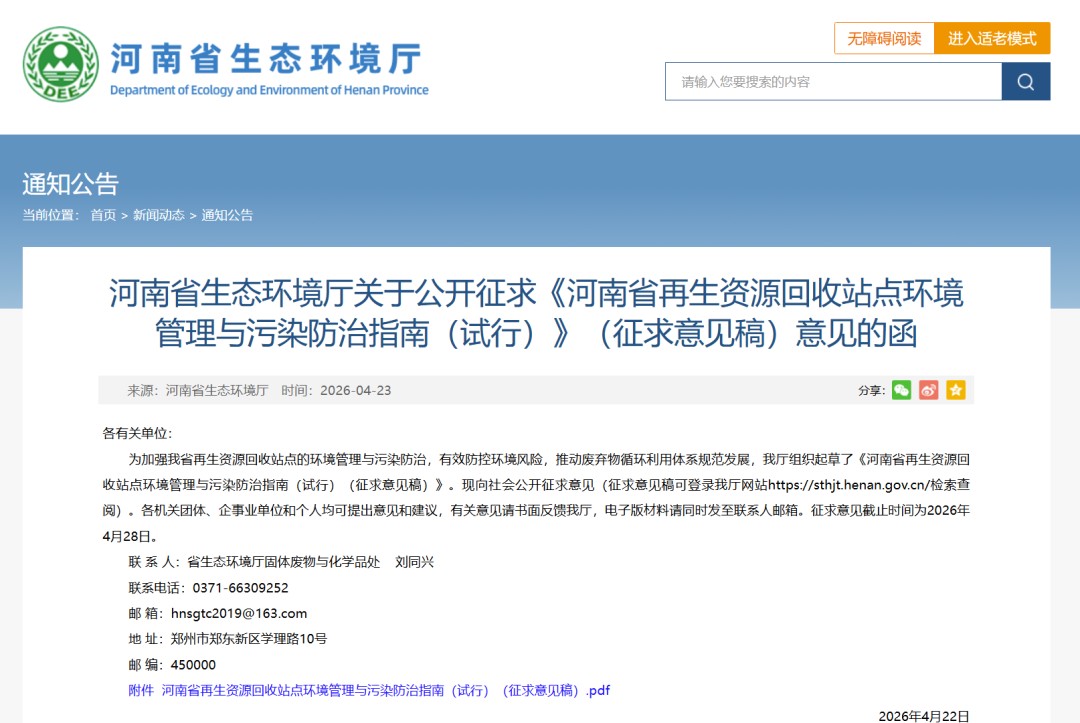
Letter of Opinions on the Public Solicitation of Opinions on the “Henan Province Guidelines for Environmental Management and Pollution Prevention of Renewable Resource Recycling Sites (Trial)” (Draft for Comments) by the Henan Provincial Department of Ecology and Environment
Issuing unit: Henan Provincial Department of Ecology and Environment
Date of issuance: 2026-04-23
Henan Province Guidelines for Environmental Management and Pollution Prevention of Renewable Resource Recycling Sites (Trial) (Draft for Comments)
1 Basis and purpose of formulation
In order to implement the laws and regulations such as the Environmental Protection Law of the People’s Republic of China, the Law of the People’s Republic of China on the Prevention and Control of Environmental Pollution by Solid Waste, and the Measures for the Administration of Renewable Resource Recycling, and to guide and standardize the environmental management and pollution prevention of renewable resource recycling sites, this Guideline is formulated.
2 Scope of application
This Guideline specifies the requirements for environmental management and pollution prevention of renewable resource recycling sites. It applies to the environmental management and pollution prevention of renewable resource recycling sites, as well as the supervision and administration by the competent ecological and environment department over pollution prevention and control at renewable resource recycling sites.
3 Normative reference documents
The following documents are indispensable for the application of this document. For any referenced document without a date, its latest version (including all amendments) applies to this document.
GB18597 Standard for Pollution Control on the Storage of Hazardous Waste
GB/T 45732 Recycling Resource Utilization System Specification for Recycling Site Construction
GB/T 27610 Classification and Coding of Waste Resources
SB/T 10719 Specification for Construction and Management of Renewable Resource Recycling Sites
4 Terms and definitions
Renewable resources are various types of waste generated in the course of social production and daily consumption that have lost all or part of their original use value and can regain use value through recycling and processing. Recycling sites are fixed places or areas at the terminal nodes of the renewable resource recycling system used for the recycling, sorting, reduction, storage, and transfer of renewable resources, including collection points and transfer stations.
5 Overall requirements
5.1 The construction of renewable resource recycling sites shall comply with the requirements of GB/T45732 and SB/T10719.
5.2 The site selection of renewable resource recycling sites shall comply with the national and local territorial spatial planning and access requirements for environmental standards, and avoid special protected areas such as drinking water source protection zones, permanent basic farmland, and ecological protection red lines. 5.3 Renewable resource recycling sites shall, in accordance with the provisions of the Measures for the Administration of Renewable Resource Recycling, complete registration with the market supervision and administration department before engaging in business activities.
5.4 If the construction of renewable resource recycling sites falls under projects that should prepare an environmental impact report (form), approval procedures shall be handled in accordance with the law.
5.5 In addition to complying with relevant laws, regulations, and standards on the national ecological environment, renewable resource recycling sites shall also comply with the relevant provisions of laws, regulations, and standards on safety and fire prevention.
6 Environmental management requirements
6.1 Renewable resource recycling sites shall establish environmental management systems and implement emergency response plans for sudden environmental incidents.
6.2 Personnel at renewable resource recycling sites shall receive environmental protection knowledge training and master the necessary environmental protection requirements.
7 Pollution prevention and control requirements
7.1 Recycling
7.1.1 Renewable resource recycling sites shall operate strictly within the scope approved by the business license.
7.1.2 Renewable resource recycling sites are strictly prohibited from collecting hazardous waste, including but not limited to medical waste, waste pesticide packaging, waste mineral oil, waste lead-acid batteries, and waste packaging barrels contaminated with toxic and harmful substances.
7.1.3 Renewable resource recycling sites that have not obtained qualification for waste electrical and electronic products shall not dismantle or process discarded electrical and electronic products such as televisions, refrigerators, washing machines, air conditioners, and computers, and shall promptly sell them to enterprises with the corresponding processing qualifications.
7.1.4 If qualification has not been obtained, renewable resource recycling sites shall not collect or dismantle scrapped motor vehicles.
7.2 Processing
7.2.1 The processing area for recycled materials should not be open-air, and the ground shall be hardened and remain intact and undamaged.
7.2.2 Recycled materials shall be finely and accurately classified in accordance with GB/T27610.
7.2.3 Renewable resource recycling sites shall separately place into the corresponding garbage collection point the waste and residue mixed in recycled materials or sorted out that cannot be used as renewable resources.
7.2.4 During the classification, reduction, and other processing of recycled materials, hazardous waste generated, including but not limited to waste paint and solvents and their packaging, waste mineral oil and its packaging, waste lead-acid batteries, waste fluorescent lamp tubes, waste mercury-containing thermometers, etc., shall be collected and stored separately; collection and storage shall comply with the requirements of GB18597, and disposal shall be carried out by qualified entities.
7.2.5 When compressing, cutting, crushing, packaging, and other processing of recycled materials, equipment with low noise and low dust should be preferred, and effective noise reduction and dust control measures should be adopted.
7.2.6 Residual liquids in recycled materials and wastewater generated during operations shall be centrally collected and properly disposed of; after pre-treatment, discharge into the municipal sewage pipeline network is encouraged, and random discharge is strictly prohibited.
7.2.7 After classification, reduction, unpacking, and other operations are completed, scattered waste residues, broken fragments, etc. shall be cleaned up promptly to keep the site tidy.
7.2.8 Transport vehicles for recycled materials shall be sealed or covered to prevent material scattering during transportation.
7.3 Storage
7.3.1 Recycled materials shall not be stacked in the open air, and storage surfaces shall be treated for water resistance and seepage prevention.
7.3.2 Recycled materials shall be stored in different zones according to category and stacked neatly. The use of fixed racks, pallets, partitions, and similar measures for layered or zoned storage is encouraged, and signs should be set up indicating the material category, name, main source, and precautions.
7.3.3 For recycled materials that may generate waste liquids or waste oil, the storage site shall have seepage prevention measures and a liquid collection system.
7.3.4 Recycled materials should be turned over quickly and moved out quickly, and long-term or large-volume storage is not advisable. 7.3.5 For the storage, disposal, or utilization of renewable resources transferred across provinces, applications for approval and filing procedures shall be handled by the provincial ecological and environment department in accordance with the relevant provisions of the Law of the People’s Republic of China on the Prevention and Control of Environmental Pollution by Solid Waste.
8 Implementation and supervision
8.1 Departmental responsibilities
8.1.1 The competent commerce department is the industry authority for renewable resource recycling and is responsible for formulating and implementing industrial policies, recycling standards, and industry development plans for renewable resource recycling.
8.1.2 The development and reform department is responsible for researching and proposing policies to promote the development of renewable resources, and organizing the promotion, application, and industrial demonstration of new technologies and new equipment for renewable resource utilization.
8.1.3 Public security organs are responsible for public order management in renewable resource recycling.
8.1.4 The market supervision and administration department is responsible for the registration management of renewable resource recycling operators and the supervision and administration of the renewable resource trading market.
8.1.5 The ecological and environment department is responsible for supervising and managing pollution prevention and control in the course of renewable resource recycling, and依法 imposing penalties on acts violating environmental pollution prevention and control laws and regulations.
8.1.6 The housing and urban-rural development and natural resources departments are responsible for incorporating renewable resource recycling sites into urban planning, and investigating and rectifying acts that violate laws and regulations related to urban planning and construction management according to law. 8.1.7 Supply and marketing cooperatives should actively leverage the recycling network function of the supply and marketing cooperative system to build a renewable resource recycling and utilization network system covering urban and rural areas.
8.2 Typical issues and rectification requirements
8.2.1 Unauthorized occupation of land issues.
If a renewable resource recycling site occupies cultivated land, basic farmland, or ecological red line areas for construction or stacking, the natural resources and planning departments shall, together with the local government, handle it according to law and order rectification within a time limit. For those that are historical remnants and difficult to clear out immediately, a step-by-step exit plan should be formulated.
8.2.2 Disorderly construction issues.
Unauthorized construction of simple sheds, enclosures, and similar structures without planning approval shall be deemed illegal construction by the urban management department or natural resources department according to law, and demolition or correction shall be ordered. For those that do belong and meet the conditions for temporary buildings, procedures may be guided for completion.
8.2.3 Insufficient pollution prevention and control measures.
If storage sites have not adopted measures such as anti-seepage, rainproofing, and windproofing, the ecological and environment department shall supervise and urge rectification. For those that, due to land conditions, cannot build permanent facilities, temporary covering and “rapid entry, rapid exit” measures shall be guided, and failure to rectify within the time limit and resulting pollution shall be penalized according to law.
8.2.4 Business operation without certificates or licenses.
Those who engage in recycling activities without obtaining a business license shall be investigated and dealt with by the market supervision department according to law.
8.2.5 Illegal recycling of hazardous waste issues.
Illegal collection, storage, or disposal of hazardous waste shall be investigated and dealt with by the ecological and environment department according to law; where crimes are involved, the case shall be transferred to the public security authorities for criminal liability.
8.2.6 Severe environmental pollution issues.
Such as discharging wastewater or exhaust gas exceeding standards, or illegally dumping solid waste. The ecological and environment department shall order suspension of production for rectification or report to the people’s government with approval authority to order suspension of business or closure according to law.
9 Supplementary provisions
Renewable resource recycling sites already established before the implementation of this Guideline that do not meet the requirements of environmental protection, fire safety, safety production, or relevant national construction standards shall be rectified in accordance with the requirements. This Guideline shall come into force on the date of promulgation. After this Guideline takes effect, if it is inconsistent with newly issued laws, regulations, or rules, the newly issued laws, regulations, or rules shall prevail.
About RESOLAR
Shanghai RESOLAR Energy Technology Co., Ltd. is committed to becoming a recycled material photovoltaic group with deep decarbonization. RESOLAR focuses on technological innovation and builds a world-leading solution for component recycling, impurity removal of damaged cells, recycled silicon materials and cells, and cascaded utilization of components. With professional technology and services, we help customers realize the recycling and reuse of waste photovoltaic resources, and make positive contributions to the development of environmental protection and new energy industries. For more detailed information, you can browse the official website: www.resolartech.com .

Latest developments/news
Contact information
Service Hotline: 13585742918 (Monday to Friday 9:00-18:00)
Enterprise email: ps@resolartech.com (Reply within 48 hours after receiving the email consultation!)
Company Address: Building 8, No. 1528, Wangxu East Road, Fengjing Town, Jinshan District, Shanghai (Caohejing Fengjing Park)