


English
News Center
—— NEWS CENTER ——
On August 3, 2026, the Development and Reform Commission of Ningxia Hui Autonomous Region issued the "15th Five-Year Plan for the Development of Circular Economy in Ningxia".
Mention
Accelerate the recycling of solid waste such as "new three types" (referring to waste materials, waste gas, and solid waste). Implement management measures for the recycling of used wind power and photovoltaic equipment, and guide power generation companies to improve their management systems for decommissioned and scrapped equipment. Support the recycling and reuse of decommissioned wind power and photovoltaic equipment and used power batteries.
Retired wind and solar power equipment and used power batteries: Establish and improve the responsibility mechanism for retired equipment of wind and solar power generation enterprises, and promote large energy enterprises to establish a "maintenance and reuse - recycling - resource-based disposal" system for wind and solar power equipment. Implement projects such as the recycling and resource-based disposal of retired new energy power generation equipment, the recycling and reuse of used solar photovoltaic panels, the comprehensive recycling, disposal and reuse of solid waste in the entire photovoltaic industry chain, and the recycling and upgrading of lithium batteries and cathode materials.
Promote the circulation of secondhand goods. Cultivate and expand the secondhand goods trading market, and promote the standardized and large-scale development of secondhand goods circulation. Encourage the development of the "Internet + secondhand" model and strengthen the supervision of secondhand goods trading platforms.
Optimize the industrial layout for resource recycling. Conduct a comprehensive survey of the production capacity of renewable resources and bulk solid waste comprehensive utilization projects, create recycling capacity maps by category, conduct capacity early warning, rationally plan project construction, and eliminate outdated production capacity in accordance with laws and regulations.
Strengthen industry supervision and management. Enhance market access management for recycled resources, and implement national industry standards for the comprehensive utilization of recycled resources such as waste plastics, waste steel, waste non-ferrous metals, waste paper, waste tires, and waste power batteries. Improve the functions of the dynamic monitoring information system for solid hazardous waste, establish an information-based traceability monitoring platform for bulk solid waste, and strengthen dynamic monitoring and traceability. Crack down on illegal and irregular recycling and dismantling of scrapped motor vehicles, waste power batteries, and waste electrical and electronic products, and improve the level of standardized development in the industry. Deepen the "online supervision + offline verification" model, conduct cross-departmental joint law enforcement and dynamic assessments, and improve the efficiency and effectiveness of comprehensive supervision.
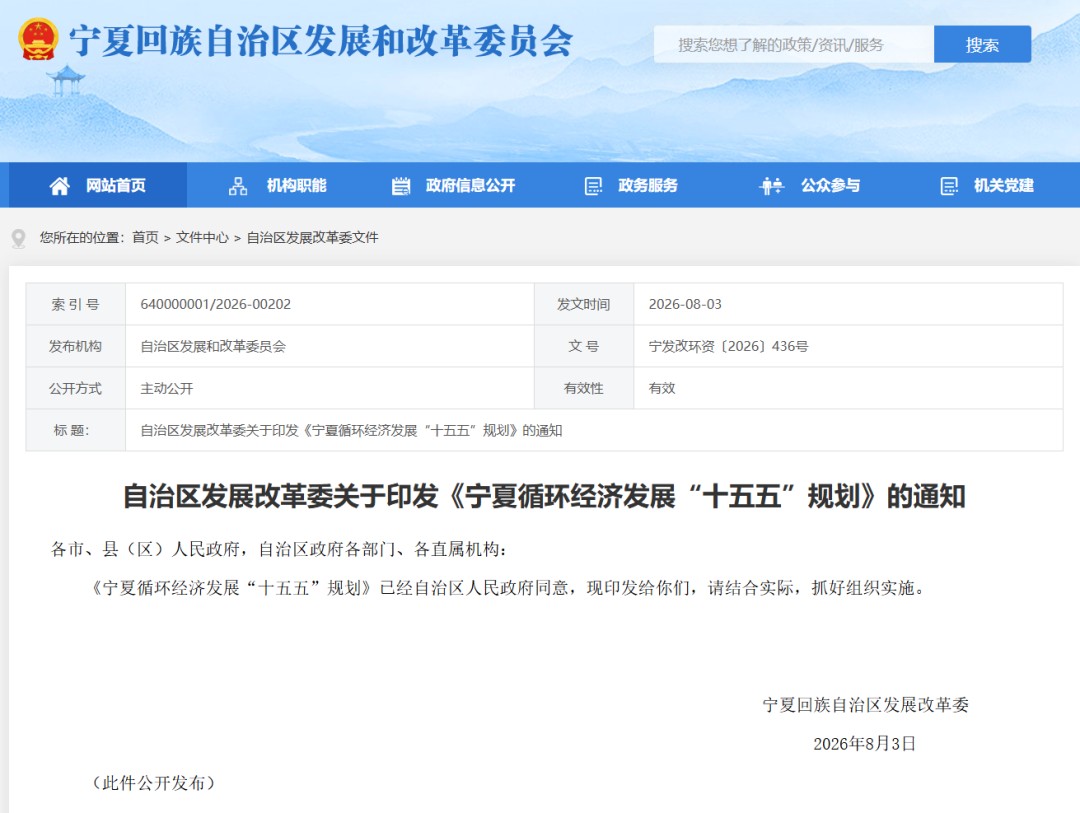
Notice from the Development and Reform Commission of Ningxia Hui Autonomous Region on Issuing the "15th Five-Year Plan for the Development of Circular Economy in Ningxia"
Issuing Authority: Development and Reform Commission of the Autonomous Region
Release Date: 2026-08-03
Document Number: Ningfa Gai Huanzi [2026] No. 436
Notice from the Development and Reform Commission of Ningxia Hui Autonomous Region on Issuing the "15th Five-Year Plan for the Development of Circular Economy in Ningxia"
To the People's Governments of all cities and counties (districts), and all departments and directly affiliated institutions of the Autonomous Region Government:
The "15th Five-Year Plan for the Development of Circular Economy in Ningxia" has been approved by the People's Government of the Autonomous Region and is hereby issued to you. Please take into account the actual situation and make good use of its implementation.
Development and Reform Commission of Ningxia Hui Autonomous Region
August 3, 2026
Ningxia's 15th Five-Year Plan for Circular Economy Development
The "15th Five-Year Plan" period is a crucial period for Ningxia to achieve basic socialist modernization in sync with the rest of the country. In accordance with the relevant provisions of the Ecological and Environmental Protection Law and the Law on Promoting the Circular Economy, and in order to implement the National "15th Five-Year Plan for Circular Economy Development" and the "Outline of the 15th Five-Year Plan for National Economic and Social Development of Ningxia Hui Autonomous Region," accelerate the construction of a circular economy system, improve the level of resource recycling, and promote the comprehensive green and low-carbon transformation of the economy and society, this plan is formulated.
I. General Requirements
Guided by Xi Jinping Thought on Socialism with Chinese Characteristics for a New Era, and thoroughly implementing the spirit of the 20th CPC National Congress and its subsequent plenary sessions, as well as the spirit of General Secretary Xi Jinping's important speech during his inspection of Ningxia and the spirit of the 11th Plenary Session of the 13th CPC Ningxia Autonomous Region Committee, we will take the strengthening of the sense of community of the Chinese nation as the main theme, and the construction of a pilot zone for ecological protection and high-quality development in the Yellow River Basin as the driving force. We will firmly establish a resource concept of conservation, intensive use, and recycling, and adhere to the principles of reduction, reuse, and recycling. We will focus on key areas and crucial links, remove obstacles to resource utilization, promote the development of the circular economy industry, reduce resource consumption and carbon emissions, and improve resource utilization efficiency, providing solid support for accelerating the construction of a beautiful new Ningxia and achieving the carbon peak target.
By 2030, the quality and efficiency of comprehensive utilization of bulk solid waste and recycling of renewable resources will be significantly improved, the circular economy system will be further improved, and a circular economy system will be basically established. The reduction rates of energy consumption per unit of GDP and water consumption per unit of GDP will meet the national targets. The comprehensive utilization rates of general industrial solid waste and urban construction waste will reach 60% and 80%, respectively. The recycling volume of major renewable resources such as scrap steel, scrap non-ferrous metals, waste plastics, waste rubber, waste glass, and waste paper will reach over 3.2 million tons.
II. Strengthening the Foundation for Reduction
(I) Promote Green Product Design. Fully implement green product design and encourage qualified enterprises to establish green supply chains. Promote modular, lightweight, and long-life design of high-end equipment manufacturing products, accelerate the innovative application of green and low-carbon technologies and equipment, and increase the substitution rate of recycled raw materials in product design. Encourage enterprises to explore and establish product carbon footprint and environmental footprint management systems, strictly control carbon emissions throughout the product lifecycle, and continuously reduce environmental impact. Promote the reduction of packaging and printing materials and colors, reducing the number of packaging layers, materials, volume, and weight, and reducing ink printing.
(II) Promoting Cleaner Production in Industries. Deepen mandatory clean production audits in key industries , encourage industrial parks and enterprises to conduct clean production audits, and promote technological upgrades to processes and equipment for enterprises that fail to meet energy and water efficiency standards . Promote green construction, steadily develop prefabricated buildings, and clearly define requirements and measures for reducing construction waste in project bidding and construction design. Strengthen the entire chain of supervision over the production, operation, and use of fertilizers, agricultural films, etc. Vigorously promote water-saving technologies, strengthen water recycling, and comprehensively improve water use efficiency.
(III) Promoting Green Consumption. We will vigorously advocate a simple, moderate, green, low-carbon, civilized, and healthy lifestyle, guiding the public to conserve water and electricity, promote the "Clean Plate Campaign," and resist excessive packaging. We will enrich green and low-carbon products and green consumption scenarios, implement a green consumption points system, and incentivize green consumption through the issuance of vouchers and points. We will improve the system for the classification, collection, and treatment of household waste, achieving a resource utilization rate of 75% for urban household waste. We will strengthen the control of plastic pollution, strictly implement the requirements for reducing and replacing single-use plastic products, and increase the promotion of recyclable, easily recyclable, and naturally degradable alternative products. We will promote the greening, reduction, and recyclability of express delivery packaging, and promote the construction of resource-saving government agencies, green schools, and low-carbon communities.
III. Improve the level of industrial resource utilization
(IV) Strengthen the comprehensive utilization of mineral resources. Conduct in-depth investigations into the current status of strategic mineral resource applications and the potential for waste recycling. Based on market consumption, improve waste recycling pathways on a "one product, one policy" basis, and support the enhancement of waste processing and key resource extraction capabilities. Strictly implement national requirements for mineral resource mining recovery rate, beneficiation recovery rate, and comprehensive utilization rate. Promote technologies such as comprehensive utilization of underground gangue and water resource protection in coal mining, and steadily improve the "three rates" level of mines. Newly built mines should meet the green mine construction standards within two years of formal commissioning. Accelerate the upgrading and transformation of existing mines, and strive to ensure that by 2030, more than 90% of large mines and more than 80% of medium-sized mines meet the green mine construction standards. Carry out research on coalbed methane exploration, collection, purification, and utilization technologies, and promote the efficient development and utilization of coalbed methane in Ningdong, Wuzhong, Shizuishan, and other regions.
(V) Accelerate the efficient recycling and utilization of industrial resources. Deepen the circular transformation of industrial parks, promote the co-construction and sharing of infrastructure such as gas and heat supply, and the centralized and collaborative disposal and utilization of waste . Strengthen the resource utilization of industrial waste heat, waste pressure, and waste gas, and support the bio-fermentation of industrial tail gas to produce fuel ethanol. Strengthen the comprehensive utilization of mine water, support industrial parks and enterprises in building reclaimed water utilization facilities, and promote the recycling of water resources. Actively promote the construction of zero-carbon industrial parks and zero-carbon factories. Strengthen the classified disposal and resource utilization of bulk industrial solid waste, and steadily and orderly promote large-scale consumption and utilization through ecological restoration, mine backfilling, and underground backfilling. Strengthen the harmless treatment and resource utilization of hazardous wastes such as industrial waste salt and fly ash from municipal solid waste incineration. Implement the industrial solid waste management ledger system, promote classified collection and storage, and prevent mixed dumping and discharge. Actively promote the construction of waste-free cities, waste-free industrial parks, and waste-free factories, and achieve a "waste-free city" construction rate of over 60% by 2030.
(VI) Promote the development of ecological circular agriculture. Focusing on characteristic and advantageous industries such as grapes, goji berries, beef cattle, and Tan sheep, promote ecological circular agriculture based on local conditions, including integrated crop and livestock farming, combined agriculture and animal husbandry, and rice-fish symbiosis. Develop under-forest economies such as forestry and fungi, forestry and medicinal herbs, and forestry and beekeeping. Upgrade the equipment and facilities for manure treatment in large-scale livestock and poultry farms, and promote the local and nearby return-to-field utilization model. Improve standardized fixed collection and storage points and distribution centers for straw, cultivate third-party service providers for collection, storage, and transportation, and promote the diversified utilization of straw. Fully promote the use of thicker, high-strength mulch film, select suitable areas and crops to conduct pilot projects for the application and promotion of fully biodegradable mulch film, and strengthen the recycling and processing of waste agricultural materials such as agricultural film, pesticide and fertilizer packaging.
(VII) Promote green construction throughout the entire engineering construction process. Strengthen standardized management of construction sites and encourage engineering construction and contracting units to set up classified storage sites for construction waste. Establish a full-process management mechanism for decoration waste, clarify the requirements for the disposal and collection of decoration waste, rationally set up decoration waste disposal points, encourage the adoption of appointment-based collection and transportation, and improve the decoration waste payment system according to the principle of "whoever generates it, pays for it." Increase the application of recycled construction waste products in housing construction, municipal engineering, transportation, water conservancy and other projects. Carry out certification and promotion of green building materials products, and establish a green building materials acceptance and application database based on actual conditions. Support government-invested projects in purchasing green building materials and encourage social investment projects to increase the application ratio of green building materials.
Column 1 Comprehensive Utilization of Solid Waste
1. Coal Gangue and Fly Ash: Strengthen the utilization of coal gangue and fly ash in areas such as subsidence area remediation, mine pit backfilling, and ecological restoration. Support the use of coal gangue and fly ash to produce new wall materials, recycled aggregates, kaolin, soil conditioners, and other products, and implement projects such as the comprehensive utilization of one million tons of coal gangue and 300,000 tons of fly ash. Implement pilot demonstration projects for the ecological restoration of coal-based solid waste. Construct general industrial solid waste landfills and closure projects.
2. Smelting Slag: Promote the high-value utilization of ferrosilicon manganese slag in the preparation of cementitious materials, desulfurizing agents, and nano-sized calcium carbonate from calcium carbide slag. Support the use of steel slag powder as a concrete admixture. Implement projects such as dehydration and drying of gasification fine slag and its comprehensive utilization, harmless treatment and resource comprehensive utilization of electrolytic manganese slag, and comprehensive utilization of microsilica powder and silicon slag solid waste.
3. Industrial by-product gypsum: Promote the large-scale utilization of desulfurized gypsum through methods such as underground backfilling, mine pit backfilling, and ecological restoration. Support the production of sulfuric acid, green building materials, and gypsum whiskers from desulfurized gypsum. Implement projects such as the comprehensive utilization of 300,000 tons of desulfurized gypsum and the production of sulfuric acid from desulfurized gypsum waste.
4. Construction Waste: Promote the classification and treatment of construction waste, and carry out resource utilization, earthwork balance, and ecological restoration of construction waste. Implement projects such as resource utilization of construction waste and supporting facilities for construction waste collection and transportation, and construct construction waste disposal sites in a reasonable manner.
5. Crop straw: Promote the comprehensive utilization of straw as fertilizer, feed, energy, and substrate for edible fungi, and implement comprehensive straw utilization projects.
6. Hazardous Waste: Promote the comprehensive utilization of hazardous waste resources and implement projects such as the high-value comprehensive utilization of hazardous waste in conjunction with general solid waste. Establish the Ningxia Hazardous Waste (including medical waste) Comprehensive Utilization and Disposal Center .
(viii) Strengthen the development and utilization of renewable resources. Carry out the upgrading action of the Lingwu National "Urban Minerals" Base, creating a demonstration base for comprehensive utilization of renewable resources in Northwest China and a production and supply base for high-quality primary-grade recycled materials. Cultivate a number of leading enterprises in renewable resource recycling with advanced technology, strong industrial chain driving force, and prominent market advantages, promoting the large-scale and clustered development of the industry. Strengthen the management of the renewable resource recycling industry and prevent potential risks to safety production and environmental pollution.
(ix) Accelerate the recycling of solid waste such as "new three types" ( referring to new types of equipment, new materials, and new components). Implement management measures for the recycling of used wind power and photovoltaic equipment, and guide power generation enterprises to improve their management systems for decommissioned and scrapped equipment. Support the recycling of decommissioned wind power and photovoltaic equipment and used power batteries. Promote the recycling of waste in new infrastructure sectors such as computing facilities, communication base stations, and energy storage power stations.
Column 2 Development and Utilization of Renewable Resources
1. End-of-life vehicles: Support end-of-life vehicle recycling and dismantling enterprises in improving their refined dismantling capabilities, establishing a sound system for the classified recycling and reuse of parts and fluorinated refrigerants, and supporting enterprises in expanding their automotive parts remanufacturing business. Implement a project for the dismantling and recycling of scrapped vehicles. By 2030, the total number of end-of-life vehicles recycled in the region will reach over 60,000.
2. Waste Electrical and Electronic Equipment: Improve the recycling network system and enhance the recycling capacity of small and new types of waste electrical and electronic equipment, as well as "four machines and one brain" products. By 2030, the recycling volume of various types of waste electrical and electronic equipment will reach more than 1.8 million units.
3. Scrap Steel and Non-ferrous Metals: Promote the integrated development of scrap steel and non-ferrous metal recycling, dismantling, processing, and distribution. Implement projects such as the recycling and utilization of scrap aluminum products and the recycling and disposal of scrap copper and lead. By 2030, the amount of scrap steel and non-ferrous metals recycled will reach more than 2.5 million tons.
4. Waste paper, waste plastics, waste rubber, waste glass, and waste textiles: Strengthen the recycling and utilization of waste cardboard, waste book paper, and waste newsprint, and promote the high-value utilization of waste plastics, waste rubber, and waste glass. Implement projects such as comprehensive utilization of waste rubber resources, circular economy demonstration projects for waste glass recycling and resource utilization, and industrialization of PE granules and modified granules resource regeneration. By 2030, the recycling and utilization of waste paper, waste plastics, waste rubber, and waste glass will reach more than 200,000 tons, more than 170,000 tons, more than 180,000 tons, and more than 150,000 tons, respectively.
5. Retired Wind and Solar Power Equipment and Used Power Batteries : Establish and improve the responsibility mechanism for retired equipment of wind and solar power generation enterprises, promote large energy enterprises to establish a "repair and reuse-recycling-resource disposal" system for wind and solar power equipment, and support cooperation between scrapped motor vehicle dismantling enterprises and power battery recycling enterprises to carry out recycling services. Implement projects such as the recycling and resource disposal of retired new energy power generation equipment, the recycling and utilization of used solar photovoltaic panels, the comprehensive recycling and reuse of solid waste in the entire photovoltaic industry chain, and the recycling and upgrading of lithium batteries and cathode materials.
IV. Expanding the Scale of Recycling
(X) Improve the recycling network for renewable resources. Improve the three-tiered recycling system of recycling collection points, transfer stations, and sorting centers. Promote the inclusion of recycling sites and sorting centers in municipal and county-level land use plans and public infrastructure land use areas. Promote the integration of household waste sorting with recycling network points, improve the rural recycling network, and promote integrated urban-rural development. Encourage enterprises to set up used clothing recycling bins in residential communities and improve the waste textile recycling system. Promote the "Internet + Recycling" model and popularize smart recycling terminals. By 2030, the recycling rate of major renewable resource varieties will reach over 70%, and the coverage rate of township recyclable material transfer stations will reach over 50%.
(xi) Promote the application of recycled materials. Increase the proportion of recycled materials used by production enterprises in the fields of building materials, equipment manufacturing, and light industrial processing. Increase government green procurement efforts and promote the priority use of recycled aggregates and recycled building materials in municipal engineering, public buildings, road transportation, and other projects. Conduct evaluations of recycled materials and implement relevant product standards and certification systems for recycled materials. Support the construction of the Ningxia Green and Low-Carbon Comprehensive Maintenance Demonstration Base and promote the "road maintenance + material recycling" model.
(xii) Actively develop the remanufacturing industry. Accelerate the remanufacturing of equipment such as industrial robots, mining machinery, construction machinery, agricultural machinery, wind power, and auto parts, and promote the application of advanced technologies such as non-destructive testing, additive manufacturing, intelligent testing, flexible processing, and laser cladding. Encourage third-party remanufacturing enterprises to develop embedded service models, encourage the use of qualified remanufactured parts in auto repair services, and implement a remanufactured product labeling system.
(XIII) Promote the circulation of second-hand goods. Cultivate and expand the second-hand goods trading market, and promote the standardized and large-scale development of second-hand goods circulation. Encourage communities to build second-hand goods consignment shops and consignment points, and organize trading activities regularly. Encourage schools to regularly organize used book exchange activities and flea markets to guide the trading and circulation of idle items. Encourage the development of the "Internet + second-hand" model and strengthen the supervision of second-hand goods trading platforms .
V. Vigorously promote the development of the circular economy industry
(XIV) Optimize the industrial layout of resource recycling. Conduct a comprehensive survey of the production capacity of renewable resources and bulk solid waste comprehensive utilization projects, draw up recycling capacity maps by category, carry out capacity early warning, rationally plan project construction, and eliminate outdated production capacity in accordance with laws and regulations . Encourage industry associations to publish annual industry progress updates to guide the orderly development of the industry and avoid low-level duplication of construction. Scientifically plan and construct recycled aluminum projects. Accelerate the cultivation of a number of leading resource recycling enterprises with strong upstream and downstream industry driving capabilities, advanced technology and equipment, and high market share.
(XV) Accelerate the upgrading of technology and equipment. Focusing on key areas such as large-scale and high-value utilization of bulk industrial solid waste, pollution reduction and carbon reduction in modern coal chemical and metallurgical industries, and recycling of waste such as decommissioned wind and solar photovoltaic modules and power batteries, organize and implement a number of technological breakthroughs and achievement transformation projects. Support the establishment of key laboratories and technology innovation centers of the autonomous region in the fields of solid waste resource utilization, energy conservation and carbon reduction, and green transformation of coal chemical industry. Encourage leading enterprises in the circular economy to form innovation consortia with upstream and downstream enterprises, universities and research institutes to carry out basic research on the circular economy and the development of key common technologies.
(XVI) Promote the development of the circular economy through digital intelligence. Accelerate the application of new-generation information technologies such as big data and artificial intelligence in the field of circular economy, promote industrial enterprises to carry out intelligent diagnosis and system improvement of resource utilization efficiency, expand the application of AI intelligent sorting technology in the sorting of waste non-ferrous metals, waste plastics, and low-value recyclables, and improve sorting accuracy and classification level.
(XVII) Cultivate the circular economy service industry. Cultivate professional service institutions specializing in circular economy certification, carbon footprint accounting, certification, assessment, auditing, finance, and consulting. Encourage the development of system solution service providers with integrated capabilities to provide enterprises and industrial parks with one-stop services such as energy audits, cleaner production audits, waste co-processing, and circular transformation. Support third-party professional institutions in providing specialized recycling services to enterprises, industrial parks, and public institutions , and cultivate a number of leading enterprises integrating online and offline recycling services.
VI. Strengthen institutional and policy safeguards
(XVIII) Improve the legal and standards system. Revise the Autonomous Region's Regulations on the Prevention and Control of Environmental Pollution by Solid Waste, and accelerate the formulation and revision of laws and regulations in the fields of renewable resource recycling, industrial solid waste, and construction waste. Accelerate the formulation and revision of relevant standards for the classified disposal and comprehensive utilization of bulk solid waste resources such as coal gangue, fly ash, and coal gasification slag. Issue technical specifications for the ecological restoration of coal-based solid waste mine pits and coal mining subsidence areas. Implement the extended producer responsibility system. Support the development of eligible voluntary greenhouse gas emission reduction projects in the circular economy field.
(XIX) Strengthen comprehensive policy support. Seek central government funding and utilize existing funds from the autonomous region to support the construction of resource recycling projects. Implement preferential tax and fee policies for comprehensive resource utilization and the "reverse invoicing" measures for resource recycling enterprises. Make good use of structural monetary policy tools such as carbon emission reduction support tools, enhance the sustainable information disclosure capabilities of financial institutions, and guide financial institutions to increase their support for the development of the circular economy industry. Strengthen the guarantee of land, energy, and water use for resource recycling projects. Implement preferential science and technology policies for enterprises, such as post-subsidy for enterprise R&D expenses and science and technology finance, and promote the efficient aggregation of innovation resources to enterprises in the circular economy field.
(20) Improve the statistical evaluation system. Implement the national circular economy statistical system and improve the statistical indicator system for industries such as industrial solid waste and recycled resources. Conduct industry-specific and key enterprise-specific evaluations and introduce third-party professional evaluations. Support industry associations and research institutions in conducting industry analysis and business climate evaluations of resource recycling.
(XXI) Strengthen industry supervision and management. Strengthen market access management for recycled resources and implement national industry standards for the comprehensive utilization of recycled resources such as waste plastics, waste steel, waste non-ferrous metals, waste paper, waste tires, and waste power batteries. Improve the functions of the dynamic monitoring information system for solid hazardous waste and establish an information-based traceability monitoring platform for bulk solid waste to strengthen dynamic monitoring and traceability. Crack down on illegal and irregular recycling and dismantling of scrapped motor vehicles, waste power batteries, and waste electrical and electronic products to improve the level of standardized development in the industry. Deepen the "online supervision + offline verification" model, conduct cross-departmental joint law enforcement and dynamic assessments, and improve the efficiency and effectiveness of comprehensive supervision.
VII. Strengthen Organization and Implementation
Uphold the Party's overall leadership over the implementation of the circular economy development plan. Establish and improve the plan's implementation mechanism, clarify the division of goals and tasks, and require all regions and departments to formulate specific, operable, and assessable work arrangements and implementation measures to promote the completion of the plan's targets and key tasks. Strengthen the planning of resource recycling projects and orderly promote the implementation of major projects. Enhance the coordination and synergy between the circular economy development plan and policies in related fields, conduct dynamic monitoring, mid-term evaluation, and summary evaluation of the plan's implementation, and promptly propose policy measures to strengthen and improve the plan's implementation based on the monitoring and evaluation results. Deepen the publicity and interpretation of the plan and provide positive policy guidance, consciously open it to the public, accept public supervision, and create a positive atmosphere in which the whole society cares about, supports, participates in, and supervises the implementation of the plan.
About RESOLAR
Shanghai RESOLAR Energy Technology Co., Ltd. is committed to becoming a recycled material photovoltaic group with deep decarbonization. RESOLAR focuses on technological innovation and builds a world-leading solution for component recycling, impurity removal of damaged cells, recycled silicon materials and cells, and cascaded utilization of components. With professional technology and services, we help customers realize the recycling and reuse of waste photovoltaic resources, and make positive contributions to the development of environmental protection and new energy industries. For more detailed information, you can browse the official website: www.resolartech.com .

Latest developments/news
Contact information
Service Hotline: 13585742918 (Monday to Friday 9:00-18:00)
Enterprise email: ps@resolartech.com (Reply within 48 hours after receiving the email consultation!)
Company Address: Building 8, No. 1528, Wangxu East Road, Fengjing Town, Jinshan District, Shanghai (Caohejing Fengjing Park)