


English
News Center
—— NEWS CENTER ——
On November 17, 2026, during the 10th China Recovered Paper Industry Conference, the Waste Paper Branch of the China Association of Renewable Resources Recycling officially released the Self-Discipline Initiative for the Recovered Paper Industry (the “Initiative”).
The Initiative sets out clear requirements in eight areas: the rule of law, integrity, market order, tax and financial compliance, environmental protection and safety, digital traceability, the “dual carbon” goals, and supply chain collaboration:
First, uphold the rule of law and operate in compliance with regulations;
Second, adhere to integrity and strictly control product quality;
Third, maintain market order and engage in healthy competition;
Fourth, observe tax and financial compliance requirements and guard against compliance risks;
Fifth, fulfill environmental responsibilities and reinforce safety safeguards;
Sixth, advance digital traceability and improve the standards system;
Seventh, put the “dual carbon” principles into practice and support the green transition;
Eighth, deepen supply chain collaboration and ensure the security of raw material supplies.
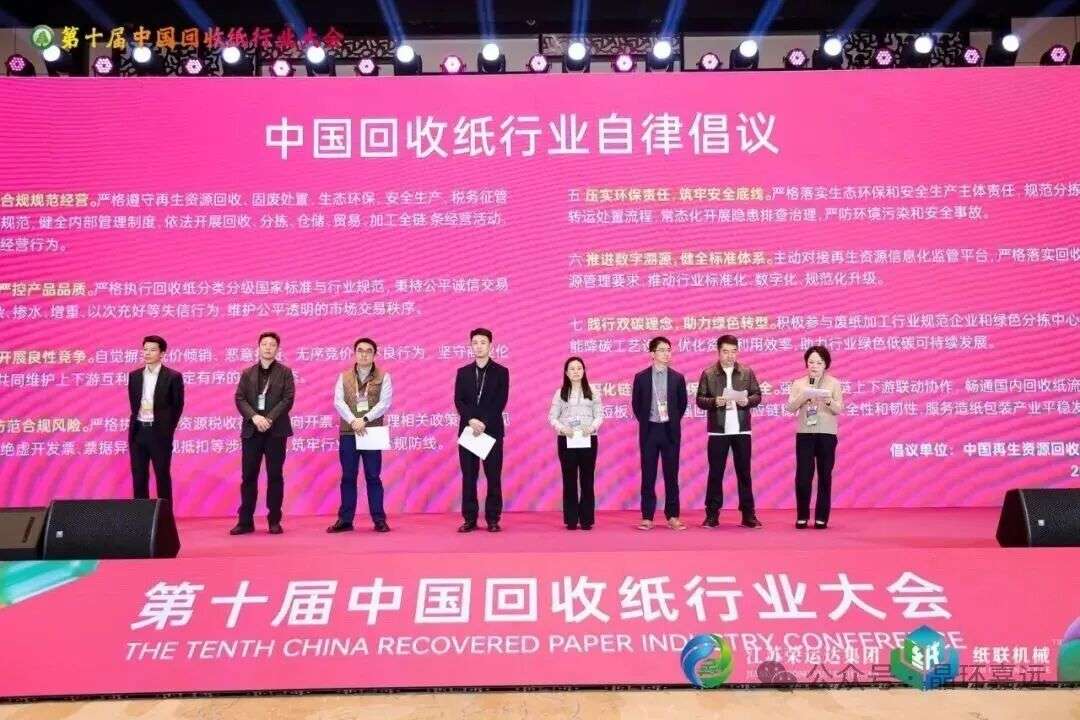
On November 17, 2026, during the 10th China Recovered Paper Industry Conference, the Waste Paper Branch of the China Association of Renewable Resources Recycling officially released the Self-Discipline Initiative for the Recovered Paper Industry (the “Initiative”). Drawing on a decade of industry development, the Initiative puts forward eight self-discipline principles for the entire industry. It aims to improve the modern industry governance system, strengthen safeguards for industrial chain security, and guide the recovered paper industry toward green, compliant, and high-quality development. The release event was hosted by Hu Jiawei, Executive Deputy Chair of the Waste Paper Branch of the China Association of Renewable Resources Recycling.
The Initiative notes that the first China Recovered Paper Industry Conference, held in 2016, issued an industry self-discipline convention. In response to challenges at the time—including fragmented business operations, nonstandard transactions, inconsistent product quality, and disorderly market competition—the convention established the basic principles of honest business practices, standardized transactions, and orderly competition. It effectively improved the market environment and helped the industry gradually move from extensive, disorderly growth to a new stage of compliant development. Over the past decade, China’s renewable resources recycling system has continued to improve, environmental oversight has become more stringent, the tax and financial regulatory system has been strengthened, and industrial and supply chains have undergone profound restructuring. Today, the recovered paper industry faces new circumstances and challenges, including mounting pressure to secure raw materials, an urgent need to improve supply chain resilience, the full implementation of digital traceability requirements, tighter constraints on green and low-carbon development, and significant risks related to invoice compliance. To address the changes facing the industry at this new stage of development, the Waste Paper Branch launched the Initiative.
The Initiative sets out clear requirements in eight areas: the rule of law, integrity, market order, tax and financial compliance, environmental protection and safety, digital traceability, the “dual carbon” goals, and supply chain collaboration:
First, uphold the rule of law and operate in compliance with regulations. Strictly comply with laws, regulations, and industry standards governing renewable resources recycling, solid waste disposal, environmental protection, workplace safety, and tax administration. Improve internal management systems, conduct all activities across the recycling, sorting, storage, trading, and processing chain in accordance with the law, and firmly prohibit illegal or noncompliant business practices.
Second, adhere to integrity and strictly control product quality. Strictly follow national standards and industry specifications for the classification and grading of recovered paper. Uphold the principles of fair and honest trading, firmly prohibit deceptive practices such as mixing in foreign materials or water, artificially increasing weight, and passing off inferior products as superior ones, and safeguard a fair and transparent market trading order.
Third, maintain market order and engage in healthy competition. Voluntarily reject harmful practices such as predatory low-price selling, maliciously outbidding competitors to secure supplies, and disorderly bidding. Uphold business ethics and industry standards, and work together to maintain a stable industrial ecosystem that supports mutually beneficial outcomes for upstream and downstream participants.
Fourth, observe tax and financial compliance requirements and guard against compliance risks. Strictly implement policies and requirements related to tax administration for renewable resources, reverse invoicing, and invoice management. Standardize the management of financial records and invoices, prohibit tax-related risks such as fraudulent invoicing, irregular invoices, and noncompliant input tax deductions, and strengthen the industry’s tax and financial compliance safeguards.
Fifth, fulfill environmental responsibilities and reinforce safety safeguards. Strictly fulfill primary responsibilities for environmental protection and workplace safety, standardize sorting and processing, storage and stacking, and transfer and disposal procedures, and regularly inspect and address potential hazards to prevent environmental pollution and safety incidents.
Sixth, advance digital traceability and improve the standards system. Proactively connect with information platforms for renewable resources supervision, strictly implement requirements for the classification, sorting, and traceability management of recovered paper, and promote the industry’s standardized, digital, and compliant development.
Seventh, put the “dual carbon” principles into practice and support the green transition. Actively participate in applications for designation as standardized enterprises in the waste paper processing industry and as green sorting centers. Promote energy-saving and carbon-reduction processes and equipment, improve resource-use efficiency, and support the industry’s green, low-carbon, and sustainable development.
Eighth, deepen supply chain collaboration and ensure the security of raw material supplies. Strengthen coordination between upstream and downstream participants across the industrial chain, improve domestic channels for recovered paper distribution, address gaps in raw material supply security, continuously enhance the stability, security, and resilience of the recovered paper supply chain, and support the steady development of the paper-making and packaging industries.
Representatives attending the release event included Li Shilei, Chair of the Waste Paper Branch of the China Association of Renewable Resources Recycling and General Manager of Zhongzihuan Renewable Resources (Tianjin) Co., Ltd.; Tian Guanxiong, Deputy Chair of the Waste Paper Branch and General Manager of Shanghai Chengsheng Environmental Protection Technology Co., Ltd.; Li Haitao, Deputy Chair of the Waste Paper Branch and Manager of Jiangsu Zhilian Renewable Resources Co., Ltd.; Luo Lishu, Deputy Chair of the Waste Paper Branch and Assistant to the General Manager of Guangdong Haiyang Materials Recycling Co., Ltd.; He Xiaodong, Director of the General Manager’s Office at Guangzhou Wanlvda Group Co., Ltd.; Lu Heng, Deputy General Manager of Anqing Lianfeng Renewable Resources Co., Ltd.; Zhu Jinghong, General Manager of Songzi Jingsheng Renewable Resources Co., Ltd.; and Lü Xing, Manager of Tianjin Qihang Renewable Resources Co., Ltd.
About RESOLAR
Shanghai RESOLAR Energy Technology Co., Ltd. is committed to becoming a recycled material photovoltaic group with deep decarbonization. RESOLAR focuses on technological innovation and builds a world-leading solution for component recycling, impurity removal of damaged cells, recycled silicon materials and cells, and cascaded utilization of components. With professional technology and services, we help customers realize the recycling and reuse of waste photovoltaic resources, and make positive contributions to the development of environmental protection and new energy industries. For more detailed information, you can browse the official website: www.resolartech.com .

Latest developments/news
Contact information
Service Hotline: 13585742918 (Monday to Friday 9:00-18:00)
Enterprise email: ps@resolartech.com (Reply within 48 hours after receiving the email consultation!)
Company Address: Building 8, No. 1528, Wangxu East Road, Fengjing Town, Jinshan District, Shanghai (Caohejing Fengjing Park)