


News Center

——  NEWS CENTER  ——

Ministry of Ecology and Environment: First Release of Technical Specifications for Pollution Control in Waste Photovoltaic Equipment Recycling and Treatment
2026-02-09
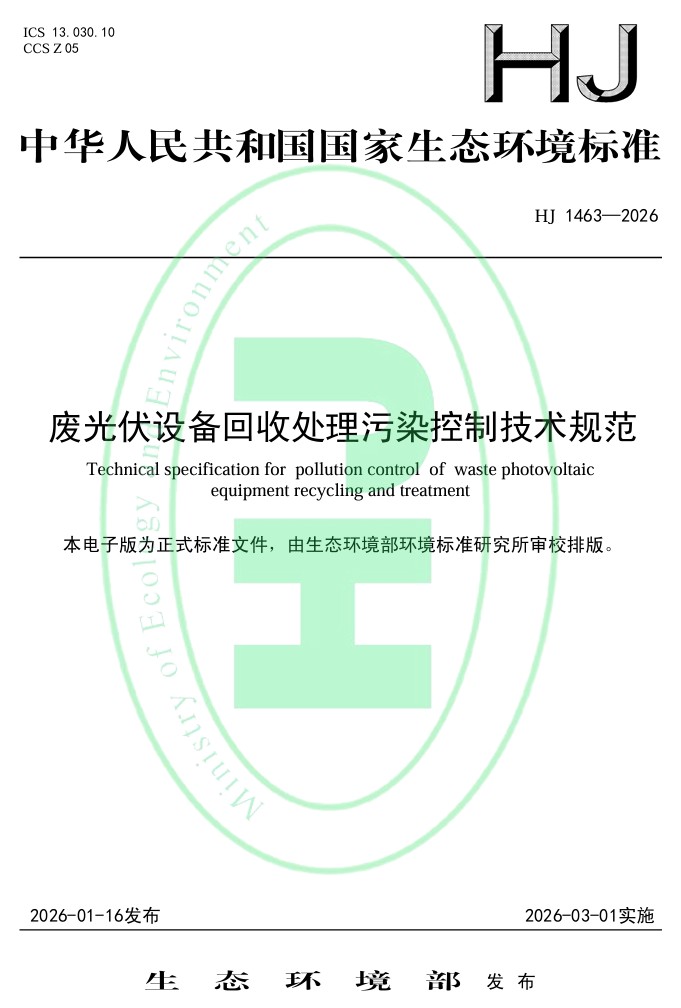
To implement the "Environmental Protection Law of the People's Republic of China," "Solid Waste Pollution Prevention and Control Law of the People's Republic of China," "Ecological Environment Monitoring Regulations," and other laws and regulations, prevent environmental pollution during the recycling and disposal process of waste photovoltaic equipment, protect the ecological environment, and standardize and guide pollution control during the recycling and disposal of waste photovoltaic equipment,the "Technical Specifications for Pollution Control in the Recycling and Disposal of Waste Photovoltaic Equipment (HJ 1463—2026)" was formulated. This standard isfirst released, with the main drafting units including the Solid Waste and Chemicals Management Technology Center of the Ministry of Ecology and Environment, the South China Institute of Environmental Sciences of the Ministry of Ecology and Environment, China National Resources Recycling Association, Tsinghua University, Guangzhou Institute of Energy Research of the Chinese Academy of Sciences, and the Chinese Research Academy of Environmental Sciences. The standard specifies the technical requirements for pollution control during the dismantling, collection, transportation, storage, disassembly, comprehensive utilization, and disposal of waste photovoltaic equipment, and will be implemented from March 1, 2026.

#4

1770600931879297796535623682.png

General Requirements

4.1  The processes of dismantling, collection, transportation, storage, disassembly, comprehensive utilization, and disposal shall follow the principles ofreduction, resource utilization, and harmlessness. Priority should be given to processes and equipment withlow energy consumption, high resource recovery rates, and low pollutant emissions.

4.2  Recycling and disposal enterprises shall have storage sites that meet environmental protection requirements and implement closed and standardized management (except for enterprises using mobile equipment for disposal).

4.3  Before disposing of waste photovoltaic equipment, the type, specifications, structure, and characteristic pollutants should be considered, and corresponding disposal plans should be formulated, clarifying the disassembly process and utilization/disposal direction. Waste photovoltaic equipment and its disassembly products should not be directly landfilled, discarded, or mixed with domestic waste and construction waste.

4.4  The concentration of pollutants discharged inwastewater during the comprehensive utilization of photovoltaic laminates and their metal and non-metal materials shall comply with the provisions of national pollutant discharge standards such as GB 8978. Where local pollutant discharge standards are applicable, they shall comply with the provisions of local pollutant discharge standards.

4.5  The emission concentrations of pollutants such asvolatile organic compounds,hydrogen sulfide,lead and its compounds, andtin and its compounds in exhaust gases shall comply with the provisions of national pollutant discharge standards such as GB 37822, GB 14554, GB 31574, and GB 16297. Where local pollutant discharge standards are applicable, they shall comply with the provisions of local pollutant discharge standards.

4.6  The entire recycling and disposal process shall comply not only with national ecological environment laws and standards but also with relevant provisions of national laws and standards on production safety, occupational health, transportation, and fire prevention.

#5

1770600931879297796535623681.png

Pollution Control Requirements for Dismantling and Collection Processes

5.1  Dismantling Process shall be based on the principles ofminimizing environmental pollution and maximizing resource utilization. The dismantling site shall have complete safety and environmental protection facilities. For processes involving cutting and crushing, measures shall be taken to prevent oil leakage, dust dispersion, and noise impact. Explosive or violent methods such as blasting or whole pulling shall not be used for dismantling. The dismantling process shall include measures such as safe component removal, isolation of pollution sources, classified collection, and packaging to prevent heavy metals (e.g., lead, cadmium), oils, chemical solvents, and ash deposits from entering the soil. The surrounding ecological environment shall be promptly restored after dismantling.

5.2  Photovoltaic components, support systems, junction boxes, inverters, transformers, cables, energy storage systems, and other parts shall bedismantled by category. The dismantling process shall prevent parts from breaking and scattering. After dismantling waste photovoltaic equipment, base materials shall not be directly discarded.

5.3  Dismantled waste photovoltaic equipment shall be temporarily stored in designated areas by category. Based on product characteristics, support systems, specialized containers, or equipment shall be used for classified collection. Identification zones shall be established based on the characteristics of waste photovoltaic equipment, and dismantled products shall be stored in separate areas and promptly cleared.

5.4  Temporary storage areas shall have pollution control measures such as rainproofing, dust suppression, leakage prevention, and seepage prevention.

#6

1770600931879297796552384512.png

Pollution Control Requirements for Transportation and Storage Processes

6.1  Dismantled waste photovoltaic equipment shall be promptly transported, and measures shall be taken during transportation to prevent dust dispersion, leakage, and seepage to avoid secondary pollution.  

6.2 During the transportation of broken waste photovoltaic equipment and components, closed containers shall be used for storage to prevent scattering or splashing of fragments. Throughout the transportation process, equipment shall be securely fastened to prevent bumps, vibrations, and noise.
6.3 The cross-provincial transfer of waste photovoltaic equipment shall comply with the relevant regulations for general industrial solid waste. Transporters shall not perform any operations on waste photovoltaic equipment that may alter its physical or chemical properties, such as dismantling, comprehensive utilization, or disposal.
6.4 The on-site transfer of disassembled waste photovoltaic equipment shall be carried out in designated areas based on the type of equipment or disassembled components. Measures such as physical isolation, specialized tools, and labeling shall be applied to prevent the mixing of materials during loading and unloading operations.
6.5 Storage areas shall have cement-hardened ground to prevent dispersion, loss, and leakage. Surrounding the site, diversion and collection facilities shall be installed. Storage areas for electronic waste such as discarded inverters and transformers shall be equipped with cover measures to prevent rain exposure, such as rain shelters.
6.6 Storage areas shall be separated from open flames or heat sources, and fire prevention measures shall be implemented to prevent the combustion of waste photovoltaic equipment and its components from causing environmental pollution.


#7

1770600931879297796405583872.png

Pollution Control Requirements for Disassembly Process

7.1 Before dismantling, the layout of the site, treatment processes, and equipment shall be determined based on material properties, contamination levels, and subsequent reuse, comprehensive utilization, or disposal requirements.
7.2 During cleaning, facilities for treating exhaust gases, wastewater, and noise shall be installed. Generated wash water should be treated and recycled where feasible. For drying processes, closed-loop drying equipment is preferred, and exhaust gas collection and treatment facilities must be provided to prevent secondary pollution.
7.3 The dispersion of particulate matter, fluorides, and other hazardous substances shall be prevented. Mechanical or automated equipment is recommended for dismantling frames, junction boxes, photovoltaic laminates, etc.
7.4 The splashing and scattering of solid waste during dismantling shall be prevented, and timely cleanup shall be carried out to avoid leaving waste in soil and causing soil contamination.
7.5 Pollution control for the dismantling and treatment of electronic waste, such as discarded inverters and transformers, shall comply with the relevant provisions of HJ 527. Pollution control for the treatment of waste lithium-ion batteries involved in energy storage systems shall refer to the relevant provisions of HJ 1186.


#8

1770600931879297796455927809.png

Photovoltaic Laminate Processing

8.1 Pollution Control Requirements for Comprehensive Utilization and Disposal Processes
8.1.1 During the treatment of PV laminates, measures for dust prevention, splash prevention, leakage prevention, and noise control shall be taken, with corresponding facilities for exhaust gas, wastewater, and noise treatment installed. Exhaust gas containing atmospheric pollutants such as fluorides and particulate matter generated during the process shall be collected under negative pressure conditions and conveyed in a closed system to the exhaust gas treatment facilities.
8.1.2 For processes involving water washing or wet crushing, the generated wastewater should be recycled. Wastewater that cannot be recycled shall be collected via pipelines and directed to wastewater treatment facilities for processing.
8.1.3 When physical methods are used for treating PV laminates, dust control measures such as hoods shall be employed to prevent the dispersion of hazardous dust, including silicon powder, lead/tin particles from solder ribbons, and fluorine-containing dust from backsheets. During operations such as crushing and cutting, enclosed equipment shall be used, and splash guards (such as protective covers or baffles) shall be installed at discharge outlets to prevent secondary pollution caused by flying fragments like glass and silicon wafer scraps.
8.1.4 When wet methods are used for treating PV laminates, continuous production equipment, including continuous feeding systems, continuous regeneration systems, and continuous discharging systems, is preferred. Equipment with measures to prevent chemical reagent overflow shall be used, and systems for chemical reagent recovery, wastewater treatment, and recycling shall be installed. For wastewater containing pollutants such as copper, nickel, chromium, and fluorides, technologies such as adsorption, precipitation, and redox shall be selected and combined based on the wastewater's composition and concentration. When organic solvents are used, equipment with a sealed design is preferred, and effective local exhaust hoods shall be installed to prevent volatile organic compound leaks.

8.1.5 When pyrometallurgical methods are used for treating PV laminates, the treatment equipment shall prevent the escape of pyrolysis gases at the feeding and discharging ports. Temperature sensing devices should be installed within the equipment. Dust suppression facilities shall be provided during product conveying. Flue gas collection and purification devices, along with online exhaust gas monitoring devices, shall be installed to achieve automated control throughout the entire process of exhaust gas collection, purification, and monitoring. For exhaust gases containing pollutants such as sulfur dioxide, nitrogen oxides, fluorides, non-methane hydrocarbons, particulate matter, and hydrogen sulfide, technologies such as desulfurization, denitrification, combustion, and dust removal shall be selected and combined based on the exhaust gas's composition and concentration.


8.2 Comprehensive Utilization of Metal Materials
8.2.1 When physical methods are used for dismantling frames, reusable metal components such as aluminum frames and fasteners shall undergo cleaning, derusting, polishing, etc. Rust removal reagents shall be properly recovered.
8.2.2 When wet methods are used for recovering metallic silver from PV cells or solder ribbons, measures to prevent solution leakage shall be taken during operations such as leaching, filtration, and impurity removal. Heavy metal-containing catalysts used should be recycled. For wastewater containing pollutants such as copper, lead, and fluorides, technologies such as adsorption, precipitation, and redox shall be selected and combined based on the wastewater's composition and concentration. For exhaust gases containing pollutants such as sulfuric acid mist, hydrogen chloride, and fluorides, technologies such as absorption, adsorption, and condensation shall be selected and combined based on the exhaust gas's composition and concentration.

8.2.3 When pyrometallurgical methods are used for recovering metals from solder ribbons, measures such as splash prevention and negative pressure collection shall be taken. Dust suppression measures shall be implemented during product conveying, and flue gas collection and purification devices shall be installed. For exhaust gases containing pollutants such as sulfur dioxide, nitrogen oxides, fluorides, lead and its compounds, and tin and its compounds, technologies such as desulfurization, denitrification, combustion, and dust removal shall be selected and combined based on the exhaust gas's composition and concentration.


8.3 Comprehensive Utilization of Non-metallic Materials
8.3.1 When physical methods are used for recovering silicon materials, dust prevention and noise reduction measures shall be taken during crushing and sorting. When pyrometallurgical methods are used for recovering silicon materials, for exhaust gases containing pollutants such as nitrogen oxides, fluorides, lead and its compounds, and tin and its compounds, technologies such as denitrification, adsorption, absorption, and dust removal shall be selected and combined based on the exhaust gas's composition and concentration.
8.3.2 When wet methods are used for recovering glass, measures to prevent solution leakage shall be taken during operations such as soaking, filtration, and impurity removal. For wastewater containing pollutants such as copper, lead, nickel, and suspended solids, technologies such as adsorption, flocculation, precipitation, and redox shall be selected and combined based on the wastewater's composition and concentration. For exhaust gases containing pollutants such as volatile organic compounds, technologies such as adsorption and combustion shall be selected and combined based on the exhaust gas's composition and concentration.

8.3.3 When pyrometallurgical methods are used for recovering glass, measures such as splash prevention and negative pressure collection shall be taken. Dust suppression measures shall be implemented during product conveying, and flue gas collection and purification devices shall be installed. For exhaust gases containing pollutants such as sulfur dioxide, nitrogen oxides, fluorides, lead and its compounds, and tin and its compounds, technologies such as desulfurization, denitrification, combustion, and dust removal shall be selected and combined based on the exhaust gas's composition and concentration.


8.4 Disposal
8.4.1 Waste materials generated during dismantling and comprehensive utilization processes, such as waste circuit boards, waste mineral oil, and waste organic solvents, shall be collected separately and managed as hazardous waste. Waste materials generated during the operation of production and pollution control facilities, such as spent activated carbon, waste packaging, and fluorine-containing sludge, shall be identified according to the requirements of GB 5085.7. Those classified as hazardous waste shall be utilized or disposed of as hazardous waste.
8.4.2 When utilizing or disposing of products such as waste glass, waste plastics, and waste wires and cables generated during dismantling and comprehensive utilization processes, facilities matching the process and complying with relevant pollution control requirements shall be equipped to achieve the recycling of metallic and non-metallic materials. Products that cannot be recycled, such as carbon black, bottom slag, dust, and chemical reagents, shall be promptly outsourced for disposal.
8.4.3 When solid waste generated from comprehensive utilization processes is disposed of in general industrial solid waste landfills, the acceptance requirements of GB 18599 shall be met. For incineration disposal, the pollution control requirements of GB 18485 shall be referenced. For landfill disposal of hazardous waste, the pollution control requirements of GB 18598 shall be met; for incineration disposal, the pollution control requirements of GB 18484 shall be met.
8.4.4 The disposal of junction boxes and lead-out wires shall refer to the relevant provisions of GB/T 23685. The disposal of encapsulant and backsheet materials shall refer to the relevant provisions of HJ 364.


#9

1770600931879297796455923712.png

Environmental Management Requirements

9.1 General Requirements
9.1.1 The environmental protection management system established by the treatment enterprise shall include pollution prevention and control measures for normal production activities, emergency management for environmental incidents, daily operation and maintenance of environmental protection facilities, and environmental emission monitoring, among other content.
9.1.2 The enterprise shall improve its working mechanism for responding to environmental incidents, which includes formulating an environmental emergency response plan, establishing a system for training and drills related to the plan, and conducting regular training and drills. In the event of an environmental incident, the corresponding emergency response plan shall be activated immediately, and a report shall be submitted to the ecological environment department and other relevant authorities in accordance with the plan's requirements.

9.1.3 Records related to the recycling and treatment of waste photovoltaic equipment, including training records, management ledgers, dismantling activities, and environmental protection work reports, shall be retained for a period of not less than 3 years.


9.2 Information Management Requirements
9.2.1 The owners of photovoltaic equipment, their components, and materials, as well as the enterprises involved in the recycling and treatment of waste photovoltaic equipment, are encouraged to establish a full-process traceability system for the recycling and treatment of waste photovoltaic equipment, based on information and artificial intelligence technology, and to connect with the relevant information platform of the Ministry of Ecology and Environment for solid waste management.
9.2.2 In accordance with the requirements of HJ 1033, HJ 1200, and HJ 1259, an environmental management ledger for general industrial solid waste and hazardous waste shall be established. The enterprise shall truthfully record operational information such as the type, quantity, nature, treatment, disposal, and product flow of the waste photovoltaic equipment, to ensure the process is traceable to its source, monitorable, trackable, and the information is verifiable.

9.2.3 The treatment enterprise is recommended to have video surveillance within the plant area that covers the entire process from the entry of waste photovoltaic equipment to the exit of dismantled products. This should at a minimum include key areas and points such as the plant entrance and exit, the feeding port, monitoring points for measuring equipment, storage areas, and their entry and exit points.

9.3 Environmental Monitoring Requirements
The monitoring plan formulated by the treatment enterprise in accordance with the law shall include the setting of monitoring points, monitoring indicators, monitoring frequency, and monitoring methods. Secondary pollution to the surrounding environment resulting from the treatment process shall be prevented.


ScreenShot_2026-02-06_163840_305


About RESOLAR

Shanghai RESOLAR Energy Technology Co., Ltd. is committed to becoming a recycled material photovoltaic group with deep decarbonization. RESOLAR focuses on technological innovation and builds a world-leading solution for component recycling, impurity removal of damaged cells, recycled silicon materials and cells, and cascaded utilization of components. With professional technology and services, we help customers realize the recycling and reuse of waste photovoltaic resources, and make positive contributions to the development of environmental protection and new energy industries. For more detailed information, you can browse the official website: www.resolartech.com .

Previous:No more content