


English
News Center
—— NEWS CENTER ——
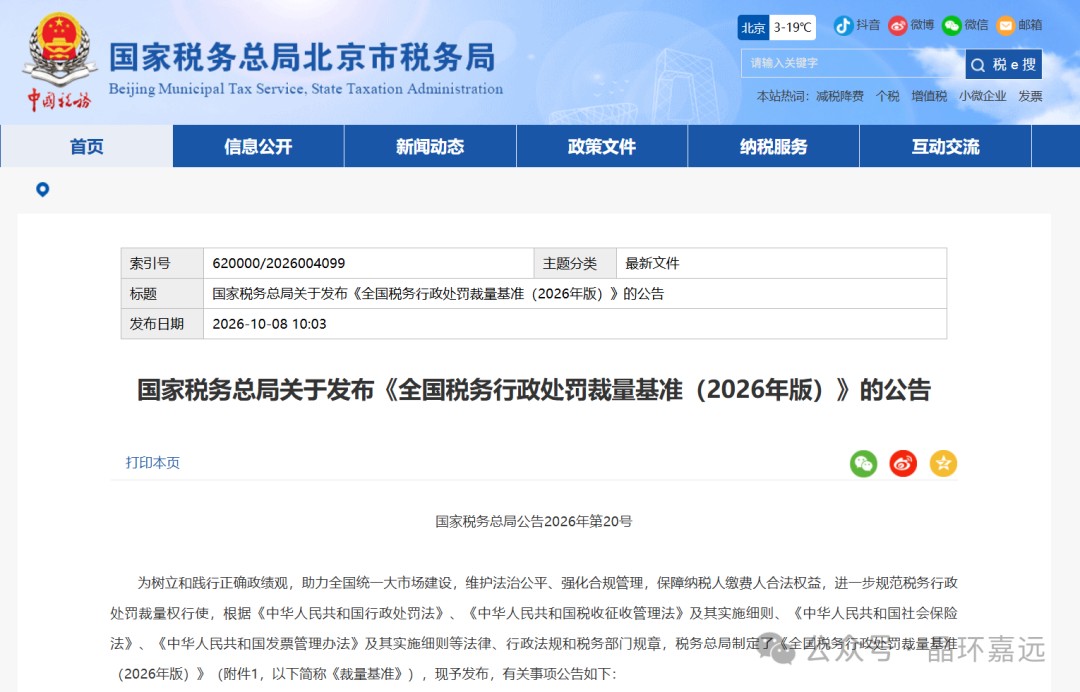
The National Tax Administrative Penalty Discretionary Standards (2026 Edition) take effect on November 1. Their key change is to replace the locally varying discretion previously applied to conduct such as issuing false invoices and tax evasion with nationally unified, quantifiable criteria. This directly narrows the scope for ambiguous practices that recycling businesses may previously have encountered in areas such as reverse invoicing and purchases from individual collectors. The following outlines the risk points that warrant particular attention, taking into account the industry’s specific business chain.
The new standards do not create new tax obligations, but they change how violations are assessed for penalties: the previously fragmented and predictable “local flexibility” is replaced by uniform, quantifiable penalty tiers. For recycling businesses, the focus of compliance should shift from “how to obtain an invoice” to “how to ensure that the business chain behind every invoice can withstand tax inspection.”
According to statistics in the China Renewable Resources Industry Development Report (2026), the market size, total recycling volume, source composition, and share collected from individual collectors for the six core categories are shown in Table 1.
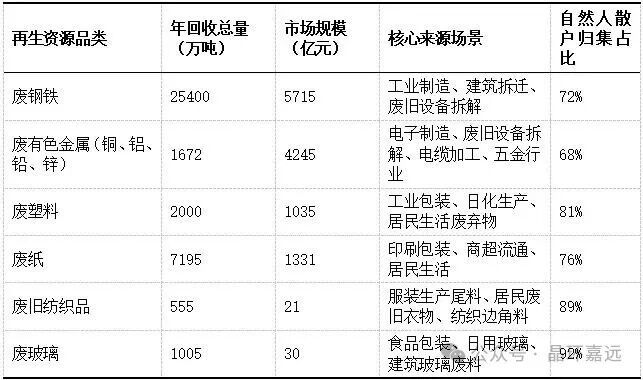
Table 1. Market and Collection Structure of China’s Core Renewable Resource Categories in 2025 (Source: China Renewable Resources Recycling Industry Development Report (2026) and related data estimates
The data clearly show that the upstream supply of China’s renewable resources industry is highly dependent on collection from individual collectors. Among low-value-added consumer goods categories, the share collected from individual collectors is close to 90% for waste glass and waste textiles, with supply collection relying almost entirely on intermediaries handling small, scattered lots. Among medium- and high-value-added categories, the share exceeds 75% for waste plastics and waste paper. Even for waste steel and non-ferrous metals—the categories with the strongest industrial characteristics and highest value—the share collected from individual collectors is close to 70%. Under this highly fragmented collection model, upstream taxpayers are small in scale, dispersed, and loosely organized, with low tax compliance. Downstream businesses have difficulty obtaining special VAT invoices to claim input tax credits, resulting in a relatively heavy tax burden at the recycling stage and creating a long-standing, objectively low level of tax compliance across the industry.
What the unified, quantified discretionary standards mean for the renewable resources industry
In the past, fines for issuing false invoices varied from one locality to another, and businesses sometimes formed expectations for non-compliant invoicing practices based on “local conventions.” The new standards cover 66 violations across nine categories and establish five uniform tiers—minor, relatively minor, general, relatively serious, and serious—with quantified criteria specified for each violation. This means renewable resource businesses can no longer rely on “this has always been handled this way locally” as a defense. Invoice irregularities involving reverse invoicing or purchases from individual collectors will be subject to consistent, predictable penalty tiers nationwide.
Particular attention should be paid to the fact that issuing false invoices, tax evasion, resisting tax, and tax fraud are explicitly excluded from the lists of violations eligible for “no penalty for minor violations” and “no penalty for a first-time violation.” If practices previously relied on by the renewable resources industry in purchases from individual collectors—such as using self-prepared supporting documents or “finding invoices”—are found to constitute false invoicing or tax evasion, there is virtually no room for flexible enforcement.
Item 49: Issuing false invoices
Legal basis: Article 35, paragraph 1, of the Measures of the People’s Republic of China on the Administration of Invoices
Discretionary tiers and specific standards:
Relatively minor: The amount of false invoices is less than RMB 10,000. Illegal gains shall be confiscated, and a fine of RMB 10,000 to RMB 50,000 shall be imposed.
General: The amount of false invoices exceeds RMB 10,000 and is no more than RMB 500,000. Illegal gains shall be confiscated, and a fine of RMB 50,000 to RMB 100,000 shall be imposed.
Relatively serious: The amount of false invoices exceeds RMB 500,000 and is no more than RMB 2.5 million; or, having received two or more administrative penalties for issuing false invoices within five years, the party issues false invoices again in an amount exceeding RMB 300,000 and no more than RMB 1.5 million. Illegal gains shall be confiscated, and a fine of RMB 100,000 to RMB 300,000 shall be imposed.
Serious: The amount of false invoices exceeds RMB 2.5 million; or, having received two or more administrative penalties for issuing false invoices within five years, the party issues false invoices again in an amount exceeding RMB 1.5 million; or other serious circumstances apply. Illegal gains shall be confiscated, and a fine of RMB 300,000 to RMB 500,000 shall be imposed.
Item 19: Tax evasion: A taxpayer forges, alters, conceals, or destroys without authorization account books or accounting vouchers; records excessive expenditures or fails to record or underreports income in account books; or, after being notified by the tax authority to file a return, refuses to file or files a false tax return, thereby failing to pay or underpaying tax payable
Legal basis: Article 63, paragraph 1, of the Law of the People’s Republic of China on the Administration of Tax Collection
Relatively minor:
The taxpayer is subject to an administrative penalty by the tax authority for the first time within five years, and the unpaid or underpaid tax is less than RMB 500,000, or accounts for less than 30% of the tax payable.
A fine of 50% of the unpaid or underpaid tax shall be imposed.
General:
The taxpayer is subject to an administrative penalty by the tax authority for the first time within five years, and the unpaid or underpaid tax is at least RMB 500,000 and accounts for at least 30% of the tax payable.
A fine of 50% to 100% of the unpaid or underpaid tax shall be imposed.
Relatively serious:
The taxpayer has been subject to administrative penalties by the tax authority two or more times within five years, and the unpaid or underpaid tax is less than RMB 500,000 or accounts for less than 30% of the tax payable, or other relatively serious circumstances apply.
A fine of one to three times the unpaid or underpaid tax shall be imposed.
Serious:
The taxpayer has been subject to administrative penalties by the tax authority two or more times within five years, and the unpaid or underpaid tax is at least RMB 500,000 and accounts for at least 30% of the tax payable, or other serious circumstances apply.
A fine of three to five times the unpaid or underpaid tax shall be imposed.
If the taxpayer actively cooperates with the tax inspection or voluntarily pays in full the additional tax identified in the inspection before the tax authority issues a tax treatment decision, the minimum standard for each tier may apply.
Item 21: A taxpayer fails to file a tax return and fails to pay or underpays tax payable
Legal basis: Article 64, paragraph 2, of the Law of the People’s Republic of China on the Administration of Tax Collection
Relatively minor:
The taxpayer is subject to an administrative penalty by the tax authority for the first time within five years, and the unpaid or underpaid tax is less than RMB 500,000.
A fine of 50% of the unpaid or underpaid tax shall be imposed.
General:
The taxpayer is subject to an administrative penalty by the tax authority for the first time within five years, and the unpaid or underpaid tax is at least RMB 500,000.
A fine of 50% to 100% of the unpaid or underpaid tax shall be imposed.
Relatively serious:
The taxpayer has been subject to administrative penalties by the tax authority two or more times within five years, and the unpaid or underpaid tax is less than RMB 500,000, or other relatively serious circumstances apply.
A fine of one to three times the unpaid or underpaid tax shall be imposed.
Serious:
The taxpayer has been subject to administrative penalties by the tax authority two or more times within five years, and the unpaid or underpaid tax is at least RMB 500,000, or other serious circumstances apply.
A fine of three to five times the unpaid or underpaid tax shall be imposed.
Reverse invoicing: Failure to fulfill tax-handling obligations can result in the loss of eligibility
The reverse invoicing system addresses the difficulty renewable resource businesses face in obtaining source documents from individual collectors. Invoices issued through reverse invoicing can serve as supporting documents for VAT input tax credits and pre-tax deductions for corporate income tax purposes. This convenience comes with strict obligations to handle tax matters on the seller’s behalf: when a resource recycling business issues a “reverse invoice” to an individual, it must handle the filing of VAT, surcharges, and individual income tax on behalf of the seller, and submit the Report on Taxes and Fees Handled on Behalf of Others on a monthly basis.
The direct consequence of failing to fulfill these obligations is not a fine, but the “suspension of eligibility for reverse invoicing,” together with recovery of taxes and fees due and late payment surcharges. For renewable resource businesses that rely on reverse invoicing to maintain their input tax credit chain, suspension of eligibility undermines the foundation of their business model. In addition, once an individual’s cumulative sales through reverse invoicing exceed RMB 5 million over 12 consecutive months, the business may no longer issue reverse invoices to that individual and should guide them to register a business entity and issue invoices themselves. This threshold must be incorporated into supplier management procedures.
Purchases from individual collectors and purchase-and-sales ledgers: business authenticity is the underlying factor in determining penalties
The compliance focus for purchases from individual collectors has shifted from “whether an invoice can be obtained” to “whether the business behind the invoice can be proven to be genuine.” When determining the penalty tier, tax authorities take into account factors such as the degree of cooperation with inspections and the consequences of the violation. The completeness of retained records directly affects whether a business can prove the authenticity of its transactions during an inspection and seek a lower penalty tier.
The purchase ledger is the core record for meeting retention requirements. Announcement No. 5 requires businesses to record, for each transaction, the purchase date and location, the seller’s name and contact details, product name, quantity, and price. Supporting materials include purchase contracts or agreements, transport documents, weighbridge tickets, transfer and payment records, and seller identity verification documents. The Code for the Construction and Management of Renewable Resources Collection Sites, implemented in July 2026, further requires the establishment of electronic purchase-and-sales ledgers and their retention for at least three years. It also links these requirements with the “four flows in alignment” (contract flow, goods flow, fund flow, and invoice flow) oversight for reverse invoicing. Incomplete ledgers, or discrepancies between ledgers and fund or goods flows, will directly undermine the credibility of the business’s claims of transaction authenticity during an inspection and may lead to a more severe penalty tier.
About RESOLAR
Shanghai RESOLAR Energy Technology Co., Ltd. is committed to becoming a recycled material photovoltaic group with deep decarbonization. RESOLAR focuses on technological innovation and builds a world-leading solution for component recycling, impurity removal of damaged cells, recycled silicon materials and cells, and cascaded utilization of components. With professional technology and services, we help customers realize the recycling and reuse of waste photovoltaic resources, and make positive contributions to the development of environmental protection and new energy industries. For more detailed information, you can browse the official website: www.resolartech.com .

Latest developments/news
Contact information
Service Hotline: 13585742918 (Monday to Friday 9:00-18:00)
Enterprise email: ps@resolartech.com (Reply within 48 hours after receiving the email consultation!)
Company Address: Building 8, No. 1528, Wangxu East Road, Fengjing Town, Jinshan District, Shanghai (Caohejing Fengjing Park)