


English
News Center
—— NEWS CENTER ——
Prices for decommissioned photovoltaic modules with frames began their first round of price reductions on May 26, followed by an overall decline for six consecutive weeks. During this period, there was only one brief rebound in some categories, but it failed to continue. Over the past two weeks, prices across all categories have once again continued to fall, with the overall market remaining in a long-term fluctuating downward trend.
As module prices continued to decline, the previously frenzied market atmosphere of hoarding goods and scrambling for supply has completely faded, and the industry has gradually returned to rational operations. Industry participants have clearly recognized that even small-scale recycling workshops will ultimately fall into losses after previously purchasing and stockpiling decommissioned modules at blindly high prices. Entering the photovoltaic module recycling sector rashly simply by following the trend can easily result in substantial losses.
Looking ahead, as digital supervision platforms for renewable resources are successively established in various regions and integrated online and offline unified trading systems are implemented, while new tax policies related to unified reverse invoicing are comprehensively introduced, competent authorities are continuously intensifying efforts to crack down on illegal dismantling, non-compliant recycling practices, and tax violations. The operating space for scattered small workshops will continue to be squeezed, and the compliant and standardized development of the industry has become an inevitable trend.
Week 1 (May 18)
Market divergence: prices of older small-size modules increased, while large-size, high-power modules fell sharply.
Week 2 (May 26 · 1st round of price reductions)
Market reversal: some older models led the decline, and the market officially entered a price-reduction cycle.
Week 3 (June 2 · 2nd round of price reductions)
Prices fell across all categories, and the decline spread.
Week 4 (June 9 · 3rd round of price reductions)
Prices across all categories continued to decline, with no signs of stabilization yet.
Week 5 (June 16 · 4th round of price reductions)
Prices across all categories accelerated their decline, with the drop significantly greater than the previous week; some categories fell by more than 10%.
Week 6 (June 23 · 5th round of price reductions)
Prices across all categories continued to decline, with some categories falling by more than 10%.
Week 7 (June 30 · 6th round of price reductions)
Prices across all categories continued to decline.
Week 8 (July 7 · 1st rebound)
Market divergence: prices of older modules rebounded, while prices of new modules continued to fall.
Week 9 (July 14 · 7th round of price reductions)
The brief structural rebound ended, and module prices across all categories once again entered an accelerated decline.
Week 10 (July 21 · 8th round of price reductions)
Module prices across all categories continued to decline, and the overall downward trend persisted.
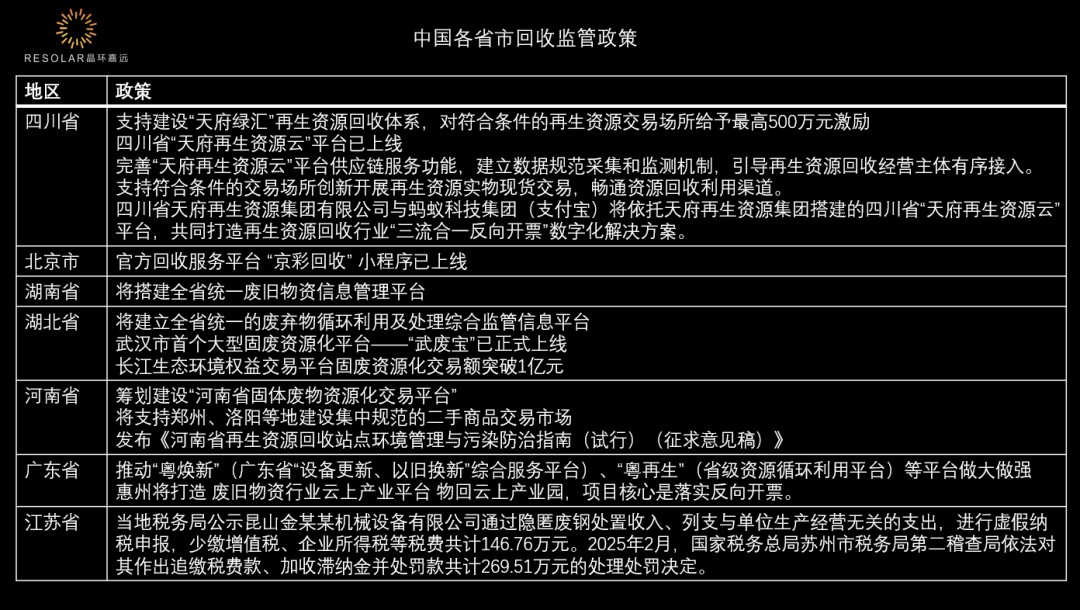
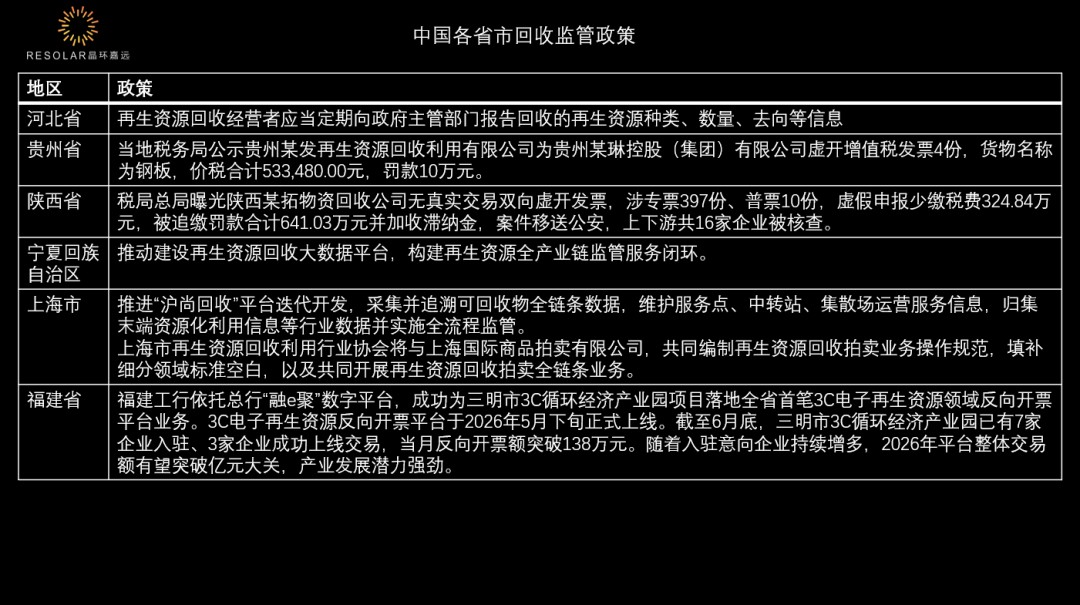
The prices currently published by the market are all tax-inclusive reference prices. A large number of distributed decommissioned modules in the industry are still traded through offline cash transactions without invoices and unreported tax arrangements. However, as nationwide fiscal and tax compliance policies for renewable resources are fully implemented, the space for informal circulation in the industry is continuously shrinking and gradually being eliminated.
Starting July 1, 2026, when individuals sell scrapped products through “unified reverse invoicing for the three flows” (the payment platform directly connects to automatically deduct taxes and issue invoices), the advance individual income tax withholding rate for annual sales of no more than 600,000 yuan will be reduced to 0.25% (the rate remains 0.5% for amounts exceeding 600,000 yuan and for traditional reverse invoicing). On July 2, 2026, the “five flows integration” reverse invoicing product system of Zihuan Lianjin was officially connected to the “three flows integration” reverse invoicing service of Industrial and Commercial Bank of China, successfully issuing the first Lekai platform reverse invoice after the two parties began their cooperation. In July 2026, Sichuan Tianfu Renewable Resources Group Co., Ltd. and Ant Technology Group (Alipay) will rely on the “Sichuan Tianfu Renewable Resources Cloud” platform established by Tianfu Renewable Resources Group to jointly develop a digital solution for “unified reverse invoicing for the three flows” in the renewable resources recycling industry, supporting the high-quality development of the renewable resources recycling and utilization industry throughout the province.
In January 2026, the Ministry of Commerce and 9 other departments issued the Notice on Implementing the Green Consumption Promotion Initiative, which clearly stated that efforts should be made to “promote the development of a national unified recycling service platform”;
On February 24, 2026, the General Office of the Sichuan Provincial People’s Government issued the Implementation Opinions of the General Office of the Sichuan Provincial People’s Government on Further Promoting Innovation and Breakthroughs in the Service Industry, proposing support for the development of the “Tianfu Green Exchange” renewable resources recycling system and incentives of up to 5 million yuan for eligible renewable resources trading venues.
In addition, the official Beijing recycling service platform mini program “Jingcai Recycling” has been launched. The commercial authorities of the Hunan provincial government will establish a province-wide unified information management platform for used materials, providing functions including information reporting, supply-and-demand coordination, price guidance, risk warnings, and carbon emission reduction assessment. Hubei Province will establish a province-wide unified comprehensive supervision information platform for waste recycling and treatment, providing services for the collection, analysis, processing, and release of information related to waste recycling and treatment. Henan Province is planning to develop the “Henan Province Solid Waste Resource Trading Platform.” The platform has completed its design plan, and preparations are progressing in an orderly manner. Hebei Province supports recycling parks and sorting centers in developing digital platforms for renewable resources recycling, integrating functions such as online trading, intelligent matching, and traceability inquiries. Hebei Province has clarified that renewable resources recycling operators should regularly report information on the types, quantities, destinations, and other details of recycled renewable resources to the competent government authorities. Guangdong Province has issued policy documents to promote the expansion and strengthening of platforms such as “Yuehuanxin” (the Guangdong Comprehensive Service Platform for Equipment Upgrades and Trade-ins) and “Yuezai-sheng” (the provincial resource recycling platform). On March 28, 2026, Wuhan’s first large-scale solid waste resource utilization platform, “Wufeibao,” was officially launched. It will use the convenience of the internet to connect the “last mile” of Wuhan’s solid waste resource recycling industry chain and support Wuhan in building the country’s largest urban mining circular industry cluster. On July 9, 2026, the Shanghai Renewable Resources Recycling Industry Association and Shanghai International Commodity Auction Co., Ltd. will jointly compile operating standards for renewable resources recycling auctions to fill the standards gap in this specialized field, while jointly conducting full-chain renewable resources recycling auction business.
The 2026 large-scale equipment renewal and consumer goods trade-in plans of Shanxi Province, Guangdong Province, and Jiangsu Province all mentioned for the first time that illegal recycling and dismantling activities would be severely investigated and punished in accordance with the law. They also called for the implementation of “reverse invoicing,” the standardization of tax supervision over resource recycling enterprises, and the standardization of online/offline second-hand goods trading markets.
In June 2026, the Guizhou Tax Service published a notice stating that a certain renewable resources recycling and utilization company in Guizhou had issued 4 special electronic VAT invoices to a certain holding group company in Guizhou without any genuine steel plate purchase or sales transactions. The goods were listed as steel plates, with a total tax-inclusive amount of 533,480.00 yuan. The company attempted to fabricate capital flows through the return of funds via private accounts and assist downstream enterprises in deducting input tax through the issuance of false invoices.
The tax authorities imposed an administrative penalty of 100,000 yuan on the company in accordance with the law.
In April 2026, the State Taxation Administration exposed a materials recycling company in Shaanxi for issuing fraudulent invoices in both directions without genuine transactions. The case involved 397 special VAT invoices and 10 ordinary invoices, with falsely declared and underpaid taxes and fees totaling 3.2484 million yuan. The company was ordered to pay back taxes and fines totaling 6.4103 million yuan, along with late payment surcharges. The case was transferred to the public security authorities, and 16 upstream and downstream enterprises were investigated.
About RESOLAR
Shanghai RESOLAR Energy Technology Co., Ltd. is committed to becoming a recycled material photovoltaic group with deep decarbonization. RESOLAR focuses on technological innovation and builds a world-leading solution for component recycling, impurity removal of damaged cells, recycled silicon materials and cells, and cascaded utilization of components. With professional technology and services, we help customers realize the recycling and reuse of waste photovoltaic resources, and make positive contributions to the development of environmental protection and new energy industries. For more detailed information, you can browse the official website: www.resolartech.com .

Latest developments/news
Contact information
Service Hotline: 13585742918 (Monday to Friday 9:00-18:00)
Enterprise email: ps@resolartech.com (Reply within 48 hours after receiving the email consultation!)
Company Address: Building 8, No. 1528, Wangxu East Road, Fengjing Town, Jinshan District, Shanghai (Caohejing Fengjing Park)