


English
News Center
—— NEWS CENTER ——
On November 13, 2026, the Ministry of Ecology and Environment issued the Implementation Opinions on Strengthening the Supervision of Pollution Prevention and Control for General Industrial Solid Waste (Draft for Comments), which state:
Strengthen the responsibility of entities that generate industrial solid waste (hereinafter, “waste-generating entities”) and other responsible parties. Waste-generating entities shall establish and implement industrial solid waste management ledgers in accordance with the law, accurately recording the types, quantities, destinations, storage, utilization, and disposal of industrial solid waste generated. Where a waste-generating entity engages another party to transport, utilize, or dispose of industrial solid waste, it shall verify the contractor’s legal qualifications and technical capabilities in accordance with the law, enter into a written contract, and specify pollution prevention and control requirements. These requirements shall include making clear that the contractor must inform the waste-generating entity of the details of transportation, utilization, and disposal, and agreeing on payment arrangements that help prevent the illegal transfer and dumping of solid waste (for example, paying transportation fees only after the solid waste has arrived at the utilization or disposal facility). Waste-generating entities shall not engage “intermediaries” that lack the necessary legal qualifications and technical capabilities to transport, utilize, or dispose of industrial solid waste. Waste-generating entities shall identify solid waste in accordance with the law. Industrial by-products identified as solid waste shall be managed as industrial solid waste. Decommissioned photovoltaic modules and wind power equipment no longer used for their original power generation purposes shall be managed as industrial solid waste in accordance with the law. Entities that generate, store, utilize, or dispose of industrial solid waste shall test and monitor it, and adopt corresponding pollution prevention and control measures in accordance with classification requirements (Category I general industrial solid waste, Category II general industrial solid waste, or hazardous waste).
Strengthen digital oversight of industrial solid waste. Improve the functions of the National Information Platform for Solid Waste Pollution Prevention and Control, and advance end-to-end monitoring and digital traceability of the generation, collection, storage, transfer, utilization, and disposal of industrial solid waste. Waste-generating entities shall provide the local ecology and environment department with information through the National Information Platform for Solid Waste Pollution Prevention and Control, including the types of industrial solid waste (including its management category, i.e., Category I or Category II general industrial solid waste), quantities, destinations, storage, utilization, and disposal (incineration, landfill, or other disposal methods), as well as specific measures to reduce industrial solid waste generation and promote its comprehensive utilization. Localities with the necessary capacity are encouraged to explore a real-time information collection system requiring immediate reporting upon transfer and immediate reporting upon receipt of general industrial solid waste.
Improve the system for rewarding reports of violations of ecology and environment laws and regulations, widely collect leads from public reports and online exposure, and continue to narrow the scope for the illegal dumping and disposal of solid waste.
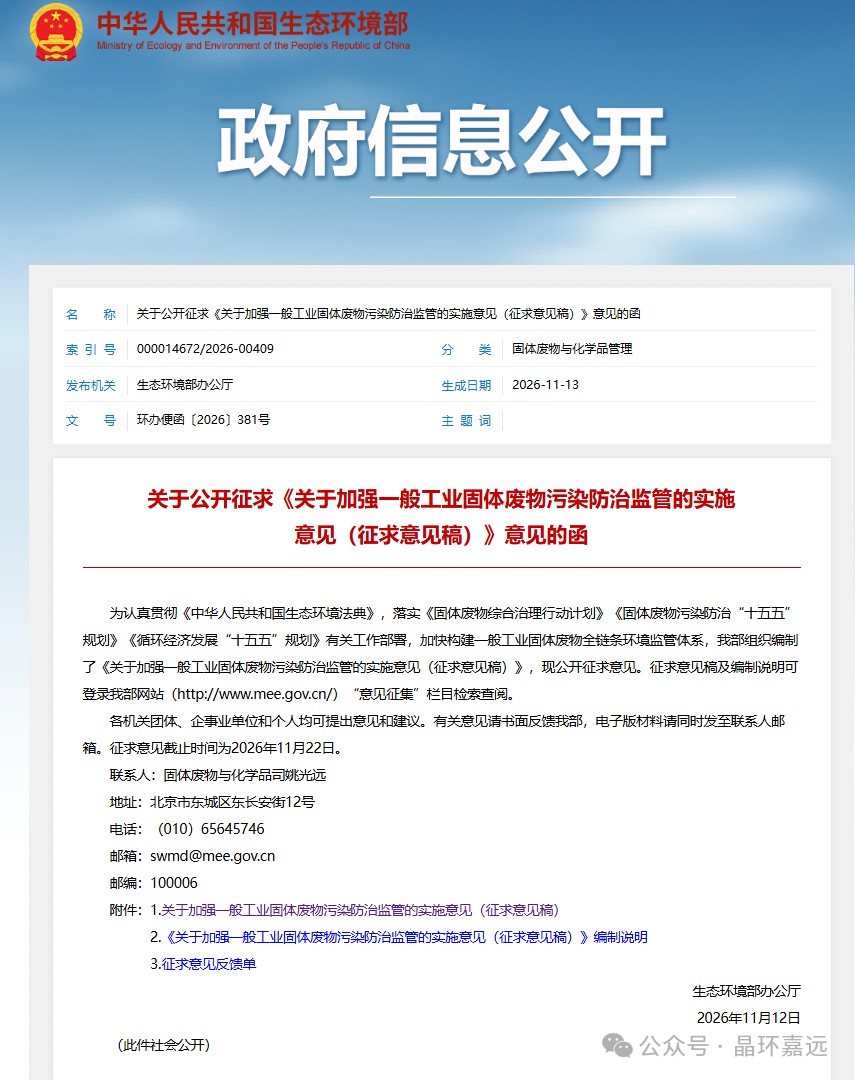
Letter on Public Consultation on the Implementation Opinions on Strengthening the Supervision of Pollution Prevention and Control for General Industrial Solid Waste (Draft for Comments)
Huanban Bianhan [2026] No. 381
To earnestly implement the Ecology and Environment Code of the People's Republic of China and carry out the relevant tasks set out in the Action Plan for the Comprehensive Management of Solid Waste, the 15th Five-Year Plan for Solid Waste Pollution Prevention and Control, and the 15th Five-Year Plan for Circular Economy Development, and to accelerate the establishment of an end-to-end environmental oversight system for general industrial solid waste, our Ministry has organized the drafting of the Implementation Opinions on Strengthening the Supervision of Pollution Prevention and Control for General Industrial Solid Waste (Draft for Comments). The draft is now open for public comment. The draft and its explanatory notes can be accessed by searching the “Solicitation of Comments” section of our Ministry’s website (http://www.mee.gov.cn/).
Government agencies, organizations, enterprises, public institutions, and individuals may submit comments and suggestions. Please provide comments to our Ministry in writing, and also send electronic copies to the contact person’s email address. The deadline for submitting comments is November 22, 2026.
Annex 1
Implementation Opinions on Strengthening the Supervision of Pollution Prevention and Control for General Industrial Solid Waste (Draft for Comments)
These Implementation Opinions are formulated to earnestly implement the Ecology and Environment Code of the People's Republic of China, carry out the relevant tasks set out in the Action Plan for the Comprehensive Management of Solid Waste, the 15th Five-Year Plan for Solid Waste Pollution Prevention and Control, and the 15th Five-Year Plan for Circular Economy Development, and accelerate the establishment of an end-to-end environmental oversight system for general industrial solid waste.
I. Strictly Prevent Transfer Risks
(I) Strengthen the responsibility of entities that generate industrial solid waste (hereinafter, “waste-generating entities”) and other responsible parties. Waste-generating entities shall establish and implement industrial solid waste management ledgers in accordance with the law, accurately recording the types, quantities, destinations, storage, utilization, and disposal of industrial solid waste generated. Where a waste-generating entity engages another party to transport, utilize, or dispose of industrial solid waste, it shall verify the contractor’s legal qualifications and technical capabilities in accordance with the law, enter into a written contract, and specify pollution prevention and control requirements. These requirements shall include making clear that the contractor must inform the waste-generating entity of the details of transportation, utilization, and disposal, and agreeing on payment arrangements that help prevent the illegal transfer and dumping of solid waste (for example, paying transportation fees only after the solid waste has arrived at the utilization or disposal facility). Waste-generating entities shall not engage “intermediaries” that lack the necessary legal qualifications and technical capabilities to transport, utilize, or dispose of industrial solid waste. Waste-generating entities shall identify solid waste in accordance with the law. Industrial by-products identified as solid waste shall be managed as industrial solid waste. Decommissioned photovoltaic modules and wind power equipment no longer used for their original power generation purposes shall be managed as industrial solid waste in accordance with the law. Entities that generate, store, utilize, or dispose of industrial solid waste shall test and monitor it, and adopt corresponding pollution prevention and control measures in accordance with classification requirements (Category I general industrial solid waste, Category II general industrial solid waste, or hazardous waste).
(II) Strictly implement environmental impact assessment and pollutant discharge permitting systems. Construction projects that generate industrial solid waste shall undergo environmental impact assessment in accordance with the law, with a detailed analysis of the types and quantities of general industrial solid waste generated. Pollutant discharge permits issued to waste-generating entities subject to pollutant discharge permit management shall specify information such as requirements for the storage, utilization, and disposal of industrial solid waste.
(III) Promote the proper management and disposal of large-volume, low-value industrial solid waste that is difficult to utilize. Local ecology and environment departments shall consult with departments responsible for the comprehensive management of circular economy development and focus on entities that generate large volumes of low-value industrial solid waste, as well as waste-generating entities that rely on the building materials industry to absorb industrial solid waste (such as fly ash), providing stronger support and guidance. Where markets have contracted or sales channels are limited, they shall promote the expansion of comprehensive utilization pathways; where there is no outlet for utilization, the waste shall be stored appropriately or disposed of in a harmless manner. They shall provide targeted publicity on the Ecology and Environment Code, raise waste-generating entities’ awareness of environmental protection and legal compliance, strengthen digital oversight, and strictly prevent illegal transfers and disposal.
II. Strictly Prevent Landfill Risks
(IV) Reduce the hazardous properties of industrial solid waste. Standards for pollution control of key types of general industrial solid waste, such as phosphogypsum, red mud, manganese slag, and lithium slag, shall be formulated progressively by category. Limits on the content of toxic and hazardous substances shall be strictly controlled. Cleaner production and harmless pretreatment shall be promoted at the generation stage to convert key types of general industrial solid waste from Category II to Category I, reducing the risk of environmental pollution from subsequent landfill disposal. Comprehensive utilization of key types of general industrial solid waste shall be strengthened to reduce the quantities stored or landfilled.
(V) Strictly strengthen environmental oversight of storage and landfill sites for general industrial solid waste. The technical boundaries of storage and landfill sites shall be strictly defined. Sites where general industrial solid waste is stockpiled that are not temporary in nature and have no subsequent utilization destination shall be managed as landfills, preventing landfills from being built under the guise of storage sites. Local ecology and environment departments shall conduct supervisory inspections of solid waste entering such sites in accordance with the law and strictly prohibit the mixing in of solid waste that does not meet site acceptance requirements. Operators and managers of storage and landfill sites shall strengthen routine management and regularly investigate potential environmental pollution risks.
(VI) Address environmental risks from seepage at legacy stockpiles of general industrial solid waste. Technical guidelines shall be developed for investigating and addressing environmental risks from seepage at legacy stockpiles of general industrial solid waste. The focus shall be on legacy tailings ponds, landfills, and stockpiles (slag piles) that had been decommissioned by the end of 2025 but have not completed closure and official deregistration. An assessment shall be conducted of their impacts on the surrounding ecological environment. For stockpiles with potential environmental risks, site-specific remediation plans shall be implemented, and a mechanism shall be established to review and verify remediation results. Sites that meet the deregistration criteria shall be deregistered promptly.
III. Prudently and Orderly Explore Channels for Large-Scale Utilization and Disposal
(VII) Strictly prevent illegal dumping under the guise of large-scale utilization and disposal. On the condition that environmental quality standards, pollution risk control requirements, and work safety requirements are met, large-scale utilization and disposal of bulk industrial solid waste shall be explored through methods such as underground backfilling, mine pit backfilling, and ecological restoration. Such utilization and disposal shall be coordinated with the needs of ecological restoration, land reclamation, and filling and backfilling, and appropriate measures shall be taken to prevent dust dispersion, loss, seepage, and other environmental pollution. Local ecology and environment departments shall carry out large-scale utilization and disposal of bulk industrial solid waste in strict accordance with the procedures of “scientific assessment, development of standards, proactive disclosure, and full-process oversight.” The use of video surveillance, vehicle tracking, satellite remote sensing, drone inspections, and other methods is encouraged to oversee utilization and disposal activities, ensuring real-time traceability throughout the entire process, preventing the mixing of industrial solid waste that does not meet requirements, and preventing the illegal transfer and dumping of industrial solid waste.
IV. Improve Digital Oversight Capabilities
(VIII) Strengthen digital oversight of industrial solid waste. Improve the functions of the National Information Platform for Solid Waste Pollution Prevention and Control, and advance end-to-end monitoring and digital traceability of the generation, collection, storage, transfer, utilization, and disposal of industrial solid waste. Waste-generating entities shall provide the local ecology and environment department with information through the National Information Platform for Solid Waste Pollution Prevention and Control, including the types of industrial solid waste (including its management category, i.e., Category I or Category II general industrial solid waste), quantities, destinations, storage, utilization, and disposal (incineration, landfill, or other disposal methods), as well as specific measures to reduce industrial solid waste generation and promote its comprehensive utilization. Localities with the necessary capacity are encouraged to explore a real-time information collection system requiring immediate reporting upon transfer and immediate reporting upon receipt of general industrial solid waste. In principle, provincial-level ecology and environment departments shall guide entities in their administrative regions that handle key types of general industrial solid waste, as well as entities that handle tailings, fly ash, coal gangue, flue gas desulfurization gypsum, and furnace slag, to complete their first annual information submissions by the end of 2027.
V. Improve Problem Detection Capabilities
(IX) Broaden channels for detecting problems. Accelerate the establishment of a multi-layered inspection system for illegal dumping and disposal, combining “satellite surveillance, on-the-ground inspections, and public reporting.” Strengthen the application of technologies such as satellite remote sensing and drone inspections, and enhance manual patrols and inspections. Improve the system for rewarding reports of violations of ecology and environment laws and regulations, widely collect leads from public reports and online exposure, and continue to narrow the scope for the illegal dumping and disposal of solid waste. Explore the development of material balance models for typical industrial solid waste and its raw and auxiliary materials and products, analyze and assess data anomalies and leads of environmental violations, and improve the ability to detect environmental violations involving industrial solid waste through non-site-based methods.
VI. Crack Down on Illegal Transfers and Dumping
(X) Address illegal transfers and dumping in accordance with the law. Strengthen two-way coordination between administrative law enforcement and criminal justice, improve mechanisms for transferring cases, and crack down severely on environmental violations and crimes such as the illegal discharge, dumping, and disposal of solid waste. Improve interprovincial and key-area mechanisms for coordinated ecology and environment enforcement, and enhance the capacity to jointly combat cross-regional environmental violations and crimes. Increase public exposure and coordinated penalties for typical cases involving egregious violations, strengthening their deterrent effect.
VII. Implementation
Ecology and environment departments at all levels in localities shall strengthen coordination, conduct thorough investigations and research on the ground, promptly summarize experience, and steadily advance the supervision of pollution prevention and control for general industrial solid waste. Updates on work progress and important matters shall be reported to the Ministry of Ecology and Environment promptly.
About RESOLAR
Shanghai RESOLAR Energy Technology Co., Ltd. is committed to becoming a recycled material photovoltaic group with deep decarbonization. RESOLAR focuses on technological innovation and builds a world-leading solution for component recycling, impurity removal of damaged cells, recycled silicon materials and cells, and cascaded utilization of components. With professional technology and services, we help customers realize the recycling and reuse of waste photovoltaic resources, and make positive contributions to the development of environmental protection and new energy industries. For more detailed information, you can browse the official website: www.resolartech.com .

Latest developments/news
Contact information
Service Hotline: 13585742918 (Monday to Friday 9:00-18:00)
Enterprise email: ps@resolartech.com (Reply within 48 hours after receiving the email consultation!)
Company Address: Building 8, No. 1528, Wangxu East Road, Fengjing Town, Jinshan District, Shanghai (Caohejing Fengjing Park)