


English
News Center
—— NEWS CENTER ——
Recently, Shanghai Second Polytechnic University, in collaboration with RESOLAR, published a study in the 3rd issue of "Wind and Solar Equipment Recycling" in 2026, revealing how eutectic solvent (DES) can be transformed into a "magic weapon" for photovoltaic recycling, opening up a new track for the green recycling of retired photovoltaic modules!
"Wind and Solar Equipment Recycling" is an industry journal that gathers information on the development of the wind and solar power recycling industry at home and abroad . It mainly includes policy news, industry information, industry research, and project information. It aims to focus on the coordinated development of the wind and solar recycling industry, create an industry exchange platform, strengthen industry planning and guidance, and promote the development of the circular economy.
Against the backdrop of the overlapping "dual carbon" goals and the wave of photovoltaic (PV) retirement, the green and efficient recycling of retired crystalline silicon PV modules has become a core requirement for resource recycling and environmental protection. Traditional recycling technologies suffer from drawbacks such as heavy secondary pollution, high energy consumption, low metal recovery rates, and easy damage to silicon wafers. Deuterated eutectic solvents (DES), with their advantages of adjustable structure, low toxicity, low volatility, low cost, and excellent solubility, have become a new type of green medium to replace traditional organic solvents and strong acid/base systems, demonstrating great application potential in the resource recycling of retired PV modules. This paper systematically reviews the definition, classification, and core characteristics of DES (Distilled Extrusion Separator) for photovoltaic (PV) recycling. It focuses on the research progress of DES in EVA film/ fluorinated backsheet removal, selective leaching of valuable metals (silver, aluminum, copper), near-non-destructive recycling of high-purity silicon wafers, and full-component coupled recycling processes. The paper compares and analyzes the techno-economic and environmental benefits of DES processes with traditional recycling processes, summarizes the bottlenecks faced in its industrial application such as poor cycle stability, difficulties in engineering scale-up, high viscosity, and insufficient targeted design, and looks forward to future directions such as the development of novel functionalized DES, mechanism research, process integration, and large-scale application. The aim is to provide theoretical reference and technical support for the development of green and efficient recycling technologies for retired PV modules.
01
Research progress on the application of eutectic solvents in the resource recycling of decommissioned photovoltaic modules
Source: Zhu Jiajian, Shanghai Second Polytechnic University, RESOLAR Energy Technology (Shanghai) Co., Ltd.
RESOLAR Energy Technology (Shanghai) Co., Ltd.Jie Yahui, Shanghai Second Polytechnic University
Zhang Li, Shanghai Second Polytechnic University
Liu Juncheng, Shanghai Second Polytechnic University
Yuan Wenyi, Shanghai Second Polytechnic University

1. Introduction
The demand for low-carbon emissions and the global energy crisis have driven the rapid development of the photovoltaic (PV) industry. In 2023, the global newly installed solar PV capacity reached 345.5 GW, with the cumulative installed capacity exceeding 1.42 TW. According to forecasts from organizations such as the International Energy Agency (IEA), the global cumulative installed PV capacity will reach 10 TW by 2030 and grow to 30–80 TW by 2050. As PV modules reach the end of their 25-30 year service life, a large-scale retirement wave will arrive. Retired PV modules are rich in high-value components such as glass, high-purity silicon, silver, aluminum, and copper, possessing extremely high resource utilization value. For example, silver is one of the largest consumer sectors in the PV industry, and its recycling can significantly reduce dependence on primary silver mining and the import of strategic mineral resources.
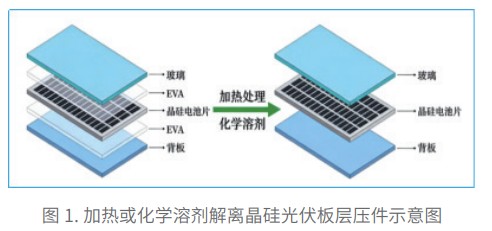
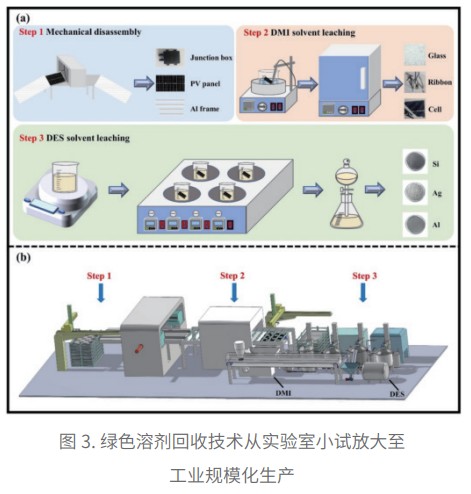
The recycling process of retired photovoltaic modules includes three main steps: (1) mechanical disassembly of the aluminum (Al) frame and junction box, (2) separation of each layer, and (3) recovery of valuable metals. However, during the manufacturing process, EVA tightly binds the glass, solar cells and backsheet together, posing a huge challenge to recycling. The high stability and strong adhesion of EVA hinder the separation of silicon wafers and glass, significantly increasing the difficulty of recycling. Therefore, separating EVA has become a prerequisite for recycling valuable components. Currently, the methods for separating retired photovoltaic modules include mechanical separation, thermal decomposition and chemical dissolution. Mechanical separation technologies (such as electrostatic sorting after crushing, high-voltage pulse crushing, hot knife cutting, laser irradiation, etc.) can achieve preliminary recycling. The preliminary resource utilization of crushed materials can be completed through simple sorting, but this method has inherent defects such as difficulty in separating silicon wafers and glass and incomplete EVA peeling; although hot knife cutting can melt the EVA layer by heating the blade to achieve separation of glass, backsheet and main body, it can only partially release the adhesion between EVA and glass and silicon wafer surface, and cannot achieve complete peeling. In contrast, EVA can achieve 100% thermal decomposition under an inert atmosphere at 500-550℃. However, high energy consumption and emissions of harmful gases (especially toxic waste gases generated by the pyrolysis of fluorinated backsheets) remain the core challenges for the large-scale application of thermal decomposition technology. Overall, traditional physical crushing and sorting methods suffer from low separation accuracy, large metal loss, and low silicon wafer utilization. Pyrolysis methods easily generate fluorinated toxic gases and organic waste gases. Hydrometallurgy uses strong acid systems such as nitric acid and hydrochloric acid, which have drawbacks such as severe equipment corrosion, large wastewater discharge, and high environmental risks, making it difficult to meet the requirements of green and low-carbon development.
With the rapid development of green solvent technology , novel media such as ionic liquids, eutectic solvents, and bio-based solvents are gradually being applied in the field of solid waste resource recovery. Among them, eutectic solvents (DES) are formed by the self-assembly of hydrogen bond acceptors and hydrogen bond donors through hydrogen bonding. They have outstanding advantages such as simple synthesis, good biocompatibility, no flash point, strong designability, and recyclability. They can selectively act on EVA polymers, metal elements/oxides, and silicon substrates, and are suitable for the precise separation requirements of multi-layered structures and multi-material interfaces in photovoltaic modules. Compared with ionic liquids (complex synthesis, high toxicity, and high cost) and bio-based solvents (low efficiency and lengthy processes), eutectic solvents have become the most promising solvent system in the field of photovoltaic green recycling. Currently, DES has been widely used in key links such as EVA film dissolution and removal, efficient silver and aluminum leaching, and high-purity silicon wafer recovery, becoming a research hotspot for the resource recovery of retired photovoltaic modules. Based on this, this article provides a systematic review of the application of DES in the whole-process resource recycling of retired crystalline silicon photovoltaic modules, covering solvent characteristics, separation mechanism, process research, economic and environmental benefits, industrialization bottlenecks and future prospects. It comprehensively summarizes the latest research results in this field and provides a reference for promoting the industrial application of DES green recycling technology.

2. Classification and core characteristics of eutectic solvents
2.1 Definition and Mainstream Classification of DES
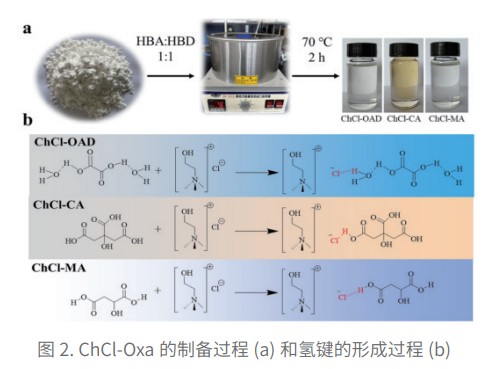
Eutectic solvents are low-melting-point eutectic mixtures formed by heating hydrogen bond acceptors (HBA, mostly quaternary ammonium salts and zwitterionic compounds) and hydrogen bond donors (HBD, carboxylic acids, alcohols, phenols, amides, urea, etc.) in a certain molar ratio. Their melting points are significantly lower than those of the individual components. DES suitable for photovoltaic recycling can be divided into four main categories according to the type of hydrogen bond donor . Carboxylic acid DES uses oxalic acid, citric acid, malonic acid , tartaric acid, etc., as hydrogen bond donors. It is highly acidic, has high efficiency in dissolving EVA and leaching metals, and is currently the most widely used system. Alcohol DES uses ethylene glycol, glycerol, etc., as hydrogen bond donors. It has low viscosity, low toxicity, and is silicon wafer friendly, and is often used for metal leaching and gentle dissociation. Amide DES uses urea, acetamide, etc., as hydrogen bond donors. It is neutral, mild, and has low corrosiveness, suitable for silicon wafer protective recycling. Hydrophobic DES uses menthol, long-chain fatty acids, etc., as hydrogen bond donors. It is highly hydrophobic, easy to separate and regenerate, and provides a new pathway for EVA removal. The mainstream hydrogen bond acceptors are mainly choline chloride (ChCl) and betaine hydrochloride (BeCl). These raw materials are readily available, inexpensive, and biodegradable, making them the two most commonly used hydrogen bond acceptors in the photovoltaic recycling field . Figure 2 shows the preparation and hydrogen bond formation process of the three DES solvents. As shown in Figure 2a, three types of DES were prepared using ChCl as HBA and OAD, CA, and MA as HBD. The strong hydrogen-bonding interaction (OH-Cl) between HBA and HBD significantly lowered the melting point of the mixture compared to the individual components, ensuring that the DES remained in a stable viscous liquid state. This configuration promoted proton delocalization in the organic acids, thereby increasing the acidity of the DES and potentially improving their efficiency in solute separation.
2.2 Core Features of DES Adapted for Photovoltaic Recycling
In the recycling of decommissioned photovoltaic modules, DES exhibits four irreplaceable core advantages . First, its solubility is precisely adjustable . By changing the types and molar ratio of HBA and HBD, the polarity, acidity, and complexing ability of the solvent can be controlled, achieving selective separation of EVA, metals, and silicon wafers—a characteristic that traditional single solvents cannot achieve. Second, it is environmentally friendly. Most components are derived from biomass, are non-toxic, biodegradable, and have no VOC emissions, replacing traditional toxic and harmful reagents such as toluene, trichloroethylene, and strong acids, reducing secondary pollution at the source. Third, it has low volatility and high thermal stability . DES has no flash point and does not easily volatilize at high temperatures, ensuring high safety and making it suitable for high-temperature processing steps in photovoltaic recycling while reducing solvent loss. Finally, it is simple to prepare and low in cost. DES is prepared using a one-step synthesis method, eliminating the need for complex purification processes. The raw materials are all bulk chemical products, facilitating large-scale production and application, laying the foundation for its industrial promotion.

3. Research progress on the application of DES in the entire process of retired photovoltaic module recycling
3.1 DES for the dissolution and removal of EVA film and fluorinated backsheet
The efficient removal of EVA film and fluorinated backsheet is the primary bottleneck in photovoltaic module recycling, directly determining the efficiency and quality of subsequent silicon wafer and metal recycling. Degraded esters (DES) can achieve efficient polymer degradation and stripping through multiple mechanisms, including permeation, swelling, and chemical bond breaking. Carboxylic acid DES is the mainstream system for EVA dissociation. Yu et al. first used a choline chloride-oxalic acid (ChCl-Oxa) system, achieving 100% EVA separation and 98.4% aluminum backsheet removal rate after 10 h of treatment at 175 ℃, with no significant performance degradation after 10 solvent cycles. Building on this, Yu et al. developed a choline chloride-oxalic acid dihydrate (ChCl-OAD) system, utilizing water of crystallization to reduce solvent viscosity and significantly improve solvent permeability. Complete module dissociation can be achieved in just 8 h at 165 ℃, further reducing energy consumption. Hydrophobic DES provides a new solution for green decomposition. The menthol-decanoic acid system developed by Yang et al. can achieve efficient separation of glass-backsheet-EVA at 80 °C for 2 h, relying on hydrophilic-hydrophobic switching to achieve solvent recycling and significantly reduce the reaction temperature. Its mechanism of action is mainly that the difference in thermal shrinkage between EVA and backsheet at high temperature creates interfacial channels, allowing DES to penetrate into the interior of the film; acidic DES provides H⁺ to catalyze the hydrolysis and cleavage of EVA ester groups, destroying the polymer chain structure; at the same time, DES leaches out the aluminum layer, further weakening the interfacial adhesion and achieving complete decomposition of the laminate.
3.2 DES is used for the selective leaching and separation of metals such as silver, aluminum, and copper.
Silver, aluminum, and copper are the most economically valuable recyclable metals in photovoltaic modules. DES (Dry Evaporation Extraction) can achieve mild, efficient, and highly selective leaching, avoiding excessive corrosion and metal loss associated with traditional strong acid systems . Silver leaching is a core research area in this field. Zhang et al. used a choline chloride-urea system with CuCl₂ as an oxidant, achieving a 100% silver leaching rate at 80 °C, with a silver recovery rate of 98.6% after water precipitation. Lemoine et al. used a choline chloride-ethylene glycol (Ethaline) system coupled with Fe³⁺/Fe²⁺ redox shuttle, achieving a silver leaching rate of 99.9% at 75 °C, and silver recovery and oxidant regeneration could be achieved through electrodeposition, forming a closed-loop process. The betaine hydrochloride-ethylene glycol (BeCl-EG) system developed by Huang et al., with CuCl₂ added as an oxidant, achieved a silver leaching rate of 99.86% at 100 °C for 45 min, maintaining an efficiency of 95.87% after 24 cycles, demonstrating excellent cycle stability. Aluminum leaching often occurs simultaneously with EVA dissociation. Acidic DES can convert aluminum into stable complexes, with removal rates generally exceeding 98%. High-efficiency leaching of welding metals such as copper and tin can also be achieved by adjusting the composition of DES. The mechanism involves oxidizing ions (Cu²⁺, Fe³⁺) oxidizing Ag⁺ to Ag⁺, while Cl⁻, ethylene glycol, and carboxyl groups form stable complexes with Ag⁺, promoting continuous metal dissolution. Aluminum reacts under acidic conditions to form coordinating ions, achieving efficient dissolution.
3.3 DES used for silicon wafer surface etching and high-purity silicon recovery
High-purity silicon wafers are the core value component of photovoltaic modules, accounting for over 40% of the total module value. Traditional strong acid and alkali treatments easily cause corrosion and damage to the silicon wafers, rendering them unusable . The DES system has extremely high chemical inertness to the silicon substrate , dissolving EVA and leaching metals without destroying the silicon crystal structure, enabling near-lossless recycling. Zhu Nengwu et al. used a choline chloride and oxalate-based deep eutectic solvent hydrogen peroxide aqueous solution system (ChCl-OA-H2O2) to leach the metals, followed by alkaline washing to remove the antireflective coating. The silicon wafer retention rate reached 99.41%, with a purity of 97.47 wt%, and the efficiency of the recycled cells reached over 92% of the original wafers. The mild characteristics of DES allow it to retain the thickness, morphology, and electrical properties of the silicon wafers to the greatest extent, making it the optimal choice for high-value recycling of high-purity silicon wafers.
3.4 Integrated Application of DES Coupling Technology in Photovoltaic Whole Component Recovery
In the recycling of decommissioned photovoltaic modules, DES exhibits four irreplaceable core advantages . First, its solubility is precisely adjustable . By changing the types and molar ratio of HBA and HBD, the polarity, acidity, and complexing ability of the solvent can be controlled, achieving selective separation of EVA, metals, and silicon wafers—a characteristic that traditional single solvents cannot achieve. Second, it is environmentally friendly. Most components are derived from biomass, are non-toxic, biodegradable, and have no VOC emissions, replacing traditional toxic and harmful reagents such as toluene, trichloroethylene, and strong acids, reducing secondary pollution at the source. Third, it has low volatility and high thermal stability . DES has no flash point and does not easily volatilize at high temperatures, ensuring high safety and making it suitable for high-temperature processing steps in photovoltaic recycling while reducing solvent loss. Finally, it is simple to prepare and low in cost. DES is prepared using a one-step synthesis method, eliminating the need for complex purification processes. The raw materials are all bulk chemical products, facilitating large-scale production and application, laying the foundation for its industrial promotion.

4. Bottlenecks and Challenges in the Industrial Application of DES
4.1 Solvent cycling stability, viscosity limitations, and insufficient regeneration technology
Under high temperature and strong acid conditions, some DES (Dissolved Enzyme Extractors) suffer from problems such as hydrogen bond donor decomposition and solvent deterioration, making it difficult to meet industrial requirements in terms of cycle life. For example, when carboxylic acid DES is used for extended periods above 180 °C, oxalic acid decomposes, leading to a decrease in solvent acidity and reduced separation efficiency. Simultaneously, carboxylic acid and alcohol DES have high viscosity at room temperature, affecting mass transfer efficiency, resulting in longer reaction times and slow product-solvent separation, thus limiting processing efficiency. High viscosity also increases energy consumption for pumping and stirring, further increasing operating costs. While viscosity can be reduced by increasing temperature or adding co-solvents, increasing temperature increases energy consumption and the risk of solvent degradation, while adding co-solvents increases costs and separation difficulty. Therefore, developing low-viscosity DES systems or efficient viscosity control methods is crucial for improving DES process efficiency. Furthermore, current solvent regeneration methods still primarily rely on distillation and desolventization, which are energy-intensive and result in solvent loss during regeneration, further increasing costs. Developing efficient, low-energy solvent regeneration technologies to improve the cycle stability of DES is a primary issue that needs to be addressed for its industrial application .
4.2 Challenges in Targeted Design and Scale-up of Dedicated DES
Existing DES (Density Extraction System) technologies are mostly general-purpose systems, with limited research on specialized DES for novel photovoltaic modules such as ultra-thin silicon wafers, bifacial modules, and tandem modules. There is still room for improvement in separation selectivity. For example, tandem modules contain multiple semiconductor materials and complex laminated structures, making it difficult for general-purpose DES to achieve precise separation of each layer. Furthermore, highly selective leaching DES for different metals needs further development to improve the purity and efficiency of metal separation.
Currently, most DES recycling technologies are still in the laboratory intermittent reaction stage. Industrialization requires specialized equipment for continuous dissociation, continuous leaching, and online separation, but existing equipment cannot meet the process requirements of DES, which involves high viscosity, high temperature, and strong corrosiveness. Furthermore, the lack of mature engineering equipment and standard processes, along with the compositional differences between different batches of decommissioned components, poses a challenge to process stability. Achieving a smooth transition from laboratory pilot-scale testing to industrial-scale production is a significant engineering challenge.

5. Conclusion and Outlook
Deep eutectic solvent (DES), as a green, adjustable, cost-effective, and efficient novel solvent, is well-suited to the needs of precise separation and high-value recycling of all components in the multi-layered structure of retired crystalline silicon photovoltaic modules. It exhibits unparalleled advantages over traditional processes in EVA film removal, silver-aluminum-copper leaching, and high-purity silicon wafer recycling. The DES process achieves green and low-carbon operation, no secondary pollution, high recovery rate, and high silicon wafer integrity , making it a core development direction for the future industrialization of photovoltaic recycling. Although challenges remain in areas such as cycle stability, scale-up, and viscosity control, with the development of new solvents, coupled process innovation, and equipment technology upgrades, DES will inevitably become the mainstream technology for the resource recycling of retired photovoltaic modules, providing crucial support for the green, low-carbon, and circular development of China's photovoltaic industry. Future research should focus on the following directions: First, developing novel functionalized DES with low viscosity, low temperature, high efficiency, and long cycle life to achieve rapid low-temperature dissociation of EVA, reducing energy consumption and solvent degradation risks; second, deepening in-situ mechanism and quantum chemical calculation research to reveal the interfacial interaction mechanism of DES-polymer-metal-silicon, providing theoretical guidance for targeted DES design; third, developing DES-ultrasound, DES-microwave, and DES-electrochemical coupling enhancement processes to improve separation efficiency and shorten reaction time; fourth, developing continuous, modular, and automated industrial equipment, establishing standardized process flows, and promoting the technology from the laboratory to industrialization; and fifth, establishing a full life-cycle evaluation system for DES recycling, improving green standards and industry norms, and providing a scientific basis for policy formulation and industrial development.
About RESOLAR
Shanghai RESOLAR Energy Technology Co., Ltd. is committed to becoming a recycled material photovoltaic group with deep decarbonization. RESOLAR focuses on technological innovation and builds a world-leading solution for component recycling, impurity removal of damaged cells, recycled silicon materials and cells, and cascaded utilization of components. With professional technology and services, we help customers realize the recycling and reuse of waste photovoltaic resources, and make positive contributions to the development of environmental protection and new energy industries. For more detailed information, you can browse the official website: www.resolartech.com .

Latest developments/news
Contact information
Service Hotline: 13585742918 (Monday to Friday 9:00-18:00)
Enterprise email: ps@resolartech.com (Reply within 48 hours after receiving the email consultation!)
Company Address: Building 8, No. 1528, Wangxu East Road, Fengjing Town, Jinshan District, Shanghai (Caohejing Fengjing Park)