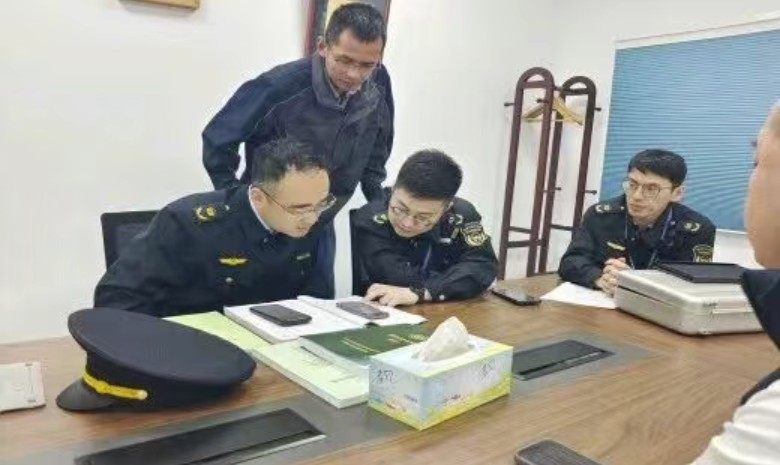
In late spring 2026, at the Cao'an Highway intersection, a construction waste and spoil transport truck was precisely stopped by cross-provincial joint law enforcement officers. This was not a temporary roadside inspection, but routine checkpoint-based control jointly carried out by the ecological environment law enforcement departments of Jiading and Kunshan based on a shared spoil truck license plate database. Since the two places established the “Jiading-Kunshan Linkage · Ecological Co-governance” mechanism, cross-provincial joint enforcement on solid waste has shifted from occasional action to a regular measure.

In the workshop of a slag comprehensive utilization and disposal center in Kunshan, law enforcement officers went deep into the production front line to verify the full-process treatment of municipal solid waste incineration bottom slag. Through processes such as coarse material separation, crushing and screening, and metal eddy current separation, the slag is separated into three categories of products: non-ferrous metals, scrap iron, and recycled sand and gravel aggregate. By checking against the mobile law enforcement terminal and electronic warehousing receipts, officers reviewed one by one the filing timeliness and compliance of the cross-provincial solid waste transfer manifests from the Shanghai Jiading incineration power plant.
At present, Kunshan has established cross-provincial tax-related case transfer and evidence mutual recognition mechanisms. Information on tens of thousands of cross-provincial spoil and tailings transport vehicles has been synchronously incorporated into Shanghai's monitoring database, enabling full traceability of transport trajectories. However, beyond the closed-loop logistics system, transactions without invoices and private cash settlement have become a major industry pain point: the high-value non-ferrous metals sorted by slag treatment centers are mostly sold to downstream individual smelters and small processing plants, and off-book end transactions without issued invoices have led to breaks in the transaction chain across the entire industrial chain, also putting compliant enterprises at a competitive disadvantage.
In the past, when there was no invoice-based closed loop, the sources, flows, and transaction compliance of recycled metal goods were all in a regulatory blind spot. This joint law enforcement action focuses on full-chain traceability of solid waste “from generation to disposal”, checking not only purchase and storage ledgers and transport records, but also specifically supervising the invoicing status of resource recycling enterprises in transactions with individual merchants. The Yangtze River Delta solid waste enforcement task force relies on satellite remote sensing and drone inspections to investigate clues to problems, and then provincial-level law enforcement departments conduct on-site verification of cross-provincial solid waste utilization filings, achieving full-chain control over source, route, and terminal.
In addition to law enforcement rectification, the Yangtze River Delta is relying on institutional innovation and digital technology to pave the way for compliant and resource-oriented development of slag. The State Taxation Administration's “reverse invoicing” policy has been fully implemented, making up for the long-standing shortcoming of invoice-free transactions by scattered operators in the resource recycling industry. In response to gaps in input tax deduction and pre-tax deduction caused by scattered operators in the industry being unwilling or unable to issue invoices, the solution no longer relies solely on law enforcement blocking, but combines institutional regulation with unblocking.
The slag treatment centers in Jiading and Kunshan rely on the Leqi enterprise collaboration platform and carbon data blockchain to realize real-time on-chain uploading of information such as vehicle weighing, material identification, and GPS trajectories, with data sharing across multiple departments. Transaction data is synchronously connected to the carbon brain accounting engine, which automatically matches carbon reduction factors. The category, weight, and flow of every batch of recycled metals are preserved throughout the process, generating a full life-cycle carbon footprint report.
The ecological value of solid waste resource utilization has already become visible on the ground. Shanghai has built waste-free roads through the use of slag aggregate, incineration ash, and recycled aggregates from renovation waste; Minhang District has processed 1.4 million tons of construction waste, reducing carbon dioxide emissions by 0.28 tons per ton and achieving annual carbon reduction of 117,000 tons, and the emissions reduction can also be converted into green revenue through carbon inclusive trading. Compliant invoices are no longer merely transaction vouchers, but have become core support for transforming solid waste into tradable green assets.
In 2026, the EU Carbon Border Adjustment Mechanism enters the substantive levy stage. If recycled metals from slag lack complete compliant traceability and carbon footprint data, exporting enterprises will bear high carbon tariffs; while relying on full-chain filings, manifest vouchers, and digital traceability qualifications can not only reduce carbon tariff costs, but also build a credit advantage for low-carbon supply chains. The verification by law enforcement departments of details such as cross-provincial transfer filings, receiving qualifications, and electronic manifests is in fact laying a solid foundation for the industry's green credit.
According to the announcement of the State Taxation Administration, there is now a clear policy basis for reverse invoicing by resource recycling enterprises to individual merchants, solving the historical difficulty of the industry's purchases lacking input invoices. The Yangtze River Delta pilot program clarifies the qualification of slag treatment centers as recycling entities, allowing VAT invoices to be reverse-issued to individual metal buyers, together with supporting incentives such as immediate levy-and-refund and reduced corporate income tax taxable income.
The platform implements intelligent control of “payment triggers reverse invoicing”, automatically verifying tax exemption quotas for individual operators, withholding taxes at the prescribed tax rate for the amount exceeding the quota, and directly pushing electronic invoices to tax digital accounts. Reverse invoicing vouchers are recognized as compliant input documentation, allowing enterprises to enjoy multiple tax incentives simultaneously. Kunshan continues to deepen cross-regional collaboration, strictly investigating illegal spoil transport and dumping, implementing full-process filing for construction projects, and cumulatively generating tens of thousands of electronic transfer manifests; across Jiangsu Province, the scale of reverse invoicing has grown steadily, forming a standardized chain of “invoice upon payment, tax upon invoicing, warehousing upon tax payment”, while also establishing a risk warning mechanism for large-value invoicing to safeguard the compliance baseline.
The “three-in-one” model of solid waste manifests, compliant transaction vouchers, and carbon asset certificates has become the core path for the slag industry to move from gray operations to transparent compliance. Cross-provincial joint law enforcement strictly cracks down on illegal transfers and non-compliant storage, verifies disposal qualifications and material destinations, eliminates regulatory vacuums, and also provides governance support for tax digital verification and the standardized development of the industry.
Compliance governance is reshaping the industry's development landscape. Jiading and Kunshan have successively introduced detailed rules for full life-cycle management of construction waste, and normalized multi-department joint rectification has sharply reduced cases of illegal cross-provincial dumping and non-compliant transactions involving solid waste. Jiading, Kunshan, and Taicang have established cross-provincial joint prevention and control over the water system, compressing the space for illegal operations, enabling compliant resource utilization enterprises to operate steadily, and squeezing the survival space of non-compliant traders.
Next, the Yangtze River Delta's joint solid waste law enforcement will continue extending full-chain inspections, using waste generation ledgers, disposal records, and resource utilization facilities as support points to weave a dense green regulatory evidence-preservation network. This governance system not only punishes violations, but also opens up development space for compliant enterprises.
In the future, with interconnected reverse invoicing data, intelligent accounting of carbon reduction, and integration with carbon inclusive trading, the Yangtze River Delta will build a new green industrial chain linking slag - recycled metals - end-product exports. The cross-regional co-governance and compliance pilots in Jiading and Kunshan will drive the upgrading of the entire circular economy industrial chain. From industrial parks in Jiangsu to waste-free pilot zones in Zhejiang, from solid waste bases in Anhui to Shanghai's carbon trading window, every node in the circulation of solid waste and compliant transactions will add a solid, credible, low-carbon foundation for the ecological green development of the Yangtze River Delta.