


English
News Center
—— NEWS CENTER ——

On July 18, the fourth lecture of the 2026 Wenhui Lecture Hall annual theme, “Green Development: Greener, More Prosperous, More Beautiful and Stronger,” titled “From the ‘New Three’ to ‘New Solid Waste’: The Full Cycle of New Quality Productive Forces,” was held. Zhang Rongqi, Chairman of the Fiber Composite Materials Recycling Branch of the China Materials Recycling Association, delivered the keynote speech. Corporate guests Liu Tao, Deputy General Manager of Shanghai Weixiang Zhongyi New Energy Technology Co., Ltd., and Wang Hudong, Deputy General Manager of RESOLAR, shared case studies. During the roundtable session, Li Liang, Chairman of Shanghai Energy Conservation and Emission Reduction Center Co., Ltd., held a discussion with the three speakers. The event was livestreamed simultaneously on platforms including the Shangguan App, CCTV Video, the Wenhui Lecture Hall video account, and the International Green Hydrogen, Ammonia and Methanol Forum video account.
Following compilation, the content is divided into the keynote speech, the Liu Tao and Wang Hudong case-sharing sections, the dialogue section, the Q&A section, and user sharing. This is “New Three, New Solid Waste” Part 3—Wang Hudong’s sharing.
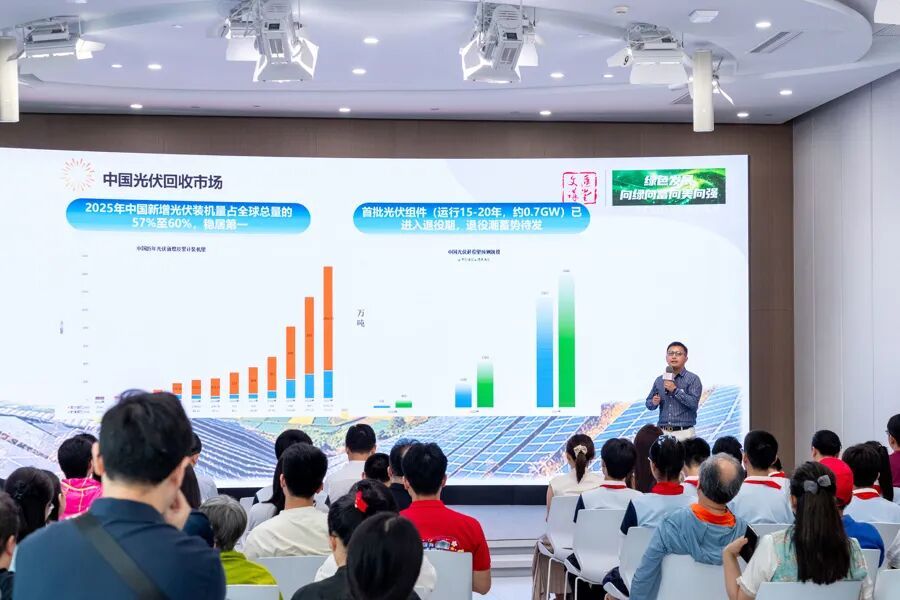
Based on practical experience, I will share with you the high-value utilization of decommissioned photovoltaic modules in four parts.
First, let us review China’s domestic photovoltaic recycling market.
All aging modules installed before 2015 will be phased out, with the disposal volume expected to reach 4 million tonnes.
From 2013 to 2025, the growth in China’s newly installed photovoltaic capacity continued to rise, exceeding 1000GW (gigawatts) by 2025. Total installed capacity accounted for 57% to 60% of the global total, meaning that for every two additional photovoltaic panels installed globally, one is installed in China. Early photovoltaic modules had a service life of approximately 15 to 20 years. China’s cumulative installed photovoltaic capacity before 2015 was nearly 40GW, and these modules have now become low-efficiency modules. New modules currently generally achieve efficiencies of 23% to 24%, whereas previous photovoltaic modules had a factory efficiency of only 18% and now operate at approximately 10% to 12%; therefore, these modules will all face retirement. Conservatively estimated by module weight, the total volume of decommissioned photovoltaic modules will be approximately 1.5 million tonnes by 2030. If modules retired early due to technology upgrades, faults and other reasons are included, there will be 4 million tonnes of solid waste requiring disposal. A production line such as that of Jinghuan Jiayuan in Anhui can process only 10,000 tonnes per year, illustrating the enormous disposal volume.
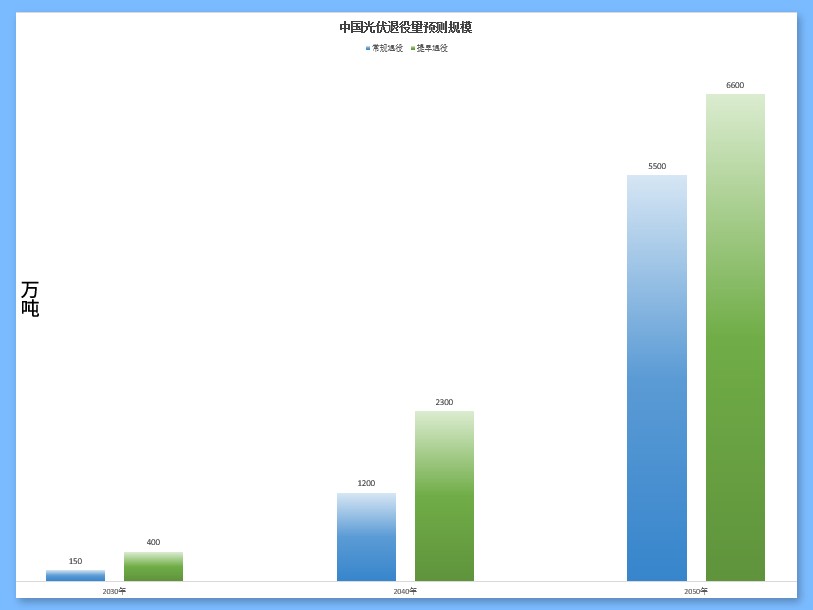
Trend Chart of the Decommissioning Wave for Photovoltaic Modules Over the Next 30 Years Keynote Speaker’s PPT
In 2024, recyclable waste from photovoltaic modules received its first identification code
In response to the approaching wave of photovoltaic module decommissioning, policies have provided substantial support. In 2023, the National Development and Reform Commission issued the Guiding Opinions on Promoting the Recycling and Circular Utilization of Decommissioned Wind Power and Photovoltaic Equipment, which mentioned two points: first, by 2025, a responsibility mechanism for the disposal of decommissioned equipment from centralized wind farms and photovoltaic power stations will be basically established, and relevant standards and specifications for the circular utilization of decommissioned wind power and photovoltaic equipment will be further improved. Second, by 2030, industrial clusters will be formed, and a complete technical system for the full-process circular utilization of decommissioned wind power and photovoltaic equipment will be established.
In 2024, the recyclable waste category for photovoltaic modules finally received its first identification code, with the waste code 900-015-S17. This sends a clear signal to compliant disposal companies: photovoltaic modules will undergo formal recycling, and environmental authorities can use this code for supervision.
Regulations restrict incineration by informal workshops, as hazardous substances can cause irreversible pollution
In March 2026, the Ministry of Ecology and Environment officially released the Technical Specification for Pollution Control in the Recycling and Treatment of Waste Photovoltaic Equipment. For the first time, control specifications were established in advance for an immature industry, demonstrating the regulatory authorities’ firm determination to prevent “informal workshops” from disrupting compliant disposal companies and the market.
Currently, as Mr. Liu mentioned, a full life-cycle management platform for power batteries has already been introduced, whereas the photovoltaic module recycling sector is one step behind. Many informal workshops continue to carry out harmful treatment of photovoltaic modules without restraint. Combined with the public’s still limited awareness, many people do not know that photovoltaic module backsheet materials contain fluorine and lead; open-air incineration can cause irreversible environmental pollution. Following an on-site investigation, CCTV’s Focus Interview program in 2024 exposed in “Where Do Discarded Photovoltaic Modules Go?” that many illegal and disorderly informal workshops in Henan Province conducted open-air incineration, producing pervasive black smoke and discharging wastewater directly into soil, causing irreversible environmental pollution and resulting in penalties by environmental authorities. Due to incomplete industry standards, policies and regulations, illegal or non-compliant informal workshops are difficult to eliminate, and there is still a long way to go.
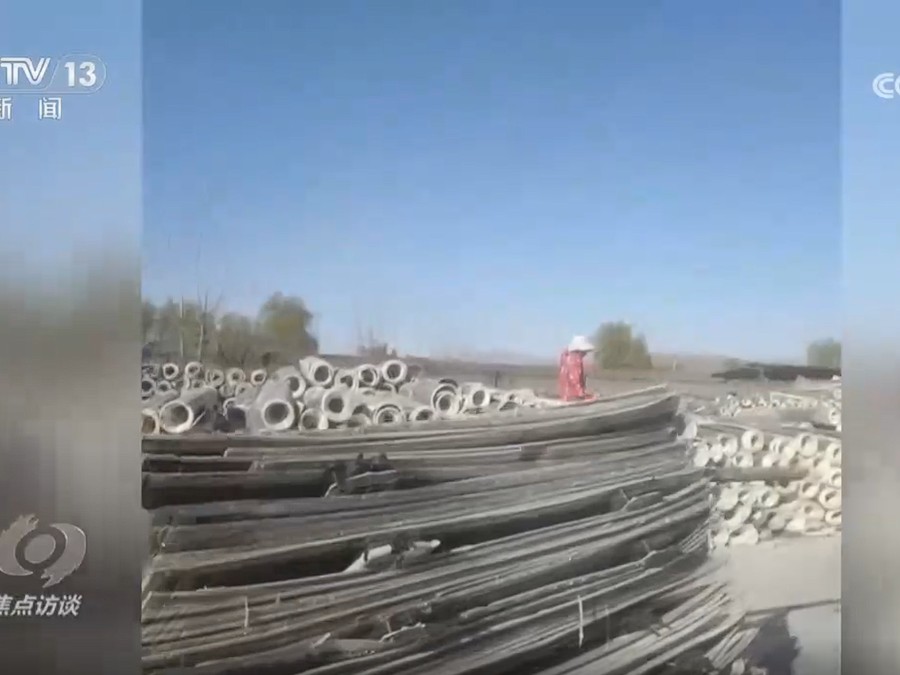
CCTV Exposes Non-Compliant Informal Workshops Discharging Wastewater into Soil Source: CCTV
EVA encapsulant film dismantling involves three steps, while cascade utilization offers broad applications and significant value
The structure of crystalline silicon photovoltaic panels resembles a sandwich, with solar cells in the middle layer composed of silicon, silver and copper ribbons. Two layers of glass are bonded together by an EVA encapsulant film, with an aluminum frame on the outside. Among these components, the EVA encapsulant film is the key technical issue that must be addressed during dismantling. The dismantling process consists of three steps. First, mechanical removal separates the aluminum frame and junction box. Second, various approaches, including physical, chemical and pyrolysis methods, are used to separate the components, obtaining the backsheet, ribbons, glass and solar cells. Third, silver ingots and silicon materials are extracted from the solar cells.
As Mr. Liu mentioned in his presentation, if battery energy consumption cannot be reduced below 70%, batteries can be reused in other fields through cascade utilization. The same applies to photovoltaic modules: if they still retain 12% or 13% power-generation capability, components can be replaced to preserve all their functions and use them in off-grid power supply systems, billboards, bus stops, signs and related applications. They absorb solar energy during the day and, combined with energy storage, can release electricity at night. Shenzhen has undertaken considerable practical work in this regard.
Single recycling methods have advantages but cannot balance high recovery rates with high-value utilization
For end-of-life disposal, one of the two truly commercialized approaches is physical recycling. Physical recycling includes mechanical crushing, hot-knife and high-voltage pulse methods, all of which physically crush modules into powder. Based on differences in physical properties, various equipment and methods such as density and electrostatic separation are then used to sort these organic and inorganic powder particles into copper powder, silver powder and glass powder. Its main advantages are low cost, simple processes, low energy consumption, high speed and broad applicability. Its disadvantages are relatively low separation purity, resulting in low recovery value for valuable metals, as well as dust generation. How to achieve 100% separation of these granular materials—that is, the separation of high-purity, high-value materials—urgently requires technological R&D breakthroughs.
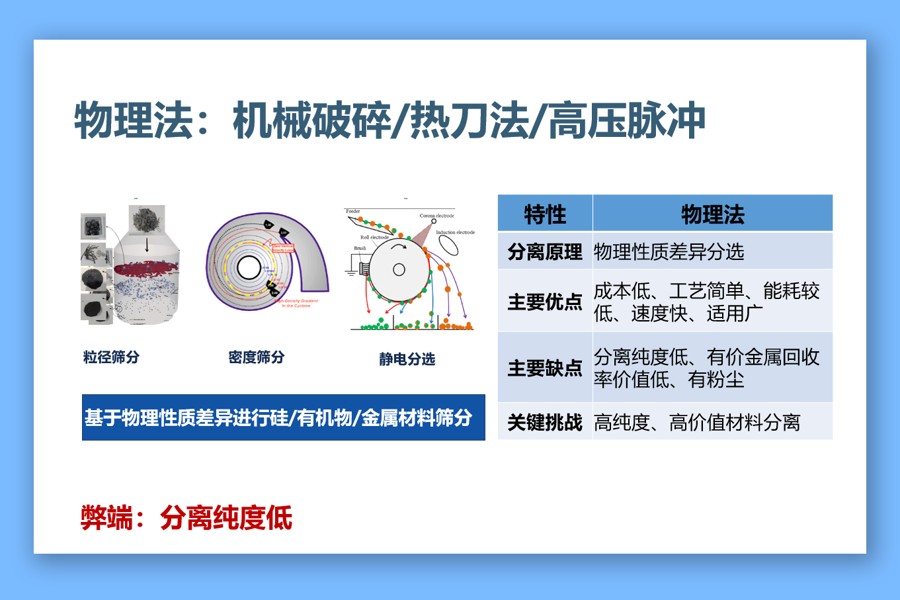
Disadvantage of Physical Recycling: Low Separation Purity Keynote Speaker’s PPT
The second, more common method on the market is pyrolysis, including the use of tunnel furnaces and pyrolysis furnaces. Its main separation principle is to remove EVA through pyrolysis in an air or nitrogen atmosphere, thereby separating the glass and solar cells. Typically, photovoltaic modules are placed in a furnace for combustion pyrolysis to remove the intermediate EVA film, allowing the glass and solar cells to separate, after which the solar cells are purified. The advantages are a high separation rate and high recycling purity. However, EVA cannot be recovered after high-temperature decomposition; energy consumption is high; treatment of the exhaust gas generated after pyrolysis is complex and stringent, requiring greater environmental investment; and process control during pyrolysis is difficult, as the main busbars of the cells can easily detach, reducing silver content in the solar cells. The technical challenge lies in reducing energy consumption, including the difficulty of exhaust-gas treatment.
At present, neither standalone physical recycling nor pyrolysis technology can simultaneously achieve both high recovery rates and high-value products.
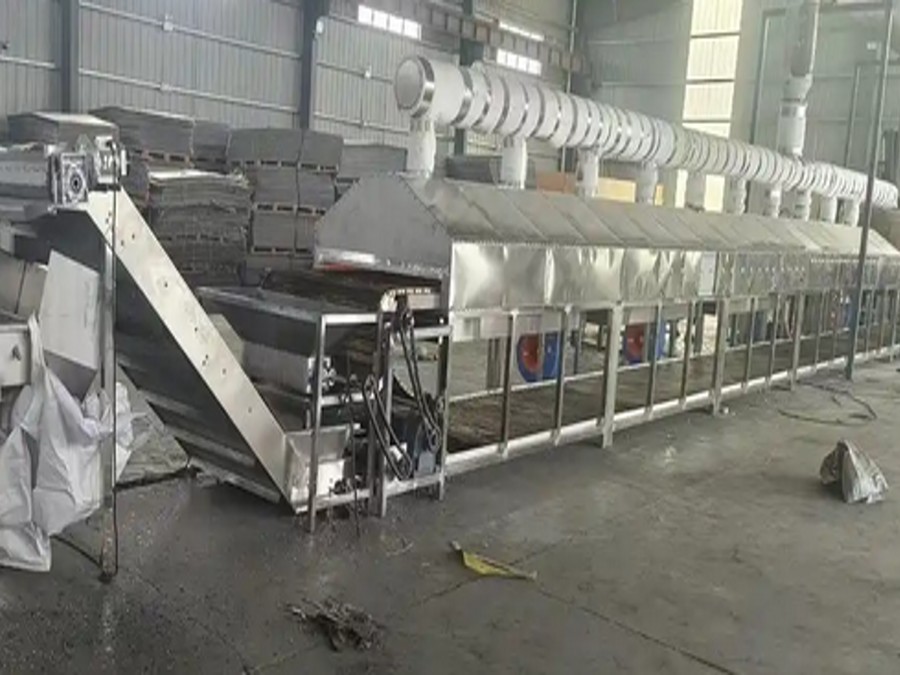
Pyrolysis Technology Can Easily Reduce Silver Content in Solar Cell Main Busbars Image Source: Jinghuan Jiayuan
How does RESOLAR do it? RESOLAR has established China’s first 10,000-tonne-scale production line for processing end-of-life modules in Fengyang, Anhui.
Its dismantling approach incorporates self-developed technology, with finished products sold at prices 20% higher than the market
In the first step, an adaptive frame-removal machine is used to remove the aluminum frame. In the second step, self-developed GST wet separation is used. This is a solvent independently developed by the company’s Dow team to separate glass from solar cells, producing large pieces of glass that can be sold directly to the glass manufacturing industry and remelted for use in photovoltaic or daily-use glass. In the third step, after the glass is removed, the solar cells remain. A self-developed integrated furnace with low-oxygen atmosphere control separates the solar cells and ribbons, producing strip-shaped ribbons that can be sold as bulk commodities. In the fourth step, the solar cells consist of silver and silicon; silver is extracted through wet impurity removal and can be cast into silver ingots for sale. The remaining silicon material undergoes multiple washing processes to reach 6N grade, or 99.9999% purity, and can then be made into solar cells again through ingot pulling and wafer slicing. This is the full-process technology that Jinghuan Jiayuan has successfully established.
What is the main difference between our products and mainstream products on the market? Most informal workshops on the market produce powdered finished products with purity of only 70%-80%. If glass powder is mixed with silicon, glass manufacturers cannot use it, resulting in low product value. Jinghuan’s finished products are generally sold at prices 20% higher by comparison. For all recycled-material sales, downstream manufacturers conduct full-process performance testing before use.
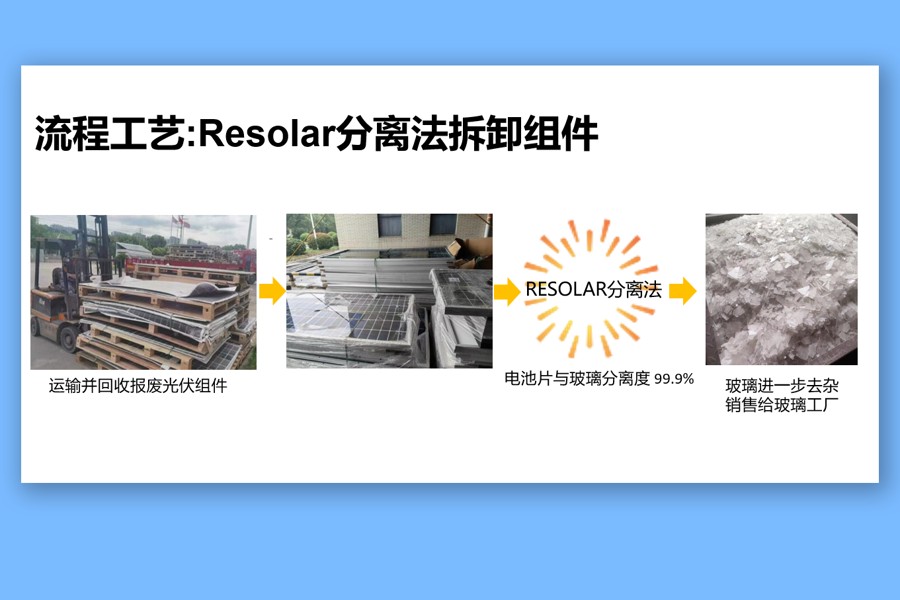
RESOLAR Dismantles Glass into Blocks, Facilitating Remanufacturing Keynote Speaker’s PPT
The world’s first photovoltaic module made from recycled materials has milestone significance
RESOLAR was established in 2023 and has developed very rapidly. In Shanghai’s highly active green finance and economic environment, it completed its Series A financing round in 2025. Investors include SPIC Ronghe, CITIC Environment and Bright Capital, and it is currently conducting the next financing round with other funds. In 2025, under the leadership of the ECOPV, RESOLAR recycled solar modules from Trina Solar, dismantled them to obtain recycled materials, and worked with partners including Yongzhen and Flat Glass to produce the world’s first photovoltaic module made from recycled materials. Testing showed that this TOPCon 210N-66 recycled photovoltaic module, with its golden dimensions, achieved a conversion efficiency of 20.7%. Although this is slightly lower than the 23% conversion rate of modules manufactured using virgin materials, it is of milestone significance, meaning that a full-industry-chain closed loop can be completed using recyclable regenerated materials and that future production capacity can be implemented.
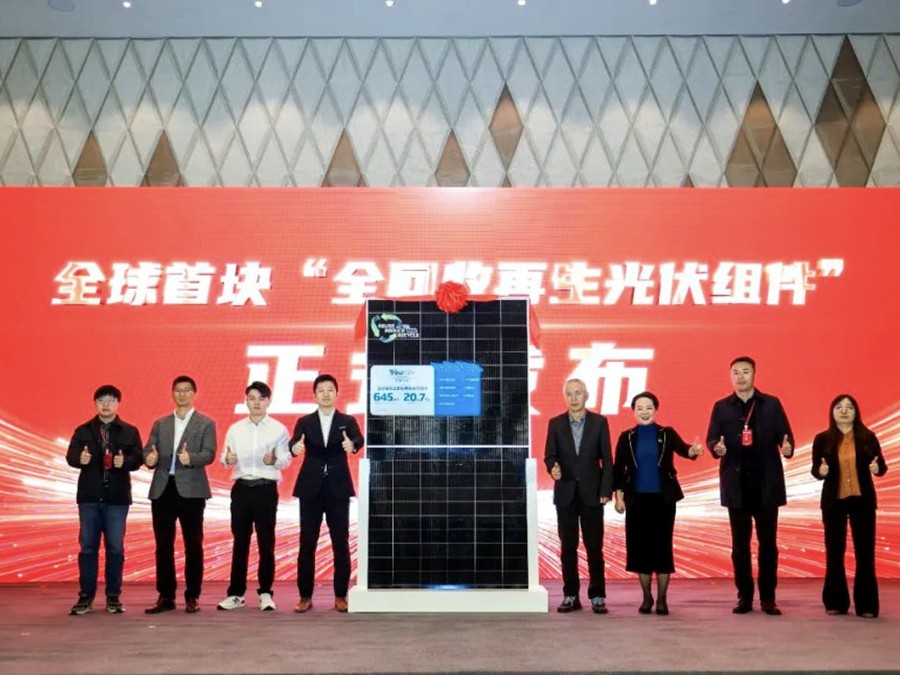
In 2025, RESOLAR and Trina Solar collaborated to manufacture the world’s first photovoltaic module made entirely from recycled materials. Testing showed that this TOPCon 210N-66 recycled photovoltaic module, with its golden dimensions, achieved a conversion efficiency of 20.7% and power exceeding 645W. Image Source: Jinghuan Jiayuan WeChat Official Account
RESOLAR is also expanding internationally and is currently communicating and cooperating with a number of leading overseas companies. Meanwhile, we participated in the preparation of the China Photovoltaic Recycling and Circular Utilization White Papers for 2023/24/25 and the 2023 China Wind Power and Photovoltaic Equipment Circular Utilization Industry Development Report, as well as in the formulation and review of national and industry standards concerning the recycling, utilization and disposal of waste photovoltaic modules, enterprise technical requirements, technical specifications and other standards. Internationally, under the leadership of the Photovoltaic Special Committee of the Green Supply Chain Alliance, we are jointly developing international standards to connect China’s recycling technologies and experience with the world.
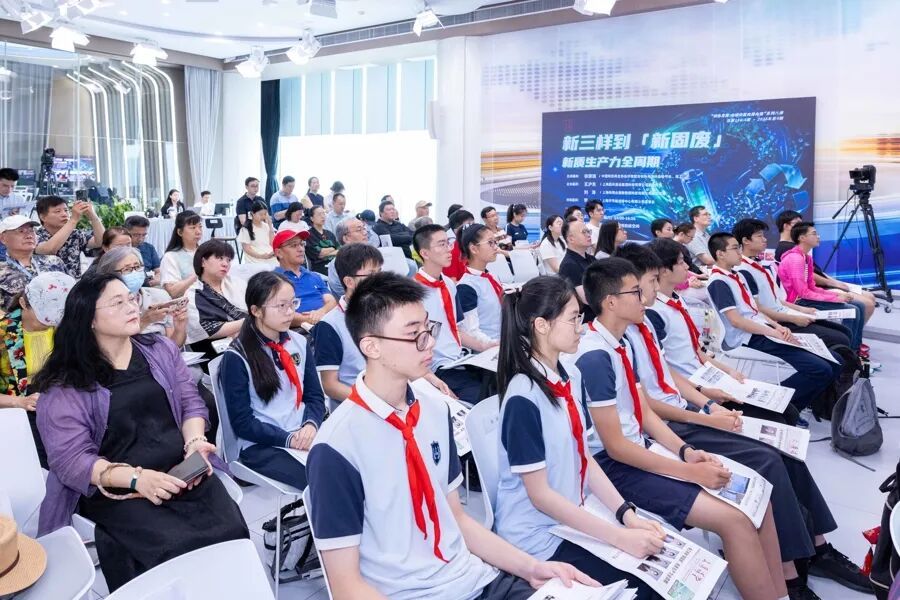
A team of 12 new ninth-grade students from Shanghai COSCO Experimental School, led by teacher Li Liang, attended the Wenhui Lecture Hall and actively asked questions
Three matters are very important for the future: first, to conduct original data sampling and measurement for various types of modules and establish benchmarks for recycling test methods. Second, to establish a big-data platform for full life-cycle traceability management, enabling the destination of every stage to be known. At the same time, new recycling and treatment technologies must continue to be developed, including encapsulant film dismantling, intact recovery of solar cells or silicon wafers, and high-purity, low-cost, high-efficiency and environmentally friendly recovery technologies for high-value metals such as silver.
The company’s 2035 plan aims to establish sound connections with large upstream enterprises of more than 1GW and small enterprises of less than 1GW, and jointly establish standards for fully recyclable solar panels. This may involve establishing joint ventures or directly joining RESOLAR’s recycling network, using owners to uniformly standardize decommissioning requirements for their power stations and achieve efficient circulation; various recycled materials would then be sold back to the owners’ industrial chains under agreements, enabling solar panels to be manufactured entirely from recycled materials.
RESOLAR is actively seeking strategic partnerships with global industry leaders and investment institutions—particularly in Japan, South Korea and European countries—to jointly advance the large-scale deployment of photovoltaic recycling facilities with capacities exceeding 10,000 tonnes. While focusing on these core markets, we also look forward to working with partners around the world to promote the global circular economy.
About RESOLAR
Shanghai RESOLAR Energy Technology Co., Ltd. is committed to becoming a recycled material photovoltaic group with deep decarbonization. RESOLAR focuses on technological innovation and builds a world-leading solution for component recycling, impurity removal of damaged cells, recycled silicon materials and cells, and cascaded utilization of components. With professional technology and services, we help customers realize the recycling and reuse of waste photovoltaic resources, and make positive contributions to the development of environmental protection and new energy industries. For more detailed information, you can browse the official website: www.resolartech.com .

Latest developments/news
Contact information
Service Hotline: 13585742918 (Monday to Friday 9:00-18:00)
Enterprise email: ps@resolartech.com (Reply within 48 hours after receiving the email consultation!)
Company Address: Building 8, No. 1528, Wangxu East Road, Fengjing Town, Jinshan District, Shanghai (Caohejing Fengjing Park)