


English
News Center
—— NEWS CENTER ——
On December 30, 2025, the National Development and Reform Commission and the Ministry of Finance issued the Notice on Implementing the Policy for Large-Scale Equipment Renewal and Consumer Goods Trade-In in 2026.
For the first time, it proposes supporting China Resources Recycling Group Co., Ltd. in accelerating the development of a nationwide, functional platform for resource recycling and reuse. It supports the supply and marketing cooperative system in improving recycling networks that cover grassroots areas below the county level. It also supports qualified regions in building centralized and standardized second-hand goods trading markets.
Supervision over scrapped-product recycling and dismantling enterprises will be strengthened to improve the standardization of recycling and utilization of used equipment. Ecological and environmental law enforcement supervision will be intensified, and environmental violations in recycling and dismantling will be severely cracked down on. The “reverse invoicing” system for resource recycling enterprises purchasing scrapped products from individual sellers will continue to be promoted and implemented, with stronger supervision.
Compared with the policy orientation in 2025 and earlier, which focused on encouraging the expansion of the recycling market, the main direction of policy development in 2026 has shifted simultaneously toward three dimensions: channel standardization, environmental protection control, and tax compliance. For the first time, the latest policy strengthens compliance implementation at the provincial level, driving the local renewable resource recycling industry to move away from extensive growth and expansion and fully transition toward refined, compliant operations.
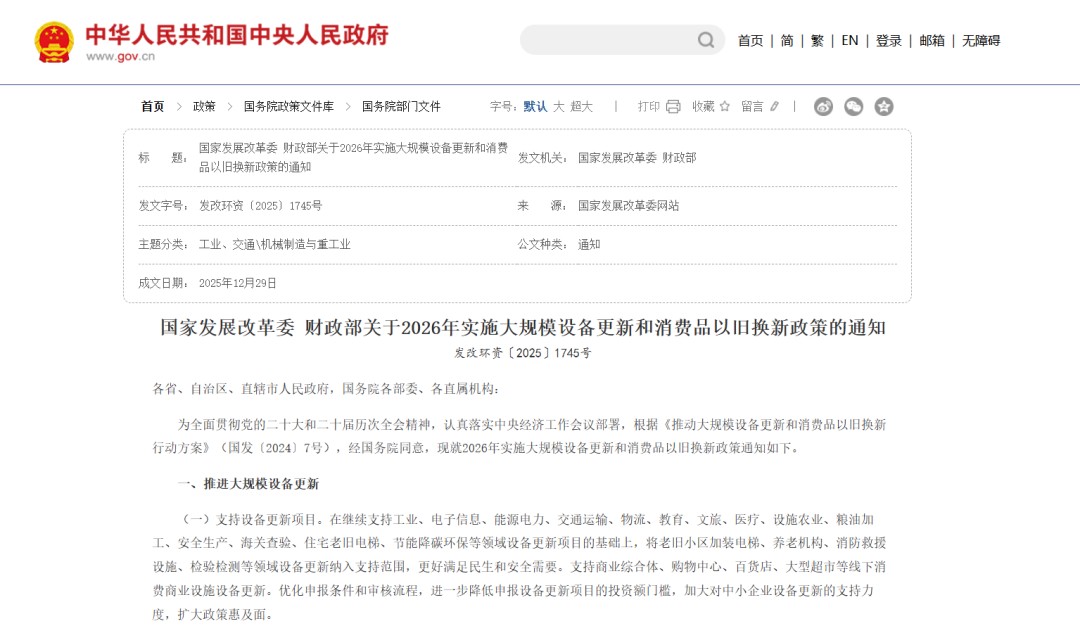
Document Content Notice of the National Development and Reform Commission and the Ministry of Finance on Implementing the 2026 Policy for Large-Scale Equipment Renewal and Consumer Goods Trade-In Policy Issuing Authorities:National Development and Reform Commission Ministry of Finance Issue Date: December 29, 2025 Document No.:发改环资〔2025〕1745号 Notice of the National Development and Reform Commission and the Ministry of Finance on Implementing the 2026 Policy for Large-Scale Equipment Renewal and Consumer Goods Trade-In People’s governments of all provinces, autonomous regions, and municipalities directly under the Central Government, and all ministries, commissions, and directly affiliated institutions of the State Council: In order to fully implement the guiding principles of the 20th National Congress of the Communist Party of China and the plenary sessions of the 20th CPC Central Committee, and to earnestly implement the arrangements of the Central Economic Work Conference, in accordance with the Action Plan for Promoting Large-Scale Equipment Renewal and Consumer Goods Trade-In (Guo Fa〔2024〕No. 7), and with the approval of the State Council, the following notice is hereby issued regarding the implementation of the policy for large-scale equipment renewal and consumer goods trade-in in 2026. I. Promote Large-Scale Equipment Renewal (I) Support equipment renewal projects. On the basis of continuing to support equipment renewal projects in fields such as industry, electronic information, energy and power, transportation, logistics, education, culture and tourism, healthcare, facility agriculture, grain and oil processing, workplace safety, customs inspection, old residential elevators, energy conservation, carbon reduction, and environmental protection, equipment renewal in fields such as elevator installation in old residential communities, elderly care institutions, fire and rescue facilities, and inspection and testing will be included in the support scope to better meet livelihood and safety needs. Support equipment renewal for offline consumer commercial facilities such as commercial complexes, shopping centers, department stores, and large supermarkets. Optimize application conditions and review procedures, further lower the investment threshold for applying for equipment renewal projects, increase support for equipment renewal by small and medium-sized enterprises, and expand policy coverage. (II) Support the scrapping and renewal of old operating freight trucks. Continue to support the scrapping of operating freight trucks meeting China IV and below emission standards and their replacement with low-emission freight trucks, with priority support for replacement with electric freight trucks. Subsidy standards shall be implemented in accordance with the Notice on Implementing the Scrapping and Renewal of Old Operating Freight Trucks (Jiao Gui Hua Fa〔2025〕No. 17). (III) Support the renewal of new energy urban buses. Promote the electrification replacement of urban buses, and continue to support the renewal of new energy urban buses and power batteries. Subsidy standards shall be implemented in accordance with the Implementation Rules for Subsidies for the Renewal of New Energy Urban Buses and Power Batteries in 2025 (Jiao Ban Yun〔2025〕No. 4). (IV) Support the scrapping and renewal of old agricultural machinery. Continue to support the scrapping and renewal of old agricultural machinery. The subsidy scope and subsidy standards shall be implemented in accordance with the Notice on Properly Implementing the 2025 Subsidy Policy for the Scrapping and Renewal of Agricultural Machinery (Nong Ban Ji〔2025〕No. 3). All regions may optimize and adjust the 12 categories of agricultural machinery eligible for scrapping and renewal subsidies that can be independently selected, based on agricultural production needs and the stage of agricultural mechanization development. (V) Strengthen full-chain management of projects and funds. Strengthen full-chain management of project reserves, applications, reviews, approvals, implementation, and fund payment and use. Refine and improve project support conditions and review standards in various fields, further strengthen review controls, and continuously improve project quality. Taking into account factors such as average depreciation periods of equipment in different industries and technology renewal cycles, refine and improve quantitative requirements such as minimum service life and technical indicators for eliminated equipment by field, and make equipment depreciation and minimum service life mandatory conditions for project applications. Strictly regulate equipment elimination and scrapping disposal, standardize asset management, and avoid resource waste. II. Implement Consumer Goods Trade-In (VI) Optimize fund allocation. Taking into account factors such as the permanent resident population, regional gross domestic product, ownership of automobiles and household appliances in each region, as well as implementation of consumer goods trade-in policies and funds, and issues identified in audits, systematically evaluate local work performance and reasonably determine the scale of fund allocation for each region. Focus subsidies on categories with broader coverage and stronger driving effects, and emphasize the promotion of green, low-carbon, and smart products. (VII) Support automobile scrapping and renewal. Individual consumers who scrap passenger vehicles registered under their own names and purchase new energy passenger vehicles included in the Catalogue of New Energy Vehicle Models Exempted from Vehicle Purchase Tax or fuel passenger vehicles with engine displacement of 2.0 liters or below shall receive subsidy support for automobile scrapping and renewal. For the purchase of new energy passenger vehicles, the subsidy shall be 12% of the vehicle price (up to 20,000 yuan); for the purchase of fuel passenger vehicles with engine displacement of 2.0 liters or below, the subsidy shall be 10% of the vehicle price (up to 15,000 yuan). (VIII) Support automobile replacement and renewal. Individual consumers who transfer passenger vehicles registered under their own names and purchase new energy passenger vehicles included in the Catalogue of New Energy Vehicle Models Exempted from Vehicle Purchase Tax or fuel passenger vehicles with engine displacement of 2.0 liters or below shall receive subsidy support for automobile replacement and renewal. For the purchase of new energy passenger vehicles, the subsidy shall be 8% of the vehicle price (up to 15,000 yuan); for the purchase of fuel passenger vehicles with engine displacement of 2.0 liters or below, the subsidy shall be 6% of the vehicle price (up to 13,000 yuan). (IX) Support household appliance trade-in. Individual consumers who purchase products meeting Grade 1 energy efficiency or water efficiency standards among 6 categories of household appliances, including refrigerators, washing machines, televisions, air conditioners, computers, and water heaters, shall receive a subsidy of 15% of the product sales price. Each consumer may receive a subsidy for 1 item per product category, with a maximum subsidy of 1,500 yuan per item. (X) Support the purchase of new digital and smart products. Individual consumers who purchase 4 categories of products, including mobile phones, tablets, smart watches and bracelets, and smart glasses (with a single-item sales price not exceeding 6,000 yuan), shall receive a subsidy of 15% of the product sales price. Each consumer may receive a subsidy for 1 item per product category, with a maximum subsidy of 500 yuan per item. Support subsidies for the purchase of new smart home products (including age-friendly home products); the specific subsidy categories and subsidy standards shall be reasonably formulated by local authorities according to actual conditions. (XI) Improve the implementation system. Implement the requirements for building a unified national market. The automobile scrapping and renewal, automobile replacement and renewal, trade-in of 6 categories of household appliances, and purchase of new products in 4 categories of digital and smart products specified in this notice shall be implemented nationwide with unified subsidy standards. All regions shall unify and standardize the management system for consumer goods trade-in, and improve full-chain implementation rules including list management of participating business entities, filing of product sales prices, issuance of subsidy qualifications, and review and payment of funds. Establish a subsidy fund pre-allocation system. On the basis of implementing budget arrangements, part of the subsidy funds shall be pre-allocated to corresponding enterprises or payment platforms according to enterprise sales and advance funding conditions, so as to alleviate the pressure on enterprises from advancing funds. Give full play to the advantages of different sales channels and support offline physical retail. Improve consumption convenience in rural areas by increasing offline business entities in rural areas and guiding online channels to tilt toward rural areas. III. Smooth the Recycling and Circular Utilization Network (XII) Improve the recycling network for used equipment and consumer goods. Improve the three-tier recycling system consisting of renewable resource drop-off points, transfer stations, and sorting centers, and smooth channels for the handover and sale of used equipment and consumer goods. Support China Resources Recycling Group Co., Ltd. in accelerating the construction of a nationwide, functional resource recycling and reuse platform. Support the supply and marketing cooperative system in improving recycling networks that cover grassroots areas below the county level. Guide “Internet + Recycling” enterprises to expand categories and improve their ability to recycle used equipment and consumer goods. (XIII) Standardize second-hand goods trading and remanufacturing of used equipment. Encourage the development of the “Internet + Second-Hand” model. Support qualified regions in building centralized and standardized second-hand goods trading markets. Improve systems for used goods transaction management, evaluation, and appraisal. Enhance the level of the remanufacturing industry for used electromechanical equipment, automotive parts, and other items. The quality characteristics and safety and environmental protection performance of remanufactured products shall not be lower than those of the original new products. (XIV) Expand the resource recycling industry. Arrange ultra-long-term special treasury bond funds to support the construction of high-level resource recycling projects. Strengthen scientific and technological breakthroughs in major technical equipment for resource recycling. Promote the application of recycled materials. Strengthen supervision over scrapped-product recycling and dismantling enterprises, and improve the standardization level of recycling and utilization of used equipment. Strengthen ecological and environmental law enforcement supervision, and severely crack down on environmental violations in recycling and dismantling. Continue to promote the implementation of the “reverse invoicing” system for resource recycling enterprises purchasing scrapped products from individual sellers, and strengthen supervision. IV. Leverage the Guiding Role of Standards Improvement (XV) Accelerate the improvement of the standards system. Benchmark against advanced international levels, improve energy conservation and carbon reduction standards and pollutant emission standards for key industries, and strictly implement technical specifications for pollution control in the treatment of waste electrical and electronic products. Strengthen the application of energy efficiency and water efficiency standards for household appliances, electronics, and other consumer goods. (XVI) Strengthen supervision over standards implementation. Strictly implement the regulations on mandatory scrapping standards for motor vehicles and vehicle safety and environmental protection inspection standards, and eliminate old vehicles that meet mandatory scrapping standards in accordance with laws and regulations. Encourage timely scrapping of household appliances that have reached the recommended service life. Strengthen quality supervision and random inspections of key consumer goods such as household appliances and new energy vehicles, and severely crack down on acts such as passing off fake products as genuine, inferior products as good ones, old products as new ones, counterfeit qualified products, and forging or misusing energy efficiency and water efficiency labels. V. Strengthen Organization and Implementation (XVII) Strengthen organizational leadership. The National Development and Reform Commission shall play its role as the lead department of the inter-ministerial joint meeting mechanism for the “Two New” policies, work with the Ministry of Finance to arrange ultra-long-term special treasury bond funds to implement the “Two New” policies, and strengthen overall coordination and tracking and scheduling. The Ministry of Commerce, the Ministry of Transport, the Ministry of Agriculture and Rural Affairs, and other departments shall formulate implementation rules for their respective fields according to their division of responsibilities, and organize local authorities to properly implement relevant policies in related fields. Provincial people’s governments shall promptly organize implementation based on actual conditions, consolidate responsibilities of all parties, manage the pace of work, strengthen coordination and advancement, and continuously improve the effectiveness of the “Two New” policies. (XVIII) Clarify funding channels. The National Development and Reform Commission, together with relevant departments, shall arrange ultra-long-term special treasury bond funds to support equipment renewal, to be used for implementing the support policies and eligible project construction listed in items (I), (II), (III), (IV), and (XIV) of this notice; ultra-long-term special treasury bond funds shall be directly allocated to local governments to support consumer goods trade-in, to be used for implementing the support policies listed in items (VII), (VIII), (IX), and (X) of this notice. Funds directly allocated to local governments for consumer goods trade-in shall generally be shared between the central and local governments according to the principle of 9:1, with the central government bearing 85%, 90%, and 95% for eastern, central, and western regions respectively. Provincial finance departments shall arrange matching funds in proportion according to the allocation of central funds, and the method for sharing funds below the provincial level shall be determined by provincial finance departments. If a region uses up the amount of central funds allocated for consumer goods trade-in, the excess shall be supported by local funds of that region, and the central government shall no longer bear it. Regions with problems such as a relatively large amount of unpaid subsidy funds shall be urged or penalized more strongly through appropriate means. Any central funds allocated for consumer goods trade-in that remain unused as of December 31, 2026 shall be recovered by the central government. (XIX) Standardize the use of funds. The National Development and Reform Commission and the Ministry of Finance shall reasonably manage the pace and allocate ultra-long-term special treasury bond funds to local governments in quarterly batches to support consumer goods trade-in. Local governments shall reasonably formulate balanced fund use plans by field and implement the consumer goods trade-in policy in a stable and orderly manner. The ultra-long-term special treasury bond funds allocated by the central government to support consumer goods trade-in shall be used to implement subsidy policies in the relevant fields specified in this notice. Local governments shall be given more autonomy. If the matching funds arranged by local governments in proportion are used to implement automobile scrapping and renewal, automobile replacement and renewal, trade-in of 6 categories of household appliances, and purchase of new products in 4 categories of digital and smart products specified in this notice, the subsidy standards and organizational implementation methods shall remain consistent with this notice; if they are used to implement subsidies for the purchase of new smart home products (including age-friendly home products), the specific subsidy categories and subsidy standards shall be reasonably formulated by local authorities according to actual conditions. In addition, local governments may independently and reasonably determine subsidy categories, subsidy standards, organizational implementation methods, and other matters within the framework of the consumer goods trade-in policy, and are encouraged to give priority to supporting products with high levels of energy efficiency, water efficiency, and environmental protection. All regions shall promptly complete the settlement of consumer goods trade-in subsidy funds for 2025, and ensure smooth cross-year continuity and a stable and orderly transition of relevant support policies. (XX) Strengthen supervision and management. Relevant departments shall, according to their division of responsibilities, strengthen full-chain supervision over the implementation of equipment renewal projects and the use of funds, coordinate online monitoring and early warning with offline on-site verification, and resolutely prevent problems such as untimely fund allocation, delayed use, occupation, and misappropriation. Provincial people’s governments are the primary responsible entities for project and fund management. They shall strictly manage ultra-long-term special treasury bond funds, conduct daily scheduling and on-site evaluation of equipment renewal projects, and strengthen supervision over consumer goods trade-in funds. They shall strictly implement the centralized treasury payment system, firmly uphold the red lines and bottom lines for fund use, and shall not list fictitious expenditures, falsely report expenditures, or replace actual expenditure with allocations, so as to avoid fund accumulation and idleness. All regions shall strengthen interdepartmental data connectivity and sharing. Based on the subsidy data platforms already built by the central and local governments, they shall establish data sharing channels among departments such as commerce, transportation, agriculture and rural affairs, finance, public security, taxation, industry and information technology, and realize comparison and cross-verification of key data including subsidy qualifications, new energy vehicle model information, vehicle registration information, commodity invoice information, logistics information, and fiscal fund expenditure information. For those that fail to meet the above requirements or violate financial and economic discipline, funds shall be recovered in a timely manner, and the responsibilities of relevant personnel shall be seriously pursued in accordance with laws and regulations. (XXI) Create a fair participation environment. All regions shall treat online and offline business entities equally and without discrimination, as well as business entities of different ownership types, different places of registration, and different scales participating in large-scale equipment renewal and consumer goods trade-in. Illegal and non-compliant acts such as fraudulent subsidy claims, subsidy arbitrage, and “raising prices before subsidies” shall be seriously handled in accordance with laws and regulations. Suspected crimes shall be transferred to judicial authorities for strict investigation and handling in accordance with the law. (XXII) Conduct timely tracking and evaluation. The National Development and Reform Commission, together with relevant departments, shall strengthen evaluation and guidance on the implementation of the “Two New” policies in all regions and fields, supervise the implementation of key tasks, promptly identify problems, and respond quickly to resolve them. Provincial people’s governments shall conduct self-evaluation and self-inspection of policy implementation, project implementation, fund use, and achievement of performance objectives, and promptly submit reports to the National Development and Reform Commission and the Ministry of Finance, while copying relevant information to departments such as the Ministry of Transport, the Ministry of Agriculture and Rural Affairs, and the Ministry of Commerce. The National Development and Reform Commission shall consult with the Ministry of Finance to compile and form a performance evaluation report, and use the evaluation results as an important basis for subsequent optimization of fund arrangements. (XXIII) Build social consensus. All regions and relevant departments shall strengthen publicity and interpretation of the “Two New” policies. Make full use of consumer rights hotlines and the supervision and complaint functions of official platforms to respond to public concerns in a timely manner. Through provincial government service platforms or third-party platforms entrusted and filed by provincial governments, regularly summarize and release information on subsidy use, investigation and punishment of violations, and other matters, enhance the transparency of policy implementation, and create a favorable social atmosphere. National Development and Reform Commission Ministry of Finance
发改环资〔2025〕1745号
December 29, 2025
About RESOLAR
Shanghai RESOLAR Energy Technology Co., Ltd. is committed to becoming a recycled material photovoltaic group with deep decarbonization. RESOLAR focuses on technological innovation and builds a world-leading solution for component recycling, impurity removal of damaged cells, recycled silicon materials and cells, and cascaded utilization of components. With professional technology and services, we help customers realize the recycling and reuse of waste photovoltaic resources, and make positive contributions to the development of environmental protection and new energy industries. For more detailed information, you can browse the official website: www.resolartech.com .

Latest developments/news
Contact information
Service Hotline: 13585742918 (Monday to Friday 9:00-18:00)
Enterprise email: ps@resolartech.com (Reply within 48 hours after receiving the email consultation!)
Company Address: Building 8, No. 1528, Wangxu East Road, Fengjing Town, Jinshan District, Shanghai (Caohejing Fengjing Park)