


English
News Center
—— NEWS CENTER ——
A brand-new photovoltaic panel from a reputable brand typically sells for RMB 0.7–0.8 per watt, but quotes from some unofficial channels may be as low as RMB 0.6 per watt or even lower.
Where exactly does the price difference come from?
Some say it is “direct sales from the manufacturer,” some say it is “discounts for bulk purchases,” and others confidently claim, “They come from the same production line, just without the brand label.”
What are the facts? The National Center of Supervision and Inspection on Solar Photovoltaic Products Quality disclosed that the overall pass rate of randomly inspected PV modules fell from nearly 100% in 2019 to 62.9% in 2024, with more than one-third of modules failing to meet standards. Industry research also shows that refurbished, downgraded, and counterfeit panels account for a considerable proportion of products circulating in the market.
Refurbished panels mainly come from three sources: decommissioned modules removed from power plants, downgraded or defective modules from the production process, and refurbished and repaired modules.
In plain terms, used panels, factory-rejected panels, or panels that were damaged and then repaired are collected by some parties, simply cleaned, given new labels, and sold as “brand-new genuine products.”
Proper recycling and reuse of second-hand modules is not a problem in itself. The problem is that refurbishers will not tell you that the modules have been refurbished. They package them as “brand-new modules,” sell them at the price of new modules, and make excessive profits.
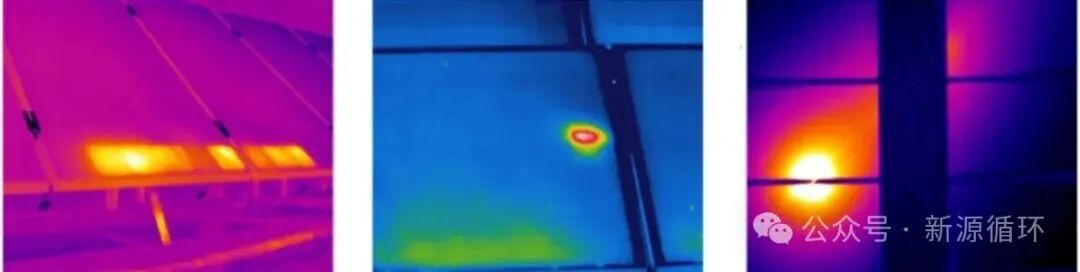
Genuine modules come with a 25-year power warranty. If a problem occurs, you can ask the manufacturer for replacement or compensation. However, these refurbished panels are not covered by any warranty from the brand owner. If hot spots, microcracks, or degradation occur, you can only pay for replacement yourself. Once modules are installed on a roof, removal and reinstallation involve a range of costs, including labor, transportation, and auxiliary materials. For some old or low-power modules, these costs may even exceed the value of the modules themselves. Some refurbished panels may not even provide basic safety assurance. Aged glass and back sheets are highly prone to glass breakage, structural failure, and encapsulation delamination, potentially causing fires, electric leakage, and falling objects from height.
How can ordinary buyers inspect them?
No professional equipment is needed. Refurbished panels have three visible flaws that can be identified with the naked eye.
Nameplate label:
The nameplate label of a genuine PV panel indicates the brand, model, power, current, voltage, certification marks, and factory serial number, with clear lettering and neat printing.
Labels affixed later to refurbished panels often have blurred fonts, rough printing, incomplete information, or even no factory serial number.
There is also a more sophisticated counterfeiting method—“serial number cloning.” Genuine or imitation labels are purchased online and affixed to refurbished panels. Major brands such as Chint, Tongwei, and LONGi currently provide official verification channels, where you can enter the product serial number or barcode on the official website to verify authenticity. If it cannot be found, there is definitely a problem.
Solder marks between solar cells:
The solder joints on genuine modules are uniform, smooth, and neatly arranged, with no solder buildup or oxidation on the ribbon surface.
Welding on refurbished panels is mostly manually repaired afterward, resulting in uneven solder joint sizes and rough surfaces. Oxidation spots and obvious color differences may even be visible. Cell spacing is also uneven, and there may be bubbles or delamination in the encapsulation layer, which can be seen after unboxing under sunlight.
Aluminum frame:
The aluminum frame of a genuine product is smooth, neat, and free of corrosion spots. Its joints are tight, with no obvious gaps or burrs along the edges.
Refurbished modules usually receive little attention in aluminum frame treatment. They may have corrosion spots, loose joints, obvious gaps, and sharp burrs to the touch. Some are repainted or polished to conceal signs of wear on the frame, but the workmanship is rough and abnormalities can be found upon close inspection.
Before purchasing PV panels, it is recommended that you ask the supplier to provide a brand authorization certificate and verify it through official channels. Legitimate sales channels will always provide official sales documentation and compliant invoices. If a seller says, “It will be cheaper without an invoice,” the channel is most likely unofficial.
PV module pricing is highly transparent, and there are publicly available market references for the cost of every raw material. If a quote is significantly below market prices, the difference must come from cost-cutting in some part of the process.
Refurbished panels can enter the market not because people are dealing in second-hand modules, but because large numbers of decommissioned panels do not enter formal recycling channels.
Decommissioned panels are not waste in themselves. After professional testing, sorting, and grading, a large proportion can fully enter the secondary market and be used in applications with lower requirements for module efficiency, such as agricultural-PV integration, fishery-PV integration, carports, and sunrooms.
However, the problem is that large numbers of decommissioned panels are collected through unofficial channels, without professional testing or grading standards. Regardless of microcracks or degradation, they are simply cleaned and refurbished, then directly sold as new products.
Companies engaged in formal recycling are instead being pushed out of the market by these gray-market chains.
About RESOLAR
Shanghai RESOLAR Energy Technology Co., Ltd. is committed to becoming a recycled material photovoltaic group with deep decarbonization. RESOLAR focuses on technological innovation and builds a world-leading solution for component recycling, impurity removal of damaged cells, recycled silicon materials and cells, and cascaded utilization of components. With professional technology and services, we help customers realize the recycling and reuse of waste photovoltaic resources, and make positive contributions to the development of environmental protection and new energy industries. For more detailed information, you can browse the official website: www.resolartech.com .

Latest developments/news
Contact information
Service Hotline: 13585742918 (Monday to Friday 9:00-18:00)
Enterprise email: ps@resolartech.com (Reply within 48 hours after receiving the email consultation!)
Company Address: Building 8, No. 1528, Wangxu East Road, Fengjing Town, Jinshan District, Shanghai (Caohejing Fengjing Park)