


English
News Center
—— NEWS CENTER ——
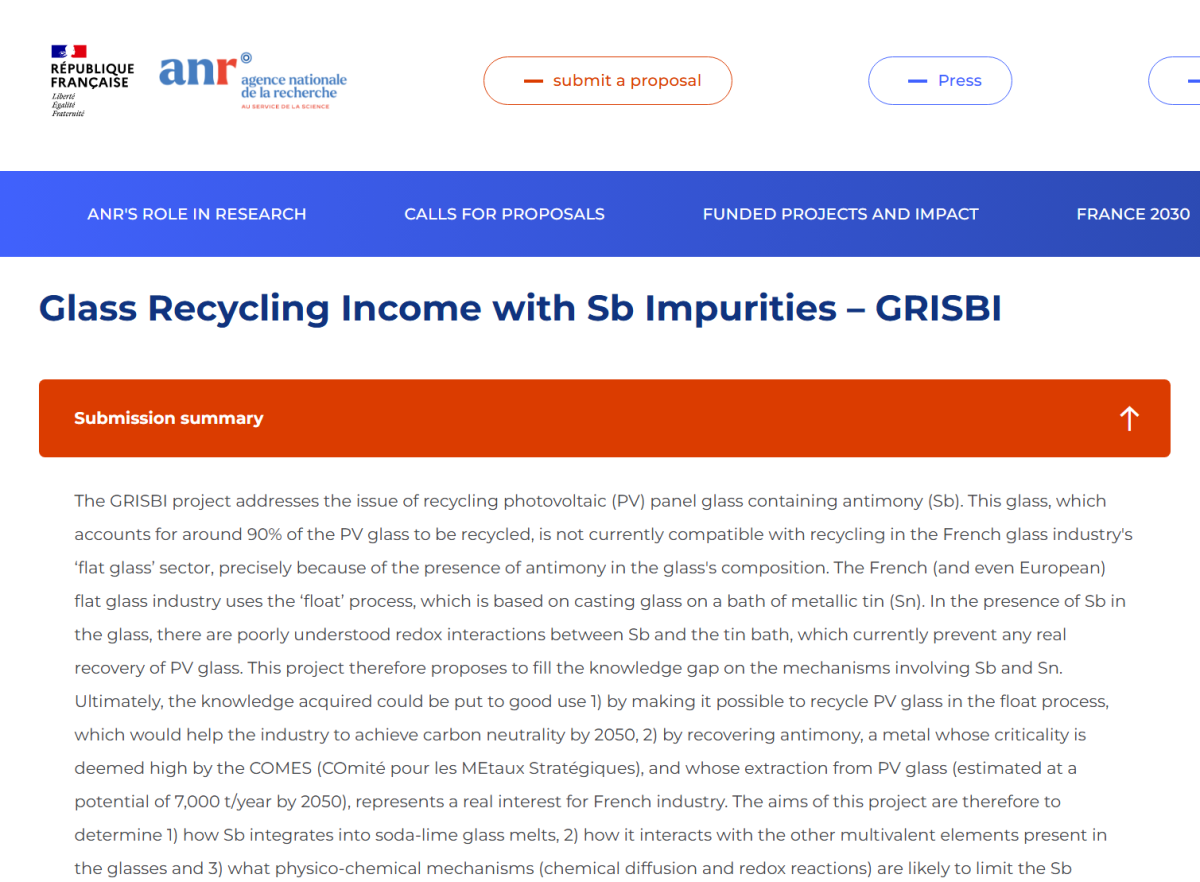
- Determine the forms in which Sb occurs in soda-lime glass melts;
- Understand the diffusion and redox mechanisms involving Sb, multivalent elements, and the molten-tin interface;
- Recover antimony as a strategic metal (COMES classifies it as a high-risk critical metal; the potential recoverable quantity by 2050 is 7,000 t/a).
How it differs from PHOTORAMA: PHOTORAMA takes an engineering detour, using “mechanical sorting + blending at ≤20% into Saint-Gobain float lines.” GRISBI aims to dismantle, at a fundamental level, the restriction that “antimony-containing glass cannot enter the float process.” It is fundamental research and does not replace short-term blending solutions.
About RESOLAR
Shanghai RESOLAR Energy Technology Co., Ltd. is committed to becoming a recycled material photovoltaic group with deep decarbonization. RESOLAR focuses on technological innovation and builds a world-leading solution for component recycling, impurity removal of damaged cells, recycled silicon materials and cells, and cascaded utilization of components. With professional technology and services, we help customers realize the recycling and reuse of waste photovoltaic resources, and make positive contributions to the development of environmental protection and new energy industries. For more detailed information, you can browse the official website: www.resolartech.com .

Latest developments/news
Contact information
Service Hotline: 13585742918 (Monday to Friday 9:00-18:00)
Enterprise email: ps@resolartech.com (Reply within 48 hours after receiving the email consultation!)
Company Address: Building 8, No. 1528, Wangxu East Road, Fengjing Town, Jinshan District, Shanghai (Caohejing Fengjing Park)