


English
News Center
—— NEWS CENTER ——
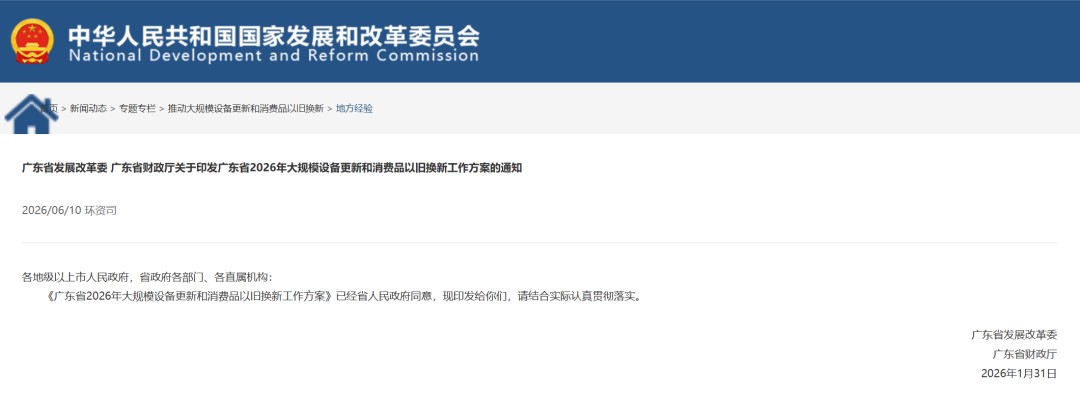
On June 10, 2026, Guangdong Province issued the " Notice of the Guangdong Provincial Development and Reform Commission and the Guangdong Provincial Department of Finance on Issuing the Guangdong Province 2026 Large-Scale Equipment Renewal and Consumer Goods Trade-in Work Plan" .
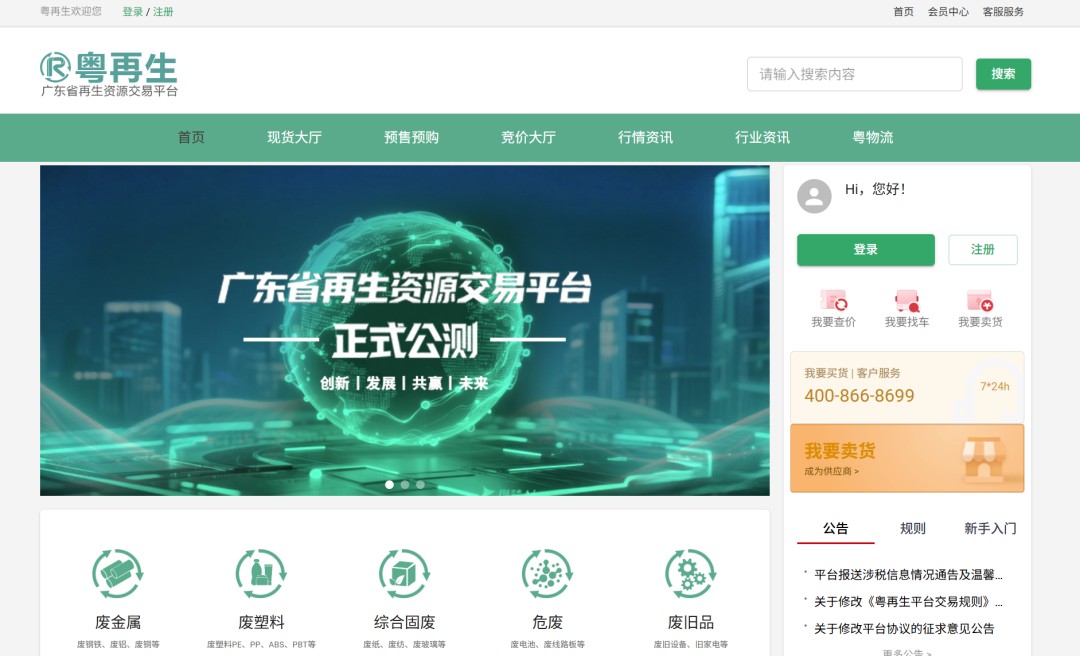
This is the first time that the " reverse invoicing" system has been implemented, which requires recycling companies to issue invoices to individuals who sell their scrapped products. " Regulate the tax order of the resource recycling industry . Develop a 'trade-in + recycling' logistics system and new models to promote the ' Guangdong Renewal' initiative." The province will strengthen and expand platforms such as the "Guangdong Provincial Comprehensive Service Platform for Equipment Renewal and Trade-in" and the "Yue Recycling" (provincial-level resource recycling platform) . It will standardize the trading of secondhand goods and the remanufacturing of scrap equipment, improve the management, evaluation, and appraisal systems for secondhand goods transactions, and improve the mechanism for promoting the application of recycled materials. The province will conduct in-depth special campaigns to rectify the illegal dumping and disposal of solid waste, strictly investigate illegal dismantling activities , and promote the entry of scrap products and equipment into formal disposal channels . It will strengthen the supervision of scrap recycling and dismantling enterprises .
Compared to the policies of 2025 and earlier, which focused on encouraging the expansion of the recycling market, the policy development focus of Guangdong and Shanxi provinces in 2026 shifted to three dimensions: channel standardization, environmental control, and tax compliance. This latest policy from both provinces marks the first time that the implementation of compliance measures has been strengthened at the provincial level, driving the local renewable resource recycling industry away from extensive incremental expansion and towards a comprehensive transformation towards refined and compliant operations.
Guangdong Recycling Platform As a key provincial-level resource recycling platform developed by Guangdong Province , the Guangdong Recycling Platform It precisely targets industry pain points such as transaction verification, tax compliance, and "reverse invoicing," and comprehensively utilizes BeiDou positioning, electronic fences, video surveillance, and blockchain evidence storage. Utilizing advanced digital technologies such as carbon footprint tracking, the platform comprehensively achieves end-to-end traceability management integrating "five flows" (information , capital, logistics, and information), helping enterprises improve their standardized and refined management levels. The platform has obtained ICP certification from the Ministry of Industry and Information Technology. We have obtained EDI licenses and Level 3 network security protection certifications, serving over 200 enterprises and government agencies. Document content Notice from the Development and Reform Commission of Guangdong Province and the Department of Finance of Guangdong Province on Issuing the Work Plan for Large-Scale Equipment Renewal and Trade-in of Consumer Goods in Guangdong Province in 2026 Issuing agencies: Guangdong Provincial Development and Reform Commission, Guangdong Provincial Department of Finance Release date: June 10, 2026 To the People's Governments of all prefecture-level cities and above, and all departments and directly affiliated institutions of the Provincial Government: The "Guangdong Province 2026 Large-Scale Equipment Renewal and Consumer Goods Trade-in Work Plan" has been approved by the Provincial People's Government and is hereby issued to you. Please implement it conscientiously in light of your actual circumstances. Guangdong Provincial Development and Reform Commission Guangdong Provincial Department of Finance January 31, 2026 Guangdong Province's 2026 Large-Scale Equipment Replacement and Consumer Goods Trade-in Program To fully implement the spirit of the 20th National Congress of the Communist Party of China and its subsequent plenary sessions, and to earnestly implement the arrangements of the Central Economic Work Conference, in accordance with the requirements of the "Notice of the National Development and Reform Commission and the Ministry of Finance on Implementing the Large-Scale Equipment Renewal and Consumer Goods Trade-in Policy in 2026" (NDRC Circular No. 1745 [2025]), the following work plan is formulated: I. Deepen the implementation of large-scale equipment renewal campaign (I) Vigorously Promote Equipment Upgrading in Key Areas. Conduct assessments and diagnoses of existing products in key areas, deeply explore equipment upgrading needs, and routinely plan and reserve equipment upgrading projects. Strengthen the guiding principles of green and low-carbon development, energy conservation and environmental protection, and safety and intelligence. While continuing to support equipment upgrading projects in industries such as manufacturing, electronics and information, energy and power , transportation, logistics, education, culture and tourism, healthcare, facility agriculture, grain and oil processing, production safety, old residential elevators, and energy conservation, carbon reduction, and environmental protection, expand support to include elevator installation in old residential communities, elderly care institutions, fire and rescue facilities, and testing and inspection facilities. Support equipment upgrading for offline consumer commercial facilities such as commercial complexes, shopping centers, department stores, and large supermarkets. Optimize application conditions and review processes, further lower the investment threshold for applying for equipment upgrading projects, increase support for equipment upgrading in small and medium-sized enterprises, and expand the policy's reach. Strengthen project planning and application guidance, strictly screen and review projects, and continuously improve project quality. (II) Support for the scrapping and replacement of old commercial freight vehicles. Continue to support the replacement of scrapped commercial freight vehicles meeting only the National IV emission standard or below with low-emission freight vehicles, with priority given to electric freight vehicles. Subsidy standards will be implemented in accordance with the "Notice of the Ministry of Transport, the National Development and Reform Commission, and the Ministry of Finance on Implementing the Scrapping and Replacement of Old Commercial Freight Vehicles" (Jiao Guihua Fa [2025] No. 17). Specific requirements for our province will be formulated separately by the Provincial Department of Transportation in consultation with relevant provincial departments. (III) Accelerate the replacement of urban buses with new energy vehicles and power batteries. Promote the electrification of urban buses and continue to support the replacement of urban buses with new energy vehicles and power batteries. The subsidy standards shall be implemented in accordance with the "Notice of the General Office of the Ministry of Transport, the General Office of the National Development and Reform Commission, and the General Office of the Ministry of Finance on Issuing the 'Implementation Rules for Subsidies for the Replacement of New Energy Urban Buses and Power Batteries in 2025'" (Jiaobanyun [2025] No. 4). Specific requirements in our province shall be formulated separately by the Provincial Department of Transportation in consultation with relevant provincial departments. (IV) Support the scrapping and replacement of old agricultural machinery. Continue to support the scrapping and replacement of old agricultural machinery, increase efforts to eliminate old agricultural machinery that is energy-intensive, heavily polluting, and has low safety performance, and accelerate the promotion and application of advanced, applicable, energy-saving, environmentally friendly, safe, and reliable agricultural machinery. The scope and standards of subsidies shall be implemented in accordance with the "Notice of the General Office of the Ministry of Agriculture and Rural Affairs, the General Office of the National Development and Reform Commission, the General Office of the Ministry of Finance, and the General Office of the National Food and Strategic Reserves Administration on Implementing the 2025 Agricultural Machinery Scrapping and Replacement Subsidy Policy" (Agricultural Machinery Office [2025] No. 3). The 12 types of agricultural machinery eligible for scrapping and replacement subsidies that our province can choose independently, as well as the specific implementation rules, will be formulated separately by the Provincial Department of Agriculture and Rural Affairs in consultation with relevant provincial departments. (V) Continue to provide interest subsidies and risk compensation for equipment upgrade loans. Continue to implement the provincial-level financial interest subsidy and risk compensation policy for equipment upgrades. In accordance with the "Implementation Rules for the Management of Interest Subsidies and Risk Compensation for Large-Scale Equipment Upgrade Loans in Guangdong Province" (Yue Jin Guan [2024] No. 14), provide "interest subsidies + risk compensation" for eligible technological upgrading and equipment upgrade loans. Improve the dynamic management of the project list and the approval guarantee mechanism for candidate projects, increase project matching efforts, and make good use of re-loans for technological innovation and technological upgrading. Explore appropriately expanding the coverage of candidate projects and strengthen support for inclusive micro and small enterprises and enterprises in eastern, western, and northern Guangdong. II. Further implement the consumer goods trade-in program (VI) Make full and effective use of funds for the trade-in of consumer goods. Referring to national practices, and taking into account factors such as the number of permanent residents, regional GDP, number of cars and home appliances owned, the implementation of consumer goods trade-in policies and funds, and problems discovered in audits, a systematic evaluation of the effectiveness of local work will be conducted to scientifically and rationally determine the scale of support funds for each region. For car scrapping and replacement, car replacement, trade-in of six types of home appliances, and purchase of four types of digital and smart products, unified support categories and subsidy standards will be implemented in accordance with national requirements; local governments are not allowed to expand the scope or raise standards on their own. Strengthen the supply of high-quality products, raise the technical threshold, and focus subsidies on categories with wider coverage and stronger driving effects, promoting the entry of more green, low-carbon, safe, and intelligent consumer goods into residents' lives. (VII) Support for Vehicle Scrapping and Renewal. Individual consumers who scrap their passenger vehicles registered in their own name and purchase new energy passenger vehicles included in the "Catalogue of New Energy Vehicle Models Eligible for Vehicle Purchase Tax Reduction and Exemption" or fuel passenger vehicles with an engine displacement of 2.0 liters or less in Guangdong Province will receive vehicle scrapping and renewal subsidies. For scrapping the aforementioned eligible old vehicles and purchasing new energy passenger vehicles, a subsidy of 12% of the vehicle price (maximum not exceeding RMB 20,000) will be provided; for scrapping the aforementioned eligible fuel passenger vehicles and purchasing fuel passenger vehicles, a subsidy of 10% of the vehicle price (maximum not exceeding RMB 15,000) will be provided. Specific implementation details in Guangdong Province will be formulated separately by the Guangdong Provincial Department of Commerce in consultation with relevant departments. (viii) Support for vehicle replacement and renewal. Individual consumers who transfer their passenger vehicles registered in their own name and purchase new energy passenger vehicles included in the "Catalogue of New Energy Vehicle Models Eligible for Vehicle Purchase Tax Reduction and Exemption" or fuel passenger vehicles with an engine displacement of 2.0 liters or less will receive a vehicle replacement and renewal subsidy. For the purchase of new energy passenger vehicles, the subsidy will be 8% of the vehicle price (maximum not exceeding RMB 15,000); for the purchase of fuel passenger vehicles with an engine displacement of 2.0 liters or less, the subsidy will be 6% of the vehicle price (maximum not exceeding RMB 13,000). Specific implementation details for our province will be formulated separately by the Provincial Department of Commerce in consultation with relevant departments. (ix) Support trade-in of old home appliances. Individual consumers who purchase appliances of the following six categories—refrigerators, washing machines, televisions, air conditioners, computers, and water heaters—that meet the Level 1 energy efficiency or water efficiency standard will receive a subsidy of 15% of the product's sales price. Each consumer can receive a subsidy for one appliance of each category, with a maximum subsidy of 1,500 yuan per appliance. (x) Support for the purchase of new digital and smart products. Individual consumers purchasing mobile phones, tablets, smartwatches/bands, and smart glasses (with a single item sales price not exceeding 6,000 yuan) will receive a subsidy of 15% of the product sales price. Each consumer can receive a subsidy for one item of each product category, with a maximum subsidy of 500 yuan per item. Subsidies will also be provided for the purchase of new smart home products (including age-friendly home products). The specific categories and standards for subsidies will be reasonably formulated by the Provincial Department of Commerce in conjunction with relevant provincial departments based on actual conditions. III. Deepen the implementation of the whole-chain recycling and reuse action (XI) Accelerate efforts to address shortcomings in the recycling system. Focusing on green sorting centers for renewable resources, intelligent sorting and recycling facilities such as smart recycling bins, the construction of reverse logistics recycling systems for production enterprises, and the construction of an "Internet + recycling" system, we will plan and deploy a number of projects to address shortcomings in recycling and actively seek support from ultra-long-term special treasury bonds. We will support the supply and marketing cooperative system in leveraging the advantages of its grassroots outlets to build green sorting centers according to local conditions, and further improve the three-tiered recycling network with county-level sorting centers as the support, town and street transfer stations as nodes, and village and community recycling outlets as terminals. (XII) Vigorously develop the resource recycling industry. Implement the "reverse invoicing" system for resource recycling enterprises to individual sellers of scrapped products, and regulate the tax order of the resource recycling industry . Develop a "trade-in + recycling" logistics system and new models, and promote the expansion and strengthening of platforms such as "Guangdong Renewal" and "Guangdong Regeneration" . Regulate the trading of second-hand goods and the remanufacturing of scrap equipment, improve the management, evaluation, and appraisal systems for used goods transactions, and improve the mechanism for promoting the application of recycled materials. Conduct in-depth special campaigns to rectify the illegal dumping and disposal of solid waste, strictly investigate illegal dismantling activities , and promote the entry of scrapped products and equipment into formal channels for disposal . Strengthen supervision of scrap recycling and dismantling enterprises , continue to provide guidance to standardized dismantling enterprises included in the national subsidy list, and actively strive for central government special funds for the treatment of waste electrical and electronic products. IV. Deepen the implementation of the standards-upgrading and guidance action (XIII) Accelerate the formulation and revision of standards. Adhere to serving enterprises and consumers, further implement the Standards Leadership Initiative, optimize energy conservation and carbon reduction standards and pollutant emission standards for key industries, and continuously promote the use of standards to drive equipment upgrades and improve the quality of consumer goods. Support various entities in participating in the formulation and revision of relevant standards such as those for elevator installation in existing residential buildings (old communities). Dynamically adjust the "four standards lists" and continuously accelerate the standard formulation and revision process. Continue to expand the scope of "Greater Bay Area Certification" issuance and its acceptance scenarios to enhance its influence. (XIV) Strengthen the supervision of standard implementation. Organize and carry out publicity and implementation of mandatory national standards related to "new energy and new industries". Strictly implement the technical specifications for pollution control in the treatment of waste electrical and electronic products, and strengthen the application of energy efficiency and water efficiency standards for consumer products such as home appliances and electronics. Carry out investigation and rectification of quality and safety hazards of key industrial products, focusing on key areas such as industrial clusters, e-commerce platforms, trade markets in urban-rural fringe areas and rural markets, and increase the intensity of quality supervision and spot checks on key consumer products such as home appliances and automobiles, and severely crack down on acts such as passing off counterfeit products as genuine products, substandard products as superior products, used products as new products, substandard products as qualified products, and counterfeiting and misusing energy efficiency and water efficiency labels. Continue to carry out provincial metrological supervision and spot checks on products registered with "China Energy Efficiency Label" and "China Water Efficiency Label". V. Strengthen Organization and Implementation (XV) Strengthen Organizational Leadership and Overall Coordination. The Provincial Development and Reform Commission, as the leading department of the Provincial Special Working Group on "Two New" Enterprises, will work with the Provincial Department of Finance to allocate funds from ultra-long-term special treasury bonds to implement the "Two New" policies. The Provincial Department of Commerce will take the lead in carrying out relevant work on the trade-in of consumer goods; the Provincial Department of Agriculture and Rural Affairs will take the lead in carrying out relevant work on the scrapping and renewal of agricultural machinery; and the Provincial Department of Transportation will take the lead in carrying out relevant work on the renewal of old commercial freight vehicles, urban new energy buses, and power batteries, and organize local governments to implement relevant policies. Local governments and relevant departments should focus on the key areas of equipment renewal identified by the state, promptly plan and reserve projects in their respective regions, fields, and industries, and actively seek support from ultra-long-term special treasury bonds. Local governments should strengthen cross-departmental data connectivity and sharing, establish cross-departmental data sharing channels based on the national and provincial subsidy data platforms, and achieve key data comparison and cross-verification; they should promptly organize implementation, solidify the responsibilities of all parties, grasp the work pace, enrich support methods, and fully leverage the effectiveness of the "Two New" policies. (XVI) Smooth, Orderly, and Standardized Use of Funds. In accordance with national policy requirements, provincial and municipal finance departments will allocate matching funds at a ratio of 8.5:1.5 based on the allocation of central government funds. Central government funds will be used to implement the consumer goods trade-in support policies listed in Articles (VII), (VIII), (IX), and (X) of this plan. Provincial and municipal matching funds will be used to implement the aforementioned policies or other expanded support categories. Specific sharing ratios between the province and municipalities will be notified separately. All localities and relevant departments must strictly implement the support standards for relevant fields specified in this plan to ensure that fund allocation complies with the "two new" policy requirements and that tangible benefits directly reach consumers. Where the state allows local governments to independently and reasonably determine the subsidy categories, subsidy standards, and implementation methods within the framework of the consumer goods trade-in policy, the Provincial Department of Commerce will consult with relevant provincial departments to formulate separate plans, encouraging priority support for products with high energy efficiency, water efficiency, and environmental protection levels. All localities and relevant departments must pay more attention to the timing and balance of fund use, rationally formulate balanced fund use plans for different fields, and use funds evenly on a monthly basis to ensure the smooth and orderly implementation of the consumer goods trade-in policy throughout the year. Local governments must promptly settle the 2025 consumer goods trade-in subsidy funds and ensure a smooth and orderly transition of related support policies across fiscal years. If a city exhausts its 2026 central and provincial funding quota, the excess will be borne by the city itself, and the province will no longer provide support. For regions with significant outstanding subsidy payments, appropriate measures will be taken to increase oversight or penalties. Any unused central and provincial funding quotas by December 31, 2026, will be recovered. (XVII) Effectively Enhance the Convenience for Enterprises and Consumers to Participate. Implement the requirements for accelerating the construction of a unified national market, break down local protectionism, eliminate regional and channel restrictions, and support online and offline businesses, as well as businesses of different ownership, registration locations, and sizes, to participate in large-scale equipment upgrades and consumer goods trade-ins on an equal footing. All regions should unify and standardize the management system for consumer goods trade-ins, and improve the detailed implementation rules for the entire chain, including the management of participating business entities, product sales price filing, subsidy eligibility issuance, and fund review and disbursement. Under the premise of ensuring fund security, regions are encouraged to promote the pre-allocation mechanism of funds based on their actual conditions, optimize the fund review and disbursement process, and promptly and efficiently disburse subsidies and preferential treatment, reducing the financial burden and operational pressure on enterprises. Guide financial institutions to increase financial support for the production, service, and consumption of green home appliances. Make good use of the "Guangdong Renewal" consumer goods trade-in public service platform to comprehensively enhance the consumer experience. Give full play to the advantages of different sales channels and support offline physical retail; improve the convenience of consumption in rural areas by increasing the number of offline business entities in rural areas and guiding online channels towards rural areas . (XVIII) Strengthen the whole-chain supervision of projects and funds. Strengthen the closed-loop management of "new social organizations" projects, closely monitor the whole-chain management of project reserves, application, review, allocation, implementation and fund payment and use, and ensure that all parties fulfill their responsibilities. In accordance with the national deployment, and taking into account factors such as the average depreciation period of equipment in different industries and the technology update cycle, refine and improve the quantitative requirements such as the minimum service life and technical indicators of the equipment to be phased out in different fields, and make equipment depreciation and minimum service life mandatory conditions for project application. Strictly manage the elimination and scrapping of equipment, standardize asset management, and avoid waste of resources. Relevant provincial departments should do a good job in organizing and implementing the equipment renewal projects supported by the ultra-long-term special treasury bonds, urge all localities and relevant units to accelerate project construction and fund disbursement, and promote the formation of physical workload as soon as possible; coordinate online early warning and offline on-site verification to resolutely prevent problems such as untimely allocation of funds, slow use, and misappropriation. The people's governments of all prefecture-level cities and above are the primary responsible entities for project and fund management. They must strictly manage the funds from ultra-long-term special treasury bonds, conduct daily scheduling and on-site assessments of equipment upgrade projects, and strengthen supervision of funds for the trade-in of old consumer goods. They must strictly implement the centralized treasury payment system, firmly adhere to the red lines and bottom lines for fund use, and refrain from fictitious expenditures, false reporting of expenditures, or using appropriations in lieu of payments, to avoid the accumulation and idleness of funds. The provincial special working group for "two new" projects should continuously monitor progress, urge implementation, and track effectiveness, conduct regular problem investigations, and rectify and resolve each problem found to ensure comprehensive coverage without leaving any blind spots. (XIX) Timely follow-up evaluation. The Provincial Development and Reform Commission, together with relevant provincial departments, will strengthen the evaluation and guidance of the implementation of the "two new" policies in various regions and fields, urge the implementation of key tasks, promptly identify problems, and respond quickly to resolve them. Municipal governments at the prefecture level and above shall conduct self-evaluations and self-inspections on policy implementation, project implementation, fund utilization, and achievement of performance targets, and promptly submit reports to the Provincial Development and Reform Commission and the Provincial Department of Finance, and send copies of relevant information to the Provincial Department of Transportation, the Provincial Department of Agriculture and Rural Affairs, the Provincial Department of Commerce, and other relevant departments. The Provincial Development and Reform Commission, in consultation with the Provincial Department of Finance, will compile a performance evaluation report and use the evaluation results as an important basis for subsequent optimization of fund allocation. (20) Foster a positive atmosphere for public participation. All localities and relevant departments should strengthen policy publicity, utilize hotlines for "new social organizations" policies, and ensure smooth channels for consumer complaints and reports to promptly address public concerns. They should regularly summarize and publish information on subsidy usage and the handling of violations through relevant platforms to enhance the transparency of policy implementation. All localities must severely crack down on illegal and irregular activities such as fraudulent subsidy claims, and platforms and merchants raising prices before providing subsidies; those suspected of criminal activity should be transferred to judicial organs for severe punishment according to law.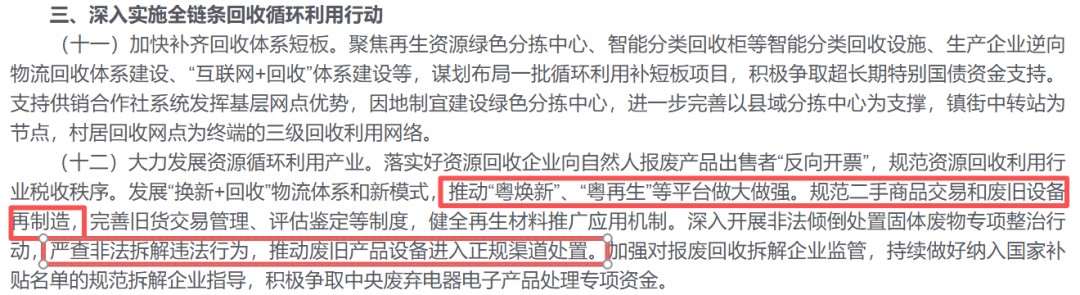
About RESOLAR
Shanghai RESOLAR Energy Technology Co., Ltd. is committed to becoming a recycled material photovoltaic group with deep decarbonization. RESOLAR focuses on technological innovation and builds a world-leading solution for component recycling, impurity removal of damaged cells, recycled silicon materials and cells, and cascaded utilization of components. With professional technology and services, we help customers realize the recycling and reuse of waste photovoltaic resources, and make positive contributions to the development of environmental protection and new energy industries. For more detailed information, you can browse the official website: www.resolartech.com .

Latest developments/news
Contact information
Service Hotline: 13585742918 (Monday to Friday 9:00-18:00)
Enterprise email: ps@resolartech.com (Reply within 48 hours after receiving the email consultation!)
Company Address: Building 8, No. 1528, Wangxu East Road, Fengjing Town, Jinshan District, Shanghai (Caohejing Fengjing Park)