



English
News Center
—— NEWS CENTER ——
On March 17, 2026, Shanxi Province issued the " Notice on Issuing the Action Plan for Implementing Large-Scale Equipment Renewal and Consumer Goods Trade-in Policy in Shanxi Province in 2026", which mentioned supporting the recycling of waste in new infrastructure fields such as waste power batteries, retired wind and solar power equipment , data centers and communication base stations.
It also mentioned for the first time the need to severely punish illegal recycling and dismantling activities in accordance with laws and regulations. It further emphasized the implementation of " reverse invoicing" by resource recycling companies to individuals who sell their scrapped products. The document outlines measures to regulate tax supervision of resource recycling companies, encourage the development of the "Internet + secondhand" model, support recycling companies in utilizing relevant information platforms and mobile applications for "online appointments and offline recycling," and promote the construction of centralized and standardized offline secondhand goods trading markets to facilitate the development of the secondhand goods circulation market.
Compared to the 2025 and earlier documents, which focused on encouraging the expansion of the recycling market , the 2026 policy development focus shifts to three dimensions : channel standardization, environmental control, and tax compliance . This document, for the first time, strengthens the implementation of compliance at the policy level, enabling the recycling industry to transform from extensive growth to refined compliant operation.
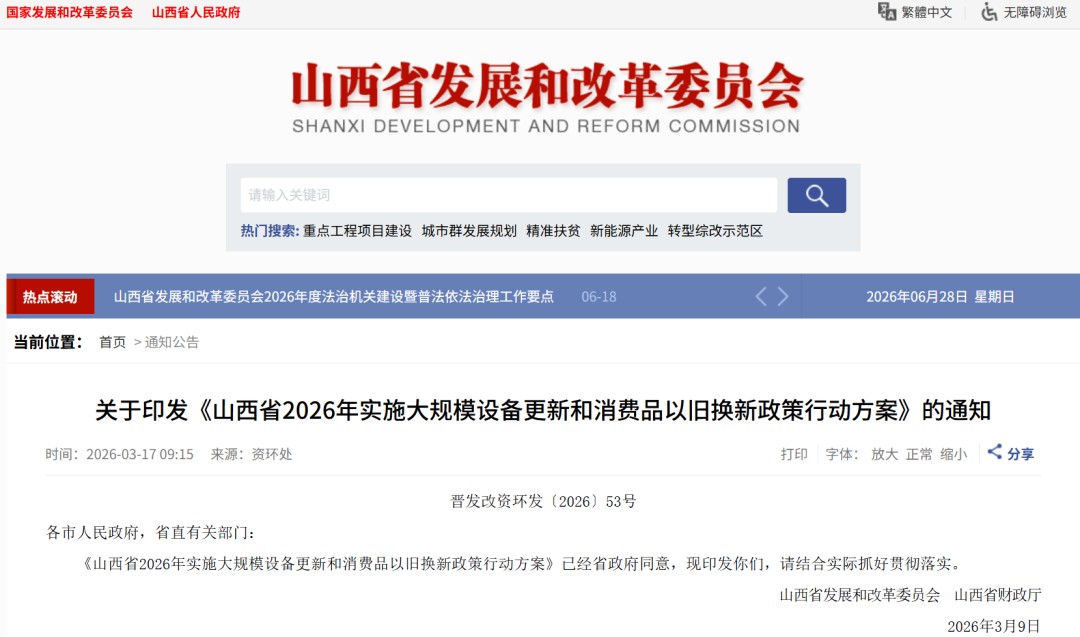
Document content Notice on Issuing the "Shanxi Province 2026 Action Plan for Implementing Large-Scale Equipment Renewal and Consumer Goods Trade-in Policy" Jinfa Gaizi Huanfa [2026] No. 53 Issuing agencies: Shanxi Provincial Development and Reform Commission, Shanxi Provincial Department of Finance Release date: March 17, 2026 Shanxi Province will implement a large-scale equipment upgrade and consumer goods trade-in policy in 2026. Action Plan In order to fully implement the spirit of the 20th CPC National Congress and its subsequent plenary sessions, and to earnestly implement the requirements of the "Notice of the National Development and Reform Commission and the Ministry of Finance on Implementing the Policy of Large-Scale Equipment Renewal and Trade-in of Consumer Goods in 2026" (NDRC Environmental Resources [2025] No. 1745), this plan is formulated to continuously promote large-scale equipment renewal and trade-in of consumer goods in our province, effectively unleash the potential of domestic demand, and expand effective investment. I. Comprehensively promote large-scale equipment upgrades (I) Continue to increase efforts in equipment upgrades in existing supported sectors. Continue to increase the planning and reserve of equipment upgrade projects and recycling projects in sectors such as industry, electronics and information, energy and power , transportation, logistics, education, culture and tourism, healthcare, facility agriculture, grain and oil processing, work safety, old residential elevators, energy conservation, carbon reduction, and environmental protection. Guide key industry enterprises to accelerate the elimination of outdated, inefficient, and expired production lines and high-energy-consuming equipment, focusing on high-end, intelligent, green, and safe directions, and strengthen the promotion and application of advanced equipment and processes. Support the upgrading and transformation of existing coal-fired power units to improve the energy efficiency of key energy-consuming equipment such as boilers and motors. Orderly promote the application of electric boilers, electric kilns, and electrical equipment in sectors such as metallurgy and building materials to improve the electrification level of end-use energy. Promote the upgrading of new energy equipment and power grid facilities. Support the upgrading of safety production and rescue equipment in mining and hazardous chemical industries, and improve the standardization of rescue teams. Promote the upgrading of facilities and equipment in public service sectors such as education and healthcare, explore models for the open sharing and efficient utilization of advanced equipment, and enhance the capacity to guarantee public services. (The Provincial Development and Reform Commission, the Provincial Department of Industry and Information Technology, the Provincial Energy Bureau, the Provincial Department of Education, the Provincial Department of Culture and Tourism, the Provincial Health Commission, the Provincial Department of Agriculture and Rural Affairs, the Provincial Grain and Reserves Bureau, the Provincial Emergency Management Department, and the Provincial Department of Housing and Urban-Rural Development are responsible according to their respective duties, and the people's governments of all cities shall ensure implementation. The following also require implementation by the people's governments of all cities, and will not be listed individually.) (II) Accelerate the Layout of Equipment Renewal Projects in Newly Expanded Support Areas. Following national policy guidance, and focusing on areas supported by the expanded national policy in 2026, such as elevator installation in old residential communities, elderly care institutions, fire and rescue facilities, and the renewal of equipment in testing and inspection facilities and offline consumer commercial facilities, we will accelerate industry research and demand assessment, and precisely plan a number of mature projects in line with national policies to better meet the needs of people's livelihoods and safety. We will prioritize the installation of elevators in existing residential buildings, improve age-friendly renovations, and facilitate residents' travel. We will promote the upgrading and transformation of nursing beds, rehabilitation equipment, safety monitoring, and smart management equipment in elderly care institutions. We will support fire and rescue departments in updating special vehicles, personal protective equipment, and intelligent rescue equipment. We will encourage testing and inspection institutions to introduce advanced instruments, enhance their technical service capabilities, and improve their quality infrastructure service system. We will promote the renovation and upgrading of community retail commercial facilities, and encourage commercial complexes, shopping centers, department stores, and large supermarkets to update elevators, refrigeration, lighting, and other equipment. We will focus on safe production in the hazardous chemicals industry, improve the safety and reliability of production, storage, and transportation facilities and equipment, promote the application of unmanned intelligent equipment, and strengthen the updating and allocation of advanced safety and emergency equipment. (The Provincial Development and Reform Commission, the Provincial Department of Housing and Urban-Rural Development, the Provincial Department of Civil Affairs, the Provincial Department of Emergency Management, the Provincial Fire and Rescue Corps, the Provincial Administration for Market Regulation, the Provincial Department of Commerce, and the Provincial Department of Industry and Information Technology are responsible according to their respective duties.) (III) Further promote the scrapping and replacement of commercial freight vehicles, urban buses, and agricultural machinery. Continue to encourage the replacement of scrapped commercial freight vehicles with emission standards of National IV and below with low-emission freight vehicles, prioritize support for replacement with electric freight vehicles, promote the large-scale application of new energy heavy trucks, and increase the proportion of clean transportation of bulk goods in key industries. Promote the electrification of urban buses, encourage bus companies to develop green and smart buses, and support the safe and orderly replacement of power batteries that have exceeded their warranty period. Focus on increasing yield through mechanized sowing and reducing losses through mechanized harvesting, and in combination with the needs of agricultural production and the level of agricultural mechanization development, support the scrapping and replacement of advanced, applicable, energy-saving, environmentally friendly, safe, and reliable agricultural machinery. The subsidy support standards for the above-mentioned areas will still be implemented in accordance with the "Implementation Rules for the Scrapping and Renewal of Old Operating Freight Vehicles in Shanxi Province in 2025" (Jin Jiao Yun Guan Fa [2025] No. 123), the "Implementation Rules for the Subsidy of New Energy Urban Buses and Power Batteries in Shanxi Province in 2025" (Jin Jiao Cheng Ke Fa [2025] No. 90), and the "Notice on Implementing the Subsidy Policy for the Scrapping and Renewal of Agricultural Machinery in 2025" (Jin Nong Fa [2025] No. 42). (Led by the Provincial Department of Transportation and the Provincial Department of Agriculture and Rural Affairs, with the cooperation of the Provincial Development and Reform Commission, the Provincial Department of Finance, the Provincial Department of Ecology and Environment, the Provincial Public Security Department, and the Provincial Department of Commerce) (IV) Strengthen the whole-chain management of projects and funds. Comprehensively improve project management efficiency, relying on the national major construction project database to implement whole-chain management of project reserves, application, review, allocation, implementation, and fund payment and use. Further clarify the support conditions and review standards for equipment renewal projects in various fields supported by the national ultra-long-term special treasury bonds, and strengthen the review of key nodes. Strictly implement the quantitative requirements such as the minimum service life and technical indicators of equipment to be phased out in different fields by the state, and make equipment depreciation and minimum service life mandatory conditions for project applications. Strictly manage equipment elimination and scrapping, and standardize asset management. Promptly forward and allocate the national ultra-long-term special treasury bond funds for equipment renewal in our province, supporting equipment renewal projects in key areas determined by the state, as well as the scrapping and renewal of old operating freight vehicles, new energy urban buses, and agricultural machinery, and urge the timely implementation and standardized use of funds. Strengthen the supervision of project implementation and fund use through online monitoring and offline verification, and resolutely prevent problems such as untimely fund allocation, idle funds, and misappropriation. (The Provincial Development and Reform Commission, the Provincial Department of Finance, the Provincial Department of Industry and Information Technology, the Provincial Energy Bureau, the Provincial Department of Education, the Provincial Department of Culture and Tourism, the Provincial Health Commission, the Provincial Department of Agriculture and Rural Affairs, the Provincial Grain and Reserves Bureau, the Provincial Emergency Management Department, the Provincial Department of Housing and Urban-Rural Development, the Provincial Department of Civil Affairs, the Provincial Fire and Rescue Corps, the Provincial Administration for Market Regulation, and the Provincial Department of Commerce are responsible according to their respective duties.) II. Optimize the implementation of the trade-in program for consumer goods. (V) Clarify the scope and standards of subsidies. Deepen the implementation of the special action to boost consumption and promote the upgrading of large-scale consumption. Support the scrapping and replacement of automobiles, the replacement of old automobiles with new ones, the replacement of six types of home appliances (refrigerators, washing machines, televisions, air conditioners, computers, and water heaters), and the purchase of new digital and smart products (mobile phones, tablets, smartwatches/bands, and smart glasses). The subsidy standards will be implemented in accordance with the national unified requirements. Within the framework of the national consumer goods replacement policy, and in light of the actual situation in our province, appropriately increase the categories of subsidized goods, support products with high energy efficiency, water efficiency, and environmental protection levels, and focus on supporting the State Council's "Artificial Intelligence" initiative. The "Energy+" initiative specifically targets next-generation smart terminals; subsidy standards and implementation methods will be formulated separately. It will also connect the consumer goods industry chain, promote the diversification, quality improvement, and brand creation of consumer goods industries, and develop specialized consumer goods industrial parks. (Led by the Provincial Department of Commerce, with the cooperation of the Provincial Development and Reform Commission, the Provincial Department of Finance, and the Provincial Department of Industry and Information Technology) (VI) Optimize the overall allocation of funds. Based on the scale of the ultra-long-term special treasury bonds allocated to our province for the consumer goods trade-in program, the Provincial Department of Finance will implement local matching funds according to the principle of a 9:1 ratio of central to provincial funding. The Provincial Development and Reform Commission, in consultation with the Provincial Department of Finance and relevant provincial departments, will rationally determine the allocation amount of funds for each sector based on factors such as the actual stock of consumer goods, sales orders, policy implementation effectiveness, and fund execution. Central government funds and provincial matching funds will be allocated in batches on a quarterly basis, and adjustments will be made promptly based on fund usage. Priority will be given to subsidizing categories with broader coverage and stronger multiplier effects, emphasizing the promotion of green, low-carbon, and intelligent products to improve the efficiency of fund utilization and better unleash consumption potential. (The Provincial Development and Reform Commission, the Provincial Department of Finance, and the Provincial Department of Commerce are responsible according to their respective duties.) (VII) Improve Implementation and Supervision Systems. A unified and standardized management system for the trade-in of consumer goods should be established, and detailed rules should be improved for the entire chain, including dynamic management of the list of business entities, product sales price filing, subsidy eligibility disbursement, and fund verification and payment. A subsidy pre-allocation system should be established, allocating funds to enterprises or payment platforms based on their sales and advance payments to alleviate their financial burden. The subsidy eligibility disbursement, document uploading, and review processes should be simplified, with clear payment deadlines. Multi-departmental joint review and approval should be implemented to reduce redundant reporting and unnecessary steps. Cross-departmental data sharing should be strengthened, promoting cross-verification of key data among departments such as commerce, transportation, agriculture and rural affairs, finance, public security, taxation, and industry and information technology. Online and offline sales channels should be streamlined, with increased support for offline physical retail to improve consumer convenience in rural areas. Illegal and irregular activities such as subsidy fraud, price gouging followed by subsidies, and scalping should be severely punished; those suspected of crimes should be transferred to judicial organs for strict investigation and prosecution. Consumer complaint channels should be streamlined, and information on subsidy use and the handling of violations should be regularly summarized and published through third-party service platforms to improve policy implementation transparency. (The Provincial Department of Commerce, the Provincial Development and Reform Commission, the Provincial Department of Finance, the Provincial Department of Transportation, the Provincial Department of Agriculture and Rural Affairs, the Provincial Administration for Market Regulation, the Provincial Public Security Department, the Provincial Taxation Bureau, and the Provincial Department of Industry and Information Technology are responsible according to their respective duties.) (VIII) Strengthen the Use and Management of Funds. Supervision of the entire process of subsidy review and fund disbursement must be strengthened. The centralized treasury payment system must be strictly implemented, and the red lines for fund use must be strictly adhered to. False listing of expenditures, false reporting of expenditures, and using appropriations in lieu of disbursement are strictly prohibited. Large-scale non-disbursement of subsidies is strictly prohibited. For any violations of the above requirements or financial regulations, illegally disbursed subsidies must be promptly recovered, and relevant personnel must be held accountable according to law and regulations. A smooth and orderly transition of the consumer goods trade-in subsidy policy across fiscal years must be ensured, and the settlement of 2025 subsidy funds must be completed in a timely manner. Any unused consumer goods trade-in funds allocated by each city by December 31, 2026, will be recovered by the central government. (Led by the Provincial Department of Commerce, with the cooperation of the Provincial Development and Reform Commission and the Provincial Department of Finance) III. Improve the recycling system (ix) Enhance waste recycling capacity. Support the construction of recycling systems for automobiles, electronic products, home appliances and furniture, and promote "Internet + recycling" , community smart recycling bins, and " vehicle-based warehousing". "...and other models. Streamline the channels for the sale of used equipment and consumer goods, and promote the construction of recycling resource collection points, transfer stations, and sorting centers. Give full play to the advantages of the grassroots operation and service outlets of supply and marketing cooperatives, and improve the coverage of the grassroots recycling network. Encourage qualified production and sales enterprises to carry out reverse logistics recycling of waste products. Support the recycling of waste in new infrastructure fields such as used power batteries, retired wind and solar power equipment , data centers, and communication base stations. Strengthen scientific and technological research on major technologies and equipment for resource recycling. Increase the promotion and application of recycled materials, promote government procurement of recycled resource products, and guide production enterprises to increase the proportion of recycled materials used. Strictly investigate and punish illegal recycling and dismantling activities in accordance with laws and regulations. Implement "reverse invoicing" by resource recycling enterprises to natural persons selling scrapped products , and standardize tax supervision of resource recycling enterprises . (The Provincial Department of Commerce, Provincial Development and Reform Commission, Provincial Supply and Marketing Cooperative, Provincial Department of Industry and Information Technology, Provincial Energy Bureau, Provincial Data Bureau, Provincial Department of Science and Technology, Provincial Market Supervision Bureau, and Provincial Taxation Bureau are responsible according to their respective duties.) (X) Regulate the circulation and remanufacturing of second-hand goods. Encourage the development of the "Internet + second-hand" model, support recycling companies in conducting "online appointment and offline recycling" through relevant information platforms and mobile applications, encourage the construction of centralized and standardized offline second-hand goods trading markets , and promote the development of the second-hand goods circulation market. Strengthen information security supervision of second-hand transactions of computer, communication, and consumer electronics products. Accelerate the cultivation of the remanufacturing industry, explore and promote the remanufacturing of waste electromechanical equipment, auto parts, etc., and strengthen the innovation, research and development, and application of common key technologies for remanufacturing. (The Provincial Department of Commerce, the Provincial Development and Reform Commission, the Provincial Department of Industry and Information Technology, and the Provincial Department of Science and Technology are responsible according to their respective duties.) IV. Strengthening Standards Guidance and Supervision (XI) Strictly enforce and supervise the implementation of standards. Strengthen the binding force of standard implementation and strictly implement relevant national standards in the field of waste recycling. Enforce the mandatory scrapping standards for motor vehicles and vehicle safety and environmental protection inspection standards, and eliminate old vehicles that have reached the mandatory scrapping standards in accordance with laws and regulations. Strictly implement the technical specifications for pollution control in the treatment of waste electrical and electronic products. Improve the product quality monitoring system, include important consumer goods such as home appliances and home decoration products in the key areas of quality and safety supervision, increase the intensity of quality supervision and spot checks on key consumer goods in accordance with standards, and severely punish illegal acts such as adulteration, counterfeiting, and misuse of energy efficiency and water efficiency labels, including adulteration, falsification, and misrepresentation of products. Strengthen the management of defective product recalls. (The Provincial Market Supervision Bureau, the Provincial Department of Commerce, the Provincial Public Security Department, and the Provincial Department of Ecology and Environment are responsible according to their respective duties.) V. Strengthen Organization and Implementation (XII) Strengthen Organizational Leadership and Responsibility Implementation. All cities and relevant departments must ensure the implementation of this plan and related policies for "new social organizations and new economic entities," strictly implement the main responsibility for project and fund management, strengthen daily supervision of projects and funds, conduct policy interpretation through multiple channels and in various forms, treat all types of business entities participating in equipment upgrades and consumer goods trade-ins equally, conduct timely self-assessments of policy implementation, project implementation, fund usage, and performance target achievement, actively promote advanced models and typical experiences, and continuously promote the thorough implementation of policies for "new social organizations and new economic entities." The Provincial Development and Reform Commission should fully leverage its role as the leading department in the inter-departmental joint meeting system for "new social organizations and new economic entities," strengthen overall coordination and tracking, and work with relevant departments to promote the implementation of key tasks. The Provincial Department of Finance should actively implement local matching funds. The competent departments of various sectors in equipment upgrades should continue to plan and reserve projects, and increase efforts to promote the implementation of equipment upgrade projects. The Provincial Department of Commerce, the Provincial Department of Transportation, the Provincial Department of Agriculture and Rural Affairs, and other departments should, according to their respective responsibilities, refine and improve the implementation rules for relevant fields, rationally formulate plans for the balanced use of funds, and organize the implementation of relevant policies in their respective fields. (Relevant departments are responsible according to their respective responsibilities)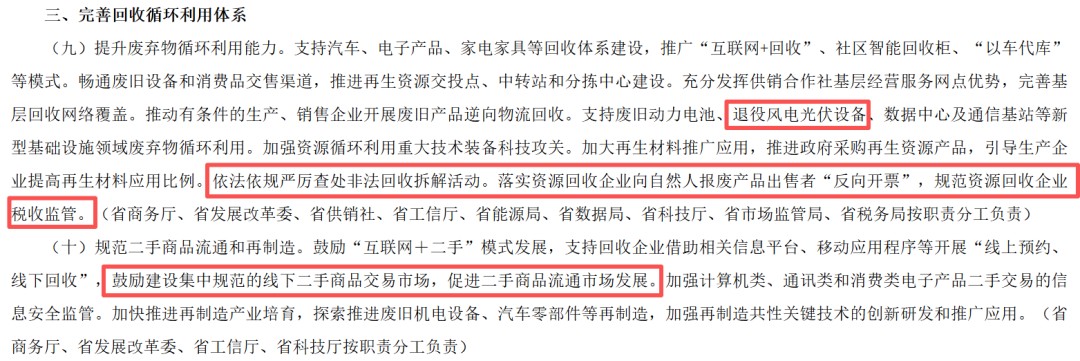
About RESOLAR
Shanghai RESOLAR Energy Technology Co., Ltd. is committed to becoming a recycled material photovoltaic group with deep decarbonization. RESOLAR focuses on technological innovation and builds a world-leading solution for component recycling, impurity removal of damaged cells, recycled silicon materials and cells, and cascaded utilization of components. With professional technology and services, we help customers realize the recycling and reuse of waste photovoltaic resources, and make positive contributions to the development of environmental protection and new energy industries. For more detailed information, you can browse the official website: www.resolartech.com .

Latest developments/news
Contact information
Service Hotline: 13585742918 (Monday to Friday 9:00-18:00)
Enterprise email: ps@resolartech.com (Reply within 48 hours after receiving the email consultation!)
Company Address: Building 8, No. 1528, Wangxu East Road, Fengjing Town, Jinshan District, Shanghai (Caohejing Fengjing Park)