


English
News Center
—— NEWS CENTER ——
On April 13, 2026, the Hubei Provincial Department of Justice released the "Hubei Provincial Regulations on Waste Recycling and Treatment (Draft for Review)," the core contents of which are as follows: Recycling stations are strictly prohibited from engaging in processing businesses such as cleaning and dismantling waste that easily cause pollution; those who refuse to rectify violations will be subject to corresponding fines. Photovoltaic solar panel manufacturers are encouraged to establish and improve multi-channel recycling systems in accordance with the requirements of the extended producer responsibility system. Support will be given to the construction of remanufacturing industrial bases, the establishment of a quality assurance system for remanufactured products, and information service systems for the recycling of remanufactured parts, product marketing, and traceability, promoting the prominent labeling of remanufactured product quality certification and application. Support will be given to the research and development and promotion of photovoltaic solar panel residual value assessment, cascade utilization, and recycling technologies, and the promotion of cascade utilization product quality certification. The provincial government's development and reform department should, in conjunction with multiple departments, establish a unified provincial comprehensive information platform for the supervision and management of waste recycling and treatment, providing services such as the collection, analysis, processing, and release of information related to waste recycling and treatment, and achieving data docking and information sharing. Industry associations and enterprises are encouraged to build waste supply and demand information systems to promote resource circulation and utilization. Guide recycling entities to utilize next-generation information technology to build waste recycling business information platforms and recycling traceability systems.
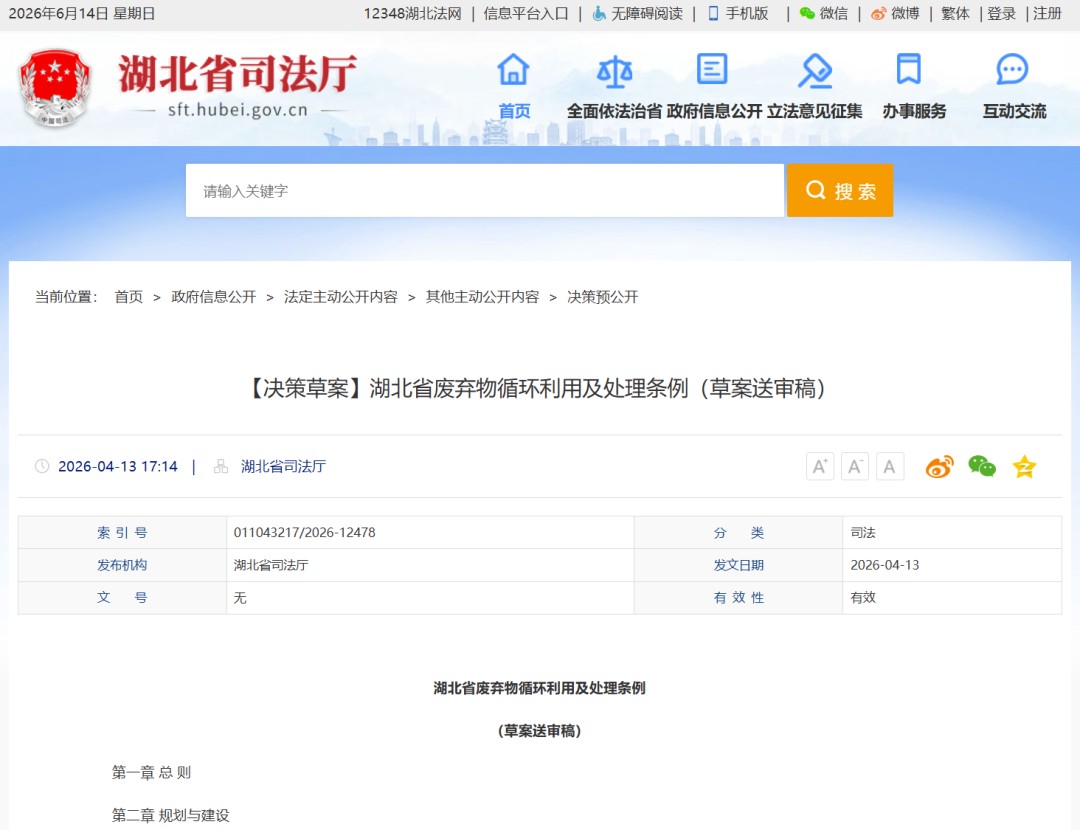
Chapter 1 General Provisions Article 1 [Legislative Purpose] This Regulation is formulated in accordance with the provisions of the Ecological Environment Code of the People's Republic of China, the Law of the People's Republic of China on Promoting the Circular Economy, and other relevant laws and regulations, and in light of the actual conditions of this province, in order to promote the refined management, effective recycling, and efficient utilization of waste in all sectors of production and daily life, develop the waste recycling industry, build a waste recycling and treatment system, accelerate the green transformation of development mode, and promote high-quality economic and social development. Article 2 [Scope of Application] This Regulation applies to the recycling, operation, utilization, and treatment of waste and its supervision and management activities within the administrative region of this province. The term "waste" as used in these Regulations refers to items or substances generated in production, daily life and other activities that have lost their original value or have been abandoned even if they have not lost their value, as well as items or substances that are required by law to be recycled, utilized and disposed of, including industrial waste, agricultural waste and social waste. Where laws, regulations, and rules provide otherwise for the recycling, utilization, and disposal of waste, those provisions shall prevail. Article 3 [Legislative Principles] The recycling and treatment of waste shall adhere to the principles of reduction, reuse, resource recovery, harmlessness, and liability for pollution, and follow the requirements of overall planning, clear rights and responsibilities, coordinated promotion, classified management, risk prevention, full traceability, digital empowerment, and public participation. Article 4 [Government Responsibilities] The Provincial People's Government shall take unified leadership over the work of waste recycling and treatment within the administrative region of the province, and implement a target responsibility system and assessment and evaluation system for waste recycling and treatment. People's governments at all levels are responsible for the recycling and treatment of waste within their respective administrative regions, and shall incorporate the content of waste recycling and treatment into the outline of the national economic and social development plan. They shall establish a working coordination mechanism to organize, coordinate, and supervise relevant departments in fulfilling their supervisory and management responsibilities for waste recycling and treatment in accordance with the law, and study and resolve major issues in waste recycling and treatment. They shall formulate and implement economic and technological policies and measures to promote the development of the waste recycling and treatment industry. Article 5 [Responsibilities of Government Departments] The development and reform departments of people's governments at or above the county level shall be responsible for organizing, coordinating, supervising and managing the recycling and treatment of waste; the ecological and environmental departments of people's governments at or above the county level shall supervise and manage the prevention and control of environmental pollution in the recycling and treatment of waste. The commerce departments of people's governments at or above the county level shall supervise and manage the waste recycling work, and shall be responsible for supervising and managing the construction of recycling and treatment systems for used goods circulation, scrapped motor vehicles and social waste; the economic and information technology departments of people's governments at or above the county level shall be responsible for supervising and managing the construction of recycling and treatment systems for industrial waste; the agricultural and rural affairs departments of people's governments at or above the county level shall be responsible for supervising and managing the construction of recycling and treatment systems for agricultural waste; and the housing and urban-rural development (environmental sanitation) departments of people's governments at or above the county level shall be responsible for supervising and managing the construction of recycling and treatment systems for construction waste and domestic waste. The relevant departments of people's governments at or above the county level, including those responsible for natural resources, market supervision, science and technology, transportation, health, water administration, culture and tourism, emergency management, public security, finance, taxation, banking, statistics, and education, as well as management departments such as supply and marketing, postal services, and customs, shall be responsible for the supervision and management of waste recycling and disposal within their respective scopes of responsibility. Article 6 [Regional Collaboration] The provincial people's government shall strengthen cooperation with neighboring provinces and establish a collaborative mechanism for waste recycling and treatment across administrative regions. Through overall planning, technology alignment, and policy coordination, it shall promote the sharing of infrastructure for waste recycling and treatment, collaborative emergency response, and joint prevention and control of safety risks. The people's governments of prefecture-level cities (states) and counties can consult with each other to coordinate the construction of centralized waste treatment facilities and sites, and establish a cross-administrative region waste recycling and treatment cooperation mechanism. Article 7 [Statistical Survey System] The statistical departments of people's governments at or above the county level shall, in conjunction with the relevant departments of development and reform, ecology and environment, commerce, economy and information technology, agriculture and rural affairs, housing and urban-rural development, and environmental sanitation, strengthen the statistics, surveys and analysis of relevant statistical information on the generation, comprehensive utilization and treatment of waste in accordance with the national waste recycling and treatment survey system, and regularly publish the statistical results to the public. The provincial and municipal (prefecture-level) people's governments shall establish and improve a waste recycling indicator system with industrial solid waste generation intensity, industrial solid waste comprehensive utilization rate, agricultural waste comprehensive utilization rate, major renewable resource recycling rate, and construction waste resource utilization rate as core indicators, and link it with the green development indicator system and the ecological civilization construction indicator system. Article 8 [Formulation and Implementation of Standards and Technical Specifications] The provincial people's government's market supervision department is responsible for the comprehensive coordination, guidance, and supervision of the formulation and implementation of relevant standards and technical specifications. The provincial people's government's development and reform, ecology and environment, commerce, economy and information technology, agriculture and rural affairs, and housing and urban-rural development departments shall, according to their respective responsibilities, formulate relevant standards and technical specifications for waste source reduction, recycling, harmless treatment, and pollution control in their respective fields, and organize their implementation. Industry associations are encouraged to develop leading group standards for waste recycling and treatment. Article 9 [Industry Management] The waste recycling industry association shall strengthen industry self-regulation, standardize industry behavior, safeguard the interests of its members and the industry, organize personnel training, provide information consulting and other services, cooperate with the competent industry authorities to study and formulate industry development plans, industrial policies and waste recycling and treatment standards, and, entrusted by the competent industry authorities, conduct industry statistics and surveys, and regularly publish information on the status of waste recycling and treatment. Article 10 [Publicity, Education and Rewards for Whistleblowers] State organs, social organizations, enterprises, public institutions, grassroots self-governing organizations and news media shall strengthen publicity, education and popularization of science on the recycling and treatment of waste. The education authorities of people's governments at or above the county level shall guide schools to educate students on the relevant knowledge of waste recycling. Radio, television, newspapers, and online media are encouraged to strengthen public awareness campaigns on waste recycling and disposal through special programs, columns, and public service advertisements. Any organization or individual has the right to report illegal activities related to the recycling and disposal of waste. People's governments at all levels shall, in accordance with relevant regulations, commend and reward units and individuals who have made outstanding contributions and achieved excellent results in the recycling and treatment of waste. Chapter Two: Planning and Construction Article 11 [Industrial Development Planning] The provincial people's government's development and reform department, together with the relevant departments of ecology and environment, commerce, economy and information technology, agriculture and rural affairs, housing and urban-rural development, etc., shall, in accordance with the national economic and social development plan and in light of the actual conditions of Hubei Province, organize the formulation of the provincial waste recycling and treatment industry development plan, scientifically coordinate the development of the waste recycling and treatment industry and ecological environmental protection, and submit it to the provincial people's government for approval before implementation. The development and reform departments of the people's governments at the prefecture-level city (prefecture) and county level shall, in conjunction with the relevant departments of ecology and environment, commerce, economy and information technology, agriculture and rural affairs, housing and urban-rural development, organize the preparation of the waste recycling and treatment development plan for their respective administrative regions in accordance with the provincial waste recycling and treatment development plan, submit it to the people's government at the same level for approval and implementation, and report it to the provincial people's government for record. The development plan for the waste recycling and treatment industry should include the planning objectives, scope of application, main contents, key tasks and safeguard measures. The development plan for the waste recycling and treatment industry shall be strictly implemented. If adjustments are necessary, they shall be approved by the original approving authority. Article 12 [Network Construction Planning] The development and reform departments of people's governments at or above the county level shall, in conjunction with the departments of commerce, economy and information technology, agriculture and rural affairs, housing and urban-rural development, and natural resources, formulate a construction plan for waste recycling and treatment networks based on the overall land space plan, ecological environment protection plan, and waste recycling and treatment industry development plan, and submit it to the people's government at the same level for approval before implementation. The planning for the construction of waste recycling and treatment networks should be based on the specific conditions of the region, such as economic development level, population density, environment and resources, and should specify the layout and scale of waste recycling networks, transfer stations, sorting centers, trading markets, utilization and treatment sites and facilities. The construction and operation of recycling outlets, transfer stations, sorting centers, trading markets, utilization and processing sites and facilities shall comply with relevant regulations on ecological environmental protection, safety and fire protection, and occupational health. Article 13 [Network Construction] People's governments at or above the county level shall, in accordance with the construction plan for waste recycling and treatment network construction, coordinate and promote the integrated construction and operation of the household waste classification and collection system, the agricultural input packaging waste collection system, and other social source waste collection systems. Developers of newly constructed residential communities and shopping malls shall, in accordance with relevant national standards, construct waste recycling stations or reserve sites for recycling facilities. For existing residential communities and shopping malls that have not constructed waste recycling stations or reserved sites for recycling facilities, the housing and urban-rural development departments of the people's governments at the county level or above, in conjunction with the people's governments of towns (townships) or subdistrict offices, shall coordinate to resolve the issue. The establishment of waste recycling stations or facilities in industrial parks, trade markets, commercial buildings, stations, docks, tourist attractions, express delivery stations, and other similar locations is encouraged. Article 14 [Sorting Center and Market Construction] People's governments at or above the county level shall, in accordance with the waste recycling and treatment network construction plan, construct one or more sorting centers within their administrative regions. The construction of comprehensive sorting centers and specialized sorting centers should be promoted in a categorized manner. Comprehensive sorting centers should strengthen their functions in safety inspection, sorting, packaging, and storage. Specialized sorting centers should strengthen their functions in sorting, shearing, crushing, cleaning, packaging, and storage. We encourage and guide the construction of regional distribution and trading markets to promote effective matching of production and demand and drive the integrated development of waste recycling and processing. Chapter 3 Recycling and Management Article 15 [Mandatory Recycling] Enterprises that produce products or packaging materials listed in the national mandatory recycling list shall be responsible for recycling the waste products or packaging materials. If a producer entrusts a seller or other organization to recycle or a waste utilization enterprise to utilize the waste products or packaging materials specified in the preceding paragraph, the entrusted party shall be responsible for recycling in accordance with the provisions of relevant laws and regulations and the agreement of the contract. Enterprises should recycle raw materials that have lost their original function, classify and sort them, and stack them properly to prevent secondary pollution. Article 16 [Registration and Modification of Recycling Operations] Operators engaged in waste recycling operations shall register as business entities in accordance with laws and regulations. For projects requiring approval, operations may only commence after obtaining approval from the relevant departments. Waste recycling operators engaged in the recycling of both production-related and non-production-related scrap metals shall register with the public security organ of the county-level people's government in their locality within fifteen days from the date of obtaining their business license. If there are any changes to major filing items such as the entity's name, business scope, business location, legal representative or principal responsible person, the scrap metal recycling operator shall complete the change procedures with the county-level people's government's public security organ within fifteen days from the date of the change. Article 17 [Requirements for Recycling Operations] The establishment of waste recycling operation sites shall comply with the layout requirements of the provincial waste recycling and treatment network construction plan, and shall adhere to the principles of convenience for the public, maintenance of public safety management, and protection of the public's normal production and life. The commerce departments of people's governments at or above the county level shall, in conjunction with relevant departments, formulate technical specifications for the establishment of waste recycling facilities within their respective administrative regions and publish them to the public. Waste recycling facilities shall comply with these technical specifications. Article 18 [Obligations and Responsibilities of Recycling Operators] Waste recycling operators shall comply with the provisions of laws and regulations concerning work safety, fire protection, occupational health, urban sanitation, and environmental protection. Waste recycling operators are prohibited from engaging in waste processing activities such as cleaning and dismantling that may cause environmental pollution within recycling sites ; when carrying out waste collection and loading/unloading activities in residential areas, they must not affect the normal lives of residents; different types of waste should be stored separately. Waste recycling operators can provide recycling services through door-to-door collection, setting up collection points, and online appointments. They are encouraged and supported to install sorting and disposal equipment in government agencies, enterprises, residential communities, shopping malls, tourist attractions, and express delivery stations, and to adopt various incentive methods for waste recycling. Article 19 [Prohibited Waste Items for Recycling] Waste recycling operators shall not recycle the following items: (i) Stolen goods or items suspected of being stolen goods reported by the public security authorities; (ii) Discarded municipal public facilities, electricity, telecommunications, fire protection and other special items without legal proof of origin; (iii) Other items that are prohibited from being recycled by laws and regulations. Article 20 [Recycling of Industrial Waste] Units that generate industrial solid waste such as phosphogypsum, steel slag, coal gangue , fly ash, tailings, and smelting slag shall establish industrial solid waste management ledgers , promote the classified collection and storage of industrial solid waste, implement classified and graded management, and innovate the industrial solid waste collection and transportation management model. Article 21 [Extended Producer Responsibility System] Producers of electrical and electronic products, lead-acid batteries, vehicle power batteries, and other products shall, in accordance with regulations, establish a waste product recycling system by means of self-construction or entrustment . We encourage electrical and electronic enterprises, automobile manufacturers, battery manufacturers, scrapped vehicle recycling and dismantling enterprises, and comprehensive utilization enterprises to cooperate in various forms to jointly build and share a waste electrical and electronic equipment and waste battery recycling system. Producers of products such as photovoltaic solar panels and wind turbine blades are encouraged to establish and improve multi-channel recycling systems in accordance with the requirements of the extended producer responsibility system. Article 22 [Recycling of Agricultural Waste] Producers, operators, and users of agricultural inputs shall promptly recycle packaging waste and used agricultural films from agricultural inputs such as pesticides, fertilizers, and feed. Pesticide producers, operators, and users may negotiate and determine the specific methods for fulfilling their obligations to recycle pesticide packaging waste. Pesticide and agricultural film operators and pesticide packaging waste and used agricultural film recycling stations shall establish recycling ledgers to record the quantity and destination of pesticide packaging waste and used agricultural films. Recycling ledgers shall be kept for at least two years. Units and individuals engaged in livestock and poultry breeding shall promptly collect and store agricultural waste such as livestock and poultry manure and carcasses generated during the breeding process. County-level people's governments should make overall plans to promote the construction of crop straw recycling systems and encourage market entities to participate in the construction of crop straw recycling systems. Article 23 [Management System for Construction Waste] This province implements a full-process manifest management system for construction waste. The housing and urban-rural development departments of people's governments at or above the county level shall, in conjunction with relevant departments, establish a construction waste supervision and service system, which shall include basic information such as construction waste generating projects, transportation companies and vehicles, disposal facilities and sites, and violations and breaches of trust, so as to achieve full-process monitoring and information-based traceability of construction waste. People's governments at or above the county level should encourage the adoption of advanced technologies, processes, equipment and management measures to promote the reduction of construction waste at the source. Article 24 [Household Waste Sorting System] A household waste sorting system is implemented in this province. The environmental sanitation departments of the people's governments at the prefecture-level city (or above) level shall issue a guidance catalog for household waste sorting and strengthen supervision and management. Units and individuals that generate household waste shall, in accordance with regulations, sort and dispose of household waste into the corresponding collection containers. Household waste is classified according to the following standards: (a) Recyclable materials refer to household waste that is suitable for recycling and reuse, including paper, plastics, metals, glass products, textiles, etc. (ii) Hazardous waste refers to household waste that poses a direct or potential threat to human health or the natural environment, including batteries, light bulbs, medicines, pesticides, thermometers, paint and their containers, etc. (iii) Kitchen waste refers to perishable household waste containing organic matter, including household kitchen waste generated in daily life, kitchen waste generated by collective canteens of government agencies, enterprises and institutions and enterprises engaged in catering business activities in food processing, catering services and unit catering activities, and other kitchen waste generated by farmers' markets, agricultural product wholesale markets, etc. (iv) Other waste refers to household waste other than recyclables, hazardous waste and kitchen waste. Article 25 [System of Responsibility for the Management of Household Waste Sorting and Disposal] A system of responsibility for the management of household waste sorting and disposal shall be implemented, and the responsible persons shall be determined in accordance with the following provisions: (i) The unit is responsible for the management of the offices and production sites of state organs, enterprises, public institutions, social organizations and other organizations; (ii) Where a residential community is managed by a market-based property management company, the property service company shall be the responsible party for management, and the property service contract may stipulate the content of household waste sorting and disposal services; where a residential community is managed by the owners or their employers, the owners' committee or employers shall be the responsible party for management; in rural areas, the village committee shall be the responsible party for management. (iii) For public places such as roads, squares, parks, public green spaces, and public waters, the management unit or its entrusted unit shall be the person responsible for management; (iv) For airports, passenger stations, rail transit, ports, wharves, ships, and public places such as tourism, culture, sports, entertainment, and commerce, the operating and management units shall be responsible for management; (v) At the construction site of a construction project, the construction unit shall be the person responsible for management; (vi) If the person in charge of management cannot be determined, the township people's government, subdistrict office, village committee, or residents' committee shall determine the person in charge of management. Article 26 [Responsibilities of Those Responsible for the Management of Household Waste Sorting and Disposal] Those responsible for the management of household waste sorting and disposal shall bear the following responsibilities: (i) Establish a daily management system for the sorting and disposal of household waste, and publicize the sorting and disposal requirements, such as the disposal locations and methods; (ii) In accordance with the relevant national, provincial and municipal regulations on the categories, markings and specifications of household waste sorting and collection containers, household waste sorting and collection containers shall be reasonably configured, and collection facilities and containers shall be kept in good condition and the surrounding environment shall be kept clean; (III) Carry out publicity on household waste sorting knowledge, guide and supervise units and individuals to implement household waste sorting, and improve the accuracy of household waste sorting and disposal; (iv) The sorted household waste shall be handed over to the relevant units for collection and transportation in accordance with the corresponding requirements; (v) Advise and stop behaviors that do not comply with the requirements for waste sorting and disposal, and urge them to correct them; if they still fail to sort and dispose of waste in accordance with the regulations, they shall be reported to the environmental sanitation authorities. (vi) If it is found that the collection and transportation unit does not meet the requirements for classified collection and transportation, it shall be reported to the environmental sanitation authority, which shall handle the matter in a timely manner. Township governments and subdistrict offices shall supervise the performance of management responsibilities by those in charge of waste sorting and disposal within their jurisdiction. Article 27 [Collection and Transportation of Domestic Waste] The environmental sanitation departments of people's governments at or above the county level shall organize the cleaning, collection and transportation of urban and rural domestic waste, and may select qualified units to carry out the cleaning, collection and transportation of domestic waste through bidding or other means. Units responsible for the classified collection and transportation of recyclables, hazardous waste, and bulky waste shall implement scheduled or regular collection and transportation, and shall implement daily collection and transportation of kitchen waste and other waste. Article 28 [Responsibilities of Domestic Waste Collection and Transportation Units] Domestic waste collection and transportation units shall comply with industry standards and the following provisions: (i) Use dedicated vehicles and vessels to transport household waste in a classified manner; dedicated vehicles and vessels shall clearly indicate the category of household waste being transported, implement closed transportation, and be equipped with online monitoring systems; (ii) Collect and transport domestic waste according to the prescribed time, route and requirements to prevent the spillage of domestic waste and the leakage of sewage; (iii) Transport household waste to centralized collection facilities or qualified transfer and treatment sites as required; (iv) Establish a management ledger for the classified collection and transportation of household waste, and record information such as the source, type, quantity, and destination of household waste; (v) Develop emergency plans for the classified collection and transportation of household waste; (vi) Refuse to accept household waste that does not conform to the classification regulations; (vii) It is prohibited to collect or transport sorted household waste together, and it is prohibited to mix hazardous waste, industrial solid waste, construction waste, etc. into household waste. Chapter Four: Utilization and Processing Article 29 [Promotion of Circular Economy Model] The development and reform departments of people's governments at or above the county level shall, in conjunction with the economic and information technology departments, coordinate the construction of waste utilization and treatment clusters and cultivate exemplary enterprises for waste utilization and treatment in accordance with the development plan for the waste recycling and treatment industry. Support waste recycling enterprises to extend their industrial chain, increase product added value, and form a complete industrial system including sorting, dismantling, resource utilization and harmless treatment. We encourage the circular transformation of industrial parks, promote the construction of eco-industrial parks, and popularize circular agricultural production models such as crop-livestock integration and agriculture-livestock integration. Article 30 [Promoting the Development of the Remanufacturing Industry] People's governments at or above the county level shall encourage and support the development of the remanufacturing industry and promote the application of common key technologies in remanufacturing such as non-destructive testing, additive manufacturing, and flexible processing. Support the construction of remanufacturing industrial bases, establish a quality assurance system for remanufactured products and information service systems for remanufactured parts recycling, product marketing, and traceability, and promote the quality certification and application of remanufactured products; encourage enterprises that meet the conditions stipulated by the state to carry out remanufacturing of products such as motor vehicle parts, construction machinery, mining machinery, machine tools, and office equipment, as well as the reuse of specific products such as electrical and electronic waste, scrapped motor vehicles and ships, waste tires, and waste lead-acid batteries. Remanufactured and reused products shall meet the quality standards stipulated by the state and shall be marked in a prominent position. Article 31 [Used Goods Trading] The market supervision and commerce departments of the provincial people's government shall, together with the development and reform, economic and information technology and other relevant departments, support qualified regions in building centralized and standardized waste trading markets, encourage the development of online used goods trading models, establish a talent training and management mechanism for the waste assessment and appraisal industry, and improve the waste trading management system. Families and individuals are encouraged to transfer or utilize their unused items through donations, charity sales, or secondhand transactions. Article 32 [Utilization and Treatment of Industrial Waste] The market supervision department of the provincial people's government shall, in conjunction with the economic and information technology department, establish a comprehensive utilization product standard system that meets the requirements of engineering quality, safety and environmental standards, and promote the large-scale production and efficient utilization of industrial waste recycling industry. Enterprises shall, in accordance with national and provincial regulations, recycle industrial wastes generated during the production process, such as phosphogypsum, steel slag, coal gangue, fly ash, tailings, and smelting slag, as well as sludge generated during urban sewage treatment. Products manufactured using industrial waste shall meet relevant national product quality standards and shall clearly indicate the source of the raw materials. Article 33 [Utilization and Disposal of Waste Electrical and Electronic Equipment, Waste Batteries, etc.] People's governments at or above the county level shall support cooperation between manufacturers and users of electrical and electronic equipment, lead-acid batteries, vehicle power batteries, and other products to promote intelligent and refined dismantling. People's governments at or above the county level should encourage electrical and electronic enterprises, automobile manufacturers, battery manufacturers, scrap vehicle recycling and dismantling enterprises, and comprehensive utilization enterprises to establish a traceability management system covering the entire industrial chain and life cycle of waste electrical and electronic products and waste batteries. Support the research and development and promotion of residual value assessment, cascade utilization and recycling technologies for photovoltaic solar panels, waste power batteries, etc., and promote the quality certification of cascade utilization products. Article 34 [Utilization and Treatment of Agricultural Waste] The agricultural and rural affairs departments of people's governments at or above the county level shall take measures to promote the recycling of packaging waste of agricultural inputs such as fertilizers, feeds, and agricultural films, as well as waste agricultural films; and take incentive measures to support the centralized harmless treatment of pesticide packaging waste by specialized institutions or organizations. The agricultural and rural affairs departments of people's governments at or above the county level shall guide and support units and individuals engaged in livestock and poultry breeding to treat livestock and poultry manure by methods such as returning manure to the fields, producing biogas, and manufacturing organic fertilizer. The agricultural and rural affairs departments of people's governments at or above the county level shall take measures to support the return of crop straw to the field and promote the use of crop straw as fertilizer, feed, energy, substrate, and raw material. The construction of regional agricultural waste comprehensive utilization and treatment centers is encouraged. Article 35 [Utilization and Treatment of Construction Waste] Construction units shall classify and utilize construction waste generated during project construction. The adoption of new technologies and processes for the comprehensive utilization of construction waste is encouraged. If the conditions for utilization and treatment are not met, the construction unit shall entrust qualified producers or operators to utilize the waste or transfer it to a construction waste treatment site for harmless treatment. Construction waste utilization and treatment sites should meet ecological and environmental protection requirements and strictly control pollution such as exhaust gas, wastewater, dust, and noise. Products made from the comprehensive utilization of construction waste should comply with national and industry standards. Government-invested public buildings and infrastructure projects should give priority to the design, use, and procurement of such products; other projects are encouraged to give priority to the design, use, and procurement of such products. Article 36 [Utilization and Disposal of Domestic Waste] Domestic waste shall be disposed of in accordance with the following provisions: (a) Recyclable materials shall be sorted and utilized by resource utilization enterprises; (ii) Hazardous waste shall be disposed of in a harmless manner by units with the corresponding treatment qualifications in accordance with regulations; (iii) Kitchen waste shall be recycled and rendered harmless through methods such as composting and returning to the field, and biochemical treatment; (iv) Other waste shall be disposed of by incineration or other means. Article 37 [Disposal of Waste Not Temporarily Utilized] Units that generate waste shall utilize the waste according to economic and technical conditions; for waste that is not temporarily utilized or cannot be utilized, storage facilities and sites shall be constructed in accordance with national regulations, and the waste shall be stored safely and classified, or harmless treatment measures shall be taken. Chapter Five: Safeguards and Supervision Article 38 [Funding and Project Support] The finance departments of people's governments at or above the county level shall include the operating expenses for waste recycling and treatment in their fiscal budgets and establish special funds. The development and reform departments of people's governments at or above the county level shall coordinate existing funding channels to support the construction of key projects for waste recycling and treatment. The provincial-level people's government commerce department shall formulate a catalog of low-value recyclable materials, and people's governments at or above the county level shall adopt measures such as financial subsidies, government procurement of services, and franchising to support the recycling and utilization of low-value recyclable materials. People's governments at or above the county level should guide and encourage social capital to participate in the construction of waste recycling and treatment systems, and promote the intensive, standardized and industrialized operation of waste recycling, utilization and treatment services. Article 39 [Tax and Financial Policy Support] The tax authorities of people's governments at or above the county level shall, in accordance with the law, implement tax incentives for units and individuals engaged in the waste recycling and treatment industry, such as corporate income tax reduction and exemption and value-added tax refund upon collection. The financial regulatory authorities of people's governments at or above the county level shall guide financial institutions to support the development of the waste recycling and treatment industry by providing financial products and services such as green credit, green insurance, and green bonds. Government-backed financing guarantee institutions are encouraged to provide financing guarantees for eligible small and micro enterprises and engage in waste recycling and treatment. Article 40 [Land Use Guarantee] The natural resources departments of people's governments at or above the county level shall, in accordance with the territorial spatial planning and the construction planning of waste recycling and treatment network sites, coordinate the land use for the construction of waste recycling and treatment systems. Land for the construction of facilities for the classified collection, transfer, storage, sorting and treatment of social waste shall be included in the scope of public infrastructure land use and guaranteed. Article 41 [Industrial Development and Key Enterprise Cultivation] People’s governments at or above the county level shall, in accordance with the requirements of the development plan for the waste recycling and treatment industry, accelerate the cultivation of key enterprises in the fields of waste recycling, second-hand goods trading, sorting and utilization, and remanufacturing, cultivate waste recycling industrial chains in emerging fields such as waste equipment remanufacturing and new types of waste, and promote the development of the waste recycling and treatment industry. Article 42 [Promotion and Procurement of Recycled Products] State organs, public institutions and social organizations shall include eligible waste recycling materials, products, equipment and facilities in the scope of government green procurement, implement priority procurement and mandatory procurement in accordance with the law, and increase the efforts in green procurement. Enterprises are encouraged to increase the proportion of recycled materials used in their production and operation, and are supported in including the application of recycled materials in the scope of corporate social responsibility. The use of recycled products is encouraged and guided. Article 43 [Support for Scientific and Technological Innovation] The science and technology administrative department of the provincial people's government shall include the tackling of major common key technologies, research and development of key process technologies and equipment, application demonstration and industrialization of waste recycling and treatment in the scope of support of the provincial science and technology innovation plan, strategic emerging industry development plan and relevant key special projects, and allocate fiscal funds to support them. Support universities, research institutes and high-tech enterprises to carry out industry-university-research cooperation, organize technology promotion, exchange and training for waste recycling, and promote the industrial application of technological achievements. Article 44 [Intelligent Management of Waste Recycling] The provincial people's government's development and reform department shall, in conjunction with the departments of ecology and environment, commerce, economy and information technology, agriculture and rural affairs, and housing and urban-rural development, establish a unified provincial comprehensive supervision and information platform for waste recycling and treatment , providing services such as collection, analysis, processing and release of information related to waste recycling and treatment, and achieving data docking and information sharing. Industry associations and enterprises are encouraged to establish waste exchange information systems to release supply and demand information on various types of waste and resource-based raw and auxiliary materials generated during production, circulation, and consumption, thereby promoting the exchange and recycling of waste. Waste recycling operators are encouraged to utilize advanced information technologies such as the Internet, the Internet of Things, big data, and cloud computing to build waste recycling business information platforms and recycling traceability systems . Article 45 [Interview Mechanism] In areas where the work of waste recycling and treatment is not being promoted effectively, the provincial people's government's development and reform department shall, together with the relevant departments such as ecology and environment, commerce, economy and information technology, agriculture and rural affairs, and housing and urban-rural development, interview the principal person in charge of the local people's government and make the interview information public. Chapter Six Legal Liability Article 46 [Guiding Provisions] Where there are other provisions in laws and regulations, those provisions shall prevail in the event of a violation of this Regulation. Article 47 [Legal Liability for Failure to Perform Duties According to Law] If state organs and their staff abuse their power, neglect their duties, or engage in malpractice for personal gain in the recycling and disposal of waste, their competent authorities or supervisory organs shall impose disciplinary sanctions on the directly responsible supervisors and other directly responsible personnel in accordance with the law; if a crime is constituted, criminal liability shall be pursued in accordance with the law. Article 48 [Legal Liability for Violation of Cleaning and Dismantling Obligations] Anyone who violates the provisions of this Regulation by engaging in the cleaning, dismantling, or other processing of recycled waste within a recycling site shall be ordered to rectify the situation by the commerce department of the people's government at or above the county level; if the rectification is refused, the unit shall be fined between 2,000 and 10,000 yuan, and the individual shall be fined between 500 and 1,000 yuan. Article 49 [Legal Liability for Unsorted Waste Storage] If a waste recycling operator violates the provisions of this Regulation by failing to sort and store recyclable items, the commerce department of the people's government at or above the county level shall order it to rectify the situation within a specified period and impose a fine of not less than 1,000 yuan but not more than 5,000 yuan; if it fails to rectify the situation within the specified period, it shall be fined not less than 5,000 yuan but not more than 10,000 yuan. Article 50 [Legal Liability for Failure to Configure Household Waste Sorting Collection Containers as Required] Anyone who violates the provisions of this Regulation by failing to configure household waste sorting collection containers reasonably in accordance with the categories, markings, and specifications of such containers shall be ordered to rectify the situation by the environmental sanitation department of the people's government at or above the county level, and shall be fined between 2,000 yuan and 20,000 yuan. Article 51 [Legal Liability for Failure to Collect and Transport Household Waste in Accordance with Regulations] Anyone who violates the provisions of this Regulation by collecting or transporting household waste that has already been sorted and disposed of together, or by mixing hazardous waste, industrial solid waste, construction waste, etc., into household waste, shall be ordered by the environmental sanitation department of the people's government at or above the county level to rectify the situation within a specified period; if the rectification is not made within the specified period, a fine of not less than 3,000 yuan but not more than 50,000 yuan shall be imposed. Chapter Seven Supplementary Provisions Article 52 [Definitions] The following terms in this Regulation shall have the following meanings: (a) Industrial waste refers to solid waste generated during industrial production activities. (ii) Agricultural waste refers to solid waste generated during agricultural production activities. (iii) Social waste refers to solid waste generated in social production and life. (iv) Household waste refers to solid waste generated in daily life or in the provision of services for daily life, as well as solid waste that is considered household waste according to laws and administrative regulations. (v) Construction waste refers to the waste soil, waste materials and other solid waste generated by construction units and contractors during the construction, renovation, expansion and demolition of various buildings, structures and pipelines, as well as during the decoration and renovation of houses by residents. Article 53 [Effective Date] This Regulation shall come into force on [Date].













About RESOLAR
Shanghai RESOLAR Energy Technology Co., Ltd. is committed to becoming a recycled material photovoltaic group with deep decarbonization. RESOLAR focuses on technological innovation and builds a world-leading solution for component recycling, impurity removal of damaged cells, recycled silicon materials and cells, and cascaded utilization of components. With professional technology and services, we help customers realize the recycling and reuse of waste photovoltaic resources, and make positive contributions to the development of environmental protection and new energy industries. For more detailed information, you can browse the official website: www.resolartech.com .

Latest developments/news
Contact information
Service Hotline: 13585742918 (Monday to Friday 9:00-18:00)
Enterprise email: ps@resolartech.com (Reply within 48 hours after receiving the email consultation!)
Company Address: Building 8, No. 1528, Wangxu East Road, Fengjing Town, Jinshan District, Shanghai (Caohejing Fengjing Park)