


English
News Center
—— NEWS CENTER ——
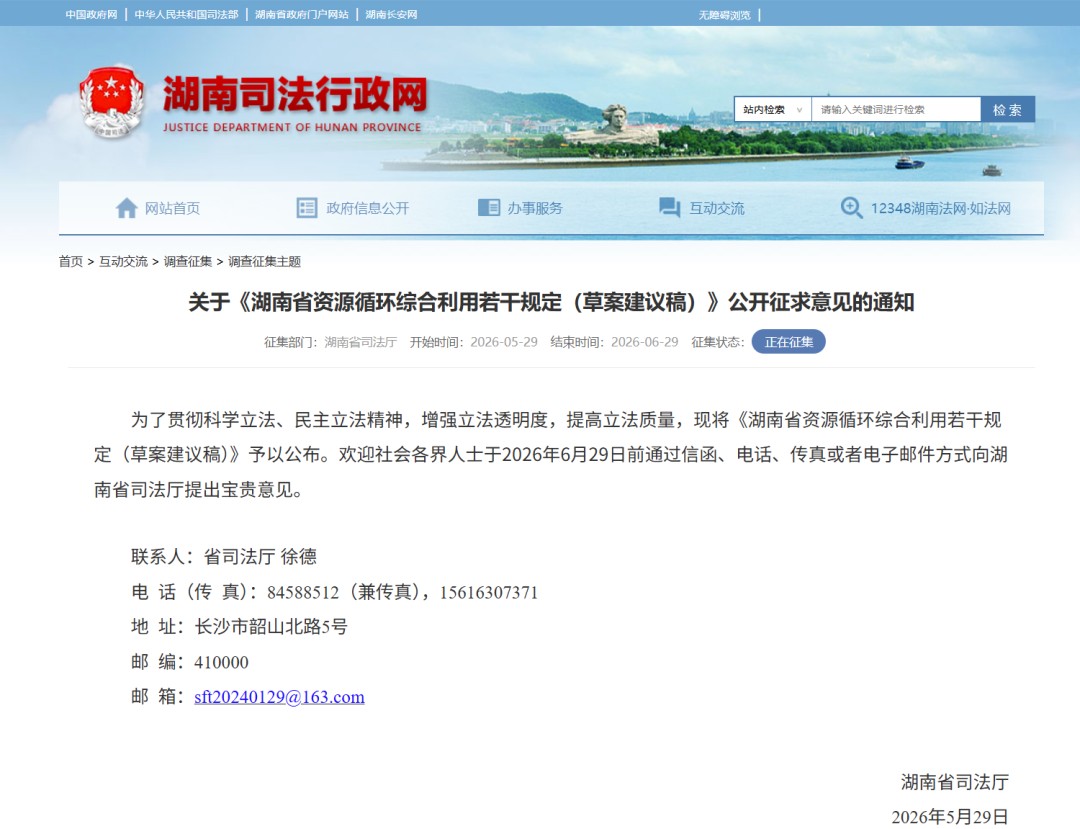
The full text is as follows: Hunan Province Regulations on the Integrated Utilization of Resources and Circular Economy (Draft for Comments) May 26, 2026 Article 1 [Scope of Application and Principles] The term integrated utilization of resources in these Regulations refers to activities such as the collection, dismantling, resource-based utilization, and harmless disposal of waste materials generated in production and daily life, which have lost their original value or have not yet lost their value but have been discarded. Integrated utilization of resources should adhere to the principles of government guidance, market operation, enterprise responsibility, public participation, and whole-process supervision, and comply with the basic requirements of reduction, resource-based utilization, and harmlessness. Article 2 [Enterprise Main Responsibility] Enterprises shall carry out the recycling and utilization of the waste they generate in accordance with the principle of "who generates, who is responsible," or entrust enterprises that meet the required conditions to carry out utilization; where technical and economic conditions are not met and utilization is temporarily unsuitable, harmless disposal shall be carried out in accordance with the law. In recycling, dismantling, and utilization activities, enterprises shall give priority to advanced and applicable technologies, processes, equipment, and management measures to improve the efficiency and safety and environmental protection level of integrated utilization of resources. Enterprises shall strictly implement the national system for mandatory take-back of products and packaging materials, fully implement the extended producer responsibility system, and fulfill recycling, utilization, and disposal obligations in accordance with the law. Article 3 [Construction of the Waste Material Recycling Network] The municipal (prefectural) and county-level people's governments in the region shall plan and build an urban-rural integrated waste material recycling network system in a coordinated manner, and, based on local conditions and rational layout, establish recycling outlets, transfer stations, and sorting centers, and promote the integration of the two networks of household waste collection outlets and waste material recycling outlets. Recycling enterprises are encouraged to integrate resources through chain operations, franchised operations, mergers and reorganizations, and other means, and to cultivate leading waste material recycling enterprises that are large-scale, standardized, and professional. Intelligent recycling terminals, vehicle-as-warehouse, appointment-based door-to-door recycling, and other models are encouraged to provide convenient and efficient waste material recycling services; producers and sellers of home appliances, furniture, motor vehicles, and other products are encouraged to build reverse logistics systems and carry out old-for-new replacement and designated recycling activities; resource utilization enterprises are encouraged to participate in the construction of recycling networks and develop an integrated business model of recycling—sorting—processing—utilization. Primary supply and marketing cooperatives are encouraged to leverage their organizational and network advantages, integrate agricultural production and marketing outlets, convenience service stations, idle land, factory buildings, and other resources, participate in the construction of urban-rural waste material recycling networks, and promote the construction of standardized recycling stations and green sorting centers. Article 4 [Operation and Management of Waste Material Recycling] Units and individuals engaged in waste material recycling, sorting, trading, and other business activities shall handle market entity registration procedures in accordance with the law, and may carry out business activities only after obtaining a business license. The market supervision and management departments shall, within fifteen working days from the date of completion of registration, share market entity registration information with the competent departments of commerce, ecology and environment, and other departments at the same level. The main body of waste material recycling operations shall hand over the collected waste materials to units with corresponding qualifications or statutory conditions for sorting, processing, dismantling, utilization, or disposal. It is strictly prohibited to carry out cleaning, dismantling, processing, or other operations involving environmental pollution within recycling sites. Article 5 [Waste Material Information Management Platform] The provincial people's government's competent commercial department shall establish a province-wide unified waste material information management platform to organize waste material recycling, sorting, trading, and other operators to truthfully report business information, and realize functions such as supply-demand matching, price guidance, data statistics, risk early warning, and carbon reduction and efficiency assessment. Article 6 [Recycling and Utilization of Low-Value Recyclables] The provincial people's government's competent department for housing and urban-rural development shall take the lead in formulating and dynamically updating the catalog of low-value recyclables in household waste, and strengthen classified recycling and guidance. People's governments at the county level and above may adopt financial subsidies, government procurement of services, franchising, and other means to support the construction and operation of household waste low-value recyclable recycling and utilization systems. Article 7 [Management of Recycling of Agricultural Waste] Producers, operators, and users of agricultural inputs shall promptly recycle packaging waste and agricultural films of pesticides, fertilizers, feeds, and other materials in accordance with relevant national and provincial regulations, and deliver them for sale to designated recycling stations; they shall not discard, dump, or pile them up without authorization. Scrapped or eliminated agricultural machinery shall be sold to qualified motor vehicle recycling and dismantling enterprises, agricultural machinery maintenance enterprises, or agricultural machinery professional cooperatives, and shall not be dismantled, disposed of, or transferred in violation of regulations without authorization. Recycling entities are encouraged to provide door-to-door recycling, agency services, and other convenient measures. Article 8 [Management of Recycling and Dismantling of Scrapped Motor Vehicles] Enterprises engaged in the recycling and dismantling of scrapped motor vehicles shall obtain the corresponding qualification certification in accordance with the law, and carry out dismantling operations within the approved business premises. Their production processes, equipment, and pollution prevention and control measures shall comply with national and provincial mandatory standards, technical specifications, and environmental management requirements. The competent commercial department of the provincial people's government shall coordinate planning, optimize the industrial layout for recycling and dismantling of scrapped motor vehicles, and establish a production capacity monitoring and early warning system; for prefectural-level cities where the actual annual dismantling volume is significantly lower than the approved dismantling capacity, relevant qualification approvals shall be suspended, and specific measures shall be formulated separately. The competent commercial departments of people's governments at the county level and above shall, together with relevant departments, carry out supervision and inspection of recycling and dismantling activities for scrapped motor vehicles; where it is found that an enterprise no longer meets the qualification conditions, process equipment, or pollution prevention and control requirements, it shall be ordered to make rectifications within a prescribed time limit; where rectification is refused or fails to meet the requirements, the qualification certification shall be revoked by the original issuing authority. Units and individuals shall sell scrapped motor vehicles to recycling and dismantling enterprises with qualifications and their branches established in accordance with the law, and obtain the Article 9 [Recycling and Disposal of Waste Electrical and Electronic Products] Enterprises engaged in the processing of waste electrical and electronic products shall obtain processing qualifications in accordance with the law, operate within the approved premises, and carry out processing activities within the scope permitted by their qualifications. Operators engaged in the recycling of waste electrical and electronic products shall adopt diversified recycling methods and provide convenient and efficient recycling services. It is encouraged to set up classified recycling facilities and temporary storage points for used home appliances at places such as state organs, public institutions, commercial areas, and express logistics stations. Article 10 [Recycling and Utilization of Waste Power Batteries] Units engaged in the comprehensive utilization of waste power batteries shall obtain a pollutant discharge permit or complete pollutant discharge registration, and possess corresponding technical capabilities, equipment, and pollution prevention and control facilities. It is encouraged for entities such as power battery producers, sellers, comprehensive utilization enterprises, recycling entities, maintenance service outlets relying on the network, charging and swapping stations, and scrapped motor vehicle recycling and dismantling enterprises to establish power battery recycling service outlets in accordance with the law. Units and individuals shall sell waste power batteries to power battery recycling service outlets or comprehensive utilization enterprises established in accordance with the law. No unit or individual may directly or, after processing, use waste power batteries for electric bicycles, user-side energy storage stations, or other fields prohibited by laws, regulations, and mandatory standards. Waste lead-acid power batteries and the like that are classified as hazardous waste in accordance with the law shall have their recycling, utilization, disposal, and other activities strictly subject to hazardous waste management regulations. Article 11 [Supervision and Management of Recycling and Dismantling] People's governments at the county level and above shall establish a sound joint law enforcement and special rectification mechanism, and investigate and deal with illegal acts such as unqualified recycling, illegal dismantling, environmental pollution, and threats to safety in accordance with the law. The relevant departments of people's governments at the county level and above shall publicly disclose contact information to society and accept public reports. Upon receiving a report, they shall promptly investigate and handle it in accordance with the law, and keep the reporter's identity confidential. For reports made under real names, the handling result shall be notified to the reporter in writing or orally. Article 12 [Management of Industrial Solid Waste] Enterprises generating industrial solid waste shall implement classified and hierarchical management of industrial solid waste, carry out classified collection, standardized storage, and compliant transport, and strictly prohibit mixed stacking, mixed storage, and mixed discharge. Enterprises shall establish a ledger for industrial solid waste management to truthfully record information such as type, quantity, flow, storage, utilization, and disposal, and report it in accordance with the law through the industrial solid waste pollution prevention and control information platform. In the process of mineral resource exploration, mining, and smelting, enterprises shall comprehensively develop and utilize associated mineral resources with utilization value, reduce the generation of solid waste such as tailings and slag. Where conditions for utilization are not yet available, effective protection measures shall be taken to prevent waste and pollution. The recycling and reuse of tailings shall be subject to demonstration and approval by the county-level people's government and the departments of natural resources and emergency management at the municipal level and above. Article 13 [Resource-Based Utilization of Hazardous Waste] The competent ecological and environmental departments of the provincial people's government shall implement classified management of cross-provincial transfer into the province for resource-based utilization of hazardous waste: those included in the "blacklist" shall be strictly prohibited from transfer; those included in the "whitelist" shall have simplified approval procedures, and approval quantities may be verified according to the operating license scale of that category; those not included in the blacklist or whitelist shall have approval quantities dynamically adjusted based on utilization rates. The competent ecological and environmental departments of the province shall establish a joint prevention and control mechanism with relevant provincial departments, carry out annual planned batch approvals for the whitelist category, and dynamically adjust them, and disclose them in accordance with the law. For cross-provincial transfer involving hazardous waste containing strategically scarce metals, the competent ecological and environmental departments of the province shall consult with relevant provincial departments to reach a decision; where it is determined to be necessary for strategic development, approval quantities may be verified according to the operating license scale of that category. It is encouraged for hazardous waste utilization units to adopt advanced process equipment and improve the level of resource utilization. On the premise that environmental risks are controllable, support shall be given to implementing point-to-point targeted utilization of hazardous waste, and the utilization process shall not be subject to hazardous waste management, and the utilization units shall be exempt from applying for a hazardous waste business permit. The competent ecological and environmental departments of the provincial people's government shall periodically release guidance announcements on hazardous waste utilization and disposal capacity construction, and guide rational social capital investment. Article 14 [Recycling and Utilization of New Types of Waste] People's governments at the county level and above shall coordinate the promotion of the construction of new waste recycling and utilization systems for decommissioned wind turbine blades, retired photovoltaic modules, data center and communication base station decommissioned equipment, and the like. The scientific and technological, industry and informatization, and other departments of people's governments at the county level and above shall support key technologies, process equipment research and development, pilot demonstration, and application promotion for the recycling and utilization of new types of waste, and cultivate specialized enterprises and demonstration projects. Article 15 [Standardization of the Remanufacturing Industry] The provincial people's government's competent departments for industry and informatization and market supervision shall promote product certification for remanufacturing, establish a remanufactured product traceability management information platform, and standardize the production and market circulation of remanufactured products. Remanufactured products shall comply with statutory quality and safety standards, and production enterprises shall indicate the remanufacturing mark in a prominent position on the product and shall not falsely use the identity of original products. Article 16 [Promotion and Application of Recycled Material Products] The application of recycled materials and recycled products shall be encouraged and promoted, and industries such as automobiles, electrical and electronic products, power batteries, textiles, packaging, and building materials shall be guided to increase the use ratio of recycled materials and recycled products. Government agencies, public institutions, and publicly funded projects such as public buildings and infrastructure shall give priority to purchasing and using certified recycled materials and recycled products. Other entities are encouraged to prioritize such purchases and use. The people's governments at the county level and above shall include the price of recycled products for construction waste in the construction engineering materials pricing information and publish it to society on a regular basis. Article 17 [Scientific and Technological Support] The competent departments for science and technology of the provincial people's government shall include major common key technological breakthroughs, key process equipment research and development, and demonstration applications for integrated utilization of resources in the province's science and technology innovation plans and science and technology program support scope. People's governments at the county level and above shall support the construction of various scientific and technological innovation platforms such as key laboratories, industrial technology engineering centers, and enterprise technology centers in the field of integrated utilization of resources, encourage collaborative innovation among industry, academia, and research, and promote the transformation and industrialization of technological achievements. Article 18 [Standard Support] The departments of market supervision and management, development and reform, industry and informatization, ecological environment, housing and urban-rural development, agriculture and rural affairs, commerce, and other departments of the provincial people's government shall, according to their respective responsibilities, divide tasks, formulate, revise, and organize the implementation of standards and technical specifications for source reduction, circular utilization, pollution control, and other aspects of waste, and shall organize their implementation. Social groups, enterprises, and other organizations are encouraged to put forward suggestions for standard formulation and participate in standard formulation and revision work. Article 19 [Land Use Guarantee] People's governments at the county level and above shall include land for waste sorting collection, transfer storage, sorting and processing, and other recycling and utilization facilities into the planning and land use guarantee for public infrastructure and territorial spatial planning; establish a land use guarantee mechanism for integrated resource utilization projects, delineate special zones or reserve quotas within industrial land, and dedicate them to the development of integrated resource utilization industries, with strict control over land use purposes and a strict prohibition on illegal and irregular land use. Article 20 [Fiscal and Financial Support] People's governments at the county level and above shall optimize the use of fiscal funds, leverage the guiding role of government investment funds, focus on supporting the construction of recycling systems, industrial development, cultivation of key enterprises, technological research and development, and demonstration and promotion, and guide social capital investment; financial institutions are encouraged to develop specialized financial products and services. Article 21 [Tax Policy Support] The tax authorities of the province shall, in accordance with the law, implement preferential tax policies such as value-added tax, enterprise income tax, environmental protection tax, and resource tax for integrated utilization of resources, formulate specific implementation measures, strengthen policy publicity and guidance, and promote the fast implementation of tax preference policies. Article 22 [Effective Date] These Regulations shall come into force on XXXX XX XX, XXXX. Where previous provincial regulations concerning integrated utilization of resources are inconsistent with these Regulations, these Regulations shall prevail. Source: Hunan Judicial Administration Network
About RESOLAR
Shanghai RESOLAR Energy Technology Co., Ltd. is committed to becoming a recycled material photovoltaic group with deep decarbonization. RESOLAR focuses on technological innovation and builds a world-leading solution for component recycling, impurity removal of damaged cells, recycled silicon materials and cells, and cascaded utilization of components. With professional technology and services, we help customers realize the recycling and reuse of waste photovoltaic resources, and make positive contributions to the development of environmental protection and new energy industries. For more detailed information, you can browse the official website: www.resolartech.com .

Latest developments/news
Contact information
Service Hotline: 13585742918 (Monday to Friday 9:00-18:00)
Enterprise email: ps@resolartech.com (Reply within 48 hours after receiving the email consultation!)
Company Address: Building 8, No. 1528, Wangxu East Road, Fengjing Town, Jinshan District, Shanghai (Caohejing Fengjing Park)