



English
News Center
—— NEWS CENTER ——
On June 8, 2026, the State Taxation Administration issued Announcement No. 11 of 2026, clarifying that the nationwide full rollout of the “transaction-complete, invoice-issued” model in the finished oil retail sector. All operating entities such as gas stations, inland waterway fueling barges, and rural diesel network outlets must complete system transformation before November 1, 2026, and rely on the tax authority’s Leqi platform to issue fully digital electronic invoices immediately upon completion of transactions, comprehensively standardizing the tax collection order in the industry.
With the Leqi platform as the core carrier, this new policy sets up two adaptation modes: large group-based gas stations that can transform their own cashier, retail, and refueling machine systems may adopt the “Leqi self-use” direct connection invoicing mode; small stations without transformation capability may connect to third-party platforms and implement on-site invoicing through “Leqi joint use,” covering all transaction scenarios such as scan-to-pay, online ordering, fuel cards, cash, and corporate transfer payments, achieving integrated flow of transactions, funds, and invoicing data. At the same time, the tax authorities have made clear strict supervision rules, severely cracking down on tax evasion behaviors such as privately set collection codes and off-book operations, and imposing fines and back taxes on noncompliant entities to ensure the policy is effectively implemented under strong supervision.
The standardized and digital invoicing reform of the finished oil retail sector provides a clear compliance transformation path for the photovoltaic recycling industry, which has been plagued by disorderly and frequent occurrences. As the wave of PV module retirement continues and the recycling market expands rapidly, the industry generally faces pain points such as scattered transactions, purchases without invoices, high risks of fictitious invoicing, and low efficiency of manual invoicing. Drawing on the finished oil model, photovoltaic recycling can replicate the core approach: distinguishing between leading enterprises and small and micro businesses, promoting a dual access model of “self-use + joint use”; connecting weighing, warehousing, and settlement systems to achieve immediate invoicing for all transaction scenarios; relying on the platform to retain data traces, strengthening tax-source supervision, and filling industry compliance gaps.
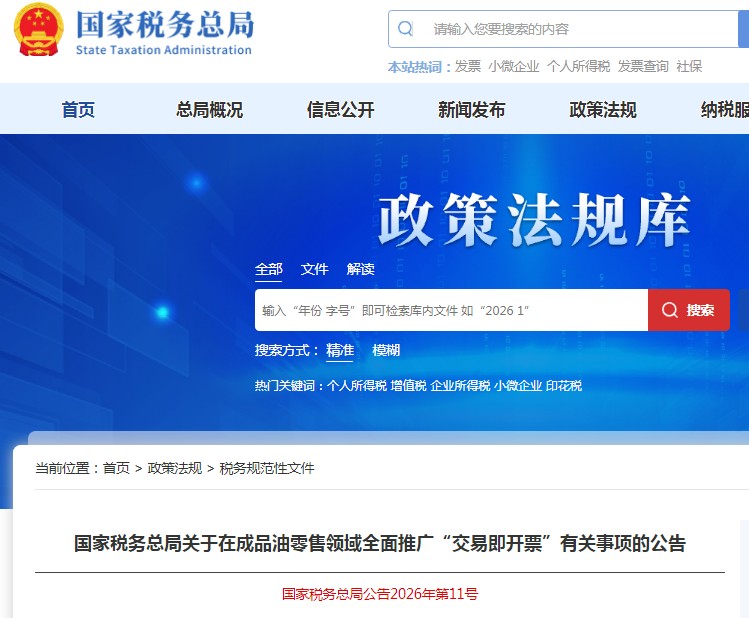
1. Finished oil retail gas stations selling finished oil shall issue invoices in accordance with the “transaction-complete, invoice-issued” model stipulated in this announcement.
For the purposes of this announcement, finished oil retail gas stations refer to taxpayers engaged in finished oil retail business, who have obtained the qualification for finished oil retail operations and the hazardous chemicals business permit in accordance with relevant national regulations, including gas stations, inland waterway fueling barges, and rural outlets that sell only diesel.
The “transaction-complete, invoice-issued” model mentioned in this announcement means that after a finished oil retail gas station completes the sale of finished oil, it shall, based on the transaction data, immediately issue a fully digital electronic invoice to the purchaser in full quantity through the tax authority’s Leqi platform.
2. Finished oil retail gas stations shall reasonably choose the implementation mode of the “transaction-complete, invoice-issued” model based on their own information system transformation capabilities. Among them: finished oil retail gas stations that meet the Leqi self-use access conditions and have the capability to transform their own information systems shall, upon confirmation by the provincial tax authority, implement the “transaction-complete, invoice-issued” model through the Leqi self-use mode; finished oil retail gas stations that do not meet the Leqi self-use access conditions or do not have the capability to transform their own information systems shall implement the “transaction-complete, invoice-issued” model through the Leqi joint-use mode.
3. Finished oil retail gas stations that choose to implement the “transaction-complete, invoice-issued” model through the Leqi self-use mode shall, in accordance with the technical standards prescribed by the tax authority, transform the fueling machine management system, retail management system, cashier system, and so on, and connect them to the Leqi platform, issuing invoices through automatic matching of commodity sales information, fund receipt information, and so on. Finished oil retail gas stations that choose the Leqi joint-use mode shall, in accordance with the technical standards prescribed by the tax authority, connect to the Leqi joint-use platform with invoicing capability, and achieve immediate invoicing after transactions are completed.
4. When finished oil retail gas stations sell finished oil and receive payment for the sale of oil, they shall issue invoices in accordance with the following provisions of the “transaction-complete, invoice-issued” model:
(1) Finished oil retail gas stations that receive payment for the sale of oil through third-party payment platforms shall issue invoices immediately through the Leqi platform after the transaction is completed.
(2) Finished oil retail gas stations that receive payment for the sale of oil through Internet platforms shall issue invoices immediately through the Leqi platform after the transaction is completed.
Internet platform enterprises shall, as the direct connection unit, access the Leqi platform, provide Leqi joint-use services to finished oil retail gas stations that have moved in, and, in accordance with the requirements of the Measures for the Administration of Tax-related Information Reporting by Internet Platform Enterprises, report tax-related information to the tax authority.
(3) Finished oil retail gas stations that receive payment for the sale of oil through fuel cards (including physical cards, virtual cards, and other forms) shall issue invoices through the Leqi platform. Buyers may choose to issue ordinary invoices without tax at the time of recharging, or may choose to issue ordinary invoices or special VAT invoices at the time of refueling.
(4) Finished oil retail gas stations that sell finished oil and receive payment for the sale of oil in cash, redemption, transfer to public accounts, or other methods shall issue invoices through the Leqi platform based on the actual transaction data.
5. Direct connection units accessing the Leqi platform shall carry out system transformation in accordance with the technical standards prescribed by the tax authority, realize automatic pre-filling of data such as receipt information, order information, and preset invoice header information, and issue invoices immediately.
6. Direct connection units accessing the Leqi platform shall strengthen monitoring of invoice issuance by finished oil retail gas stations, and promptly report to the competent tax authority to which the finished oil retail gas station belongs if tax supervision evasion is discovered.
7. Direct connection units accessing the Leqi platform shall not, on the pretext of promoting the “transaction-complete, invoice-issued” model, charge fees in violation of regulations from finished oil retail gas stations, and shall not collude with, instigate, or assist finished oil retail gas stations in evading tax supervision. Those in violation of the regulations shall have their qualification to access the Leqi platform suspended; those in violation of relevant laws and regulations shall be dealt with in accordance with relevant regulations.
8. Finished oil retail gas stations shall implement the “transaction-complete, invoice-issued” model before November 1, 2026. Those that fail to fully implement the “transaction-complete, invoice-issued” model within the period stipulated in this announcement shall be ordered by the tax authority to make corrections, and shall be dealt with in accordance with the relevant provisions of the Law of the People’s Republic of China on the Administration of Tax Collection and Levy and the Measures of the People’s Republic of China for the Administration of Invoices.
9. Tax authorities shall strictly investigate and deal with all kinds of tax supervision evasion behaviors in which finished oil retail gas stations use collection codes not belonging to their own units to collect payments. If found to be true, in accordance with Article 33 of the Measures of the People’s Republic of China for the Administration of Invoices, the tax authority shall order corrections and impose a fine of less than 10,000 yuan, and any illegal gains shall be confiscated. If tax evasion is constituted, in accordance with Article 63 of the Law of the People’s Republic of China on the Administration of Tax Collection and Levy, the tax authority shall recover the unpaid or underpaid taxes and late payment surcharges, and impose a fine of not less than 50% but not more than five times the amount of the unpaid or underpaid taxes.
10. This announcement shall take effect from the date of issuance.
This announcement is hereby issued.
State Taxation Administration
June 8, 2026
About RESOLAR
Shanghai RESOLAR Energy Technology Co., Ltd. is committed to becoming a recycled material photovoltaic group with deep decarbonization. RESOLAR focuses on technological innovation and builds a world-leading solution for component recycling, impurity removal of damaged cells, recycled silicon materials and cells, and cascaded utilization of components. With professional technology and services, we help customers realize the recycling and reuse of waste photovoltaic resources, and make positive contributions to the development of environmental protection and new energy industries. For more detailed information, you can browse the official website: www.resolartech.com .

Latest developments/news
Contact information
Service Hotline: 13585742918 (Monday to Friday 9:00-18:00)
Enterprise email: ps@resolartech.com (Reply within 48 hours after receiving the email consultation!)
Company Address: Building 8, No. 1528, Wangxu East Road, Fengjing Town, Jinshan District, Shanghai (Caohejing Fengjing Park)