


English
News Center
—— NEWS CENTER ——
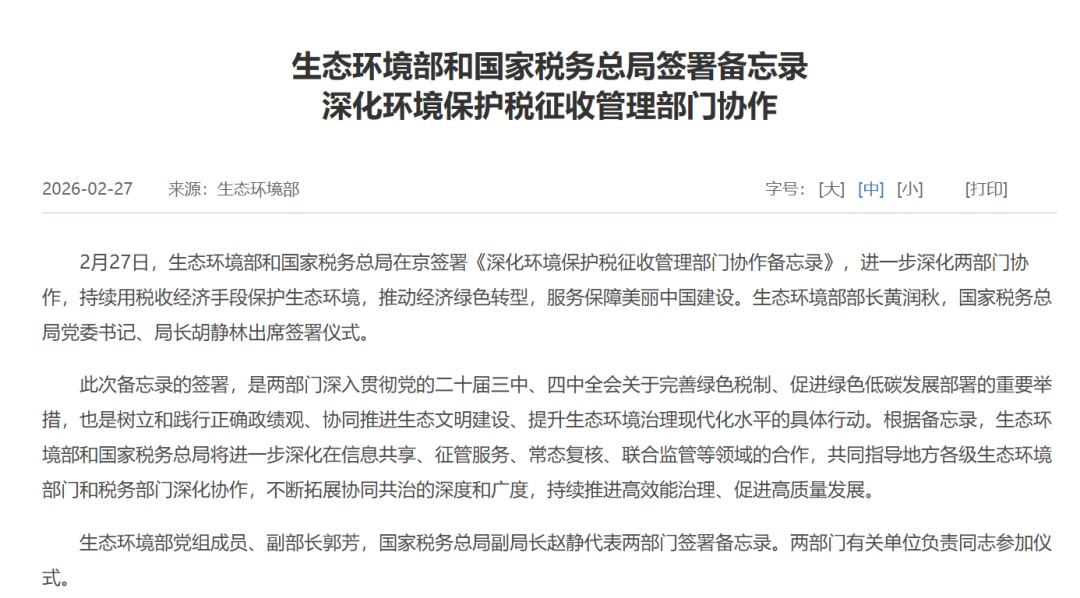
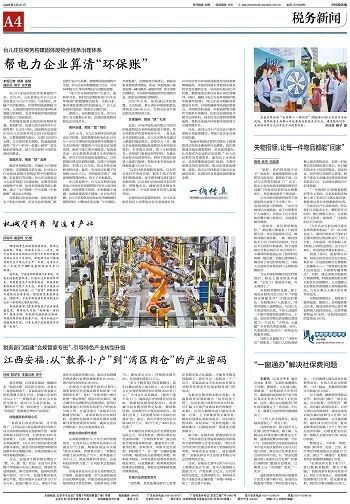
On February 27, the Ministry of Ecology and Environment and the State Taxation Administration in Beijing signed the Memorandum on Deepening Cooperation on Environmental Protection Tax Collection and Administration, further deepening cooperation between the two departments, continuously using tax leverage to protect the ecological environment, promote green economic transformation, and serve the development of a beautiful China. Huang Runqiu, Minister of Ecology and Environment, and Hu Jinglin, Secretary of the Party Committee and Director of the State Taxation Administration, attended the signing ceremony. According to the memorandum, the Ministry of Ecology and Environment and the State Taxation Administration will further deepen cooperation in information sharing, collection and administration services, routine verification, joint supervision and other areas, and jointly guide local ecology and environment departments and tax authorities at all levels to deepen cooperation, continuously expand the depth and breadth of coordinated governance, and continue to promote efficient governance and high-quality development. To address issues in the collection and administration of environmental protection tax on solid waste in the power industry, such as scattered data and lagging information, the Tai'erzhuang District Tax Bureau coordinated with the ecological environment department, regularly shared core data such as solid waste generation and comprehensive utilization plans, and established an interlinked comparison mechanism of "production scale—pollution coefficient—declaration data". Using the enterprise's power generation and installed capacity as reference production indicators, the mechanism combines the industry pollution coefficient determined by the ecological environment department to calculate the theoretical solid waste generation, compares it with the enterprise's declared data, and automatically triggers an alert for abnormal situations such as a deviation rate exceeding 20%. Last October, relying on the linkage comparison mechanism, the Tai'erzhuang District Tax Bureau found that a thermal power enterprise had a significant discrepancy between its solid waste declaration data from 2020 to 2025 and the pollution information held by the ecological environment department. After multiple rounds of on-site verification and consultations, the enterprise ultimately paid environmental protection tax of 5.9465 million yuan in accordance with the law, and improved the Solid Waste Management Ledger as required, correcting the declaration bias. Since 2025, the bureau has cumulatively investigated and supplemented environmental protection tax liabilities and late payment amounts totaling 13.8645 million yuan through risk alerts and cross-checks. This mature data exchange and coordinated supervision model can be fully applied to the photovoltaic recycling sector. For a long time, many small workshops in the industry have lacked formal business qualifications. They dispose of discarded components through crude dismantling methods, rely on cash transactions, keep non-standard accounts, and evade supervision by hiding pollutants, crowding out the market space of compliant enterprises and creating a disorderly situation in which bad money drives out good money. Relying on the tax-environment coordination mechanism, the environmental protection department synchronizes information such as emission monitoring and on-site verification with the tax authorities, while the tax authorities share data such as tax declaration, invoice flow, and business scale. Through two-way cross-checking of data, they accurately identify non-compliant workshops with illegal invoices, no tax payment records, or abnormal business volumes. On this basis, the two departments can carry out joint inspections and routine verification, strictly investigate activities such as unlicensed operations, illegal discharges, and tax-related violations. At the same time, they can leverage the guidance role of tax policies: compliant recycling enterprises with complete qualifications and standardized operations can lawfully enjoy relevant tax incentives for comprehensive resource utilization; whereas small workshops, due to their inability to improve accounts and obtain compliant invoices, not only find it difficult to enjoy policy dividends but will also continue to face regulatory pressure, with their room for survival constantly squeezed and gradually forced out of the market. The tax-environment coordination takes data co-governance as its core, making up for the shortcomings of traditional supervision. Under this supervision approach, the photovoltaic recycling industry will continue to clean up the market environment, promote the steady development of compliant enterprises, truly realize good money driving out bad money, and lead the industry toward standardized, green, and high-quality development.








About RESOLAR
Shanghai RESOLAR Energy Technology Co., Ltd. is committed to becoming a recycled material photovoltaic group with deep decarbonization. RESOLAR focuses on technological innovation and builds a world-leading solution for component recycling, impurity removal of damaged cells, recycled silicon materials and cells, and cascaded utilization of components. With professional technology and services, we help customers realize the recycling and reuse of waste photovoltaic resources, and make positive contributions to the development of environmental protection and new energy industries. For more detailed information, you can browse the official website: www.resolartech.com .

Latest developments/news
Contact information
Service Hotline: 13585742918 (Monday to Friday 9:00-18:00)
Enterprise email: ps@resolartech.com (Reply within 48 hours after receiving the email consultation!)
Company Address: Building 8, No. 1528, Wangxu East Road, Fengjing Town, Jinshan District, Shanghai (Caohejing Fengjing Park)