


English
News Center
—— NEWS CENTER ——
On July 30, 2026, the Sichuan Provincial Department of Ecology and Environment released a draft of the "Sichuan Province's 15th Five-Year Plan for Solid Waste Pollution Prevention and Control (Draft for Public Comment)" for public comment. The draft mentioned...
A special campaign will be launched to address the illegal dumping and disposal of solid waste. Focusing on the illegal dumping and landfilling of hazardous waste, industrial solid waste, and construction waste, as well as the illegal dismantling and disposal of scrapped motor vehicles, waste electrical and electronic products, and decommissioned new energy equipment, inter-departmental collaboration and regional coordination will be strengthened. Illegal activities will be severely punished according to law to effectively curb the high incidence of illegal transfer, dumping, and disposal of solid waste. A coordinated, categorized approach will be adopted to systematically address the problems, and regular reviews of the rectification results will be conducted to ensure that rectification measures are implemented effectively. By 2030, the incidence of illegal dumping and disposal of solid waste will be controlled to within 0.2 equivalent incidents per thousand square kilometers, or a decrease of more than 60% compared to 2027.
Enhance end-to-end regulatory capabilities. Relying on the national industrial solid waste information management platform, strictly implement the control requirements of the pollutant discharge permit system regarding the storage, utilization, and disposal of industrial solid waste; standardize enterprise record keeping; and strengthen the effective connection between industrial solid waste management records and ecological environment statistics. Strengthen the construction of information-based traceability capabilities for the entire process of solid waste generation, collection, storage, transportation, utilization, and disposal within the province, and improve the level of information sharing and business collaboration among departments.
Guide recycling companies to establish and improve recycling ledger management systems, and truthfully record information such as the source, type, quantity, and destination of waste electrical and electronic products.
Strengthen environmental management of decommissioned new energy equipment. Implement the extended responsibility of power battery and new energy vehicle producers, and reinforce the primary responsibility of photovoltaic power plants, wind power plants, and other enterprises to strengthen the management of decommissioned new energy equipment from the source. Implement relevant national technical specifications for pollution control in recycling and processing, encourage enterprises to establish regional centralized processing centers, support the research and application of comprehensive utilization technologies for decommissioned new energy equipment, and promote the co-processing of decommissioned equipment such as power batteries, wind turbine blades, and photovoltaic modules with waste electrical and electronic products.
Prevent and control environmental risks from illegal dismantling and disposal. Strengthen cross-departmental joint supervision and law enforcement, enhance supervision of the recycling, dismantling, utilization, and disposal of waste electrical and electronic products and retired new energy equipment, further improve complaint and reporting channels, severely crack down on illegal dismantling and disposal activities, and effectively prevent and control environmental risks.
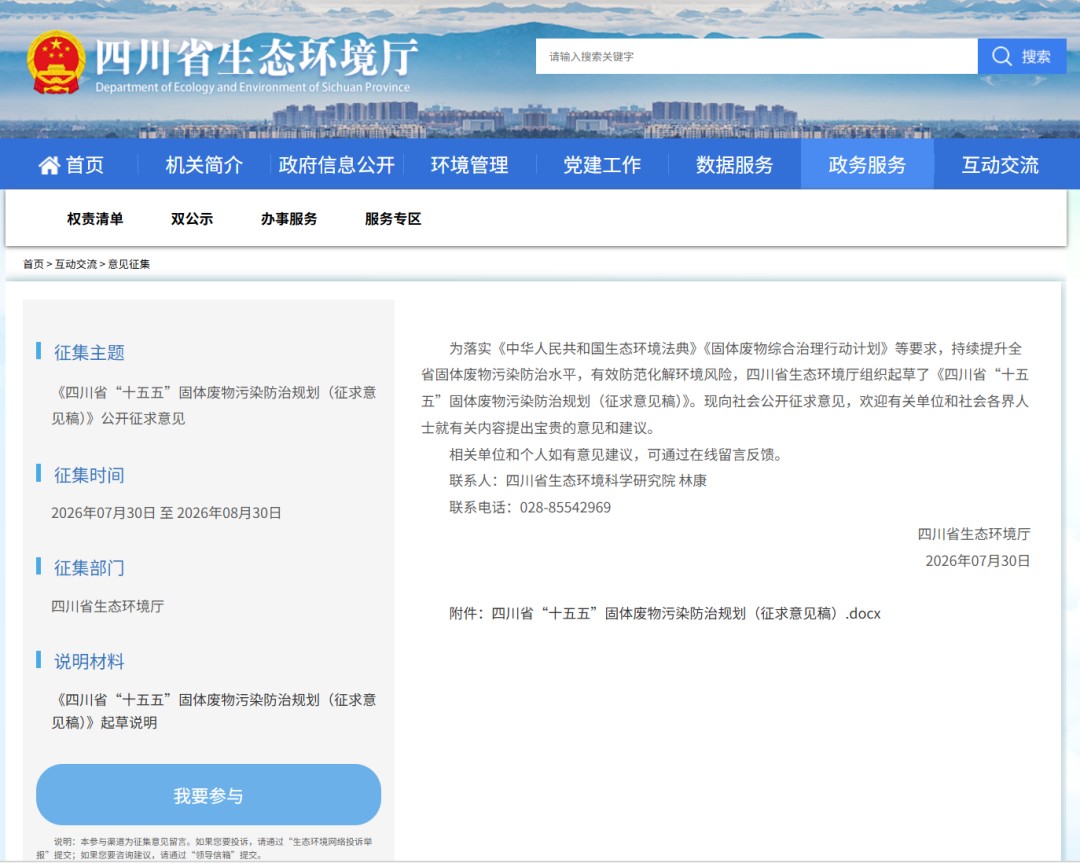
The "Sichuan Province 15th Five-Year Plan for Solid Waste Pollution Prevention and Control (Draft for Public Comment)" is open for public comment.
Issuing unit: Sichuan Provincial Department of Ecology and Environment
Release Date: 2026-07-30
Sichuan Province's 15th Five-Year Plan for Solid Waste Pollution Prevention and Control
(Draft for public comment)
Strengthening solid waste pollution prevention and control is an important task in comprehensively advancing the construction of a beautiful Sichuan, and an inevitable requirement for consolidating the ecological barrier of the upper reaches of the Yangtze and Yellow Rivers. To implement the relevant requirements of the "Ecological Environment Code of the People's Republic of China," the "Action Plan for Comprehensive Management of Solid Waste," and the "Outline of the 15th Five-Year Plan for National Economic and Social Development of Sichuan Province," and to improve the level of solid waste pollution prevention and control throughout the province and effectively prevent and mitigate environmental risks, this plan is hereby formulated to provide overall guidance for the province's solid waste pollution prevention and control work during the 15th Five-Year Plan period.
I. General Requirements
Guided by Xi Jinping Thought on Socialism with Chinese Characteristics for a New Era, and fully implementing the decisions and plans of the Provincial Party Committee and the Provincial Government, we will focus on the prevention of environmental risks throughout the entire process of solid waste disposal, and comprehensively promote the governance of hidden dangers and the construction of regulatory capacity in key areas. Adhering to the principles of reduction, resource utilization, and harmlessness, we will implement differentiated policies and systematic governance; strictly control new environmental risks and rectify historical environmental risks and hidden dangers; and rely on information technologies such as remote sensing, big data, and artificial intelligence to build a full-chain intelligent regulatory system, continuously strengthening the foundation of grassroots governance capacity. By 2030, the province will have achieved significant results in the rectification of environmental hazards related to solid waste, continuously enhanced environmental risk management capabilities, comprehensively improved the solid waste governance system and governance capacity, and made positive progress in the construction of "waste-free cities," providing solid support for building a beautiful Sichuan where humans and nature coexist harmoniously.
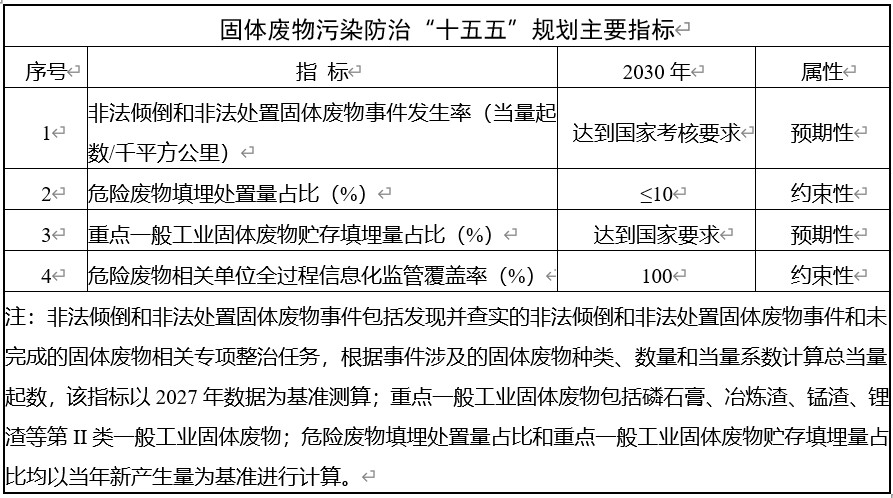
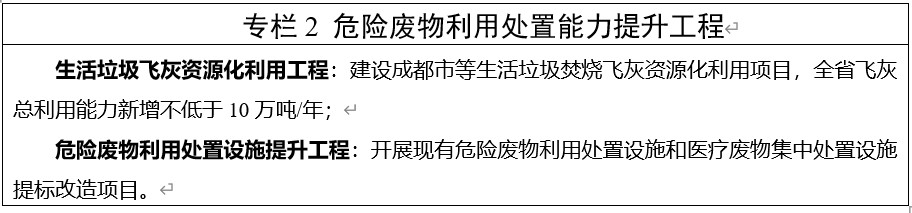
II. Further Promote Special Rectification of Solid Waste in Key Areas (I) Promote the special campaign to rectify the illegal dumping and disposal of solid waste. Focusing on the illegal dumping and landfilling of hazardous waste, industrial solid waste, and construction waste, as well as the illegal dismantling and disposal of scrapped motor vehicles, waste electrical and electronic products, and decommissioned new energy equipment, strengthen inter-departmental coordination and regional collaboration, severely punish illegal activities according to law, and effectively curb the high incidence of illegal transfer, dumping, and disposal of solid waste. Coordinate efforts, implement differentiated policies, systematically promote problem rectification, and regularly review the effectiveness of rectification to ensure that rectification measures are implemented effectively. By 2030, the incidence of illegal dumping and disposal of solid waste will be controlled within 0.2 equivalent incidents per thousand square kilometers, or decreased by more than 60% compared to 2027. (II) Promote a special investigation and remediation of the problem of garbage pollution in karst caves. Focusing on ecologically sensitive areas such as nature reserves, tourist attractions, and important water sources, as well as areas with interwoven road networks, urban-rural fringe areas, and administrative borders, establish lists of karst caves, investigation lists, problem lists, remediation lists, and spot check lists, and strengthen the three-level inspection mechanism of city and county investigations, provincial spot checks, and environmental protection supervision. Establish a long-term management and protection mechanism for karst caves, implement inspection responsibilities, and ensure that the problem does not recur. (III) Promote the investigation and rectification of environmental risks and hidden dangers in phosphogypsum storage facilities. Strictly implement the requirements of the comprehensive management action plan for phosphogypsum, aligning with the "one facility, one policy" rectification requirements, and promote the completion of environmental risk and hidden danger investigation and rectification of 28 phosphogypsum storage facilities by the end of 2027. The scale of phosphogypsum stockpiles emptied, rectified, and closed should not be less than the national requirements. Strictly implement the technical specifications for pollution control in the utilization and harmless storage of phosphogypsum, and strengthen environmental management in storage, transportation, and utilization. (IV) Conduct a comprehensive investigation and remediation of pollution risks at municipal solid waste landfills. Focusing on prominent issues such as leachate accumulation, conduct a full-coverage investigation of all newly built, in-use, closed, and decommissioned landfills in the province, scientifically assess environmental risks, implement comprehensive remediation measures tailored to each landfill, and improve the long-term mechanism for pollution prevention and control. By the end of 2027, landfills that were decommissioned before the end of 2024 will have completed closure and remediation, comprehensive remediation of high-risk landfills will be basically completed, the environmental risks of in-use landfills will be generally controllable, and the proportion of raw municipal solid waste landfilled will decrease to below 15%. (V) Implement pollution hazard investigation and rectification of hazardous waste landfills. Focusing on flexible landfills, conduct a comprehensive investigation of pollution hazards at hazardous waste landfills, establish a problem list, and formulate a "one landfill, one policy" rectification plan. For landfills with significant environmental risks, disposal activities should be suspended and effective measures should be taken to control environmental risks. For landfills that have reached their design capacity, have been out of use for more than 3 years, or have a high environmental risk level, strengthen dynamic supervision and implement comprehensive treatment projects in key areas. (VI) Conduct a comprehensive investigation and remediation of historical industrial solid waste dumps. Focusing on bulk industrial solid waste, conduct environmental risk surveys and assessments of heavy metal mines, tailings ponds, and dumping (slag) sites, and implement comprehensive remediation measures tailored to each site (pond). In the Panxi region, focus will be placed on tailings and smelting slag; in northeastern Sichuan, focus will be placed on coal gangue and fly ash; and in the Chengdu Plain and southern Sichuan, focus will be placed on phosphogypsum. Systematic remediation will be implemented, and by 2030, more than 60% of historical solid waste dumping sites will have been remediated. III. Strengthening the Prevention and Control of Industrial Solid Waste Pollution (vii) Enhance end-to-end regulatory capabilities. Relying on the national industrial solid waste information management platform, strictly implement the control requirements of the pollutant discharge permit system regarding the storage, utilization, and disposal of industrial solid waste, standardize enterprise record keeping, and strengthen the effective connection between industrial solid waste management records and ecological environment statistics. Strengthen the construction of information-based traceability capabilities for the entire process of solid waste generation, collection, storage, transportation, utilization, and disposal within the province, and improve the level of information sharing and business collaboration among departments. (viii) Strengthen risk management throughout the entire process. Strictly manage the source of industrial solid waste generation, eliminate outdated production capacity in accordance with laws and regulations, and guide enterprises to adopt advanced technologies and equipment to reduce the intensity of solid waste generation. Strengthen the source control of solid waste in industrial parks and implement mandatory clean production audits in accordance with the law. Promote the classified collection and storage of industrial solid waste, strictly prohibit mixed dumping and discharge, and strengthen the operation and maintenance management of harmless pretreatment and storage facilities. Promote the harmless pretreatment of bulk industrial solid wastes such as phosphogypsum and manganese slag to reduce end-of-pipe disposal pressure and environmental risks. (ix) Strengthen supervision of large-scale disposal and utilization. Standardize the reporting and approval process and pollution control for large-scale disposal and utilization of bulk industrial solid waste, and strengthen environmental risk control during disposal and utilization processes such as underground backfilling, mine pit backfilling, and ecological restoration. Strengthen inter-departmental coordination and steadily and orderly carry out pilot projects for backfilling and ecological restoration of bulk industrial solid waste. Encourage solid waste generating units to actively carry out large-scale disposal and utilization of general industrial solid waste under the premise of controllable environmental risks, following procedures such as "scientific demonstration, formulation of standards, proactive disclosure, and full-process supervision." Expand the utilization pathways and application scenarios of phosphogypsum, smelting slag, and tailings, reduce storage and landfill volume, and effectively control environmental risks. IV. Strengthen the whole-process environmental management of hazardous waste (X) Strengthen information-based supervision of hazardous waste throughout the entire process. Implement national requirements for full-process traceability management of hazardous waste, promote enterprises to upgrade and transform their digital monitoring equipment, and encourage units handling hazardous waste (including medical waste) to use the national hazardous waste full-process environmental management information system. Deepen the standardized construction of the "five-instance-one-code" system, strengthen the real-time dynamic information traceability of hazardous waste through "one code," and promote data interconnection, sharing, and utilization in the generation, storage, and transfer of hazardous waste. (xi) Strengthen the management of hazardous waste collection and transportation. Formulate environmental management guidelines for centralized hazardous waste collection units to standardize collection management. Deepen the pilot work on centralized collection of hazardous waste from small and medium-sized enterprises and lead-acid battery collection, and improve the "grid-based" collection system. Optimize the "whitelist" system for inter-provincial transfer, promote the pilot project for inter-provincial transfer approval of hazardous waste in the Sichuan-Chongqing Gaozhu New Area, and improve transfer efficiency. (XII) Improve the level of hazardous waste utilization and disposal. Conduct assessments on the matching of hazardous waste generation with utilization and disposal capacity, regularly issue guiding announcements on the construction of hazardous waste utilization and disposal facilities, and coordinate and guide the optimization and adjustment of the utilization and disposal structure. Urge hazardous waste generating units to strengthen the investigation and rectification of environmental risks and hidden dangers of their own utilization and disposal facilities, explore the establishment of a performance-based hierarchical management system for hazardous waste utilization and disposal facilities, require centralized hazardous waste disposal units to regularly conduct environmental safety performance assessments of landfills, promote the upgrading and renovation of old utilization and disposal facilities, and gradually eliminate technologically backward utilization and disposal facilities. Encourage the group-based development and professional operation of hazardous waste utilization and disposal, deepen cooperation mechanisms in key regions such as Sichuan and Chongqing, and actively promote the collaborative sharing of regional hazardous waste utilization and disposal facilities. Accelerate the construction of a comprehensive centralized hazardous waste disposal center in Southwest China. (XIII) Strictly control the landfill disposal of hazardous waste. Further implement the "point-to-point" targeted utilization exemption management for hazardous waste in Sichuan and Chongqing. Strengthen environmental supervision of hazardous waste landfill disposal, and gradually restrict the direct landfilling of hazardous waste that can be reduced through utilization, incineration, etc. Accelerate the construction of comprehensive utilization projects for municipal solid waste incineration fly ash, and encourage the comprehensive utilization of low-value hazardous wastes such as municipal solid waste incineration fly ash, gold concentrate cyanide tailings, and waste salt after harmless pretreatment to prevent long-term large-scale stockpiling and promote a steady decline in the proportion of hazardous waste landfill disposal. During the "15th Five-Year Plan" period, in principle, no new or expanded flexible landfill facilities for hazardous waste will be built, and no new centralized incineration facilities for hazardous waste will be built. The capacity of any single centralized incineration facility that is renovated or expanded should be greater than 30,000 tons/year. Guide cement kiln co-processing units and centralized hazardous waste disposal units to compete in a differentiated and healthy manner. (XIV) Strengthen the guarantee of medical waste collection and disposal. Continuously improve the guarantee system for the collection and disposal of medical waste for both normal and emergency use, and encourage facilities that meet the standards for the emergency collaborative disposal of medical waste, such as hazardous waste incineration and municipal solid waste incineration. Promote the upgrading and transformation of medical waste disposal facilities. Support remote areas that do not have the conditions for centralized disposal to explore on-site and nearby disposal methods. V. Strengthen environmental supervision of waste electrical and electronic products and decommissioned new energy equipment. (XV) Strengthen the construction of a waste electrical and electronic equipment (WEEE) recycling system. Promote WEEE manufacturers to fulfill their producer responsibility, and encourage the use of models such as "trade-in + recycling" and "Internet + recycling" to build a diversified recycling network. Support the construction of green sorting centers for renewable resources, increase the application of artificial intelligence technology, and promote the formation of a renewable resource recycling system with sorting centers as hubs, transfer stations as support, and recycling outlets as the foundation. Encourage property management companies and second-hand goods dealers to provide recycling services, and guide supply and marketing cooperatives and grassroots outlets such as household waste sorting and collection to expand urban and rural recycling business. Guide recycling companies to establish and improve recycling ledger management systems, and accurately record information such as the source, type, quantity, and destination of WEEE. (XVI) Optimize the structure of waste electrical and electronic equipment (WEEE) processing capacity. Adhering to the principle of relying on existing resources and centralized processing, and based on the total permitted processing capacity of "four appliances and one computer" (televisions, refrigerators, washing machines, air conditioners, and computers) across the province, existing enterprises are encouraged to dynamically optimize their processing capacity, and enterprises are supported in integrating existing capacity through acquisitions and mergers. For other WEEE products, social capital is encouraged to participate in the construction of centralized disposal facilities; the scale and capacity of newly built facilities should meet the requirements of relevant national standards and technical specifications. Enterprises are supported in using technological innovation to drive the high-value utilization of dismantled products and increase the added value of dismantled products such as metals, plastics, and circuit boards. (XVII) Strengthen environmental management of retired new energy equipment. Implement the extended responsibility of power battery and new energy vehicle producers, and strengthen the main responsibility of photovoltaic power stations, wind power stations, and other enterprises to enhance the management of retired new energy equipment from the source. Implement relevant national technical specifications for pollution control in recycling and treatment, encourage enterprises to establish regional centralized treatment centers, support the research and application of comprehensive utilization technologies for retired new energy equipment, and promote the co-processing of retired equipment such as power batteries, wind turbine blades, and photovoltaic modules with waste electrical and electronic products. (18) Prevent and control environmental risks from illegal dismantling and disposal. Strengthen cross-departmental joint supervision and law enforcement, enhance supervision of the recycling, dismantling, utilization and disposal of waste electrical and electronic products and retired new energy equipment, further improve complaint and reporting channels, severely crack down on illegal dismantling and disposal and other behaviors, and effectively prevent and control environmental risks. VI. Strengthen the prevention and control of solid waste pollution from domestic, construction, and agricultural sectors. (XIX) Strengthen the prevention and control of pollution from municipal solid waste. Strengthen environmental supervision of incineration, landfill and other disposal facilities, enhance pollution control during collection and transportation, improve the collection and treatment capacity of leachate from municipal solid waste landfills, and strengthen the collection and treatment of landfill gas. Based on local conditions, rationally set up regional waste incineration disposal projects. (20) Strengthen pollution prevention and control of construction waste. Implement classified treatment of construction waste, implement information-based supervision of the entire process of construction waste disposal, and strictly prevent illegal dumping. Strengthen pollution prevention and control in the utilization and disposal of construction waste, urge operating units to establish and improve environmental monitoring systems, and strengthen environmental supervision of the operation of construction waste disposal facilities. Conduct environmental risk assessment and pollution prevention and control of existing construction waste dumping sites. By 2030, the resource utilization rate of construction waste will reach 60%. (XXI) Strengthen pollution prevention and control of municipal sludge. Strengthen supervision and management of pollution prevention and control throughout the entire process of municipal sludge generation, transportation, treatment, and disposal; standardize disposal pathways; and address capacity gaps. Promote the establishment of an information-based management ledger for the entire sludge process. Promote the comprehensive utilization of sludge according to local conditions; scientifically plan the layout of sludge treatment and disposal facilities; prioritize the development of disposal methods such as drying and incineration, and co-incineration; and gradually reduce landfill volume. Strictly control the utilization of sludge for the production of fertilizers, nutrient soil, and other uses. (XXII) Strengthen the prevention and control of agricultural solid waste pollution. Vigorously promote the comprehensive utilization of straw, implement zoned management of straw burning, and strengthen environmental supervision and pollution control during the utilization and disposal process. Promote the construction of facilities for the collection, storage, transportation, and treatment of livestock and poultry manure, strengthen the supervision of the operation of manure treatment facilities in large-scale farms, and promote the intelligent application of manure management and precision return to the field. Improve the recycling network for waste agricultural film and pesticide packaging waste, strengthen the special rectification of non-standard agricultural film, promote thicker high-strength agricultural film and fully biodegradable agricultural film, and encourage the use of environmentally friendly and easily recyclable packaging materials and large-package pesticides. By 2030, the comprehensive utilization rate of crop straw will be stabilized at over 90%, the comprehensive utilization rate of livestock and poultry manure will reach 85%, and the recycling rate of waste agricultural film will reach 88%. VII. Promote the construction of "zero-waste cities" with high quality (XXIII) Expand and improve the construction of "zero-waste cities". Further promote the joint construction of "zero-waste cities" in the Chengdu-Chongqing economic circle, encourage neighboring regions to cooperate in the joint construction of "zero-waste cities", and explore regional collaborative governance of solid waste. Promote the construction of "zero-waste cities" in Panzhihua, Guangyuan, and Bazhong, and encourage eligible counties (cities) in the three prefectures to carry out "zero-waste city" construction. Conduct in-depth evaluation of the progress of "zero-waste city" construction. (XXIV) Promote the "zero waste" concept. Focusing on industries such as steel, non-ferrous metals, petrochemicals, and chemicals, actively guide industrial parks and enterprises to implement "zero waste" production methods and promote the reduction of industrial solid waste generation intensity. Cultivate "zero waste city cells" in different industry sectors and support large group companies to carry out the construction of "zero waste groups" based on their actual conditions. Strengthen the publicity of the "zero waste" concept and actively guide social organizations, enterprises, and the public to participate in the construction of "zero waste cities". VIII. Enhance Solid Waste Supervision Capacity (XXV) Strengthen early warning of environmental risks from solid waste pollution. Actively utilize advanced technologies and equipment such as satellite remote sensing and drones to enhance non-site, contactless, and intelligent supervision capabilities. Focusing on key ecological function zones, ecologically sensitive areas, and vulnerable areas, strengthen the investigation of potential environmental risks from solid waste. Accelerate the construction of the Southwest Regional Hazardous Waste Risk Prevention and Control Technology Center to strengthen the identification of environmental hazards from hazardous waste and environmental risk assessment. (XXVI) Strengthen environmental monitoring of storage and disposal facilities. Strengthen supervision and self-monitoring of solid waste storage and disposal facilities, and enhance routine monitoring of storage and disposal facilities such as stockpiles (slag heaps), tailings ponds, and landfills, as well as illegal dumping and disposal. Implement the classified and graded environmental supervision requirements for tailings ponds. Promote the orderly integration of hazardous waste incineration and cement kiln co-processing facilities. (XXVII) Strengthen Solid Waste Supervision and Enforcement. Strictly implement relevant laws and standards for solid waste pollution prevention and control, strengthen daily law enforcement and supervision, improve cross-departmental and cross-regional joint supervision and enforcement mechanisms, deepen cross-regional cooperation in handling ecological and environmental criminal cases, and launch a joint campaign to combat illegal and criminal activities related to the cross-regional transfer and disposal of solid waste in the adjacent areas of Sichuan and Chongqing. Strengthen the analysis and judgment of multi-source data to improve the accuracy of off-site law enforcement. Promote the graded and classified management of hazardous waste, optimize the standardized environmental management assessment methods for hazardous waste, standardize the exemption management of hazardous waste, and prevent the evasion of supervision under the guise of "by-products." Severely crack down on illegal dumping and disposal of solid waste, fraudulent identification by institutions, waste-generating enterprises evading environmental responsibilities by selling at low prices to "subsidize transportation costs," and environmental pollution crimes committed by evading supervision through "price inversion." Strengthen the connection between administrative and criminal law enforcement, and severely punish environmental violations and crimes with a "zero-tolerance" attitude. Focus on prominent ecological and environmental issues such as illegal and irregular disposal of solid waste in provincial-level ecological and environmental protection inspections. IX. Improve the solid waste pollution prevention and control guarantee system (XXVIII) Strengthen financial support. Make good use of special funds for ecological and environmental protection and national policy funds in a coordinated manner to leverage their guiding and catalytic role. Encourage financial institutions to develop green credit, green bonds and other financial products and services related to solid waste pollution prevention and control under the principles of marketization and the rule of law, so as to support solid waste pollution prevention and control and resource utilization. (XXIX) Strengthen technological support. Implement major science and technology projects for environmental governance and joint science and technology projects for ecological and environmental protection, and promote research and development of key technologies and equipment for solid waste pollution control. Actively support qualified enterprises to conduct special research on typical problems in the field of solid waste. Promote the construction of key laboratories in emerging solid waste fields, encourage research, demonstration and application of solid waste carbon capture, utilization and storage technologies, and promote synergistic efficiency in solid waste pollution reduction and carbon reduction. 10. Organization and Implementation The ecological and environmental departments of all cities (prefectures) should coordinate the implementation of the plan, work with relevant departments to refine the planning objectives and tasks, and conscientiously organize the implementation of this plan to ensure that all tasks are effectively implemented. The Department of Ecology and Environment, together with relevant departments, will strengthen the tracking and scheduling of the plan's implementation progress, conduct mid-term and final assessments of the plan's implementation, promptly summarize the problems and experiences encountered in the implementation of the plan, and, based on the progress of the work, incorporate the relevant planning objectives and main tasks into the performance evaluation of the Beautiful Sichuan construction.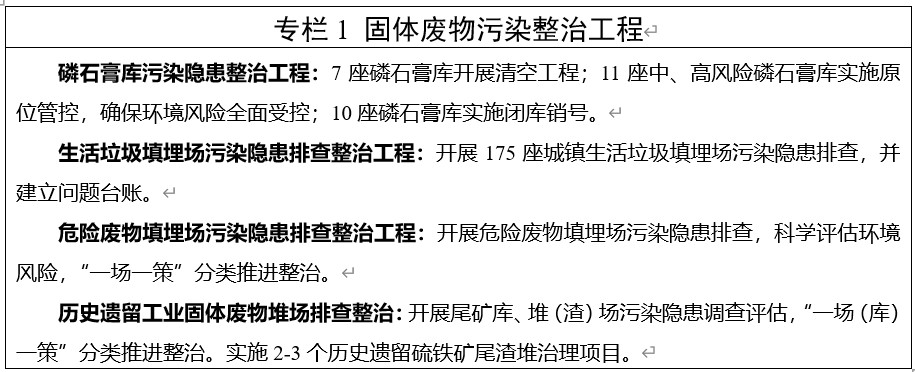
About RESOLAR
Shanghai RESOLAR Energy Technology Co., Ltd. is committed to becoming a recycled material photovoltaic group with deep decarbonization. RESOLAR focuses on technological innovation and builds a world-leading solution for component recycling, impurity removal of damaged cells, recycled silicon materials and cells, and cascaded utilization of components. With professional technology and services, we help customers realize the recycling and reuse of waste photovoltaic resources, and make positive contributions to the development of environmental protection and new energy industries. For more detailed information, you can browse the official website: www.resolartech.com .

Latest developments/news
Contact information
Service Hotline: 13585742918 (Monday to Friday 9:00-18:00)
Enterprise email: ps@resolartech.com (Reply within 48 hours after receiving the email consultation!)
Company Address: Building 8, No. 1528, Wangxu East Road, Fengjing Town, Jinshan District, Shanghai (Caohejing Fengjing Park)