


English
News Center
—— NEWS CENTER ——
On August 5, 2026, the Notice on Issuing the Shandong Province Administrative Measures for the Standardized Management of the Recycling and Comprehensive Utilization of Industrial Renewable Resources (Trial) was released. As a key highlight, the Measures propose the construction and operation of the Shandong Province Smart Monitoring Platform for the Recycling and Processing of Industrial Renewable Resources. Through digitalized supervision integrating the “five flows”—contract flow, goods flow, invoice flow, fund flow, and information flow—the platform will maintain records and conduct real-time verification throughout the processes of goods transportation, on-site weighing, fund transactions, and invoice issuance.
The following are the core contents of the document:
Recycling and processing enterprises shall strictly implement the tax administration provisions applicable to the industrial renewable resources sector, fulfill the policy requirements for “reverse invoicing,” guide natural persons to handle tax-related matters in accordance with regulations, standardize the invoicing process for purchases, strictly verify whether natural persons meet the relevant conditions, as well as the source information and actual flow of goods, establish and improve detailed ledgers for purchase and sales operations, truthfully record information on purchasing and sales, warehousing, processing, flow direction, funds, and invoices, and implement the control requirements for integrating the “five flows”—contract flow, goods flow, invoice flow, fund flow, and information flow (hereinafter referred to as the “five-flow integration”).
The Department of Industry and Information Technology of Shandong Province shall be responsible for guiding the construction and operation of the Shandong Province Smart Monitoring Platform for the Recycling and Processing of Industrial Renewable Resources. The platform shall establish management mechanisms for user access, routine dynamic supervision, and orderly exit; conduct regular online monitoring and offline verification; and coordinate the implementation of risk warnings, industry statistics, and other related work to ensure that the entire transaction process is conducted online and that the data is authentic.
Industrial and information technology departments at or above the county level shall encourage relevant market entities engaged in the recycling, processing, and utilization of industrial renewable resources within their jurisdictions to complete platform registration, information filing, and data updates, and shall urge enterprises to submit transaction, warehousing, flow-direction, and other business data truthfully, accurately, completely, and promptly.
The operating entity of the monitoring platform shall strictly implement the regulatory requirements for “five-flow integration,” unify online and offline transaction management standards, and collect important data including market entity information, transaction details, logistics tracks, fund transactions, and tax-related invoices.
The platform operating entity shall establish a full-process traceability, intelligent verification, and risk-warning management system. By applying technologies such as track tracing, big-data risk control, and intelligent verification, it shall maintain records and conduct real-time verification throughout the processes of goods transportation, on-site weighing, fund transactions, and invoice issuance; establish a risk-level warning mechanism; investigate and identify prominent problems arising during transactions; and issue timely warnings upon discovering clues of illegal or non-compliant activities, while cooperating with regulatory authorities in investigation and evidence collection.
Where market entities use technologies, processes, or equipment expressly eliminated by the state in violation of regulations to conduct production or business activities, the competent administrative authorities shall, according to their respective responsibilities, order rectification within a specified time limit and investigate and punish such activities in accordance with laws and regulations including the Ecological and Environmental Protection Code of the People’s Republic of China and the Circular Economy Promotion Law of the People’s Republic of China.
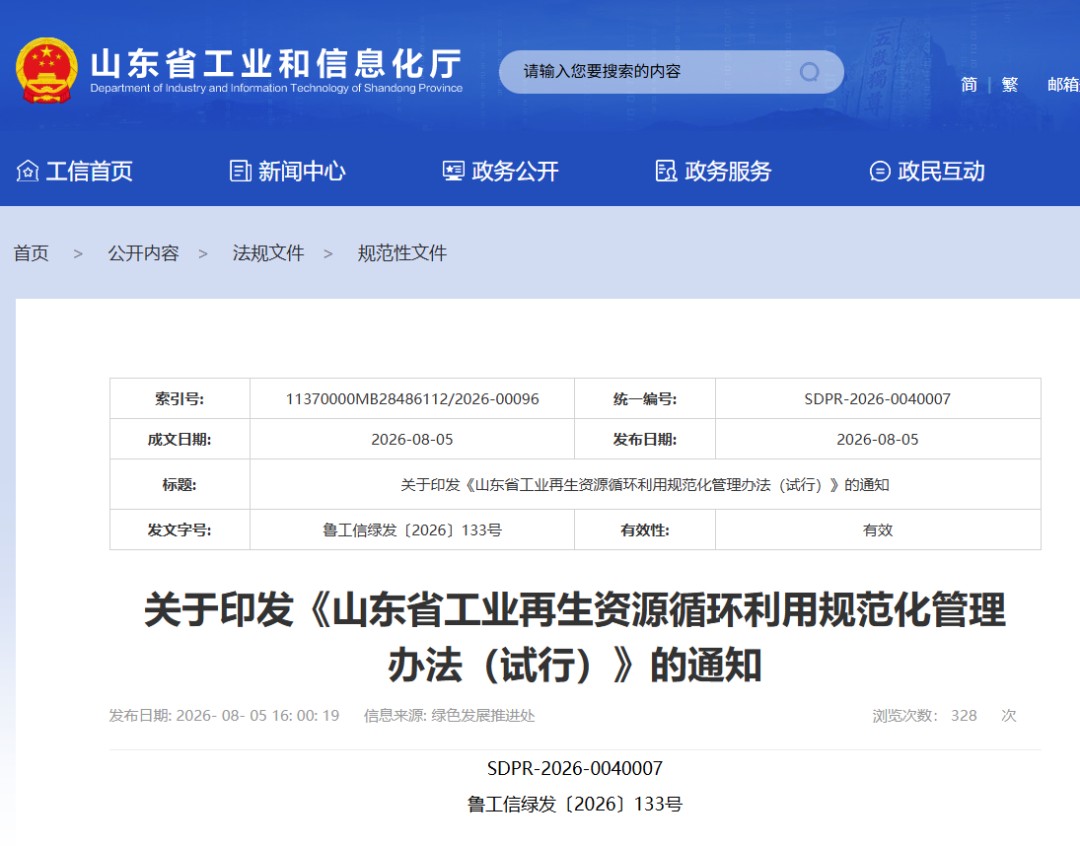
Notice on Issuing the Shandong Province Administrative Measures for the Standardized Management of the Recycling and Comprehensive Utilization of Industrial Renewable Resources (Trial)
Issuing authorities:
Department of Industry and Information Technology of Shandong Province
Shandong Provincial Development and Reform Commission
Shandong Provincial Department of Public Security
Shandong Provincial Department of Finance
Shandong Provincial Department of Ecology and Environment
Shandong Provincial Department of Commerce
Shandong Provincial Administration for Market Regulation
Shandong Provincial Tax Service, State Taxation Administration
Date of issuance: 2026-08-05
Document number:
Lu Gong Xin Lü Fa〔2026〕No. 133
Notice on Issuing the Shandong Province Administrative Measures for the Standardized Management of the Recycling and Comprehensive Utilization of Industrial Renewable Resources
(Trial)
To the People’s Governments of all cities:
The Shandong Province Administrative Measures for the Standardized Management of the Recycling and Comprehensive Utilization of Industrial Renewable Resources (Trial) have been approved by the Provincial Party Committee and the Provincial People’s Government. They are hereby issued to you for conscientious implementation in light of actual circumstances.
Department of Industry and Information Technology of Shandong Province
Shandong Provincial Development and Reform Commission
Shandong Provincial Department of Public Security
Shandong Provincial Department of Finance
Shandong Provincial Department of Ecology and Environment
Shandong Provincial Department of Commerce
Shandong Provincial Administration for Market Regulation
Shandong Provincial Tax Service, State Taxation Administration
August 5, 2026
Shandong Province Administrative Measures for the Standardized Management of the Recycling and Comprehensive Utilization of Industrial Renewable Resources (Trial)
Chapter I General Provisions
Article 1 [Purpose and Basis] These Measures are formulated to strengthen the management of the recycling and comprehensive utilization of industrial renewable resources, standardize market order, close regulatory loopholes, combat illegal activities such as fraudulent invoicing and illegal operations, and promote green, low-carbon, and high-quality industrial development, in accordance with relevant provisions including the Administrative Measures for the Recycling of Renewable Resources and the Notice of the General Office of the People’s Government of Shandong Province on Issuing the Implementation Plan of Shandong Province for Accelerating the Establishment of a Waste Recycling System (Lu Zheng Ban Fa〔2024〕No. 8).
Article 2 [Scope of Application] These Measures apply to the supervision and administration of all stages of the generation, recycling, processing, and utilization of industrial renewable resources within the administrative region of Shandong Province.
Article 3 [Definitions] A natural-person seller eligible for the “reverse invoicing” policy refers to a natural person who sells end-of-life products that they have used themselves or sells end-of-life products they have purchased, and whose cumulative sales through “reverse invoicing” over a continuous period of no more than 12 months (meaning calendar months) do not exceed RMB 5 million, exclusive of value-added tax.
A recycling business entity refers to an enterprise or individual industrial and commercial household legally engaged in the recycling of industrial renewable resources.
A recycling and processing enterprise refers to an enterprise that complies with relevant technical specifications and engages in the sorting, dismantling, shearing, crushing, baling, and intensive processing of industrial renewable resources.
A waste-generating enterprise refers to an industrial production enterprise that generates various types of industrial renewable resources during its production and business activities.
A utilization enterprise refers to an industrial enterprise that purchases and uses industrial renewable resources for product manufacturing and resource recycling.
An industry-standard enterprise refers to an enterprise included in the list of enterprises meeting the industry standard conditions for the comprehensive utilization of industrial renewable resources issued by the Ministry of Industry and Information Technology.
Article 4 [Responsibilities] The Department of Industry and Information Technology of Shandong Province shall be responsible for guiding the recycling and comprehensive utilization of industrial renewable resources throughout the province and formulating and implementing industrial development policies for the recycling and comprehensive utilization of industrial renewable resources.
Development and reform departments shall be responsible for coordinating industrial planning, circular economy development, guarantees for energy and coal consumption factors, and the coordination of major projects.
Public security departments shall be responsible for public security administration in the recycling of industrial renewable resources, supervising the implementation of the purchase registration system, and investigating and handling illegal and criminal activities such as purchasing and selling stolen goods in accordance with the law.
Finance departments shall be responsible for budget management of fiscal funds, the allocation and disbursement of funds, and guidance on performance management of funds.
Ecology and environment departments shall be responsible for supervising and administering the prevention and control of environmental pollution during the recycling, processing, and utilization of industrial renewable resources, and for investigating and handling violations of ecological and environmental laws in accordance with the law.
Commerce departments shall be responsible for the administration of the industrial renewable resources recycling sector, formulating industry development plans, guiding the filing of recycling sites, and standardizing circulation order.
Market regulation departments shall be responsible for the registration of recycling business entities for industrial renewable resources and the investigation and handling of unlicensed business operations.
Tax departments shall be responsible for tax collection and administration in the industrial renewable resources sector, implementing tax and fee policies in accordance with the law, and preventing and combating tax-related violations such as fraudulent invoicing.
Management bodies of various industrial parks and industrial clusters shall, in light of the industrial characteristics of the parks and the characteristics of industrial renewable resource generation, make overall arrangements for the industrial renewable resources recycling system and incorporate relevant matters into the industrial development plans of the parks.
Chapter II Administration of the Recycling and Comprehensive Utilization Sector
Article 5 [Source Disposal] Waste-generating enterprises shall issue invoices themselves to purchasers and declare and pay taxes in strict accordance with regulations, sell production-related industrial renewable resources to qualified recycling enterprises, and retain supporting documents such as contracts and weighbridge slips. Where such resources are transferred outside the province for storage or disposal, the transfer shall be filed with the competent provincial ecology and environment department.
Article 6 [Administration of Recycling Business Entities] Entities engaged in the recycling of industrial renewable resources must complete market entity registration and obtain a business license in accordance with the law. Where relevant business filing is required by regulations, the entity shall complete the filing with the relevant authority within the prescribed time limit in accordance with the law.
Article 7 [Administration of Recycling and Processing Enterprises] Recycling and processing enterprises shall conduct production and business activities in accordance with laws and regulations, and strictly comply with relevant provisions on industrial policies, ecological and environmental protection, work safety, tax collection and administration, and other matters. The use of production processes and equipment expressly eliminated by the state is strictly prohibited. Enterprises are encouraged to upgrade specialized processing equipment for sorting, crushing, baling, and other operations, stabilize upstream and downstream supply and sales channels, and improve the level of large-scale and refined operations.
Recycling and processing enterprises shall strictly implement the tax administration provisions applicable to the industrial renewable resources sector, fulfill the policy requirements for “reverse invoicing,” guide natural persons to handle tax-related matters in accordance with regulations, standardize the invoicing process for purchases, strictly verify whether natural persons meet the relevant conditions, as well as the source information and actual flow of goods, establish and improve detailed ledgers for purchase and sales operations, truthfully record information on purchasing and sales, warehousing, processing, flow direction, funds, and invoices, and implement the control requirements for integrating the “five flows”—contract flow, goods flow, invoice flow, fund flow, and information flow (hereinafter referred to as the “five-flow integration”).
End-of-life motor vehicle recycling and dismantling enterprises shall strictly comply with industry administration regulations, standardize the procedures for verification, dismantling, registration, and cancellation, and are strictly prohibited from improperly disposing of end-of-life vehicles and key components in violation of regulations.
Article 8 [Resource Utilization] Utilization enterprises shall, while complying with requirements for product quality, work safety, pollution prevention and control, and other matters, be encouraged to select industrial renewable resources or steadily increase the proportion of industrial renewable resources used in industrial products.
Article 9 [Development of the Standards System] The Department of Industry and Information Technology of Shandong Province shall establish and improve a standards system for the accounting and certification of carbon emission reductions from the recycling and comprehensive utilization of industrial renewable resources, and improve the methodology for accounting for carbon emission reductions from the processing and utilization of industrial renewable resources. Relevant industry associations and enterprises are encouraged to participate in the formulation of standards for the sorting, processing, quality grading, and comprehensive utilization of industrial renewable resources.
Chapter III Administration of Standardized Transactions
Article 10 [Construction of the Smart Monitoring Platform] The Department of Industry and Information Technology of Shandong Province shall be responsible for guiding the construction and operation of the Shandong Province Smart Monitoring Platform for the Recycling and Processing of Industrial Renewable Resources. The platform shall establish management mechanisms for user access, routine dynamic supervision, and orderly exit; conduct regular online monitoring and offline verification; and coordinate the implementation of risk warnings, industry statistics, and other related work to ensure that the entire transaction process is conducted online and that the data is authentic.
Industrial and information technology departments at or above the county level shall encourage relevant market entities engaged in the recycling, processing, and utilization of industrial renewable resources within their jurisdictions to complete platform registration, information filing, and data updates, and shall urge enterprises to submit transaction, warehousing, flow-direction, and other business data truthfully, accurately, completely, and promptly.
Article 11 [Standardized Transaction Data] The operating entity of the monitoring platform shall strictly implement the regulatory requirements for “five-flow integration,” unify online and offline transaction management standards, and collect important data including market entity information, transaction details, logistics tracks, fund transactions, and tax-related invoices.
Article 12 [Preventing Invoice-Driven Economic Activities] Market entities registered on the platform shall conduct comprehensive self-inspections regarding “five-flow integration,” standardize channels for obtaining input invoices, and apply for invoice quotas in accordance with the law. Tax departments at or above the county level shall focus on combating fraudulent revenue-generating activities such as the registration of shell companies, circular invoicing among affiliated enterprises, and abnormal fund flows. The use and quota management of digital electronic invoices shall be continuously optimized to reduce the scope for non-compliant enterprise operations. On the basis of verifying the authenticity of business activities, the normal invoice needs of compliant enterprises shall be safeguarded.
Article 13 [Intelligent Risk Warning] The platform operating entity shall establish a full-process traceability, intelligent verification, and risk-warning management system. By applying technologies such as track tracing, big-data risk control, and intelligent verification, it shall maintain records and conduct real-time verification throughout the processes of goods transportation, on-site weighing, fund transactions, and invoice issuance; establish a risk-level warning mechanism; investigate and identify prominent problems arising during transactions; and issue timely warnings upon discovering clues of illegal or non-compliant activities, while cooperating with regulatory authorities in investigation and evidence collection.
Article 14 [Warning Response, Disposal, and Rectification] With respect to non-compliant circumstances such as abnormal transactions, false logistics, non-compliant invoicing, and inconsistencies in fund flows, the platform operating entity shall promptly send warning notices to relevant market entities registered on the platform, specify the causes of the problems, rectification requirements, and rectification deadlines, and review the completion of rectification. Warning information shall be sent simultaneously to the relevant local industry regulatory departments, which shall, according to their respective responsibilities, urge the implementation of rectification. Where illegal or non-compliant activities are suspected, the matter shall be transferred in accordance with the law to the relevant administrative law enforcement or judicial authorities for handling.
Article 15 [Data Sharing and Verification] The Department of Industry and Information Technology of Shandong Province shall coordinate the cross-departmental sharing and joint use of platform regulatory data. Where necessary for its work, it may entrust qualified third-party professional institutions to conduct targeted transaction data verification and special business certification, and issue formal certification reports.
Chapter IV Incentive Measures
Article 16 [Implementation of Fiscal and Tax Policies] Fiscal and tax departments of people’s governments at or above the county level shall implement, in accordance with the law, preferential tax policies such as immediate collection and subsequent refund of value-added tax for comprehensive resource utilization, so as to promote the standardized and healthy development of industries related to the recycling and comprehensive utilization of industrial renewable resources.
Article 17 [Financial Support] Various financial institutions shall be encouraged to innovate financial products and increase financing support for key projects involving the recycling and comprehensive utilization of industrial renewable resources. Diversified financing channels shall be actively expanded to guide social capital to participate orderly in industrial development.
Article 18 [Enterprise Development] Upstream and downstream enterprises in the industrial renewable resources chain shall be encouraged to strengthen cooperation and promote in-depth coordination in raw material supply, technology research and development, product applications, and other areas. The Department of Industry and Information Technology of Shandong Province, together with relevant departments, shall encourage the cultivation of national-level manufacturing single-product champions, specialized and sophisticated small and medium-sized enterprises that produce new and unique products, innovative small and medium-sized enterprises, and other enterprises in the field of industrial renewable resources recycling and comprehensive utilization.
Chapter V Supervision, Administration, and Industry Self-Regulation
Article 19 [Joint Law Enforcement] Relying on the provincial economic operation coordination mechanism, the commerce, public security, market regulation, taxation, ecology and environment, and other departments shall regularly conduct joint inspections of key regions and key processes, and severely crack down on illegal activities such as non-compliant operations, fraudulent invoicing, and environmental pollution.
Article 20 [Credit-Based Classified Supervision] Industry authorities of people’s governments at or above the county level shall establish industry credit files and implement graded and classified supervision. For entities with serious legal violations and loss of credit, all departments shall implement corresponding administrative measures in accordance with laws and regulations, and promote integrity and self-discipline among market entities.
Article 21 [Industry Self-Regulation] Relevant industry associations for industrial renewable resources shall be supported in playing their role as bridges and links, formulating industry self-regulatory conventions, carrying out industry training, exchange and cooperation, and policy communication activities, guiding enterprises to operate in a standardized manner and compete fairly, and maintaining a healthy and orderly industry development environment.
Article 22 [Clustered and Standardized Development] Development and reform, industry and information technology, and commerce departments shall guide the clustered development of the industrial renewable resources processing and utilization sector, promote advanced and applicable technical equipment, and improve the automation and intelligent level of sorting and processing.
Article 23 [Publicity, Guidance, and Promotion] Publicity concerning policies, achievements, and exemplary models for the recycling and comprehensive utilization of industrial renewable resources shall be strengthened. Service mechanisms such as “one dedicated task force for each enterprise” shall be established for key enterprises, industrial enterprises shall be guided to actively practice the concept of green production, and a favorable atmosphere in which the whole society attaches importance to resource recycling and utilization shall be created.
Chapter VI Legal Liability
Article 24 [Penalties for the Use of Obsolete Processes and Equipment] Where market entities use technologies, processes, or equipment expressly eliminated by the state in violation of regulations to conduct production or business activities, the competent administrative authorities shall, according to their respective responsibilities, order rectification within a specified time limit and investigate and punish such activities in accordance with laws and regulations including the Ecological and Environmental Protection Code of the People’s Republic of China and the Circular Economy Promotion Law of the People’s Republic of China.
Article 25 [Penalties for Ecological and Environmental Violations] Where market entities violate relevant ecological and environmental administration provisions during the recycling, processing, or utilization of industrial renewable resources, the competent ecology and environment authorities shall impose penalties in accordance with the law.
Article 26 [Accountability for Failure to Perform Regulatory Duties] Where industry authorities at all levels or their staff members commit acts such as abuse of power, favoritism, or failure to perform their duties in the administration of the recycling and comprehensive utilization of industrial renewable resources, the relevant responsibilities shall be investigated in accordance with rules, Party discipline, and the law. Where a crime is suspected, the matter shall be transferred to the judicial authorities for handling in accordance with the law.
Chapter VII Supplementary Provisions
Article 27 [Coordinated Joint-Action Mechanism] The Department of Industry and Information Technology of Shandong Province shall perform its responsibilities for overall coordination and leadership, establish and improve a regular cross-departmental joint-action mechanism, strengthen supervision of the entire industrial chain covering waste generation, recycling, processing, and waste utilization, enhance overall coordination, follow-up services, and performance evaluation, jointly address disorder in the sector, severely crack down on illegal and non-compliant activities such as fraudulent invoicing, false transactions, and illegal disposal of waste, and maintain fair and standardized market order.
Article 28 [Dynamic Adjustment Mechanism] During the implementation of these Measures, where the state or the province issues new provisions, those provisions shall prevail. Where relevant policies or standards are adjusted, the corresponding contents of these Measures shall be adjusted accordingly.
Article 29 These Measures shall be interpreted by the Department of Industry and Information Technology of Shandong Province, the Provincial Development and Reform Commission, the Provincial Department of Public Security, the Provincial Department of Finance, the Provincial Department of Ecology and Environment, the Provincial Department of Commerce, the Provincial Administration for Market Regulation, and the Provincial Tax Service.
Article 30 These Measures shall come into force on September 6, 2026.
About RESOLAR
Shanghai RESOLAR Energy Technology Co., Ltd. is committed to becoming a recycled material photovoltaic group with deep decarbonization. RESOLAR focuses on technological innovation and builds a world-leading solution for component recycling, impurity removal of damaged cells, recycled silicon materials and cells, and cascaded utilization of components. With professional technology and services, we help customers realize the recycling and reuse of waste photovoltaic resources, and make positive contributions to the development of environmental protection and new energy industries. For more detailed information, you can browse the official website: www.resolartech.com .

Latest developments/news
Contact information
Service Hotline: 13585742918 (Monday to Friday 9:00-18:00)
Enterprise email: ps@resolartech.com (Reply within 48 hours after receiving the email consultation!)
Company Address: Building 8, No. 1528, Wangxu East Road, Fengjing Town, Jinshan District, Shanghai (Caohejing Fengjing Park)