


English
News Center
—— NEWS CENTER ——
On August 31, 2026, the Xiuzhou District Branch of the Jiaxing Municipal Bureau of Ecology and Environment in Zhejiang Province stated in its Reply to Proposal No. 82 of the Fifth Session of the Fifth Xiuzhou District Committee of the Chinese People’s Political Consultative Conference that:
Building on the influence of “Jiajia Shou,” a brand associated with the waste and used-goods recycling system, the district will pilot the collection of end-of-life residential photovoltaic modules to ensure that they are collected through a unified system.
In conjunction with the district-wide initiative to upgrade equipment on a large scale, a ledger will be established for distributed photovoltaic recycling. A comprehensive survey will be conducted of distributed photovoltaic power stations that have been in operation for more than 10 years across the district, and a “recycling demand list” will be drawn up for modules scheduled for retirement, linking the “decommissioning” of distributed photovoltaics with their “replacement.”
Price mechanisms will be used to guide the market. The district will explore the use of price levers such as differentiated electricity rates and tiered water prices to encourage energy-intensive enterprises to prioritize photovoltaic products containing recycled materials, creating market opportunities for recycled materials produced locally.
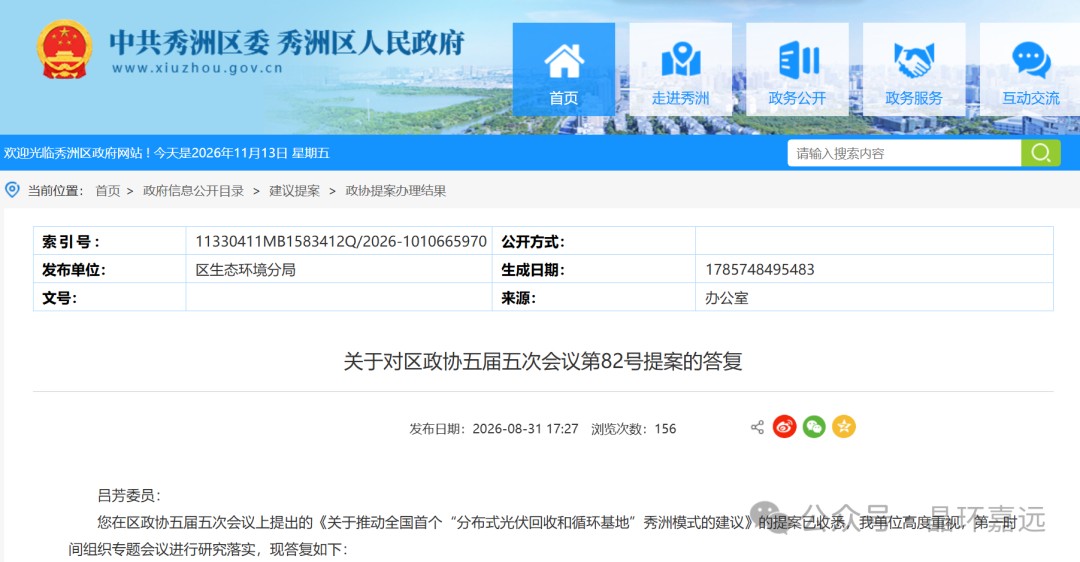
Reply to Proposal No. 82 of the Fifth Session of the Fifth Xiuzhou District Committee of the Chinese People’s Political Consultative Conference
Commissioner Lü Fang:
We have received your proposal, “Recommendations for Developing the Xiuzhou Model for the Nation’s First ‘Distributed Photovoltaic Recycling and Circular Economy Base,’” submitted at the Fifth Session of the Fifth Xiuzhou District Committee of the Chinese People’s Political Consultative Conference. Our organization attaches great importance to the proposal and promptly convened a dedicated meeting to study and implement it. Our response is as follows:
I. Innovate policy and approval service mechanisms and remove barriers to cross-departmental coordination
We have proactively planned for the recycling and utilization of photovoltaic modules and issued the Implementation Plan for the “Zero-Waste Photovoltaics” Industry in Xiuzhou District and the Guidelines for “Zero-Waste Photovoltaics” Development in Xiuzhou District. The District Government Service Center has established a proactive service mechanism and regularly conducts the “Three Visits” government service program. Seven service teams have been formed to work on the front lines. A “project concierge” team has also been established, bringing together key personnel from multiple departments to proactively liaise with project owners, map out approval stages such as project initiation and construction permits, and help enterprises plan and prepare early. For non-essential documents, applications may be accepted with missing materials to be supplemented later. Approval matters at the same stage are handled through a single service window, online processing and parallel review. This has reduced the approval time for issuing four certificates simultaneously from 2–3 months to less than 3 hours. A closed-loop mechanism has also been established to supervise, coordinate and resolve enterprise-related issues, with a dedicated working group carrying out efficient coordination and closed-loop management according to issue category, level and priority.
Going forward, we will provide project services and ensure access to essential resources, seize policy opportunities, and make every effort to secure support and resources from higher-level authorities by leveraging policy benefits related to the national initiative to upgrade equipment on a large scale, replace consumer goods with new ones, and issue ultra-long-term special treasury bonds. Projects will be carefully planned in line with the application requirements for central government budgetary investment and special treasury bonds for pollution control, energy conservation and carbon reduction. We will focus on attracting and supporting demonstration projects for photovoltaic module recycling, including those by Xin Jia Ai Si. A “one project, one leader, one roadmap” mechanism will be established to coordinate and resolve preliminary procedures, including environmental impact assessments, energy assessments and construction permits, and accelerate project implementation.
II. Build a digital monitoring platform and strengthen the foundations of the photovoltaic recycling industry
We have built the nation’s first exhibition hall dedicated to photovoltaic recycling and circular utilization and integrated China’s first geographic information system for the photovoltaic recycling industry. The system brings together research findings, including forecasts of photovoltaic equipment retirement volumes by year for China as a whole and representative climate zones, the distribution of recycling enterprises, and assessments of market scale and economic viability. It has been described as the “brain” of the photovoltaic recycling industry. We have also developed a “full-industry-chain photovoltaic cloud platform” to advance the intelligent development of the photovoltaic industry and create an ecosystem covering the entire photovoltaic new-energy industry chain.
Going forward, we will use the existing “Photovoltaic Brain” platform to explore a traceable management model covering the full lifecycle of photovoltaic products, from production and installation to operation and retirement. In conjunction with the district-wide initiative to upgrade equipment on a large scale, a ledger will be established for distributed photovoltaic recycling. A comprehensive survey will be conducted of distributed photovoltaic power stations that have been in operation for more than 10 years across the district, and a “recycling demand list” will be drawn up for modules scheduled for retirement, linking the “decommissioning” of distributed photovoltaics with their “replacement.” Resources across multiple stages—including local governments, photovoltaic power stations, manufacturers, recycling enterprises, processing enterprises and logistics providers—will be integrated through measures such as jointly developing collection points. Responsibilities at each stage will be clearly defined to jointly advance the recycling of end-of-life photovoltaic modules. Building on the influence of “Jiajia Shou,” a brand associated with the waste and used-goods recycling system, we will pilot the collection of end-of-life residential photovoltaic modules to ensure that they are collected through a unified system.
III. Make breakthroughs in key core technologies and raise the level of industrial innovation
The world’s first fully recycled photovoltaic module has been launched, with a conversion efficiency of 20.7% and an output exceeding 645 W. This marks a major breakthrough for China in the recycling and circular utilization of discarded photovoltaic modules. In strengthening enterprise R&D capabilities, Zhejiang Chuanhe New Materials Co., Ltd.’s “Chuanhe Photovoltaic Conductive Technology Enterprise Research Institute” was recognized as a provincial-level enterprise research institute in 2025. In addressing core technologies, Zhejiang Zhongju Materials Co., Ltd.’s 2024 application for the project “Research and Industrialization of Diverse Packaging Technology Routes for New, High-Efficiency Photovoltaic Cells” was selected for the 2025 provincial “Pioneer” project program. We also recommended Jiaxing Xiaochen Photovoltaic Technology Co., Ltd.’s project “Key Technologies and Industrial Application of High-Performance BC Cell Surface Micro- and Nanotexturing” for the Jiaxing Industrial Development Key Research Program. In industry-academia-research collaboration, we worked with the China Green Supply Chain Alliance to establish the Photovoltaic Recycling Industry Development Cooperation Center and jointly set up the Photovoltaic Industry Joint Innovation Laboratory with platforms including the Jiaxing Institute of Zhejiang University and the Bai Ma Lake Laboratory. In addition, we have published the China Photovoltaic Recycling and Circular Utilization White Paper for three consecutive years. It has become an important reference for government authorities, research institutes and industry associations seeking to understand the photovoltaic recycling industry.
Going forward, we will continue to encourage enterprises to prioritize technological innovation and R&D, with a focus on supporting enterprises engaged in photovoltaic recycling technologies in applying for recognition of various R&D institutions and technology programs. We will collect proposals for research needs under the province’s “Pioneer” and “Leading Goose” programs and strive to secure project approvals in photovoltaic-related technology fields. We will also actively plan engineering demonstration projects, encourage research institutes to work with photovoltaic module manufacturers on industrial technology development, explore the development and industrialization of technologies and equipment for low-carbon, environmentally friendly dismantling of photovoltaic modules and the efficient, environmentally friendly separation of high-value components, and plan a series of engineering demonstration projects for photovoltaic module recycling and utilization.
IV. Explore diverse business models and stimulate market-driven growth
We are actively promoting the extended producer responsibility system in the photovoltaic module sector and encouraging leading enterprises in the photovoltaic industry to achieve technological breakthroughs in areas such as new materials for photovoltaic manufacturing and the efficient extraction of high-value components. Module manufacturers are encouraged to leverage their own resources to expand into recycling and utilization. At the product design stage, they should give particular consideration to environmental attributes such as ease of disassembly and recyclability, reducing the difficulty and cost of subsequent recycling as well as carbon emissions during the process. In line with the goal of developing a trillion-yuan photovoltaic industry cluster, we are building a full-industry-chain development structure spanning “solar cells + photovoltaic glass + supporting products + modules + equipment + energy storage + operation and maintenance + testing + recycling.” We have built bridges for industry exchange and cooperation, successfully hosted the first China Photovoltaic Green Supply Chain Conference, and jointly established the Photovoltaic Recycling Industry Development Cooperation Center, continually expanding the industry’s development opportunities and influence. In 2025, China Resources Recycling Group New Energy Company and Yidao Environmental Protection signed a strategic cooperation agreement with the Photovoltaic Recycling Industry Development Cooperation Center. By integrating resources, the parties will advance the development of a national-level innovation and entrepreneurship base for photovoltaic resource recycling. Multiple rounds of discussions and preliminary preparations have been carried out on matters including establishing a recycling equipment R&D center and deploying the first-of-its-kind demonstration equipment in Xiuzhou. The nation’s first innovation and entrepreneurship demonstration base focused on “distributed photovoltaic recycling and circular utilization” is ready to be established, and the industrial framework for the “Xiuzhou Model” of photovoltaic recycling has begun to take shape.
Going forward, price mechanisms will be used to guide the market. The district will explore the use of price levers such as differentiated electricity rates and tiered water prices to encourage energy-intensive enterprises to prioritize photovoltaic products containing recycled materials, creating market opportunities for recycled materials produced locally. We will strengthen price monitoring, closely track market price fluctuations for recycled products such as waste glass, scrap metal and precious metals, and guide enterprises in managing market risks. We will accelerate the establishment of a recycling equipment R&D center and the deployment and operation of first-of-its-kind demonstration equipment in Xiuzhou. A national-level innovation and entrepreneurship demonstration base for photovoltaic resource recycling will be built to high standards, advancing the development of the photovoltaic module recycling industry across the entire value chain and in a standardized manner.
Finally, thank you for your concern and support for the development of distributed photovoltaic recycling in our district. We welcome your continued valuable comments and suggestions on our work.
About RESOLAR
Shanghai RESOLAR Energy Technology Co., Ltd. is committed to becoming a recycled material photovoltaic group with deep decarbonization. RESOLAR focuses on technological innovation and builds a world-leading solution for component recycling, impurity removal of damaged cells, recycled silicon materials and cells, and cascaded utilization of components. With professional technology and services, we help customers realize the recycling and reuse of waste photovoltaic resources, and make positive contributions to the development of environmental protection and new energy industries. For more detailed information, you can browse the official website: www.resolartech.com .

Latest developments/news
Contact information
Service Hotline: 13585742918 (Monday to Friday 9:00-18:00)
Enterprise email: ps@resolartech.com (Reply within 48 hours after receiving the email consultation!)
Company Address: Building 8, No. 1528, Wangxu East Road, Fengjing Town, Jinshan District, Shanghai (Caohejing Fengjing Park)