


English
News Center
—— NEWS CENTER ——
On September 23, 2026, the Hubei Provincial Department of Ecology and Environment issued the Notice on Issuing the 15th Five-Year Plan for the Prevention and Control of Solid Waste Pollution in Hubei Province, which states:
Address illegal dumping and disposal of solid waste. Improve mechanisms for routine inspections, flight inspections, and special oversight, and establish a closed-loop management system covering the entire process: “investigation – supervision – rectification – case closure – follow-up review.” Make comprehensive use of satellite remote sensing, drone aerial photography, grid-based patrols, and other methods to conduct regular, thorough screening and carry out flight inspections as needed. Strengthen coordination among departments and crack down severely on illegal collection, transfer, dumping, and disposal of solid waste.
Strengthen environmental management of the recycling and reuse of emerging solid waste. Enhance environmental risk prevention and supervision throughout the entire process of recovering, dismantling, reusing, and disposing of emerging solid waste. Strengthen source control over retired new energy equipment, implement extended producer responsibility for power batteries and new energy vehicles, and encourage photovoltaic and wind power plants to sell retired new energy equipment to comprehensive utilization enterprises.
Use the ecological and environmental credit evaluation system to apply tiered and categorized supervision and joint sanctions for dishonesty to entities that violate environmental laws. Keep channels for complaints and reports open, improve the public reward-based reporting mechanism, and foster a supervisory framework characterized by “public participation and collective prevention and control.”
Focus on research into supporting policies covering the entire chain for the sorted collection, compliant storage, safe transportation, comprehensive utilization, and harmless disposal of solid waste from the “new trio.”
Improve the functions of the ecological and environmental rights trading platform, expand trading in solid waste resource recovery, and add more categories of traded materials. Deepen the comprehensive utilization of renewable resources and promote large-scale, high-value utilization of key materials such as scrap steel, non-ferrous scrap, and waste plastics, thereby increasing resource productivity and the coordinated benefits of carbon reduction.
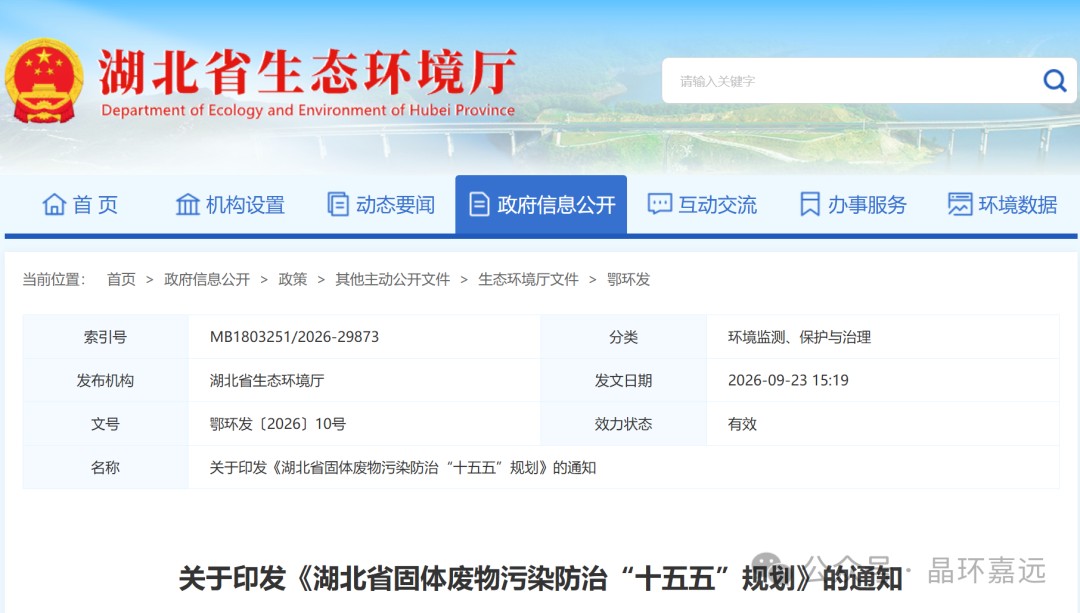
Notice on Issuing the 15th Five-Year Plan for the Prevention and Control of Solid Waste Pollution in Hubei Province
E Huan Fa [2026] No. 10
Ecology and environment, development and reform, industry and information technology, housing and urban-rural development, urban management, agriculture and rural affairs, and commerce authorities of all cities, prefectures, directly administered cities, and Shennongjia Forestry District:
To implement the decisions and arrangements of the central government and the provincial Party committee and government, and to strengthen the prevention and control of solid waste pollution in a comprehensive and systematic manner, the Provincial Department of Ecology and Environment, Provincial Development and Reform Commission, Provincial Department of Economy and Information Technology, Provincial Department of Housing and Urban-Rural Development, Provincial Department of Agriculture and Rural Affairs, and Provincial Department of Commerce have prepared the 15th Five-Year Plan for the Prevention and Control of Solid Waste Pollution in Hubei Province. It is hereby issued to you. Please organize its implementation conscientiously in light of local conditions.
Hubei Provincial Department of Ecology and Environment Hubei Provincial Development and Reform Commission
Hubei Provincial Department of Economy and Information Technology Hubei Provincial Department of Housing and Urban-Rural Development
Hubei Provincial Department of Agriculture and Rural Affairs Hubei Provincial Department of Commerce
September 23, 2026
15th Five-Year Plan for the Prevention and Control of Solid Waste Pollution in Hubei Province
(Some content has been omitted.)
This Plan is formulated to implement the work arrangements for strengthening solid waste management set out in the Outline of the 15th Five-Year Plan for National Economic and Social Development of Hubei Province, fulfill the requirements of the Action Plan for Comprehensive Solid Waste Management and the Implementation Plan for Building Hubei Province as a Pioneer Area for Beautiful China, strengthen the prevention and control of solid waste pollution, and improve comprehensive solid waste management.
I. General Requirements
Guided by Xi Jinping Thought on Socialism with Chinese Characteristics for a New Era, we will put Xi Jinping's Thought on Ecological Civilization into practice, adhere to the principles of reduction, resource recovery, and harmless disposal, and work toward the goal of building a Beautiful Hubei. We will focus on preventing and controlling environmental risks from solid waste, strictly controlling the intensity of waste generation, improving the alignment between utilization and disposal capacity and demand, and increasing the level of high-value utilization. We will establish a comprehensive solid waste management system featuring source reduction, process control, end-of-pipe utilization, and harmless management throughout the entire chain. By 2030, the “zero-waste city” initiative will cover all areas; special campaigns to address solid waste in key sectors will achieve clear results; historically stockpiled solid waste will be effectively controlled; and the high incidence of illegal dumping and disposal will be curbed.
II. Launch Special Campaigns to Address Solid Waste Pollution in Key Areas
(I) Address illegal dumping and disposal of solid waste. Improve mechanisms for routine inspections, flight inspections, and special oversight, and establish a closed-loop management system covering the entire process: “investigation – supervision – rectification – case closure – follow-up review.” Make comprehensive use of satellite remote sensing, drone aerial photography, grid-based patrols, and other methods to conduct regular, thorough screening and carry out flight inspections as needed. Strengthen coordination among departments and crack down severely on illegal collection, transfer, dumping, and disposal of solid waste.
(II) Address pollution risks from waste in karst caves. Focus on areas with concentrations of karst caves and sinkholes, including Enshi and Yichang, and conduct comprehensive, area-wide inspections. Establish a list of identified problems and implement categorized remediation. Standardize the removal and disposal of accumulated domestic waste, construction waste, and livestock and poultry manure. Implement inspections and verification at county, city, and provincial levels, and conduct regular follow-up reviews of rectification. Carry out random inspections and dynamic monitoring at sites where cases have been closed. Install video surveillance at key karst caves and sinkholes and strengthen around-the-clock dynamic supervision using technical measures such as drone patrols. Improve integrated support for waste collection, transfer, and transportation in remote areas. Crack down severely on environmental violations such as illegally dumping solid waste in karst caves and sinkholes, and publicly report typical cases.
(III) Promote comprehensive management of phosphogypsum. Conduct investigations and remediation of risks and hazards at phosphogypsum storage facilities. Strictly implement the systems for tiered acceptance and case closure, following the procedures of city-level self-inspection, provincial-level acceptance, and national-level review. Ensure that enterprises fulfill their primary responsibility for pollution control and that 100% of newly generated phosphogypsum is treated harmlessly. Plan the location of phosphogypsum resource utilization projects appropriately and expand opportunities for large-scale comprehensive utilization. Improve the regulatory mechanism for pollution prevention and control of phosphogypsum and establish a full-process supervision system covering generation, storage, transportation, and utilization.
(IV) Address pollution risks at municipal solid waste landfills. Coordinate investigations and remediation of pollution risks at municipal solid waste landfills and develop a tailored remediation plan for each landfill. Accelerate the treatment of accumulated leachate and remediation of leakage-related pollution, and implement measures to prevent and control groundwater contamination. Encourage the closure and remediation of decommissioned landfills through measures such as landfill capacity reclamation and ecological restoration.
(V) Strengthen routine environmental risk control at hazardous waste landfills. Strictly implement the remediation requirements of “one landfill, one plan,” systematically upgrade hazardous waste landfill facilities, and complete comprehensive remediation of high-risk hazardous waste landfills. Fully implement the system requiring the advance provision of funds for the retirement of hazardous waste landfills. Carry out comprehensive closure and remediation projects for landfills across the province that have reached their designed capacity, have been out of operation for more than three years, or pose high environmental risks.
III. Improve the Capacity to Manage the Disposal and Utilization of Industrial Solid Waste
(I) Improve digital management of industrial solid waste. Include entities with significant environmental pollution risks from industrial solid waste in the key regulatory scope of pollutant discharge permits, and specify requirements for the storage, utilization, and disposal of industrial solid waste. Promote the alignment of industrial solid waste management records with pollutant discharge permit environmental management records, ecological environment statistics, and unified information reporting data for pollutant discharge permits. Fully connect with the national solid waste information management platform, gradually enabling real-time collection of information and tracking of industrial solid waste throughout the entire chain, and establish an information-sharing mechanism among departments. By 2030, more than 90% of industrial solid waste entities subject to key management under pollutant discharge permits across the province will be supervised through the information platform.
(II) Strengthen environmental supervision of the comprehensive utilization of industrial solid waste. Strengthen controls on emissions of toxic and hazardous substances, including heavy metals and persistent organic pollutants, during the co-processing of industrial solid waste in industrial kilns. Formulate a provincial negative list and management standards for co-processing general industrial solid waste at municipal solid waste incineration facilities. Strengthen harmless pretreatment of bulk industrial solid waste, standardize and promote projects for backfilling open-pit mines and underground mine voids with phosphogypsum, broaden channels for managing industrial solid waste such as phosphogypsum, smelting slag, tailings, and manganese slag, and reduce environmental risks from storage and landfill disposal.
(III) Investigate and remediate sites where legacy industrial solid waste is stockpiled. Focus on bulk industrial solid waste and conduct environmental risk investigations and assessments of mines involving heavy metals, tailings ponds, and waste or slag storage sites. Implement targeted remediation under a “one site (pond), one plan” approach. Accelerate investigations and remediation of environmental safety risks involving heavy metals across the province. Continue investigating environmental risks involving thallium and antimony and implement categorized remediation. By the end of 2030, complete the remediation of all environmental risks and hazards involving heavy metals and tailings ponds.
IV. Strengthen Hazardous Waste Supervision and Build Capacity for Utilization and Disposal
(I) Improve the digital hazardous waste supervision system. Upgrade the Internet of Things system for hazardous waste supervision, fully implement standardized “Five Immediate Actions” requirements at hazardous waste generating entities, and strengthen an information-based supervision system that enables real-time traceability of hazardous waste through a unified code. Use AI to assist with environmental supervision of hazardous waste. By 2028, data from the Internet of Things system for hazardous waste supervision will be used in ecological environment statistics.
(II) Address gaps in hazardous waste utilization and disposal capacity. Strictly restrict direct landfilling of hazardous waste that can be treated through utilization or incineration, and gradually reduce the proportion of hazardous waste disposed of by landfill. Coordinate the distribution of hazardous waste utilization and disposal facilities. Address capacity gaps in the utilization of waste salt and fly ash by planning specialized treatment facilities in Wuhan, Yichang, Xiangyang, and other locations, so that the resource recovery capacity for categories in short supply can basically meet local generation needs. All new, renovation, and expansion projects involving hazardous waste utilization and disposal must be included in the list of key projects under the plan; projects not included in the list will, in principle, not be approved. In principle, support will not be provided for new flexible landfills; support for new rigid landfills will be considered prudently; and cement kilns will be actively encouraged to co-process bulk hazardous waste categories such as fly ash.
(III) Improve the utilization and disposal of hazardous waste. Promote the development of the Central China Regional Hazardous Waste Environmental Risk Prevention and Control Technology Center and the Central China Regional Comprehensive Centralized Hazardous Waste Disposal Center. Optimize the service recipients and service areas of hazardous waste collection services for small and micro enterprises, and support collection entities in upgrading their capacity and standards. Improve management of the cross-provincial transfer of hazardous waste and the effectiveness of cross-regional utilization. Establish a coordination mechanism between environmental impact assessment and operating permit approval. Issue annual indicative notices and alerts to guide investment in the construction of hazardous waste utilization and disposal facilities. Use standards, policies, and other regulatory measures to resolve structural overcapacity. Support the safe treatment of medical waste at or near its point of generation in remote rural areas.
(IV) Strengthen supervision of hazardous waste identification. Ensure that local ecology and environment authorities fulfill their responsibility for supervising hazardous waste identification, hold solid waste generating entities accountable as the primary parties responsible for identification, and require identification entities to bear corresponding legal liability for their conclusions. Conduct annual provincial-level sample inspections and reviews of identification reports, and strengthen the application of results and accountability.
V. Prevent and Control Pollution from Waste Electrical and Electronic Products and Emerging Solid Waste
(I) Strengthen environmental management of waste electrical and electronic products. Promote the implementation of extended producer responsibility by electrical and electronic product manufacturers and their participation in establishing recycling networks and sorting and utilization facilities. Strengthen environmental management of enterprises that recycle and dismantle waste electrical and electronic products, and continue to crack down on environmental pollution caused by their illegal disposal. Make full use of special funds for the treatment of waste electrical and electronic products to guide the sound development of the recycling, dismantling, and treatment industry across the province.
(II) Strengthen environmental management of the recycling and reuse of emerging solid waste. Enhance environmental risk prevention and supervision throughout the entire process of recovering, dismantling, reusing, and disposing of emerging solid waste. Strengthen source control over retired new energy equipment, implement extended producer responsibility for power batteries and new energy vehicles, and encourage photovoltaic and wind power plants to sell retired new energy equipment to comprehensive utilization enterprises. Promote research into resource recovery technologies, including hydrometallurgical recycling of retired ternary lithium batteries and the recycling and utilization of retired lithium iron phosphate batteries.
VI. Prevent and Control Solid Waste Pollution in the Domestic, Construction, Agricultural, and Other Sectors
(I) Strengthen the prevention and control of domestic waste pollution. Strengthen environmental supervision of municipal solid waste-to-energy incineration enterprises, with a focus on controlling the chelation treatment of fly ash. Promote the reduction of fly ash from municipal solid waste incineration. Improve leachate collection and treatment capacity at municipal solid waste landfills and strengthen the collection and disposal of landfill gas. Consolidate achievements in plastic pollution control and strictly implement requirements for the standardized use and reduction of plastic products.
(II) Strengthen the prevention and control of construction waste pollution. Coordinate the planning and construction of facilities for construction waste utilization and disposal. Strictly implement pollution control standards covering the entire chain of construction waste generation, collection, storage, transportation, utilization, and disposal, and implement the sorted collection, transportation, and disposal of construction waste, as well as resource recovery. Conduct comprehensive investigations and environmental risk assessments of existing construction waste stockpiles, and implement pollution prevention, control, and remediation at temporary storage sites that pose environmental risks or have caused environmental pollution.
(III) Strengthen the prevention and control of municipal sludge pollution. Strengthen information-based management throughout the entire process for sludge at urban and rural wastewater treatment plants, enhance environmental risk control at sludge storage sites, and implement measures to prevent scattering, loss, and leakage. Promote comprehensive sludge utilization and co-processing in line with local conditions, and gradually reduce the amount sent to landfill. Promote the harmless treatment and resource recovery of sludge.
(IV) Strengthen the prevention and control of agricultural solid waste pollution. Strengthen environmental supervision of the utilization and disposal of crop straw. Support major crop-growing counties in establishing recycling networks for agricultural film and discarded pesticide packaging, promote the scientific use and recycling of agricultural mulch film, and strengthen monitoring of residual mulch film in farmland. Focus on the Danjiangkou Reservoir area and explore the establishment of a joint control mechanism for non-standard agricultural mulch film. Strengthen pollution supervision of livestock and poultry farming and standardize the use of manure as fertilizer on farmland.
VII. Deepen High-Quality Development of “Zero-Waste Cities”
(I) Promote province-wide joint development of “zero-waste cities.” Systematically plan “zero-waste city” development tasks for the 15th Five-Year Plan period and expand the scope of development in an orderly manner. Deepen regional coordination and actively participate in the joint development of “zero-waste cities” among the three provinces in the middle reaches of the Yangtze River: Hubei, Hunan, and Jiangxi. Based on the functional positioning and industrial characteristics of the Wuhan metropolitan area, the Yichang-Jingzhou-Jingmen urban cluster, and the Xiangyang metropolitan area, promote the development of “zero-waste city” clusters in a differentiated manner and establish a development framework featuring regional coordination and distinctive characteristics. Assess progress in “zero-waste city” development and conduct “zero-waste index” evaluations. Support Wuhan and other cities in taking the lead in becoming “zero-waste cities.”
(II) Promote multi-scenario demonstration projects for “zero-waste cells.” Focus on key industries such as steel, non-ferrous metals, petrochemicals, and chemicals, and guide industrial parks and enterprises in carrying out “zero-waste” upgrades aimed at reducing the intensity and hazard of solid waste generation. Develop “zero-waste enterprises,” “zero-waste industrial parks,” “zero-waste supply chains,” and “zero-waste groups.” In conjunction with initiatives to build a Beautiful Hubei, promote the development of “zero-waste” government agencies, communities, villages, and scenic areas. Organize diverse “zero-waste” awareness-raising and practical activities, and build a communications network for “zero-waste” culture.
VIII. Systematically Strengthen Solid Waste Monitoring and Supervision Capacity
(I) Achieve full coverage of digital supervision for key facilities. Relying on the Hubei Yangtze River Protection Digital Governance Smart Platform, systematically build province-wide solid waste supervision capacity using “remote sensing + artificial intelligence,” and conduct routine monitoring of storage and disposal facilities such as waste and slag storage sites, tailings ponds, and landfills, as well as illegal dumping and disposal.
(II) Achieve full coverage of networked management of key risk sources. Strengthen supervision and monitoring, as well as self-monitoring, at solid waste storage and disposal facilities. Establish an environmental pollution monitoring and early warning system for tailings ponds and advance the development of a monitoring network for key heavy metal pollution sources. Steadily achieve full coverage of “installing, networking, and connecting” for hazardous waste incineration and cement kiln co-processing facilities. Include municipal solid waste landfills and hazardous waste landfills in the provincial groundwater environmental monitoring network and conduct more frequent monitoring.
(III) Improve the integrated law enforcement and joint supervision system. Improve cross-departmental and cross-regional joint law enforcement mechanisms for solid waste, deepen cooperation with provinces in the middle reaches of the Yangtze River, and establish an integrated work platform for information sharing, joint law enforcement, and emergency coordination. Crack down severely on environmental violations such as illegal cross-provincial dumping and falsification of monitoring data. Use the ecological and environmental credit evaluation system to apply tiered and categorized supervision and joint sanctions for dishonesty to entities that violate environmental laws. Keep channels for complaints and reports open, improve the public reward-based reporting mechanism, and foster a supervisory framework characterized by “public participation and collective prevention and control.”
IX. Improve the Policy Framework for the Prevention and Control of Solid Waste Pollution
(I) Improve regulations and standards for pollution prevention and control. Promote the promulgation of regulations in areas such as waste recycling and treatment. Formulate guidelines for the large-scale utilization and consumption of typical bulk industrial solid waste, including phosphogypsum. Focus on research into supporting policies covering the entire chain for the sorted collection, compliant storage, safe transportation, comprehensive utilization, and harmless disposal of solid waste from the “new trio.”
(II) Optimize fiscal, tax, and financial policies. Coordinate the use of central ecological and environmental funds, ultra-long-term special treasury bonds for “Two Major Projects” and “Two New” initiatives, and provincial special funds for ecological and environmental protection and development. Prioritize support for solid waste pollution prevention and control projects, the development of green environmental protection industries, and projects involving resource recycling and utilization. Step up efforts to promote environmental pollution liability insurance.
(III) Promote coordinated pollution and carbon reduction for greater effectiveness. Improve the functions of the ecological and environmental rights trading platform, expand trading in solid waste resource recovery, and add more categories of traded materials. Deepen the comprehensive utilization of renewable resources and promote large-scale, high-value utilization of key materials such as scrap steel, non-ferrous scrap, and waste plastics, thereby increasing resource productivity and the coordinated benefits of carbon reduction. Actively guide eligible solid waste resource utilization projects to apply for inclusion in the national voluntary greenhouse gas emission reduction trading market.
(IV) Strengthen scientific and technological support for pollution control. Relying on research institutions such as the Central China Regional Hazardous Waste Risk Prevention and Control Technology Center and the Hubei Three Gorges Laboratory, conduct research and demonstrations on key technologies for resource recovery from retired power batteries and iron phosphate slag, advance key technologies for the comprehensive utilization of phosphogypsum, and accelerate the application of research results and industrial demonstration. Encourage leading enterprises to establish science and technology innovation platforms in partnership with universities and research institutes, develop teams of highly qualified technical professionals, build an end-to-end technology innovation system spanning “research and development – pilot testing – commercialization,” and create scenarios for technology validation and the application and commercialization of research results.
X. Strengthen Implementation Safeguards
Ecology and environment authorities will coordinate and promote implementation of the Plan. Relevant departments will carry out key tasks within their respective areas of responsibility and strengthen policy coordination. Conduct a mid-term assessment and a final evaluation of Plan implementation, and track progress toward targets and tasks, as well as the effects of policy implementation, on an ongoing basis.
About RESOLAR
Shanghai RESOLAR Energy Technology Co., Ltd. is committed to becoming a recycled material photovoltaic group with deep decarbonization. RESOLAR focuses on technological innovation and builds a world-leading solution for component recycling, impurity removal of damaged cells, recycled silicon materials and cells, and cascaded utilization of components. With professional technology and services, we help customers realize the recycling and reuse of waste photovoltaic resources, and make positive contributions to the development of environmental protection and new energy industries. For more detailed information, you can browse the official website: www.resolartech.com .

Latest developments/news
Contact information
Service Hotline: 13585742918 (Monday to Friday 9:00-18:00)
Enterprise email: ps@resolartech.com (Reply within 48 hours after receiving the email consultation!)
Company Address: Building 8, No. 1528, Wangxu East Road, Fengjing Town, Jinshan District, Shanghai (Caohejing Fengjing Park)