


English
News Center
—— NEWS CENTER ——
Lü Dongdong of Sichuan Yongan Guangxun stated: “Across the country, except for Tibet, where there are relatively fewer small informal workshops, almost every other province basically has 2–3 unregulated small workshops, and some provinces such as Hebei, Henan, and Zhejiang even have more than 10. Altogether, there are over a hundred such small workshops nationwide.” These small workshops springing up everywhere are creating hidden risks for both the industry and the environment.
Huang Haiyan, Executive Vice President and Chief Sustainability Officer of Chint New Energy, shared insights from the perspective of an industry participant in two aspects: “First, the current PV module recycling market is still not sufficiently standardized. Some companies simply clean used modules and then put them back into the market, making product quality difficult to guarantee and affecting the industry ecosystem; second, some recycling and disposal companies only obtain short-term profits by simply dismantling aluminum frames, while high-value resources such as silver, silicon, and copper in the modules are wasted, resulting in resource loss.”
As is well known, small workshop recycling and disposal enterprises have an inherent cost advantage: transportation costs and labor costs are low, and at the same time, there is no investment in environmental protection, so their overall costs are lower than those of compliant enterprises. Therefore, they can secure used PV modules with higher recycling prices, while compliant enterprises have high operating costs and no pricing advantage, making it easy for them to “go hungry” and making it difficult to achieve economies of scale in disposal. In order to ensure capacity utilization, compliant enterprises sometimes have no choice but to purchase processed raw materials from small workshops.
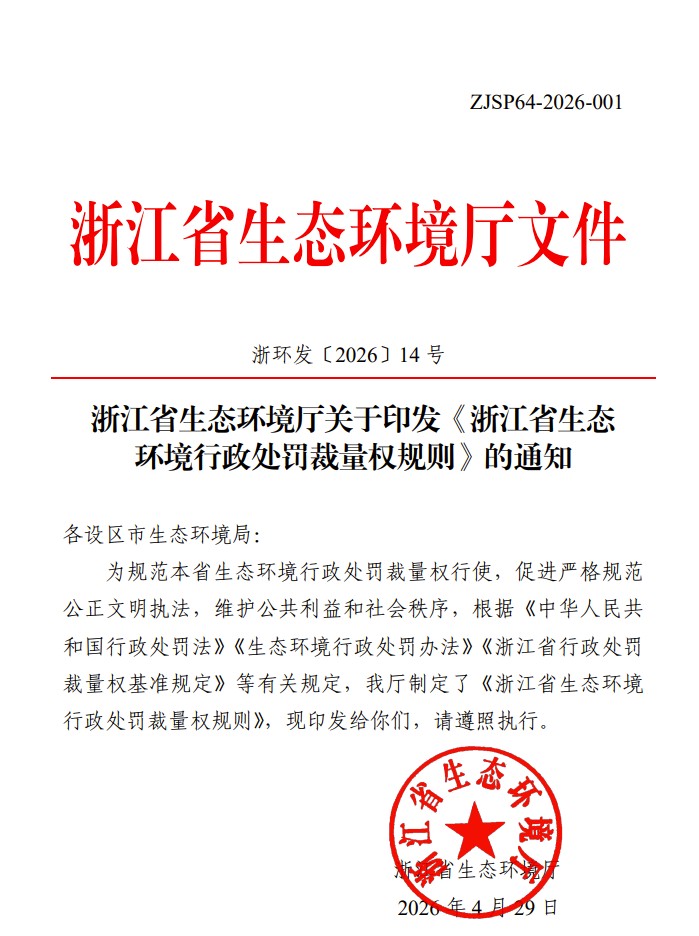
The Rules of Zhejiang Province on the Discretion Benchmark for Ecological and Environmental Administrative Penalties (Zhe Huan Fa [2026] No. 14, hereinafter referred to as the “new version of the rules”), officially implemented from June 1, 2026, precisely target the pain points of small workshops through tough provisions such as rigid discretion standards, severe punishment for malicious violations, and maximum-penalty escalation, creating an unprecedentedly strong deterrent and forcing Zhejiang’s PV recycling industry to bid farewell to wild and disorderly growth.
The New Rules Draw the Sword: Five Tough Provisions Strike Directly at the “Vital Weaknesses” of Small Workshops
(I) “Zero Exemption” for Malicious Violations, Blocking the “Survival Passage” of Small Workshops
Under the old rules, if a small workshop committed a first-time violation and showed a good attitude, it could reduce losses through “exemption for minor violations” or “lighter punishment,” and “getting caught once, stopping for a while, then resuming” became the norm. The new version of the rules clearly states that no exemption from punishment shall apply to pollution discharge through means of evading supervision or other subjectively malicious violations.
[Article 7 (Circumstances for No Penalty) No penalty shall be imposed for violations that comply with the List of Minor Illegal Acts in the Ecological and Environmental Field in the Yangtze River Delta Region Not Subject to Administrative Penalties According to Law (hereinafter referred to as the “List”); for violations not specified in the List but meeting the circumstances for no penalty as provided by the Administrative Penalty Law and other laws, regulations, and rules, no penalty shall be imposed according to law. For violations involving subjective malice, such as discharging pollutants through means of evading supervision, where subjective intent and harmful consequences are obvious, no exemption from penalty shall apply. Ecological and environmental law enforcement authorities shall adhere to the principle of combining punishment with education, and for parties not punished according to law, shall promote their lawful production, operation, and daily activities through measures such as criticism and education, guidance, and interviews.]
(II) A Scoring System for “Hard-Calculation Penalties,” Eliminating Discretionary Enforcement Space, Heavier Punishment for Repeat Offenders with “No Breathing Room,” Breaking the Vicious Cycle of “Repeated Violations”
The old version adopted a “percentage model,” under which the amount of fines depended on law enforcement personnel “judging the severity,” leaving large flexibility and much room for human manipulation, and different penalties for similar cases were common. The new version introduces a comprehensive discretionary scoring system, refining and scoring more than 10 indicators such as pollution consequences, duration of violation, subjective malice, rectification attitude, and number of violations, with each item corresponding to a fixed score, and the total score directly determines the fine amount through a formula. The new version lists the number of violations as a core scoring item, clearly stipulating that reoffending within 2 years directly raises the score + results in heavier punishment, thus forming a progressive punishment mechanism in which “each time is punished more heavily than the last”.
[Article 4 (Discretion Model) Administrative penalty discretion for ecology and environment in this province adopts the comprehensive discretion model, under which the severity of the circumstances of illegal acts is comprehensively evaluated based on multiple discretion factors, and corresponding punishment is imposed. The comprehensive discretion model refers to setting several discretion factors for illegal acts in light of the actual conditions of ecological and environmental administration and the characteristics of illegal acts, dividing each factor from light to severe into multiple levels with corresponding scores assigned, determining the score for each single factor according to the specific performance of the illegal act under each factor, then summing the single-factor scores to obtain the total score, and further determining the mode of punishment.]
Article 5 (Discretion Factors) Discretion factors refer to the factors clearly specified in these discretion rules and discretion benchmark standards that ecological and environmental law enforcement authorities shall consider when exercising penalty discretion, mainly including:
(1) consequences of the illegal act, including environmental pollution caused, ecological damage, economic losses, public health harm, and social impact; (2) the objects harmed by the illegal act; (3) the amount or value of illegal gains or unlawfully obtained property; (4) the party’s admission of fault and acceptance of punishment, as well as the corrective measures taken for the illegal act and their effects; (5) the means, methods, and duration of the illegal act; (6) the degree of the party’s subjective fault; (7) the party’s cooperation with the investigation;(8) the number of the party’s ecological and environmental violations; (9) the party’s age, intelligence, and mental health condition; (10) other factors that may be used to assess the severity of the circumstances of the illegal act.]
Article 13 (Fine Discretion) Ecological and environmental law enforcement authorities shall calculate the amount of fines based on the total case score. The calculation method is as follows: (1) where the penalty provisions set the fine as a fixed amount, the formula is: fine amount = statutory minimum fine amount + (statutory maximum fine amount - statutory minimum fine amount) × total case score. If the penalty provisions do not specify a statutory minimum fine amount, the maximum fine amount under the summary procedure as provided in the Administrative Penalty Law of the People’s Republic of China shall be taken as the statutory minimum fine amount. (2) where the penalty provisions set the fine as a multiple, the formula is: fine amount =[statutory minimum fine multiple + (statutory maximum fine multiple - statutory minimum fine multiple) × total case score] × base value. If the penalty provisions do not specify a statutory minimum fine multiple, the statutory minimum fine multiple shall be calculated as 0. If the final fine amount calculated contains decimals, the decimal part shall be disregarded (no rounding), and the amount shall be rounded down to the nearest yuan.]
Article 14 (Discretion for Other Types of Penalties) Where the penalty provisions stipulate that administrative penalties may be imposed concurrently, ecological and environmental law enforcement authorities shall exercise discretion in accordance with the following requirements: (1) where the total case score is above 70% (inclusive), concurrent administrative penalties shall be imposed; (2) where the total case score exceeds 30% (exclusive) but is below 70% (exclusive), whether concurrent administrative penalties shall be imposed shall be decided comprehensively in light of the circumstances of the illegal act; (3) where the total case score is below 30% (inclusive), concurrent administrative penalties generally shall not be imposed. Where the penalty provisions stipulate that concurrent administrative penalties shall be imposed, if the case qualifies for mitigated punishment, concurrent administrative penalties may be omitted. Where penalty types other than fines have a certain range, the specific punishment content shall be determined by reference to the calculation method for fine amounts.]
(III) Heavier and Maximum-Level “Strong Surcharge”
The new version of the rules clearly establishes a dual heavier-punishment mechanism: where circumstances for heavier punishment as stipulated by laws, regulations, rules, or documents of the State Council or the Ministry of Ecology and Environment are met, the fine may be increased by up to 20% on top of the baseline fine; where soil / groundwater pollution is caused, or public opinion incidents or mass complaints are triggered, the maximum penalty shall be imposed directly (punished according to the statutory maximum fine amount)
[Article 11 (Provisions on Heavier Punishment) Where circumstances for heavier punishment as stipulated by laws, regulations, rules, or documents of the State Council or the Ministry of Ecology and Environment are met, ecological and environmental law enforcement authorities shall, according to law, increase the proposed fine amount on the basis of the amount specified in the discretion benchmark table. The increased fine amount shall generally not exceed 20% of the statutory fine range, and the final fine amount after increase shall not exceed the statutory maximum fine amount.
Article 12 (Circumstances for Penalty According to the Statutory Maximum Fine Amount) For illegal acts causing serious environmental harm consequences or serious adverse social impact, after collective discussion and approval by the responsible persons of ecological and environmental law enforcement authorities, a penalty decision shall be made according to the statutory maximum fine amount.
(IV) Transparent Supervision with “No Blind Spots,” Full Traceability Throughout the Enforcement Process
At the same time, compliant recycling enterprises are ushering in development opportunities: after compliance costs are equalized, the technological and environmental advantages of compliant enterprises will become more prominent, and the supply of used modules will gradually flow back to formal channels.
[Article 10 (Provisions on Lighter and Mitigated Punishment) The following circumstances shall be deemed as “actively taking rectification measures and proactively eliminating or mitigating harmful consequences to the ecological environment”: (1) proactively fulfilling liability for compensation for ecological and environmental damage, including where, before the administrative penalty decision is made by ecological and environmental law enforcement authorities, the party has fulfilled all obligations for compensation for ecological and environmental damage (based on ecological and environmental damage compensation agreements, restoration effect assessment reports, etc. as the basis for determination), and where the party is in the process of fulfilling such obligations and ensures that restoration and compensation obligations can be fully performed (based on ecological and environmental damage compensation agreements, performance guarantee deposits, etc. as the basis for determination). (2) immediately correcting the violation or proactively correcting it before the expiry of the ordered rectification period. (3) before the administrative penalty decision, proactively shutting down or dismantling the construction project involved in the case or the pollution-related process involved in the case.]
Original policy text link: https://sthjt.zj.gov.cn/col/col1229116580/art/2026/art_a75acedaa01843b78823dda6192a9928.html
About RESOLAR
Shanghai RESOLAR Energy Technology Co., Ltd. is committed to becoming a recycled material photovoltaic group with deep decarbonization. RESOLAR focuses on technological innovation and builds a world-leading solution for component recycling, impurity removal of damaged cells, recycled silicon materials and cells, and cascaded utilization of components. With professional technology and services, we help customers realize the recycling and reuse of waste photovoltaic resources, and make positive contributions to the development of environmental protection and new energy industries. For more detailed information, you can browse the official website: www.resolartech.com .

Latest developments/news
Contact information
Service Hotline: 13585742918 (Monday to Friday 9:00-18:00)
Enterprise email: ps@resolartech.com (Reply within 48 hours after receiving the email consultation!)
Company Address: Building 8, No. 1528, Wangxu East Road, Fengjing Town, Jinshan District, Shanghai (Caohejing Fengjing Park)