


English
News Center
—— NEWS CENTER ——
As China's photovoltaic industry enters a large-scale decommissioning cycle, the recycling and reuse of discarded photovoltaic modules has been upgraded from a supplementary link to a rigid-demand track. In the past, the recycling industry generally suffered from pain points such as fragmented transactions, missing invoices, inconsistencies among the three flows, and high risks of false invoicing, which severely constrained the healthy development of the industry. Recently, the implementation of pay-and-invoice-immediately in the resource recycling industry has accelerated in many places across the country, coupled with the tax authorities' high-pressure crackdown on false invoicing crimes. These dual forces are driving the photovoltaic recycling industry toward full-process compliance, full-chain traceability, and full-link controllability, and compliance has become a mandatory issue for the industry's survival and development.
I. Pay-and-invoice-immediately expands nationwide, and invoice compliance in resource recycling enters the fast lane
In order to solve the difficulties of invoicing in renewable resource recycling, missing input invoices, and weak supervision, the State Taxation Administration has vigorously promoted reverse invoicing. Many regions have simultaneously implemented an integrated service of pay and invoice immediately, invoice and pay tax immediately, pay tax and enter the treasury immediately, covering fields such as scrap materials and agricultural products, and providing a mature compliance template for photovoltaic recycling.
On March 20, 2026, the State Taxation Administration issued the Opinions of the State Taxation Administration on Launching the 2026 “Spring Breeze Action for Convenient Tax Services”(Shui Zong Na Fu Fa [2026] No.18), mentioning the promotion of building a co-governance ecosystem. It will accelerate the promotion of the “joint use” model between tax authorities and enterprises, focus on third-party payment institutions with strong compliance capabilities, advanced information technology, and broad market coverage, and attract more high-quality entities to participate in the construction of the tax informatization ecosystem. It will expand the application scenarios of “pay-and-invoice-immediately”, and promote the further expansion and extension of “pay-and-invoice-immediately” from high-frequency livelihood sectors such as parking lots, supermarket retail, agricultural product procurement, waste recycling, catering and accommodation, culture, tourism and entertainment, and transportation and travel, so as to connect payment and invoicing, improve the invoicing experience of business entities and the invoice-use experience of consumers, and promote the digital transformation of the economy and society. It will carry out publicity on positive cases of compliant operations and honest tax payment, demonstrate the positive role that compliant operations bring to enterprise development, and promote a sound social atmosphere of honest operations and fair competition throughout society. It will continue to expose typical tax-related illegal cases, send a strong signal of handling tax-related illegal acts according to law and cracking down on them severely, and guide enterprises to firmly establish the concept of paying taxes honestly according to law and operating in compliance.
In March 2026, the Dezhou Taxation Bureau of the State Taxation Administration in Shandong Province launched the project of “promoting the application of ‘pay-and-invoice-immediately’ scenarios”. At present, “pay-and-invoice-immediately” is mainly applied in the fields of agricultural product procurement and renewable resource recycling, focusing on solving pain points such as the difficulty, low efficiency, and high risk of issuing invoices for natural persons selling agricultural products and scrap materials.
On April 2, 2026, the Information Office of the Zibo Municipal People's Government held a press conference to introduce the effective implementation of “transaction-and-invoice-immediately”. The “three-flows-in-one reverse invoicing” model is mainly applied in the fields of renewable resource recycling and agricultural product procurement, and has now been fully promoted. The application rate of qualified renewable resource recycling enterprises has reached 70%, and that of agricultural product procurement enterprises has reached 75.82%.
On April 13, 2026, ICBC Duyun Branch in Guizhou successfully reached cooperation on reverse invoicing business with a renewable resource recycling Co., Ltd. in Guizhou. The bank made full use of the product advantages of the reverse invoicing assistant featuring “zero cost, low threshold, and high efficiency”, and provided guidance and support through an exclusive service team for the entire process covering natural person real-name registration, enterprise operator order placement, natural person QR code scanning for verification and order confirmation, enterprise finance review and payment through corporate online banking U-shield, and online invoice download, thereby realizing a closed loop of transaction, payment, invoicing, and declaration, and completing a one-stop convenient experience of resource recycling enterprises for “pay-and-invoice-immediately”.
On May 6, 2026, ICBC Wuzhou Branch in Guangxi achieved an important breakthrough in reverse invoicing business for renewable resource recycling scenarios. In the past, in transaction scenarios involving agricultural and sideline products and renewable resources between enterprises and natural persons, there were generally problems such as difficulty in obtaining invoices, difficulty in VAT deduction, and inconvenience for natural persons to issue invoices, while enterprises faced financial and tax risks and natural persons lacked motivation to issue invoices. In order to solve industry pain points, ICBC Wuzhou Branch created a comprehensive service solution of “fund settlement + reverse invoicing + exclusive financial services” for enterprises, enabling them to realize one-stop payment, invoicing, and reconciliation services, improving settlement and reconciliation efficiency.
On May 13, 2026, the Zhejiang Branch of the People's Bank of China deeply extended the “pay-and-invoice-immediately” service into four key fields: gas stations, parking property management, agricultural product procurement, and renewable resources, achieving empowerment across all scenario domains. Through cooperation with supply and marketing cooperatives in multiple regions and resource recycling enterprises, it created a one-stop digital financial model of “financing + payment + invoicing”.
On May 14, 2026, pay-and-invoice-immediately of ICBC Wuxi Branch has been widely applied in renewable resource recycling enterprises, gas stations, supermarkets, and other industries in Wuxi City.
On May 20, 2026, Linyi Huadong Metal City in Shandong and the Shandong Branch of Industrial and Commercial Bank of China held a discussion and exchange on deepening cooperation in the “pay-and-invoice-immediately” business. Led by Teng Haiyang, Senior Manager of the Online Finance Department of the Shandong Branch of ICBC, the team visited Linyi Huadong Metal City and carried out special business exchanges centered on empowering the digital transformation of the renewable resource recycling industry. They focused on stage summaries regarding deepening the innovative financial service of “pay-and-invoice-immediately” to help improve quality, increase efficiency, and promote compliant development in recycled metal trading within the park. At present, the “pay-and-invoice-immediately” business of Huadong Metal City is being comprehensively piloted and promoted among merchants in the park.
- It solves the pain point of procurement without invoices and sales without input invoices, enabling enterprises to legally obtain input vouchers and reduce tax risks.
- Transactions, funds, and invoices are bound in real time and automatically leave traces, realizing full-chain traceability.
Simplifies the invoicing process, reduces compliance costs, and helps compliant enterprises expand in scale.
II. Warning from the strict crackdown on false invoicing: photovoltaic recycling must never cross the legal red line
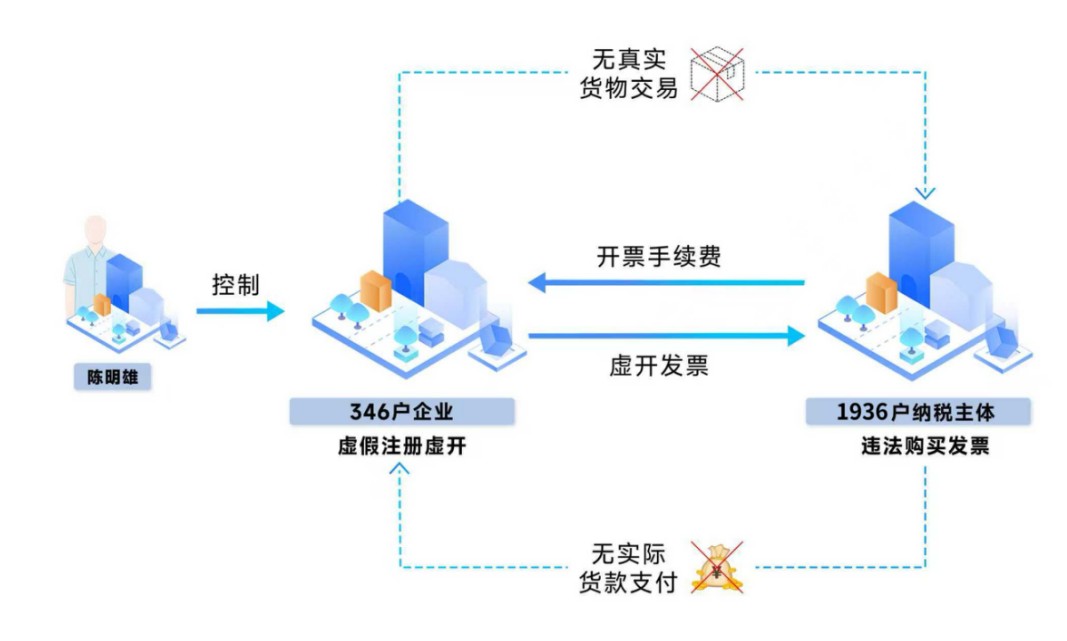
- Modus operandi: illegally purchased citizens' personal information, registered 346 shell companies, with no real business, sales but no input, and falsely issued 7846 VAT ordinary invoices to the outside world, involving an amount of 1.2 billion yuan.
Handling result: the principal offenders were sentenced to fixed-term imprisonment of five to six years and fined, and 1936 downstream invoiced enterprises were comprehensively investigated and held accountable
Article 21, Paragraph 2 of the Measures of the People's Republic of China for the Administration of Invoices stipulates: No entity or individual may engage in the following acts of falsely issuing invoices: (1) issuing invoices for others or for itself that do not conform to the actual business operations; (2) allowing others to issue invoices for itself that do not conform to the actual business operations; (3) introducing others to issue invoices that do not conform to the actual business operations.
- Shell invoicing, identity misuse, and sales without input are key targets of crackdown.
- Taxation + public security data profiling, joint assessment, and rapid dragnet closure, leaving false invoicing with nowhere to hide.
- Not only are invoicing parties severely punished, invoice-receiving enterprises are also held accountable, with closed-loop supervision across the entire chain.
III. Warning from the strict crackdown on concealed income: photovoltaic recycling must never cross the legal red line
Recently, the Second Inspection Bureau of Xi'an Taxation Bureau of the State Taxation Administration investigated and dealt with the tax evasion case of Xi'an Zhenyong Steel Structure Co., Ltd. involving concealed income in accordance with the law. Earlier, based on tax big data, the Second Inspection Bureau of Xi'an Taxation Bureau of the State Taxation Administration found that the comprehensive tax burden rate of Xi'an Zhenyong Steel Structure Co., Ltd. from 2021 to 2024 was only 0.65%, significantly lower than the industry average. After investigation, from 2021 to 2024, Xi'an Zhenyong Steel Structure Co., Ltd. made false tax declarations by concealing revenue from scrap steel sales, improperly enjoyed preferential tax policies for small and micro-profit enterprises, and underpaid VAT and other taxes totaling 1.8819 million yuan. In May 2025, the Second Inspection Bureau of Xi'an Taxation Bureau of the State Taxation Administration made a decision in accordance with the law to recover taxes and fees, impose late payment surcharges, and levy fines totaling 3.3734 million yuan.
IV. Nationwide tightening in batches of approved levy for sole proprietorships and individual businesses
Approved levy mainly refers to a tax collection method in which the tax authorities, in accordance with the law, adopt reasonable methods to verify the tax payable when it is difficult to determine the amount of tax payable by a taxpayer due to incomplete accounting books, missing information making account inspection difficult, obviously low tax calculation basis, or other reasons.
At present, the domestic tax collection and administration system is ushering in a new round of deep adjustments. Tax authorities across the country are continuously advancing the optimization and adjustment of approved levy policies. More and more cities have announced the cancellation of enterprises' qualification for approved levy and the full implementation of the audit-based collection system. As of now, the vast majority of second-tier and above cities nationwide have completely stopped accepting new applications for approved levy by enterprises, and existing approved-levy enterprises are also being converted in batches. The overall policy tightening is steady and orderly, aimed at gradually standardizing market tax order and avoiding excessive impact of blanket policies on the small and micro economy.
For a long period, approved levy was an important policy dividend supporting the initial development of small and micro enterprises. For small and micro businesses in the start-up stage without a sound financial system and with unstable revenue, the simple and convenient approved taxation method greatly reduced financial and tax pressure in the early stage of entrepreneurship, effectively stimulated grassroots mass entrepreneurship and the vitality of individual operations, and played a very important role in promoting the vigorous development of the domestic private economy. However, as the number of market entities continued to increase, many abuses gradually emerged during the long-term implementation of the policy. Quite a few business entities exploited policy management loopholes and used approved levy as a tool for illegal tax avoidance and false invoicing, deviating from the policy's original intention of supporting small and micro start-ups. A large number of shell companies with no actual business address, no actual employees, and no actual business were centrally registered in tax haven parks and used specifically to issue invoices externally for profit, forming a huge gray financial and tax industrial chain that seriously disrupted the normal market order and the national tax system. In order to thoroughly rectify industry chaos and standardize the order of tax collection and administration, canceling non-compliant approved levy and fully promoting audit-based collection has become an inevitable choice. After the policy was implemented, the first obvious change occurred in the market invoice trading environment. The previous behavior of casually buying and selling cost invoices, expense invoices, and input invoices now faces extremely high legal and tax risks. The circulation volume of non-compliant invoices in the market continues to decline, and invoice transactions are officially returning to real commercial transactions themselves.
In March 2026, the Ningde Taxation Bureau of the State Taxation Administration issued the Announcement of the Jinhan Branch of the Jiaocheng District Taxation Bureau of the State Taxation Administration Ningde Taxation Bureau on Tax Instruments for Taxpayers Not Continuing the Regular Fixed-Amount Tax Collection Method in 2026, under which 487 households would no longer be subject to approved levy and would switch to audit-based accounting from 2026.1.1.
In March 2026, the Jian'ou Taxation Bureau of the State Taxation Administration issued the Announcement of the Jian'ou Taxation Bureau of the State Taxation Administration on Terminating the Regular Fixed-Amount Public Notice, under which 5431 individual businesses would switch to audit-based accounting from 2026.1.1.
About RESOLAR
Shanghai RESOLAR Energy Technology Co., Ltd. is committed to becoming a recycled material photovoltaic group with deep decarbonization. RESOLAR focuses on technological innovation and builds a world-leading solution for component recycling, impurity removal of damaged cells, recycled silicon materials and cells, and cascaded utilization of components. With professional technology and services, we help customers realize the recycling and reuse of waste photovoltaic resources, and make positive contributions to the development of environmental protection and new energy industries. For more detailed information, you can browse the official website: www.resolartech.com .

Latest developments/news
Contact information
Service Hotline: 13585742918 (Monday to Friday 9:00-18:00)
Enterprise email: ps@resolartech.com (Reply within 48 hours after receiving the email consultation!)
Company Address: Building 8, No. 1528, Wangxu East Road, Fengjing Town, Jinshan District, Shanghai (Caohejing Fengjing Park)