


English
News Center
—— NEWS CENTER ——
On August 7, 2026, the Heilongjiang Provincial Department of Ecology and Environment issued the Industrial Solid Waste Special Rectification Action Plan, specifying that a three-month intensive campaign would be carried out from August 1 to October 30, 2026, to comprehensively investigate and rectify prominent environmental risks associated with industrial solid waste throughout the province and severely crack down on illegal activities such as illegal dumping, non-compliant storage, and disorderly dismantling.
A special campaign will be carried out to rectify the illegal dumping and disposal of solid waste, focusing on the illegal dumping and landfilling of hazardous waste, industrial solid waste, and other solid waste, as well as the illegal dismantling and disposal of scrapped motor vehicles, waste electrical and electronic products, retired new energy equipment, retired power batteries, and other discarded equipment and consumer products. Problems identified during the investigation will be documented and registered individually, and responsible parties will be urged to complete solid waste removal and transportation, site cleanup, risk control, and ecological restoration. By the end of 2026, the rectification completion rate for problems identified during the special campaign against illegal dumping and disposal of solid waste will reach more than 90%.
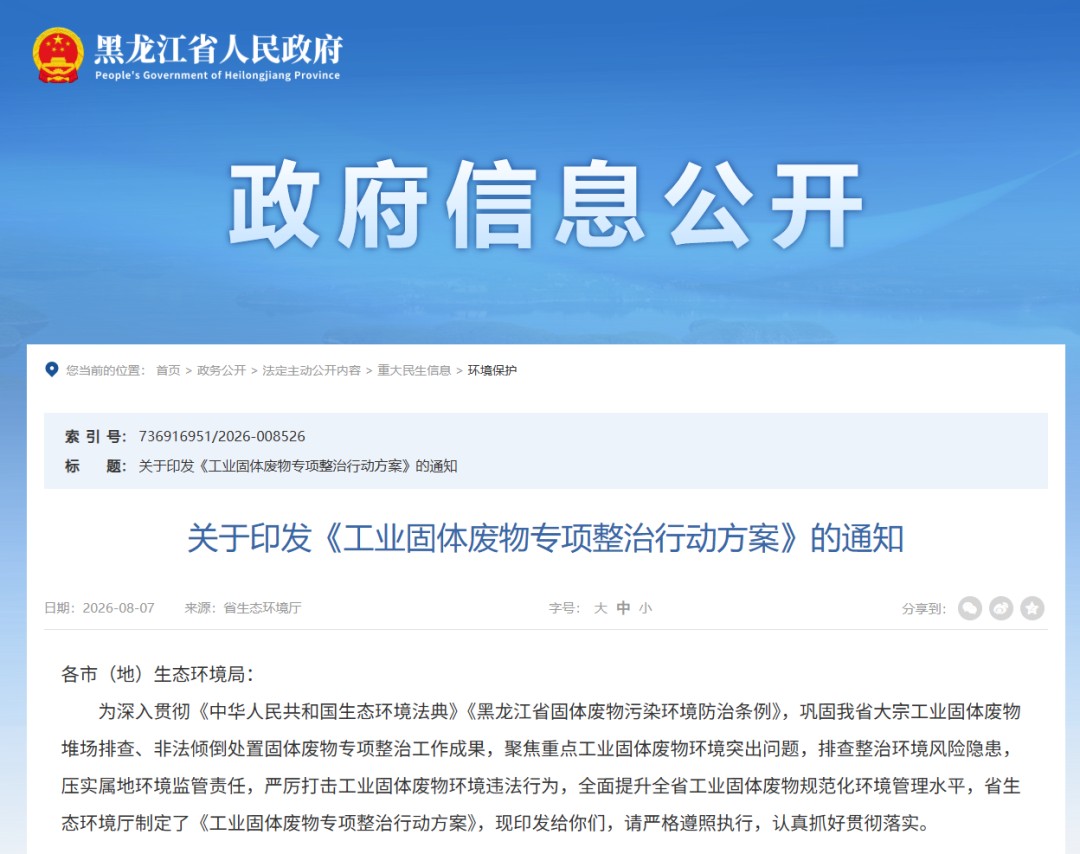
Notice on Issuing the Industrial Solid Waste Special Rectification Action Plan
Date: 2026-08-07 Source: Provincial Department of Ecology and Environment
Ecology and Environment Bureaus of all cities (prefectures):
To thoroughly implement the Ecological and Environmental Code of the People's Republic of China and the Regulations of Heilongjiang Province on the Prevention and Control of Environmental Pollution by Solid Waste, consolidate the results of investigations of bulk industrial solid waste storage sites in our province and the special campaign against illegal dumping and disposal of solid waste, focus on prominent environmental problems involving key types of industrial solid waste, investigate and rectify environmental risks and hidden dangers, strengthen territorial responsibility for environmental supervision, severely crack down on environmental violations involving industrial solid waste, and comprehensively improve the standardized environmental management of industrial solid waste throughout the province, the Provincial Department of Ecology and Environment has formulated the Industrial Solid Waste Special Rectification Action Plan, which is hereby issued to you. Please strictly follow it and earnestly implement all requirements.
Industrial Solid Waste Special Rectification Action Plan
Thoroughly implement the Law of the People's Republic of China on the Prevention and Control of Environmental Pollution by Solid Waste and the Regulations of Heilongjiang Province on the Prevention and Control of Environmental Pollution by Solid Waste. Building on the existing results of investigations of bulk solid waste storage sites and the special campaign against illegal dumping and disposal of solid waste in our province, and taking into account the characteristics of local industries, this action will focus on industrial solid waste such as coal gangue, fly ash, and oily sludge. It will comprehensively identify problems in the environmental management of industrial solid waste in the province, consolidate local responsibilities, carry out comprehensive investigations, properly advance problem rectification, and severely crack down on environmental violations. Through a three-month intensive campaign, it will promote comprehensive improvements in the quality and effectiveness of industrial solid waste environmental management throughout the province.
I. Scope and Content of Investigation and Rectification
(I) Scope of Rectification
1. Industry scope: Covering all enterprises and public institutions throughout the province that generate industrial solid waste, with a particular focus on oil and gas extraction enterprises such as the Daqing Oilfield; key waste-generating industries such as coal, thermal power, chemicals, mining and mineral processing, metallurgy, electroplating, machining, and industrial parks; as well as general industrial solid waste utilization entities, general industrial solid waste storage site operation and maintenance entities, general industrial solid waste disposal entities, and hazardous waste operators.
2. Regional scope: Covering the entire province, with particular focus on Daqing Oilfield operating areas, temporary oily sludge storage sites and surrounding areas; the banks of rivers and lakes such as the Songhua River and Heilongjiang River, drinking water source protection zones, and areas surrounding nature reserves and other protected areas; as well as areas with a high incidence of illegal dumping and areas where industrial solid waste is centrally stored, including urban-rural fringes, provincial, municipal, and county boundaries, abandoned mine pits, and idle factory areas.
3. Solid waste scope: General industrial solid waste, including tailings, coal gangue, fly ash, smelting slag, desulfurization gypsum, and dust ash, among other bulk solid waste; and industrial hazardous waste, including oily sludge, waste mineral oil, waste acids and alkalis, waste catalysts, and waste organic solvents.
(II) Basic Investigation Content
1. Investigation of enterprise compliance management. Verify the performance of statutory obligations by enterprises, including the filing of hazardous waste management plans, establishment of ledgers, and annual declarations.
2. Investigation of storage compliance. Inspect the provision of seepage prevention, rainwater prevention, loss prevention, and leakage prevention facilities at various storage facilities, and strictly investigate problems such as mixed storage, outdoor storage, missing labels, and inadequate emergency facilities.
3. Investigation of transfer and disposal processes. Strictly verify the circulation of electronic transfer manifests for hazardous waste, approval (filing) for cross-regional transfers, and the qualifications of entrusted disposal entities. Strictly investigate illegal activities such as transfers without manifests, falsified manifests, and entrusting unqualified entities for disposal.
4. Investigation of information system application. Verify the entry of information, data updates, ledger filing, and disposal reporting by enterprises in the Solid Waste Management Information System and the National Hazardous Waste Whole-Process Information System, and rectify problems such as delayed system data, missing items, incorrect reporting, and offline disposal.
(III) Investigation Period
August 1 to October 30, 2026.
II. Key Rectification Content
(I) Rectification of General Industrial Solid Waste Storage Sites
Investigate and rectify general solid waste storage sites throughout the province, including tailings ponds, fly ash storage sites, and smelting slag sites, with a focus on environmental hazards such as damaged seepage prevention systems, inadequate separation of stormwater and wastewater, failure of leachate collection and treatment facilities, and the absence of containment and protective measures. Guide waste-generating entities and storage site operation and maintenance entities in carrying out environmental risk investigations and assessments, and promote the timely elimination of pollution risks. Strictly investigate problems such as storage exceeding site capacity, disorganized storage by zones, long-term disorderly outdoor storage, and merely formal implementation of hidden hazard investigations.
(II) Rectification of Illegal Dumping of Solid Waste
Carry out an in-depth special campaign against the illegal dumping and disposal of solid waste, focusing on the illegal dumping and landfilling of hazardous waste, industrial solid waste, and other solid waste, as well as the illegal dismantling and disposal of scrapped motor vehicles, waste electrical and electronic products, retired new energy equipment, retired power batteries, and other discarded equipment and consumer products. Problems identified during the investigation will be documented and registered individually, and responsible parties will be urged to complete solid waste removal and transportation, site cleanup, risk control, and ecological restoration. By the end of 2026, the rectification completion rate for problems identified during the special campaign against illegal dumping and disposal of solid waste will reach more than 90%.
(III) Rectification of Oily Sludge from the Daqing Oilfield
In view of the characteristics of the oil and gas extraction industry at the Daqing Oilfield, carry out targeted rectification of oily sludge and address weaknesses in solid waste supervision in the energy industry. First, comprehensively investigate the quantities of oily sludge stored in oilfield operating areas, centralized gathering stations, and temporary storage sites, and strictly investigate problems such as mixed storage with other solid waste and the absence of standardized storage facilities. Second, strictly verify seepage prevention and oil pollution leakage prevention measures at storage facilities, and prevent oil pollution from infiltrating into black soil and groundwater. Third, verify the transfer manifests, system entries, and disposal destinations of oily sludge, and strictly investigate illegal and non-compliant activities such as collection and transportation without qualifications, unauthorized burial, and illegal dumping. Fourth, standardize information-based traceability throughout the entire process of oily sludge management, require true, complete, and timely entries in the National Hazardous Waste Whole-Process Information System, and prevent offline disposal and off-system circulation.
III. Work Requirements
(I) Strengthen Organizational Leadership. Earnestly organize and implement this plan, consolidate the responsibilities of all parties, adhere to the principle of “whoever pollutes is responsible for treatment,” urge industrial solid waste generators to fulfill their primary responsibility for treatment, accelerate problem rectification, prevent secondary pollution, and ensure that the special campaign achieves tangible results.
(II) Implement Strict, Standardized, and Targeted Law Enforcement. Adhere to law-based supervision, targeted law enforcement, and strict law enforcement. For minor hazards, urge immediate rectification and standardized compliance within a specified period. For malicious violations such as non-compliant disposal, illegal dumping, major environmental hazards at storage sites, and falsification of ledger data, investigate and punish them strictly in accordance with the law, pursue accountability seriously, and strengthen the deterrent effect of law enforcement.
(III) Strengthen Provincial-Level Supervision and Coordination. Each locality shall compile and summarize, on a monthly basis and as scheduled, the progress of the special campaign, the effectiveness of problem rectification, existing shortcomings and weaknesses, and next-step measures, and submit the report by the 25th of each month. An overall report on the work shall be submitted by November 10. The Provincial Department will carry out regular spot checks, supervision, tracking, and effectiveness assessments to ensure the orderly, balanced, effective, and thorough implementation of the rectification work.
(IV) Improve the Long-Term Supervision Mechanism. Taking this special campaign as an opportunity, establish and standardize mechanisms for regular inspections of industrial solid waste storage sites, dynamic investigations of illegal dumping, and special spot checks of oilfield solid waste. Continue to strengthen the routine application of information-based supervision, address weaknesses in supervision, consolidate the results of rectification, and achieve normalized, standardized, and refined supervision of industrial solid waste throughout the province.
About RESOLAR
Shanghai RESOLAR Energy Technology Co., Ltd. is committed to becoming a recycled material photovoltaic group with deep decarbonization. RESOLAR focuses on technological innovation and builds a world-leading solution for component recycling, impurity removal of damaged cells, recycled silicon materials and cells, and cascaded utilization of components. With professional technology and services, we help customers realize the recycling and reuse of waste photovoltaic resources, and make positive contributions to the development of environmental protection and new energy industries. For more detailed information, you can browse the official website: www.resolartech.com .

Latest developments/news
Contact information
Service Hotline: 13585742918 (Monday to Friday 9:00-18:00)
Enterprise email: ps@resolartech.com (Reply within 48 hours after receiving the email consultation!)
Company Address: Building 8, No. 1528, Wangxu East Road, Fengjing Town, Jinshan District, Shanghai (Caohejing Fengjing Park)