


English
News Center
—— NEWS CENTER ——
On August 12, 2026, the Qinghai Provincial Development and Reform Commission and the Qinghai Provincial Department of Ecology and Environment issued the "Notice on Issuing the Action Plan for Comprehensive Management of Solid Waste in Qinghai Province".
Mention
Implement the primary responsibility of industrial solid waste generating entities, improve the management ledger for the entire industrial solid waste chain in accordance with the law, and achieve full-process traceability and verification.
Strengthen the management of solid waste in the new energy industry. All newly built photovoltaic power stations and wind farms should submit a "Recycling and Disposal Plan for Decommissioned Equipment" at the same time during the project approval stage to implement the extended producer responsibility system.
We will continue to carry out special investigations and rectifications into the illegal dumping, stockpiling, and landfilling of solid waste, and include the illegal dismantling of waste electrical and electronic products and retired equipment such as waste power batteries, wind turbine blades, and photovoltaic modules as key areas for rectification.
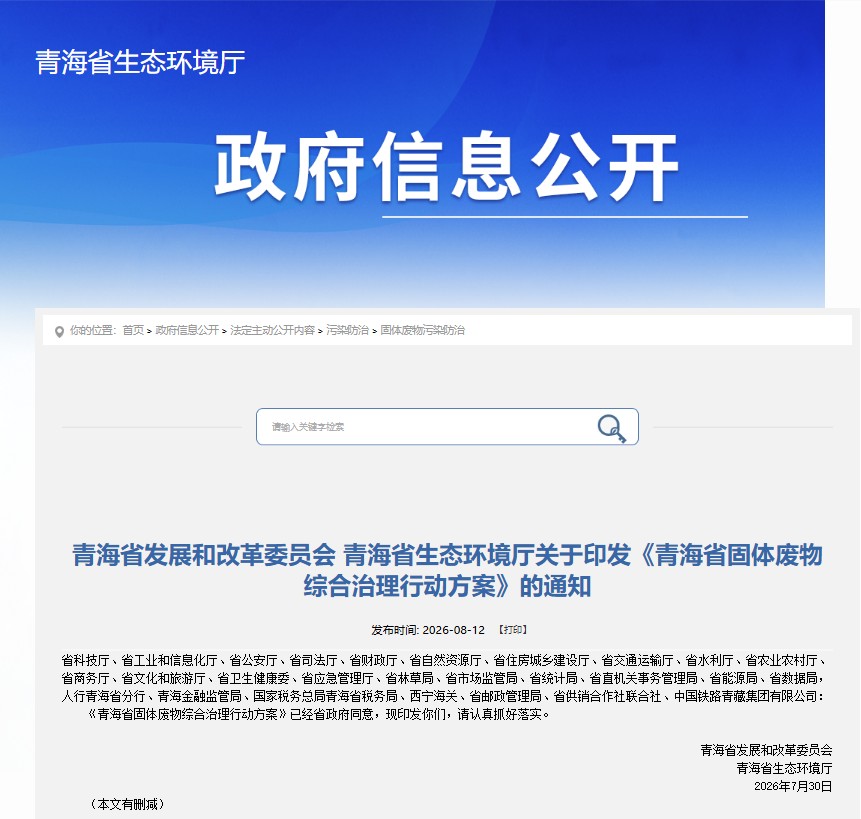
Notice from the Qinghai Provincial Development and Reform Commission and the Qinghai Provincial Department of Ecology and Environment on Issuing the "Qinghai Province Comprehensive Solid Waste Management Action Plan"
Issuing unit:
Qinghai Provincial Development and Reform Commission
Qinghai Provincial Department of Ecology and Environment
Release Date: 2026-08-12
Notice from the Qinghai Provincial Development and Reform Commission and the Qinghai Provincial Department of Ecology and Environment on Issuing the "Qinghai Province Comprehensive Solid Waste Management Action Plan"
Published: 2026-08-12
Departments of Science and Technology of Qinghai Province, Department of Industry and Information Technology of Qinghai Province, Department of Public Security of Qinghai Province, Department of Justice of Qinghai Province, Department of Finance of Qinghai Province, Department of Natural Resources of Qinghai Province, Department of Housing and Urban-Rural Development of Qinghai Province, Department of Transportation of Qinghai Province, Department of Water Resources of Qinghai Province, Department of Agriculture and Rural Affairs of Qinghai Province, Department of Commerce of Qinghai Province, Department of Culture and Tourism of Qinghai Province, Health Commission of Qinghai Province, Emergency Management Department of Qinghai Province, Forestry and Grassland Bureau of Qinghai Province, Market Supervision Bureau of Qinghai Province, Statistics Bureau of Qinghai Province, Government Offices Administration Bureau of Qinghai Province, Energy Bureau of Qinghai Province, Data Bureau of Qinghai Province, People's Bank of China Qinghai Branch, Qinghai Financial Regulatory Bureau, State Taxation Administration of Qinghai Province, Xining Customs, Qinghai Postal Administration, Qinghai Supply and Marketing Cooperative, China Railway Qinghai-Tibet Group Co., Ltd.:
The "Action Plan for Comprehensive Management of Solid Waste in Qinghai Province" has been approved by the Provincial Government and is hereby issued to you for your earnest implementation. Qinghai Provincial Development and Reform Commission
Qinghai Provincial Department of Ecology and Environment
July 30, 2026
Qinghai Province Solid Waste Comprehensive Management Action Plan
In order to fully implement the State Council's "Action Plan for Comprehensive Management of Solid Waste", effectively improve the modernization level of the solid waste management system and management capacity, promote the construction of a beautiful Qinghai, and accelerate the comprehensive green transformation of economic and social development, this action plan for comprehensive management of solid waste in the province is formulated in light of the actual situation of our province.
I. General Requirements
Guided by Xi Jinping's thought on ecological civilization, we will fully implement the spirit of the 20th CPC National Congress and its subsequent plenary sessions, earnestly implement the deployment requirements of the 10th Plenary Session of the 14th Provincial Party Committee, base ourselves on the province's "three greatest" characteristics and "three more important" strategic positions, adhere to the principle of prioritizing ecological protection, coordinating development and security, take improving the quality of the ecological environment and preventing environmental risks as the core, and follow the principles of reduction, resource utilization, and harmlessness. We will address the shortcomings in disposal and utilization facilities, improve the whole-process supervision mechanism, strengthen the governance of key areas, key regions, and key industries, and build a comprehensive solid waste management system that includes source reduction, process control, end-of-pipe utilization, and whole-chain harmless management. We will promote the continuous improvement of the ecological environment quality and support high-quality development with a high-quality ecological environment.
By 2030, significant progress will be made in the special campaign to address solid waste in key areas. The comprehensive utilization rate of industrial solid waste will continue to increase. Outstanding environmental problems such as historical solid waste and informal garbage dumps will be effectively controlled. The high incidence of illegal dumping and disposal will be curbed. The annual comprehensive utilization of bulk solid waste and the annual recycling of major renewable resources will meet the national targets. The comprehensive management capacity and level of solid waste will be significantly improved.
II. Main Tasks
(I) Promote source control and reduction to help control quantity and increase efficiency across the entire production and living chain.
1. Promote the green and low-carbon transformation of industrial structure. Strictly implement industrial access policies and eliminate outdated production capacity in accordance with laws and regulations. Strengthen the source control of solid waste in industrial parks, promote the integrated construction of mining and beneficiation of heavy non-ferrous metal mines, promote the backfilling of tailings nearby, and in principle, no longer approve the construction of beneficiation projects without self-built mines or supporting tailings utilization and disposal facilities. Formulate the "Catalogue of Graded Utilization of Associated Resources in Salt Lakes of Qinghai Province", set up a tiered recovery system for valuable elements such as lithium, magnesium, potassium, boron, rubidium, and cesium, strictly implement the "brine cascade development" process route, and adopt the integrated brine cascade development process for new projects in key salt lake areas such as Chaka, Dongtai, and Xitai. Increase support for technological transformation, strengthen the refined management and control of industrial production, promote the application of advanced green and low-carbon technologies and equipment, promote the cascade utilization of energy and the recycling of materials, and accelerate the green transformation of traditional industries. Focus on low-energy-efficiency enterprises, benchmark against energy efficiency benchmarks, formulate "one-enterprise-one-policy" energy efficiency improvement plans, and promote the upgrading of energy efficiency levels in key industries.
2. Strengthen the reduction of solid waste from household sources. Comprehensively promote the classification of urban and rural household waste, and improve the system for classified disposal, collection, transportation, and treatment. Curb excessive packaging and promote simplified and green packaging for goods, express delivery, e-commerce, and food delivery industries. Fully implement the evaluation and reporting system for the effectiveness of anti-food waste work in government canteens, and urge and guide government agencies at all levels to do a good job in food conservation. Strengthen the whole-chain governance of plastic pollution, conduct full-coverage inspections of plastic packaging containers, tools, and other product manufacturers throughout the province, and promote green alternative products. Promote "zero-waste" practices in large scenic areas. For scenic areas with more than 1 million visitors annually, fully create "zero-waste scenic areas" and prohibit single-use non-degradable plastic products from entering the scenic areas. Promote the "ticket + eco-friendly bag" bundled supply, and build "zero-waste" experience scenarios by exchanging waste for cultural and creative products, transforming plastic reduction into distinctive tourism products, and eliminating a "one-size-fits-all" approach to plastic reduction.
3. Promote the reduction of solid waste at the source of agricultural production. Continue to improve the scientific use and management of plastic film mulching, and promote the full-film mulching cultivation technology for major crops such as potatoes and corn. Strengthen the standardized recycling of packaging waste from agricultural inputs such as pesticides and veterinary drugs, and actively support enterprises and professional cooperatives with certain agricultural production and management capabilities and strong demonstration effects to form an integrated industrial chain of collection, storage, transportation, processing, and sales.
4. Strictly control the increase in construction waste. Implement requirements for the classified collection, transfer, and on-site resource utilization of construction waste, and strictly control the indiscriminate dumping and scattering of construction waste. Establish and improve construction waste management ledgers to ensure traceability and verifiability in the disposal process. Encourage the application of prefabricated construction technology in housing construction and municipal infrastructure, and promote green construction, fully furnished or standardized decoration delivery. Include the costs required for construction waste reduction, transportation, utilization, and disposal in the project cost, and simultaneously formulate and implement reduction measures during the construction phase. Explore quota management for solid waste emissions from housing construction and municipal engineering projects. Strengthen the standardized management of construction waste generated from transportation and road construction. Encourage on-site and nearby treatment of garden waste.
(II) Improve the collection, transportation and storage system, and promote closed-loop management of solid waste.
5. Strengthen the standardized management of industrial solid waste. Implement the primary responsibility of industrial solid waste generating entities, and legally improve the management ledger for the entire industrial solid waste chain to achieve full-process traceability and verification. Standardize the construction and operation of industrial solid waste storage sites, promote the classified collection of industrial solid waste, and strictly prohibit the mixed collection and disposal of industrial solid waste and domestic waste. Strictly implement the inter-provincial reporting system for industrial solid waste. Strengthen the management of solid waste from the new energy industry; all newly built photovoltaic power stations and wind farms must submit a "Recycling and Disposal Plan for Decommissioned Equipment" simultaneously during the project approval stage, and implement the extended producer responsibility system.
6. Improve the household waste recycling and operation system. Establish a sound system for the sorting, collection, transportation, and treatment of urban household waste, gradually extending its coverage to county towns and key townships. Coordinate urban and rural household waste management, promoting a "household sorting, village collection, township transfer, city/county treatment" model, while implementing on-site reduction, resource utilization, and harmless disposal in remote areas. Based on factors such as population distribution, transportation conditions, and transfer distances, rationally allocate sorting collection containers, sites, and transfer stations, promote the use of enclosed sorting and collection vehicles, and eliminate "sorting before mixing, mixed loading and transportation." Promote digital empowerment of the recycling industry and build new recycling models. Upgrade and renovate a number of household waste collection facilities.
7. Establish a closed-loop regulatory system for construction waste. Strengthen on-site management of construction waste loading, unloading, and disposal operations, and urge construction waste transportation companies to use specialized vehicles or vehicles equipped with sealing, spillage prevention, and dust prevention measures. Commercial construction waste transportation vehicles with a gross vehicle weight of 12 tons or more must be equipped with Beidou positioning devices. Strengthen daily management and mobile patrols of construction waste transportation, focusing on key construction areas, urban-rural fringe areas, areas surrounding towns and villages where construction waste transportation vehicles congregate, and areas prone to traffic accidents and with prominent safety hazards. Establish a cross-regional joint prevention and control mechanism for construction waste, and jointly investigate and punish illegal dumping at provincial and municipal (prefecture) borders.
8. Improve the collection and transportation capacity of agricultural and forestry solid waste. Steadily promote the comprehensive utilization of straw through five methods, and establish and improve a scientific management system for the use and recycling of agricultural film. Accelerate the recycling and dismantling of scrapped agricultural machinery. Leverage the recycling network of the supply and marketing cooperative system, implement the recycling and disposal responsibilities of pesticide producers, operators, and users, and construct recycling stations, centralized storage, and harmless disposal systems. Large-scale livestock and poultry farms should be equipped with facilities for the collection, storage, and treatment of manure and wastewater to achieve on-site and nearby disposal of manure and wastewater. Properly dispose of landscaping and greening waste.
9. Strictly manage the entire process of hazardous waste disposal. Scientifically plan and lay out centralized hazardous waste disposal facilities, and improve the collection and temporary storage capacity of hazardous waste from small and micro enterprises and social sources. Promote the standardized "five-instance" system for hazardous waste disposal and the "one-code" information-based supervision of transfer, utilization, and disposal. Fully implement systems for hazardous waste declaration and registration, management plans, transfer manifests, and emergency response plans. Utilize information technology to achieve full-process tracking and real-time supervision. Strengthen the whole-chain management of medical waste. Regularly conduct hazardous waste hazard investigation and rectification, and severely crack down on illegal transfer, illegal dumping, and illegal disposal of hazardous waste. Expand the pilot program for centralized collection of hazardous waste from small and micro enterprises. Based on the existing pilot program, by 2030, achieve full coverage of centralized collection services for hazardous waste or medical waste from small and micro enterprises in all eight cities (prefectures) of the province, focusing on solving the problems of "difficult collection and expensive disposal" of laboratory waste from research institutes, schools, auto repair shops, remote medical institutions, and mining enterprises throughout the province.
(III) Improve the resource recycling system and enhance the level of resource utilization.
10. Strengthen the comprehensive utilization of bulk solid waste. Expand the channels for the comprehensive utilization of solid wastes such as tailings, coal gangue, fly ash, smelting slag, industrial by-product gypsum, and chemical waste from salt lakes. Focus on the characteristic bulk industrial solid wastes of Qinghai Province, implementing differentiated policies and targeted breakthroughs. Salt lake tailings: Plan and compile the "Quality Standards for Industrial Salts by-products from Salt Lake Tailings," clarifying classification and grading, key physicochemical and safety limits, sampling and testing methods, and batch management requirements, realizing the transformation from "passive supervision of waste" to "proactive management of resource products," and opening up compliant disposal pathways and high-value resource utilization channels. Establish a comprehensive ledger for the generation, storage, and utilization of salt lake tailings, and manage storage by zone according to tailings properties. Promote the large-scale application of tailings in fields such as soda ash, caustic soda, de-icing agents, and building materials, and support the construction of comprehensive utilization demonstration bases for tailings in key salt lakes such as Chaka Salt Lake and Dongtaijinaier Salt Lake. Asbestos tailings: Strictly implement the management requirements for the hazardous waste attributes of asbestos tailings, carry out technological research on the resource utilization of asbestos tailings, conduct scientific and standardized treatment and disposal, and prohibit the new open-air unprotected stockpiling of asbestos tailings. Cyanide tailings: Implement "one file per enterprise" management for cyanide tailings from industries such as gold, and encourage qualified enterprises to build facilities for the reprocessing of cyanide tailings to recover valuable metals such as gold, silver, and copper, and gradually reduce historical stockpiles.
11. Construct a green and diversified system for the comprehensive utilization of solid waste. Strengthen the application and promotion of recycled materials such as recycled aggregates, recycled bricks, and recycled road materials. Encourage and support the development of enterprises engaged in the utilization and disposal of construction waste, research and development institutions for recycled products, and production enterprises, and promote new technologies, new materials, new processes, and new equipment for the utilization of construction waste. Strengthen the supervision of imported solid waste, strictly carry out customs enforcement operations, and support enterprises within the province to expand their import business of high-quality international recycled raw materials. Leverage the functions of government procurement policies, conduct pilot projects for government procurement to support the green and low-carbon development of highways, and actively promote the application of "new materials, new technologies, new processes, and new methods." Continue to implement straw comprehensive utilization projects and accelerate the process of resource utilization of livestock and poultry breeding waste.
(iv) Coordinate the reduction and resource utilization of solid waste and enhance the capacity for harmless treatment.
12. Continuously improve the level of harmlessness throughout the entire process. Enhance the level of harmless pretreatment of bulk industrial solid waste to reduce landfill volume at the source and effectively prevent environmental safety hazards. Rationally plan and construct municipal solid waste incineration facilities. In areas lacking cross-regional coordinated construction conditions and with relatively low waste generation and long transportation distances, select appropriately sized small-scale municipal solid waste incineration facilities for construction. Construct supporting fly ash disposal projects to gradually reduce fly ash landfill volume, systematically phase out problematic small-scale waste incineration facilities, establish a long-term supervision mechanism, and standardize the disposal of fly ash and slag from incineration.
13. Explore large-scale disposal and utilization channels in a prudent and orderly manner. Actively explore pathways such as underground backfilling, mine pit backfilling, and ecological restoration to achieve large-scale disposal and resource utilization of bulk industrial solid waste. New underground metal and non-metal mines should adopt the backfilling mining method; if this method cannot be used, rigorous feasibility studies must be conducted. Establish a sound and standardized management system, strengthen inter-departmental coordination, strictly implement approval processes and decision-making procedures according to responsibilities, and prevent illegal dumping under the guise of large-scale disposal and utilization.
(v) Carry out special campaigns to address prominent issues and prevent and mitigate environmental risks.
14. Conduct a special campaign to rectify the illegal dumping and disposal of solid waste. Continue to conduct special investigations and rectifications of illegal dumping, stockpiling, and landfilling of solid waste, and include the illegal dismantling of waste electrical and electronic products and decommissioned equipment such as waste power batteries, wind turbine blades, and photovoltaic modules as key areas for rectification. Focus on investigating environmentally sensitive areas, dumping sites, industrial parks and their surrounding areas, and areas with historical problems, to ascertain the extent of the problems, establish a problem ledger, clarify rectification responsibilities, rectification measures, and rectification deadlines, and implement a system of designated supervision and time-bound rectification. Strengthen joint law enforcement by public security, ecological environment, housing and construction, transportation, and water resources departments, and severely punish illegal activities according to law.
15. Conduct a special campaign to address environmental pollution risks at municipal solid waste landfills. A comprehensive investigation of environmental pollution risks at municipal solid waste landfills will be carried out, focusing on safe operation and leachate treatment. An assessment of groundwater pollution will be conducted to ascertain the situation and establish a detailed record. Precise "one landfill, one policy" remediation measures will be formulated, and tiered and categorized remediation will be implemented. For landfills meeting the closure criteria, scientific closure plans will be developed, and facilities for seepage prevention, leachate drainage, gas diversion, and flood control will be upgraded and improved. After closure, vegetation restoration and ecological restoration will be carried out.
16. Deepen the special campaign to address construction waste. Promote the construction of facilities for the utilization and disposal of construction waste, plan resource utilization facility construction projects in a coordinated manner, and attract social capital to participate in the governance. Conduct a comprehensive investigation and rectification of illegal and irregular activities in all aspects of construction waste generation, collection, storage, transportation, utilization, and disposal, and severely punish them in accordance with laws and regulations. Establish and improve a multi-departmental collaborative supervision and joint law enforcement mechanism, ensure smooth information sharing and clue reporting channels, guide social forces to participate in the rectification action, achieve information-based supervision of construction waste, and investigate and report typical cases in accordance with laws and regulations.
17. Conduct a special campaign to rectify historical solid waste storage sites. Conduct a comprehensive investigation and review of the environmental management of historical tailings ponds, industrial waste dumps, abandoned solid waste dumps, and informal landfills, and carry out environmental risk assessments. Prioritize the investigation and assessment of environmental hazards at historical solid waste storage sites involving heavy metals, and thoroughly promote the investigation and rectification of environmental safety hazards at tailings ponds, waste dumps, and hazardous waste landfills using a "one site, one policy" approach. Compile a list of problems and rectification measures according to environmental risk levels, and implement classified rectification, including site closure, ecological restoration, safe utilization, and harmless disposal, to gradually eliminate existing pollution and environmental risks. Gradually complete the remediation of historical solid waste storage sites, achieving dynamic zeroing of environmental hazards at tailings ponds.
(vi) Strictly supervise and enforce the entire process to promote precise, efficient and strict control.
18. Enhance information-based regulatory capabilities. Standardize the reporting of industrial solid waste management information, and incorporate the generation, utilization, and disposal of industrial solid waste into the same information regulatory platform. Strengthen information-based supervision of the entire life cycle of solid waste, and legally enhance automatic monitoring of municipal solid waste incineration, solid waste landfill, hazardous waste incineration, and co-processing in industrial kilns, as well as key heavy metal industries. Aggregate enterprise-related data from the Ministry of Industry and Information Technology, the Ministry of Taxation, the Ministry of Transportation, and the State Grid Corporation of China through the government data platform. Deploy AI-powered large-scale models based on the government cloud and computing power center, and construct a "production-storage-transfer-use-disposal" material balance verification model by integrating enterprise raw material, output, power consumption, tax payment, and hazardous waste transfer data. Identify situations such as low hazardous waste levels, illegal transfers, and mismatches between energy consumption and waste generation through the general large-scale model, issue tiered warnings, and push them to law enforcement personnel for verification, forming a "warning-verification-feedback" regulatory closed loop. Promote enterprises to upgrade and transform their digital monitoring equipment to achieve solid waste resource utilization and social co-governance.
19. Strengthen environmental law enforcement, supervision, and accountability. Strictly implement relevant laws and regulations on solid waste pollution prevention and control, and strengthen full-chain supervision from generation to disposal. Increase the intensity of law enforcement inspections on key industries, key enterprises, and key facilities, and implement a combination of "random inspections and public disclosure," key supervision, and credit supervision, and pursue accountability according to law and regulations. Strengthen ecological and environmental protection supervision, include solid waste management in the key areas of supervision, and implement special supervision for cases that cause serious ecological damage and environmental pollution. Coordinate satellite remote sensing resources and personnel from departments such as natural resources, ecology and environment, forestry and grassland, and water resources to conduct regular map comparisons of key areas such as the Three-River-Source region, implement list-based verification and supervision, build a closed-loop management mechanism of "remote sensing discovery - ground verification - rectification and cancellation," and establish and improve a normalized satellite remote sensing monitoring system. Continue to carry out "waste cleanup actions" in key areas. Establish and improve a cross-departmental and cross-regional joint supervision and law enforcement mechanism, and increase the crackdown on illegal dumping of solid waste across provinces.
(vii) Accelerate the integration of local laws, regulations, standards and technologies to improve the overall governance system.
20. Improve the legal and regulatory system. Promulgate and implement the "Regulations of Qinghai Province on the Prevention and Control of Environmental Pollution by Solid Waste," providing fundamental guidance and legal guarantees for the province's solid waste environmental management and comprehensive governance through rigid regulations. Promote the legal disclosure of industrial solid waste environmental information by polluting entities and include it in environmental credit evaluations. Continuously refine and improve the full-chain management system, including source reduction, classified storage, standardized collection, safe transportation, scientific utilization, and harmless disposal. Improve relevant technical specifications and local standards for solid waste pollution prevention and control, implement statistical survey systems for bulk solid waste and renewable resources, and construct a mature, well-defined, collaborative, and efficient full-process environmental supervision system.
21. Strengthen technological support. Based on Qinghai's ecological strategic positioning and its distinctive industries such as salt lakes, non-ferrous metals, new energy, and minerals, and considering the characteristics of high-altitude, cold, arid, and ecologically fragile areas, research and promote applicable technologies for the reduction, resource utilization, and harmless treatment of solid waste. Explore and promote policy research, scientific and technological breakthroughs, and technological challenges in the comprehensive treatment of bulk industrial solid waste such as salt lake tailings, emerging solid waste such as decommissioned photovoltaic modules, agricultural solid waste such as waste agricultural film, and hazardous waste such as asbestos tailings.
(viii) Strengthen policy support and build a long-term mechanism for comprehensive solid waste management.
22. Strengthen land use guarantees. Encourage the use of existing industrial land, abandoned mines, and closed landfills for the renovation and construction of solid waste treatment facilities. Support integrated projects of "mine backfilling + solid waste disposal". Strengthen land use guarantees for projects such as household waste sorting and collection, transfer and storage, comprehensive utilization of bulk solid waste, emerging solid waste recycling and utilization, and recycling resource sorting centers. Integrate these projects into the national land space planning. For projects involving new construction land quotas, the provincial government shall coordinate and allocate them.
23. Strengthen investment, fiscal, and financial policy support. Increase fiscal investment at all levels, make good use of central and local government funds, and focus on supporting the construction of solid waste disposal facilities, the rectification of historical issues, the building of regulatory capacity, and demonstration projects for resource utilization. Actively seek national project, funding, and policy support, and encourage the use of new public-private partnership (PPP) mechanisms to guide financial institutions and social capital to strengthen financing support for eligible solid waste comprehensive management and resource recycling projects. Guide operating entities to increase investment in solid waste comprehensive management technology research and development, strengthen recycling and harmless disposal, cultivate sustainable business models, and promote the development of a circular economy through market forces. Implement the solid waste environmental protection tax policy. Promote the practice of resource recycling companies issuing "reverse invoices" to natural persons who sell their waste products.
24. Improve the fee system. Improve the fee system for household waste and construction waste disposal, and for hazardous waste disposal, and formulate reasonable fee standards. Encourage the exploration and implementation of differentiated fee policies in conjunction with waste sorting to ensure the normal operation of various household waste treatment facilities.
III. Organization and Implementation
(I) Strengthen Organizational Leadership. All regions must earnestly fulfill their primary responsibilities, improve working systems, refine task lists, and ensure that all work measures are implemented effectively. Relevant provincial departments should closely cooperate according to their respective responsibilities to form a synergy. The Provincial Development and Reform Commission and the Provincial Department of Ecology and Environment will strengthen overall coordination, promote the implementation of all tasks in this action plan, and promptly assess progress and effectiveness. The Provincial Department of Ecology and Environment will strengthen unified supervision and management, accelerate the construction of "waste-free cities," and promote the implementation of the target responsibility system and assessment system for the prevention and control of solid waste pollution. Adhering to the principle of "whoever pollutes, treats," the responsibilities of the government and enterprises will be clarified, and the prevention and control responsibilities of the main entities responsible for solid waste pollution will be defined. Major matters should be promptly reported and requested according to procedures.
(II) Deepen Publicity and Guidance. Conduct diverse forms of publicity and education in conjunction with National Ecological Day, National Energy Conservation Publicity Week, and World Environment Day. Deepen the implementation of green living initiatives and waste sorting promotion activities, advocating a simple, moderate, green, and low-carbon lifestyle. Ensure smooth channels for public reporting, complaints, and supervision, and proactively accept social oversight. Promptly publicize and promote best practices and experiences to create a positive atmosphere for the whole society to participate.
About RESOLAR
Shanghai RESOLAR Energy Technology Co., Ltd. is committed to becoming a recycled material photovoltaic group with deep decarbonization. RESOLAR focuses on technological innovation and builds a world-leading solution for component recycling, impurity removal of damaged cells, recycled silicon materials and cells, and cascaded utilization of components. With professional technology and services, we help customers realize the recycling and reuse of waste photovoltaic resources, and make positive contributions to the development of environmental protection and new energy industries. For more detailed information, you can browse the official website: www.resolartech.com .

Latest developments/news
Contact information
Service Hotline: 13585742918 (Monday to Friday 9:00-18:00)
Enterprise email: ps@resolartech.com (Reply within 48 hours after receiving the email consultation!)
Company Address: Building 8, No. 1528, Wangxu East Road, Fengjing Town, Jinshan District, Shanghai (Caohejing Fengjing Park)